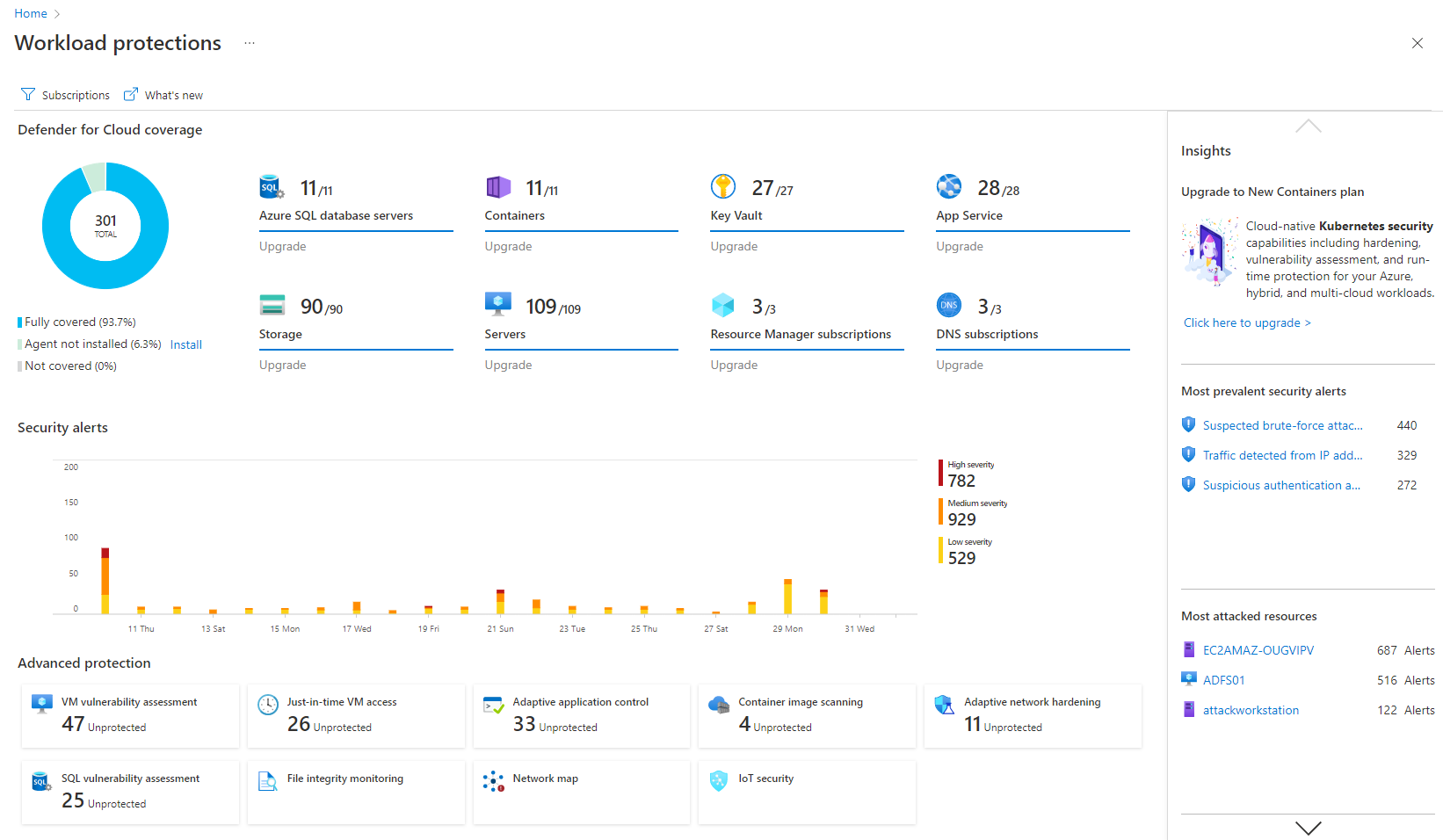
Microsoft Defender for Cloud is a Cloud Security Posture Management (CSPM) and Cloud Workload Protection Platform (CWPP) for Azure, on-premises, and multicloud (Amazon AWS and Google GCP) resources.
N/A
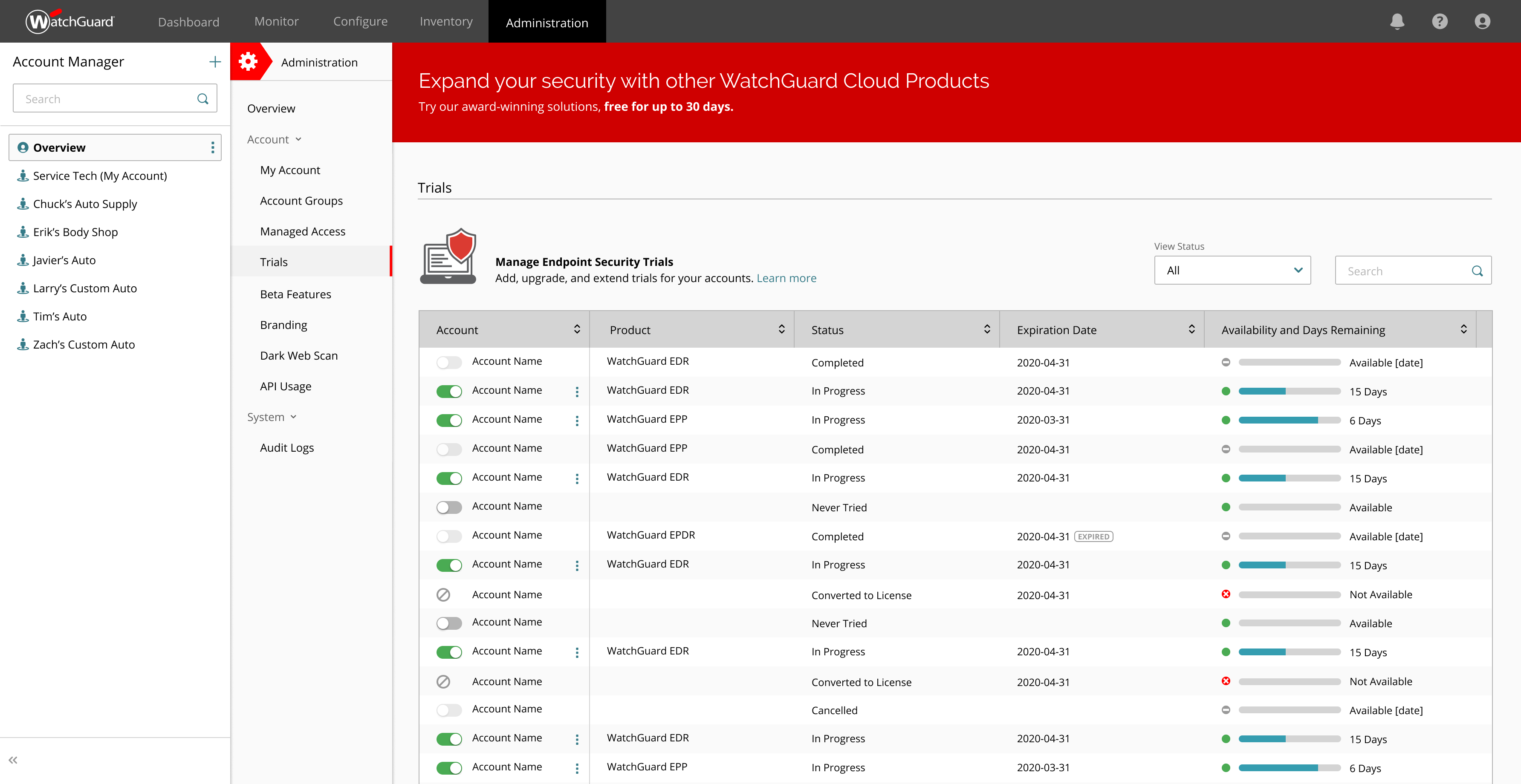
Watchguard Endpoint Security
Score 8.6 out of 10
N/A
WatchGuard EPDR (formerly Panda Adaptive Defense 360) combines next-generation antivirus protection, endpoint detection and response (EDR), patch management, content filtering, email security, full disk encryption, and more, into one package. The platform touts a unique zero-trust security service that certifies the legitimacy and safety of all running applications thanks to a combination of automated, AI-driven processes and investigation services provided by a team of malware analysts.
Because we do a profound review of functionalities, configurations, and security operations from our soft team's perspective. The best one that adapts to our actual architecture, and I mean it's so negative for us because we are more prone to Microsoft products, was Microsoft …
Competitive-wise, we've looked at Palo Alto and Proofpoint. So we selected Microsoft Defender for Cloud on the basis it was linking closer to the identity, but we've had to also, I said earlier that we've aligned with Palo Alto for the secondary tech to look at it from a device …
Barracuda goes neck to neck with Microsoft Defender for Cloud in the anti-spam, anti-phishing email suite. But why I chose this product is because again, it's very well embedded with Microsoft technology, and we're a Microsoft shop, and it works well for us to use that product …
We were one of the first ones to deploy when Microsoft released it, so it's hard to compare, but what we hear from competitors, the fact that Microsoft can see the full ecosystem using this product makes it a lot better as compared to using a third party tool. So it's the ease …
Evaluated between cost. I just think it integrates better with the Microsoft stack and I mean, I think just cost from just that perspective and being the one pane of glass, I think that's enough.
I believe Microsoft Defender for Cloud stacks up well against the other tools we looked at. It is native to the Azure platform and provides the same insights as the other tools. We selected Microsoft Defender for Cloud because it integrates well with the Azure resources and …
Microsoft Defender for Cloud offered a more integrated and comprehensive solution for our multi-cloud environment, integrating well with our security and compliance needs
Microsoft Defender for Cloud is definitely the choice with the latest market trend and attacks that are currently happening. Microsoft has been able to safe guard a lot after the recent serious attacks happening globally in the digital world. There is a trust in this software …
There is the several ways to protect the applications and lot more tools available in the market. Most commonly we used Crowd strike Falcon for endpoint detection and response capabilities. McAfee endpoint protection also provide broad range of security features. Best …
We used to use Symantec and McAfee. It's been mostly defenders since, gosh, the last eight to 10 years. So we're a small organization. We don't have a lot of folks, so single-painted glass is really important to be able to see the whole environment in a single place. And the …
When we purchase this data fund, we check with not competition and we decided to purchase these tools because it's strong and we have a good relationship with Microsoft.
It is very good in comparison to other products that we have used. Its price is very effective and attractive, and it also provides good security policies. threat intelligence is also good and user protection is also very much better, and it also serves new updates as and when …
We didn't spend much time looking into Symantec - but it was the software of choice for the district before I joined. That said, we were pretty easily talked into Watchguard Endpoint Security as we were already in the Watchguard world of products. Moving to their EDR just …
The Watchguard Endpoint Security solution is more cost effect then the ESET endpoint solution. We already had a number of WatchGuard solutions so it made sense to easily add another.
We prefer to maintain loyalty with a brand that really delivers what it promises. Our focus is to bring customers who have other solutions to Watchguard's base, however some companies have their own IT department and already work with other tools.
The WithSecure EPDR only covers part of the security needs.Using WatchGuard Endpoint Security covers the same needs, but with close integration with other security solutions used, such as the WatchGuard firewall.
WatchGuard is hands-down better than the competition, on price and value as well its amazing ROI. It scales easily and deals with the most complex security needs one could have. All the while having a UI which is seamless, ensuring that my team don't have to hunt through nested …
Way back in the day, I have used Norton end point security and really did not like the speed at which it tried to do its job. I know I am dating myself here. WatchGuard Endpoint Security, I feel, is light years ahead of Norton's product. WatchGuard Endpoint Security is FAST, …
The main reason we have selected WatchGuard Endpoint Security is the integration it has with the other WatchGuard security products we are using. The WatchGuard Cloud platform is really of great value!
We upgraded from Webroot to WatchGuard EPP as we felt it offered greater protection for end points. The basic reports are emailed to us each month that we run through with our clients each month to review the current environment and any security patterns we can see through the …
I think every products has their own pro and con. When I worked for another company they used Cisco and later they migrate them to Palo Alto. I would say every company has their own standard hardware as well as the budgets we need to be considering. WatchGuard is the best one …
The Cloud Console of WatchGuard is more user friendly. The impact of the agent on the computers and servers are less. The no trust behavior of the agent is very interesting and efficient.
WatchGuard Endpoint Security has native XDR, has 4 security pillars on a single platform, has the ability to correlate information from solutions together, and offers greater protection to critical environments.
WatchGuard Endpoint Security possui um XDR nativo, possui 4 pilares …
Watchguard is by far a tool that all organizations should be able to count on, I have had experiences with other protection tools, and none of them has responded effectively to the challenges posed by the increasingly lethal attacks of malicious people, who only intend to …
Despite offering great value for money, comparing Sophos' offering to WatchGuard Endpoint Security we find Sophos' offering is far superiour due to it's support system, the distributors it uses (apart from Arrow), it's management console, the resource-light application and, …
Control access to critical enterprise resources by business role, device type, and location, so policy changes can be made without redesigning the network.
Easily manage access control and segmentation while maintaining compliance.
Create and manage policies in an easy-to-use matrix.
Reduce the need for costly network re-architecture by automating firewall rules and access control list (ACL) administration.
Microsoft Defender for Cloud is very good at allowing users to see how their Azure environment is secure through the secure score. The recommendations are an excellent source of the controls that should be in place to ensure a secure environment. There needs to be more protection and features for data security.
I can only speak to WatchGuard Endpoint Security being well suited for us. Because we have over 350 devices (tablet, laptops, desktops, phones) on our network, this product has been a great fit, especially when paired wih our Firebox m390. Again, the protection is fast, low overhead, and virtually undetectable that it is running all the time.
Automation is crucial to managing sprawl and the additional complexity that comes with it. SOC management workbooks and process automation give significant flexibility.
The Security posture score and Security Alerts are neatly centralized and offer me crucial information quickly.
Defender for Cloud avoids the common compromise of simplicity for completeness (former Azure Security Center). The security warnings and advice go into great detail while remaining current and useful.
UI/UX. It can get a little messy when navigating around with all the flyouts in the Azure portal which can be frustrating, particularly when under time pressure.
The query languages for the queries and workbooks are another language that needs to be learned - it would be nice to have kept it closer to T-SQL or something like that to minimize the need to learn new syntax.
Adding cost estimations to the security recommendations would really improve the experience.
It is a great product that integrates nicely when running an Azure platform and even multi-cloud environment. Not looking for point-solutions but a suite that answers most requirements. It is very comfortable being able to use KQL, workbooks and automation that is native to the azure platform
Watchguard has a simple to understand GUI and installation process. It has integrated itself into our IT environment and is important to our day to day operations and security posture. It is easy to scale with the growth of the business. As a modern company needs a strong EPDR watchguard is a very good choice.
My visibility is limited because I'm only doing very small pieces of what the overall org does. And also, we have limitations on what we're allowed to use. It's not like we get a new product as users or leadership level users, and everything is on, and we can just do whatever we want. We're very restricted in what we can use any tooling within the org because of the different levels of regulatory constraints we have, because of just the nature of who we are inherently. So that's why. I don't think it's necessarily the product. I think it's more or less of what we're able to do with the product.
Easy and intuitive MSP management portal to manage all of your clients from a single pane of glass. Policies can be pushed down globally or individually based on needs. The client portal allows access to their tenant information and installs only which is nice if you are working with clients who might have an internal person or an IT team that also wants access to things to manage themself.
The software is 100% managed on a cloud platform that can be managed via an account even if they are not present within the company network where the software is installed, I even always opened the control panel on the browser of my smartphone to monitor the situation.I have never experienced any abnormal software crashes
The only annoyance I complain, if we want to be picky, is the fact of the constant disconnections from the control panel.Every about 4 hours the account logs out even if I set the "remember this device" flag; having said that I have not noticed neither slowdowns nor conflicts with other software
I gave it a 10 because I compare it to air conditioning. I need it to work every day, 24/7. I need it to be reliable and not something that requires a ton of interaction from staff to make sure it works every day. In addition, I should be able to run other things at my house when the AC is on. Panda fits that description.
The training was very helpful. It demonstrated how to configure the service for initial install, items to monitor, and how to set up for ongoing protection. Hands on training is more helpful but this is a good starting point
Implementation shouldn't present any problems in standard office environments. In environments with development teams, however, caution is needed. If zero trust is enabled, mechanisms must be in place to ensure that internal software isn't classified as a false positive (software certificate, exception folder, etc.)
Barracuda goes neck to neck with Microsoft Defender for Cloud in the anti-spam, anti-phishing email suite. But why I chose this product is because again, it's very well embedded with Microsoft technology, and we're a Microsoft shop, and it works well for us to use that product and have better visibility versus Barracuda being just an offshore, just a single product versus Microsoft Defender for Cloud being blended with other applications.
We didn't spend much time looking into Symantec - but it was the software of choice for the district before I joined. That said, we were pretty easily talked into Watchguard Endpoint Security as we were already in the Watchguard world of products. Moving to their EDR just seemed to make sense for our organization
With the implementation of watchguard (at the beginning Panda Endpoint, but it is the same) I was able to insert in the control panel all the unauthorized software previously installed by colleagues without any authorization from the various department heads.Now any licensed software goes into lockdown and can be unlocked from the control panel
By committing to go all in on Watchguard Advanced EPDR across our whole client base, we maximized our price position - enabling us to offer the best endpoint security at a price better than what lesser competitive products cost.
Leveraging Watchguard Endpoint Security as part of our unified platform strategy provides better integrated security, managed through Watchguard's cloud architecture. This significantly reduces our cost to deploy, manage, and support our client's. Our improved security offering, better delivery, and stronger price position has helped us achieve 56% growth in our managed services business over the past 18-months.
Organizations that have disparate cyber security products often require specialists for each solution in their stack. Watchguard provides outstanding training resources that equip our entire technical staff - significantly improving our service delivery while lowering our overall cost of business.