Clickability was a content management system acquired by Upland Software in 2013 which provided a SaaS platform for web content creation, management, publishing, analytics, digital marketing, and online publishing for marketers and enterprises. It has been discontinued, and is no longer available.
N/A
Drupal
Score 7.0 out of 10
N/A
Drupal is a free, open-source content management system written in PHP that competes primarily with Joomla and Plone. The standard release of Drupal, known as Drupal core, contains basic features such as account and menu management, RSS feeds, page layout customization, and system administration.
N/A
Magnolia
Score 9.8 out of 10
Mid-Size Companies (51-1,000 employees)
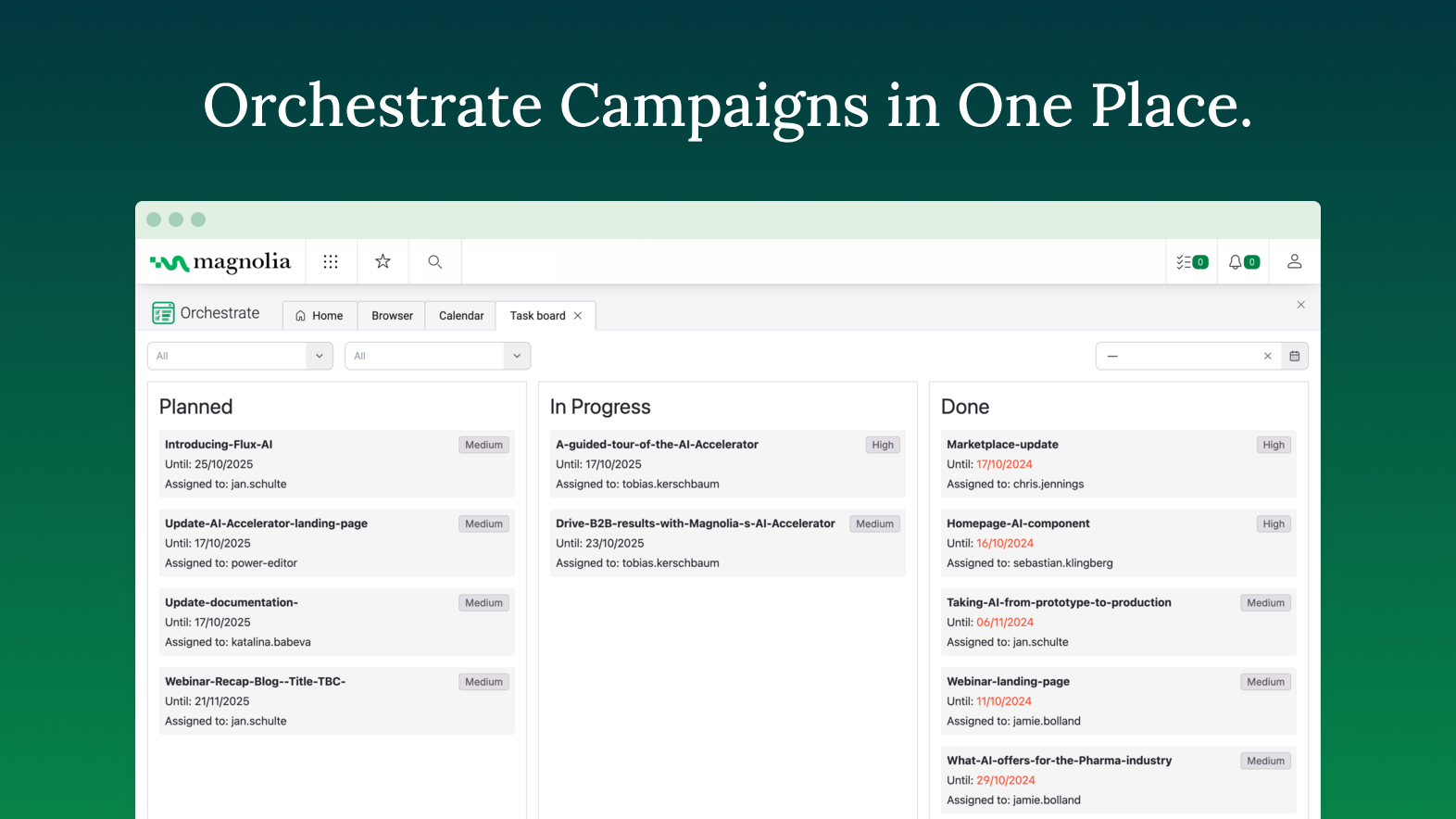
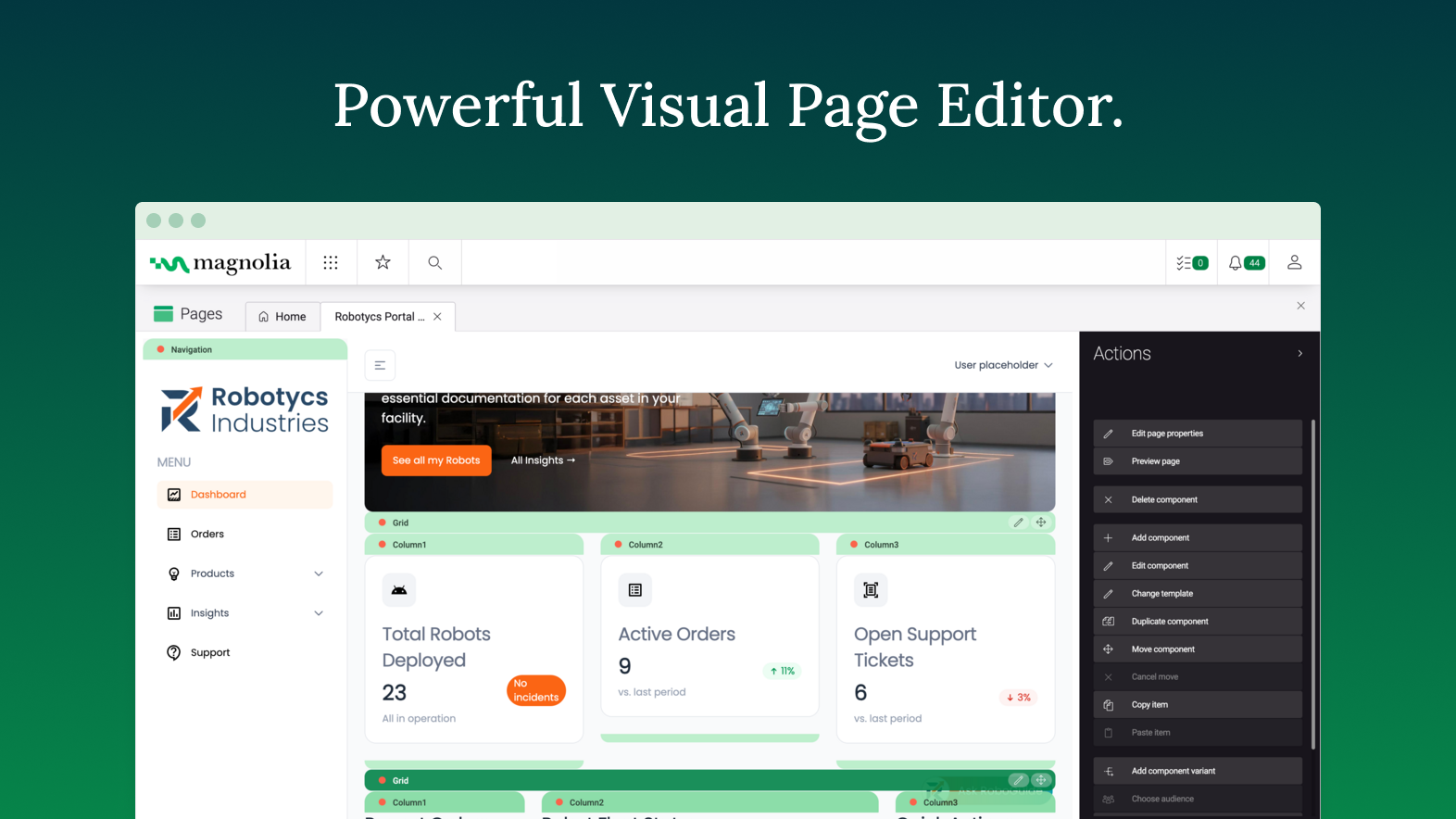
Founded in Switzerland in 1997, Magnolia is a CMS used to build composable digital experiences. Magnolia helps create fully integrated customer experiences and speeds up digital delivery of content. Magnolia boasts 480 enterprise customers, thousands of Community Edition deployments, and more than 200 certified Magnolia Partners around the world. They further state that their enterprise customers include Sanofi, Generali, the Atlassian, The New York Times, Harley Davidson, and Union…
I think it is on par with what I did with Sharepoint. Sharepoint was not the easiest and you have to do many things twice to get it to actually display. I think the easiest I have used is Wordpress. They make mobile very easy and allow for quick changes and are very social …
Verified User
Former Employee
Chose Clickability (discontinued)
I have mainly worked with open source content management systems like Wordpress, Drupal and Joomla!. Clickability is far more customizable and elegant to code things yourself. The main downfall of Clickabliity is the lack of community developed modules and plugins. If there …
I've used a number of Content Management Systems in the past that have similar features to Magnolia including custom ones that aren't widely used or can be listed, but Drupal is probably the most comparable. I would say that Drupal is more kind to custom code and overall …
Magnolia is not as costly as other enterprise grade platforms and is easier to deploy, more reliable and less resource hungry. It's often also easier to use and certainly easier to use than it's Open Source counterparts. It also manages content in a much more structured manner …
Cost was prohibitive for SiteCore. We liked the support that Magnolia gives us in terms of being an actual Company. We love open-source, but have had problems with Umbraco in the past in terms of upgrade paths etc.
Of all the ones we looked at that met our requirements Magnolia was clearly the best value for money and had a solid background that you could trust and that could take care of you in case of problems.
Putting all together: capabilities, support, community and price... Magnolia is the best combination, maybe not the best on each aspect, but for sure in the combination
Magnolia has an automatic, and speedy social media publication extension, which spread content to all social sites. Also, the insertion of extensions and plugins is more effective when on Magnolia against the opponents. Magnolia admits and adopts diversity, hence, it is a …
I evaluated many CMS products and I’m continuing to evaluate them to verify the new functionality introduced.
I evaluated these products: Alfresco, Apache Lenya, DotCMS, Drupal, Liferay, Hippo, Joomla, OpenCMS. I chose Magnolia because Magnolia offers two licensed community …
Features
Clickability (discontinued)
Drupal
Magnolia
Security
Comparison of Security features of Product A and Product B
Clickability (discontinued)
6.9
5 Ratings
17% below category average
Drupal
8.1
74 Ratings
1% below category average
Magnolia
8.0
69 Ratings
2% below category average
Role-based user permissions
6.95 Ratings
8.174 Ratings
8.069 Ratings
Platform & Infrastructure
Comparison of Platform & Infrastructure features of Product A and Product B
Clickability (discontinued)
6.5
3 Ratings
18% below category average
Drupal
7.6
69 Ratings
2% below category average
Magnolia
8.1
68 Ratings
4% above category average
API
5.13 Ratings
7.264 Ratings
8.561 Ratings
Internationalization / multi-language
8.02 Ratings
8.160 Ratings
7.661 Ratings
Web Content Creation
Comparison of Web Content Creation features of Product A and Product B
Clickability (discontinued)
6.7
5 Ratings
15% below category average
Drupal
6.5
78 Ratings
18% below category average
Magnolia
8.0
74 Ratings
3% above category average
WYSIWYG editor
6.85 Ratings
6.171 Ratings
8.565 Ratings
Code quality / cleanliness
6.05 Ratings
8.175 Ratings
8.465 Ratings
Admin section
7.04 Ratings
6.878 Ratings
8.070 Ratings
Page templates
7.04 Ratings
5.577 Ratings
8.972 Ratings
Library of website themes
5.93 Ratings
5.468 Ratings
7.01 Ratings
Mobile optimization / responsive design
5.94 Ratings
6.572 Ratings
8.563 Ratings
Publishing workflow
7.95 Ratings
6.876 Ratings
7.573 Ratings
Form generator
7.01 Ratings
6.372 Ratings
6.958 Ratings
Web Content Management
Comparison of Web Content Management features of Product A and Product B
As a true content management system it is great for site and content creation. It does need some help when it comes to adding functionality for using modern code systems that require server side scripting. For a marketing or public company site, it is an ideal CMS. For a SAAS type site, there could be many road blocks.
If you want to set up a basic Not For Profit (NFP) Membership system and content base, Word Press is easier than Drupal. However, if you have specific needs that require a fair bit of customisation then Drupal is the best CRM available. If the webmaster is confident with PHP and SQL, Drupal allows a lot of creativity.
Magnolia is a very capable DXP, that provides client with lots of flexibility in composing its own stack. While the core of the platform is a content management system, the open architecture of Magnolia DXP allows it to connect to any platform, allowing client to extend the capabilities. One scenario would be a centralized content hub - where through a single platform, content authors can choose which channel to distribute what content. For example, long form content for consumers viewing on a laptop, short form content for those using a mobile browser. This allow the client to personalized the experience based on channels. Another scenarios would be leveraging on GenAI - using Magnolia's built-in connector to ChatGPT. If that is not the service that one desire, you can always connect to another AI service such as Google Gemini. With GenAI, connected, content author can use AI as co-pilot to help them scale up their content production.
Easy to get going for a business that has tons of content they need to manage.
Clickability offers development and design services so you don't really even need IT.
No need to worry about server uptime, storage, bandwidth, etc you have all the reports at your fingers for what you are using.
Simple template and content design system, easy to expand and add.
Powerful CMS and settings with a design and programming guide provided.
AkAMAI and Limelight CDN's can be used for powerful and fast loading in many regions.
Debugging tools to see how long specific templates and content load is exceptional. One can narrow down that this specific template ran X number of times and took this look and had to be stopped at X number of time due to exceeding set limits.
Having a built in Dev, Staging, Production environments for testing makes seeing new features and how they will integrate into your site seamless.
Speed of development - time to delivery from zero to MVP was excellent
Ease of use - the authoring experience is very easy to build and train
PAAS/SAAS - the managed service platform removed the traditional overhead of running in-house technologies, meaning we could focus on value add, with less time spent keeping the lights on.
Choosing ad size/placement should be easier than it is. Now, I have to re-create the whole thing.
When you "save" anything a pop-up comes up that is redundant.
Ad list only shows a limited number. It's not until you click on one and cancel it out, then you can see all the listings. A bit tedious and redundant.
This is not an easy CMS to work with if you don't have a good understanding of website development. It isn't "plug-and-play" like Wordpress or Shopify.
Over time, doing major updates to the system can be taxing, especially if you aren't well-versed enough in doing system updates in line with your "child" theme and code.
The CMS can become somewhat cumbersome with server resources if not carefully optimized while you build and customize it to your liking.
The documentation provides samples that are often out of context, and difficult to know where the provided example code should be implemented. More tutorials providing the full project or step-by-step instructions on how to implement subject material would help greatly. Baeldung is a resource I would consider the gold standard in how this is done in other spaces.
The use of JCR and Nodes makes object serialization/deserialization painful. Jackson compatibility or similar would be a welcome enhancement to the developer experience. Maybe leveraging code-gen from light modules to build model classes when possible could help accomplish this.
Modifying the home layout from light modules is frustrating. It seems that any configuration overrides made merge with the default rather than overwriting, which makes for a difficult combination of guess-and-check while referencing the documentation to see what should be in each row/column when making changes.
Including "mark all as read" or "delete all" in the notifications app would be a great quality of life improvement. It seems that by default, users have to individually select messages and operate them.
As mentioned in the last questions we are going to use a competitor brand next year. I think the issues are trying to find and fix problems from the previous programer. The steep learning curve and lack of mobile and social sharing capabilities. Things that I like are the strength of the programing which comes with a trade off. The ease for those who don't know markup to make updates to the website. Clickability isn't the easiest and can be difficult to find the content that you are interested in. We will not be using it next year.
The time and money invested into this platform were too great to discontinue it at this point. I'm sure it will be in use for a while. We have also spent time training many employees how to use it. All of these things add up to quite an investment in the product. Lastly, it basically fulfills what we need our intranet site to do.
My experience with Clickability has been mostly positive but there are a few areas for improvement. It's generally easy to learn and use on a daily basis. I can move fast and do my job with speed with needed. But there is some clunky functionality with targeting and page building. My rating would be higher if some improvements were made.
As a team, we found Drupal to be highly customizable and flexible, allowing our development team to go to great lengths to develop desired functionalities. It can be used as a solution for all types of web projects. It comes with a robust admin interface that provides greater flexibility once the user gets acquainted with the system.
We've shown it to a number of users both clients and our own team and despite initial apprehensions, they "get it" very quickly. It's intuitive and friendly and quick to perform daily tasks. We once had a client tell us "Using Magnolia makes me smile" which says it all for us.
Drupal itself does not tend to have bugs that cause sporadic outages. When deployed on a well-configured LAMP stack, deployment and maintenance problems are minimal, and in general no exotic tuning or configuration is required. For highest uptime, putting a caching proxy like Varnish in front of Drupal (or a CDN that supports dynamic applications).
Drupal page loads can be slow, as a great many database calls may be required to generate a page. It is highly recommended to use caching systems, both built-in and external to lessen such database loads and improve performance. I haven't had any problems with behind-the-scenes integrations with external systems.
I gave [it] 7/10 only because of the loading time of pages. Otherwise, I think it deserves an 8. Normally this is not an issue per [se] but considering the rating matrix and as I have been asked to honestly write about it. Yes, the page loading times could be improved.
I found that some agents were better then others, usually you have an account representative and that I would consider level 1 support. To get really complex answers you need to talk with an engineer.
As noted earlier, the support of the community can be rather variable, with some modules attracting more attraction and action in their issue queues, but overall, the development community for Drupal is second to none. It probably the single greatest aspect of being involved in this open-source project.
You always get an answer based on your SLA. But you always get a solution. That's the successfactor in this case. To often i was frustrated about people in a company without even a clue what there product is about or how to solve a problem. Magnolia's Support Team does a very good job and try to help you in most of the cases
I was part of the team that conducted the training. Our training was fine, but we could have been better informed on Drupal before we started providing it. If we did not have answers to tough questions, we had more technical staff we could consult with. We did provide hands-on practice time for the learners, which I would always recommend. That is where the best learning occurred.
The on-line training was not as ideal as the face-to-face training. It was done remotely and only allowed for the trainers to present information to the learners and demonstrate the platform online. There was not a good way to allow for the learners to practice, ask questions and have them answered all in the same session.
Plan ahead as much you can. You really need to know how to build what you want with the modules available to you, or that you might need to code yourself, in order to make the best use of Drupal. I recommend you analyze the most technically difficult workflows and other aspects of your implementation, and try building some test versions of those first. Get feedback from stakeholders early and often, because you can easily find yourself in a situation where your implementation does 90% of what you want, but, due to something you didn't plan for, foresee, or know about, there's no feasible way to get past the last 10%
Many of other content management systems similar to WordPress need custom installation. The server costs and upgrades quickly add up. Clickability while expensive, eliminated the overhead of managing all the dependency needs for a CMS. Clickability also works with its clients to understand the business needs and proposes the solutions accordingly. They have a good support team.
Drupal can be more complex to learn, but it offers a much wider range of applications. Drupal’s front and backend can be customized from design to functionality to allow for a wide range of uses. If someone wants to create something more complex than a simple site or blog, Drupal can be an amazing asset to have at hand.
I've used several CMSs like AEM and EpiServer, and comparatively, they all excel at different things. Magnolia is the best to develop for/against. Episerver has the best/most fluid UI in terms of content editing, and the overall admin experience AEM is just all around sucks.
Drupal is well known to be scalable, although it requires solid knowledge of MySQL best practices, caching mechanisms, and other server-level best practices. I have never personally dealt with an especially large site, so I can speak well to the issues associated with Drupal scaling.
I know a big positive is the fact that it is always-on. We are the leading news corporation for our state, and in many markets, nationwide. We pride ourselves on our strong ethics in the community and thus need to exude reliability to maintain the trust of these communities. Having a website fail periodically erodes that reliable perception.
It has allowed different areas of the company to approach our team and work in a cohesive manner.
Magnolia has brought about positive impacts. For instance, we need not outsource web design and marketing services because thanks to this software, we can handle most work inhouse
The software is affordable with no compromises on capabilities and therefore it is gives us value for money.