Evoq Content is a content management system within the Evoq business suite. Evoq Content is extensible with many modules that add caching, advanced content approval workflow, granular permissions, document management, mobile accessibility of content, web farm support, and an ecommerce engine.
N/A
Paligo
Score8.7 out of 10
N/A
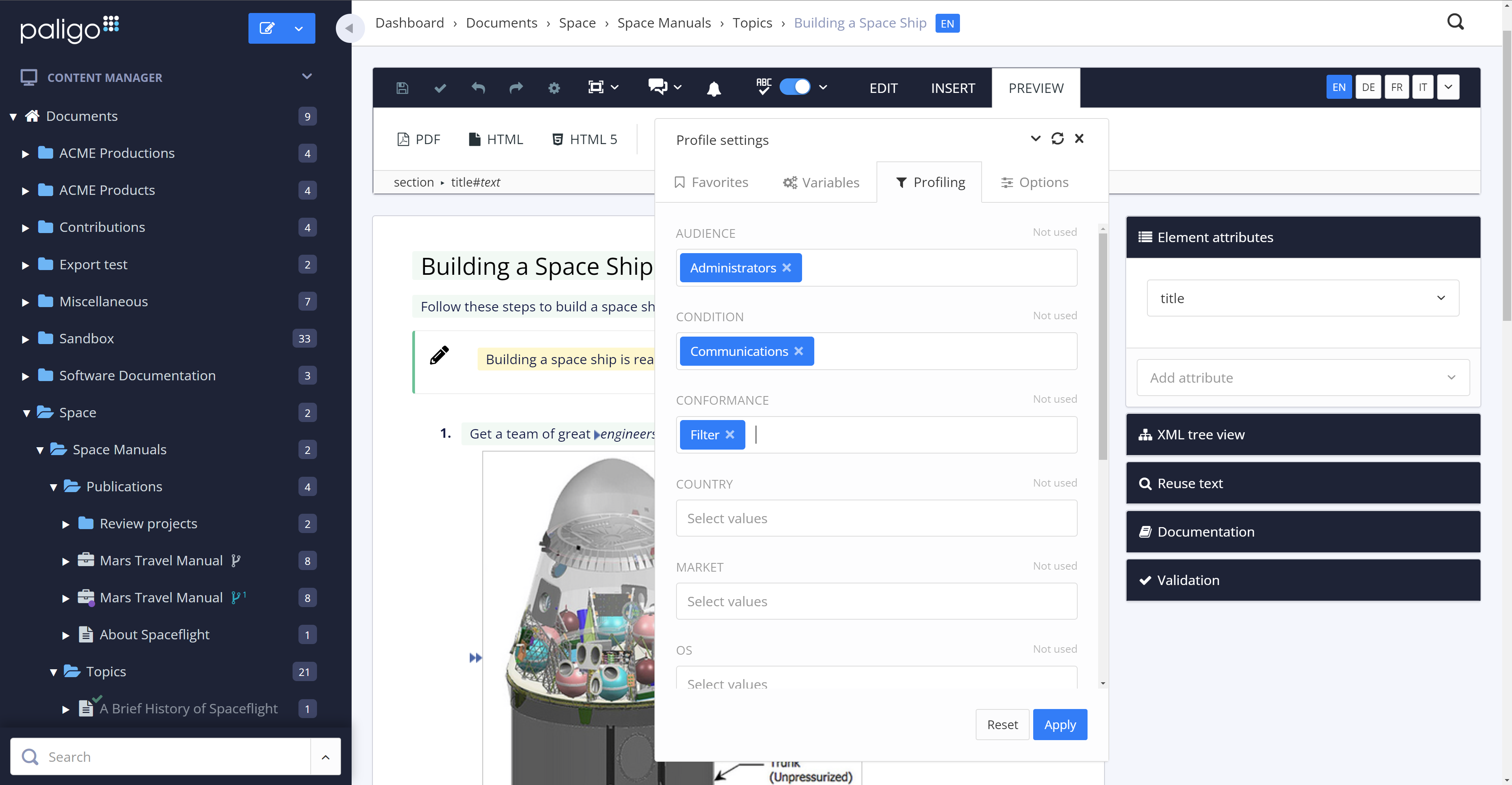
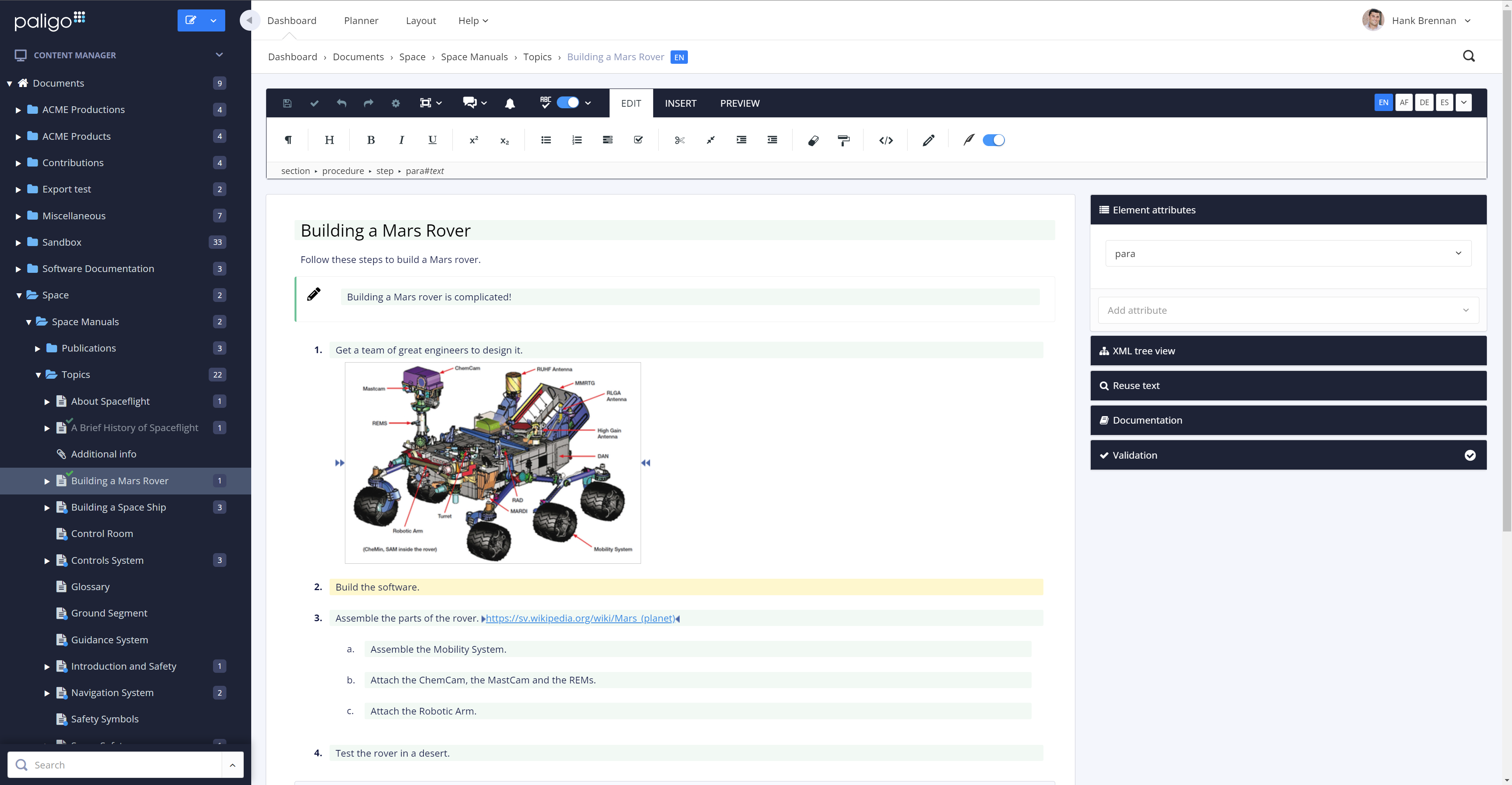
Paligo is a component content management system (CCMS) that helps teams manage complex technical documentation through structured authoring, content reuse, and controlled publishing.
If you just need to implement a website that is dynamic but not real big in Data Processing almost anyone can do so with very limited knowledge as long as you know how to use a Word Processor and your Browser. If you don't have experience with setting up a Server to run a website there are Companies like PowerDNN, Rackspace and WinHost that can help and I recommend them in that order if you are using DNN. If you need a more sophisticated e-commerce website and don't have much experience with Servers, SQL Server etc. then you should find a consultant to help you install and setup not just the DNN Platform but also select the proper Modules to accomplish what you want to do. If you need a highly customized website that is very data intensive and you are not experienced then be sure to save yourself the time and money by finding a qualified Consultant to help you. The beauty of DNN is that it can handle as simple or as complicated of an Application as you need depending on what your needs are and how far you want to take it.
One of the biggest strengths is the structured authoring, which not only gives clean content for users but is also well-suited for providing AI content. I also make good use of content reuse, which simplifies maintenance and documentation updates when features change. The taxonomy has allowed me to create versioned documentation on our site that correlates with customers' installed software versions. We're switching over to using the API for publishing to our website and that will be a nice switch from the publication structure we've used previously. The tool doesn't, at this time, allow me to connect it to a custom GPT or create one that would be based on our style guide. There also isn't an MCP server option to work better with my Claude configurations.
A de minimis incentive was given to thank the reviewer for their time. The incentive was not used to bias or drive a particular response, nor was the incentive contingent on a positive endorsement. More Info
DNN is a feature-rich, open-source project with a flexible license. This let us use it without licensing costs for custom solutions or as-is with no custom code just plug-in modules.
DNN is written in Microsoft .NET C#. This allows our developers and our customers to use their existing skill set to install and maintain the solution.
DNN is made for Windows platform, allowing us and our customers to deploy solutions to existing Windows servers or in some cases hosted platforms.
DNN integrates with Windows authentication allowing us to deploy intranet solutions and use single sign-on for improved user experience and security.
The review mode is super convenient. Comparing a snapshot of the previous versions with the current one clearly outlines the respective changes and reduces the necessary content to review tremendously.
The option to reuse text fragments is another handy feature. Text fragments will be updated whenever the original text fragment is altered is also extremely helpful.
Managing a content's structure was never easier. An intuitive drag & drop functionality allows you to design your document's structure however you like.
You can also fork content, in addition to reuse text fragments. This is another helpful option that no longer requires you to create repetetive chapters over and over.
A de minimis incentive was given to thank the reviewer for their time. The incentive was not used to bias or drive a particular response, nor was the incentive contingent on a positive endorsement. More Info
A de minimis incentive was given to thank the reviewer for their time. The incentive was not used to bias or drive a particular response, nor was the incentive contingent on a positive endorsement. More Info
The amount of CSS/JS required to customize a site's appearance can be cumbersome
Product documentation can be lacking, specifically with integrations; in some cases, support offered no real help when trying to solve a problem with an integrated service
Some features require extensive development experience to use, which can sometimes be an obstacle to less-experienced team members
A de minimis incentive was given to thank the reviewer for their time. The incentive was not used to bias or drive a particular response, nor was the incentive contingent on a positive endorsement. More Info
Even though DNN is a good CMS, I have worked with other CMSs which are far more robust at this point, and would not be overly inclined to select DNN unless cost of the product is the most important factor along with staying on .NET. DNN is a whole package so unless the client has a requirement of including authentication, authorization for users, eCommerce, sticking to something simple is a better option.
A de minimis incentive was given to thank the reviewer for their time. The incentive was not used to bias or drive a particular response, nor was the incentive contingent on a positive endorsement. More Info
Evoq proved to be a solid backbone for our property-management portal, handling ≈300 active rental listings without performance hiccups. The page-builder made it straightforward to craft listing templates that surface photo galleries, floor-plan PDFs, and embedded map pins, while role-based workflows let leasing agents edit unit details (price, availability, pet policy) without touching global site settings—a big win for operational control.
For the management side, the platform’s extensibility let us plug in a third-party rent-payment widget and an automated maintenance-ticket form with minimal custom code. Evoq’s built-in analytics have already highlighted which neighborhoods and bedroom counts drive the most traffic, guiding our marketing spend.
Two caveats:
Search & filter logic – Out-of-the-box search was too shallow for renters who expect Zillow-style filtering. We had to commission a custom module for filter chips (price range, amenities, walk score), which added time and cost. Mobile image optimization – High-resolution gallery images affected load times on 4G; a CDN or Evoq’s Digital Asset Optimizer add-on is advisable.
Overall, Evoq delivers reliable content governance and enough flexibility to support both consumer-facing listings and back-office property-management workflows, provided you budget for advanced search customization and image delivery tuning.
Reuse feature was the main reason for selection Paligo. It is the most powerful feature for us as now we have only one source of content that is used in all other documents through reuse. Makes it very easy when we need to update the content (in some cases at least once a quarter) and batch publishing makes it very easy to publish 100s of documents in one click
A de minimis incentive was given to thank the reviewer for their time. The incentive was not used to bias or drive a particular response, nor was the incentive contingent on a positive endorsement. More Info
I don't see how it could get any better unless they moved their staff into our offices. You have available to you any type of Support you need or want, both paid and free from thousands of developers and consultants all over the world. You might even find some on Mars if you look hard enough.Also, with all of the available resources available from your Browser you can literally find the answer to any question you have in a matter of minutes.
All the support requests I've submitted have been resolved in one way or another. Sometimes it takes some back and forth, which is to be expected. This is where being on a different continent becomes a drawback. Since we became Enterprise users, we've also had an additional level of help and support from a dedicated account manager in the US, and the resolutions seem to come more quickly
A de minimis incentive was given to thank the reviewer for their time. The incentive was not used to bias or drive a particular response, nor was the incentive contingent on a positive endorsement. More Info
Evoq proved to be a solid backbone for our property-management portal, handling ≈300 active rental listings without performance hiccups. The page-builder made it straightforward to craft listing templates that surface photo galleries, floor-plan PDFs, and embedded map pins, while role-based workflows let leasing agents edit unit details (price, availability, pet policy) without touching global site settings—a big win for operational control.
For the management side, the platform’s extensibility let us plug in a third-party rent-payment widget and an automated maintenance-ticket form with minimal custom code. Evoq’s built-in analytics have already highlighted which neighborhoods and bedroom counts drive the most traffic, guiding our marketing spend.
Two caveats:
Search & filter logic – Out-of-the-box search was too shallow for renters who expect Zillow-style filtering. We had to commission a custom module for filter chips (price range, amenities, walk score), which added time and cost. Mobile image optimization – High-resolution gallery images affected load times on 4G; a CDN or Evoq’s Digital Asset Optimizer add-on is advisable.
Overall, Evoq delivers reliable content governance and enough flexibility to support both consumer-facing listings and back-office property-management workflows, provided you budget for advanced search customization and image delivery tuning.
A de minimis incentive was given to thank the reviewer for their time. The incentive was not used to bias or drive a particular response, nor was the incentive contingent on a positive endorsement. More Info
Drupal is a highly expensive tool and is not offering anything extraordinary at a high price. If I keep its pricing in account then there should be some extraordinary features but unfortunately, there isn’t anything special about it; rather it was slow in its working. All these things actually forced us to move to Evoq that is just perfect in its working. Its working speed, interface, and UX are so simple that none of our team members find it tough to utilize. It has so many features like content scheduling and rich text edit. It allows easy editing of the text as well, and one can directly add text according to need.
A de minimis incentive was given to thank the reviewer for their time. The incentive was not used to bias or drive a particular response, nor was the incentive contingent on a positive endorsement. More Info
We moved from Flare to Paligo. One of the main reasons was the fact that Paligo is a cloud product. Collaboration with anyone outside of our team was more difficult with Flare. Also, maintaining a server for Flare content was going to become an issue, and overall I felt the Flare desktop product was prone to errors and issues. The flexibility of assigning Paligo licenses was a huge factor, as was the stability of the cloud platform.
A de minimis incentive was given to thank the reviewer for their time. The incentive was not used to bias or drive a particular response, nor was the incentive contingent on a positive endorsement. More Info
DNN have given us the ability to have basic sites for clients up and running in a very short time. This makes the client happy.
DNN has taken the trivial, simple tasks of changing text on a page or an image on a page and put it into the hands of the client. They do not have to pay us to do it and that also frees up more time for us to spend on development.
I am not involved in the financial decisions for my company regarding Paligo; the decision to migrate our content to this environment predates my hiring. However, I know that the migration effort from WordPress to Paligo was an initially heavy lift, but any content migration effort would be. I believe that ultimately, getting our content out of WordPress was a positive move, and I look forward to seeing what Paligo will help us accomplish in the future. Sorry, no hard numbers from me. :)