Google offers the Firebase suite of application development tools, available free or at cost for higher degree of usages, priced flexibly accorded to features needed. The suite includes A/B testing and Crashlytics, Cloud Messaging (FCM) and in-app messaging, cloud storage and NoSQL storage (Cloud Firestore and Firestore Realtime Database), and other features supporting developers with flexible mobile application development.
$0.01
Per Verification
Influ2
Score 8.5 out of 10
Mid-Size Companies (51-1,000 employees)
Influ2 is a first person-based marketing platform, presenting a new approach to account-based marketing. The solution enables B2B marketers to target chosen decision-makers, capture their intent, and track engagement at the individual level. The company boasts 75+ enterprise and medium-sized clients globally, including Fortune 500 B2B enterprises such as NVIDIA, Capgemini, and Episerver. Influ2 runs offices in NY and CA, with 50+ employees on board. Influ2 platform allows users…
N/A
Localytics
Score 6.0 out of 10
N/A
Upland Localytics helps you connect with mobile app customers on a deeper, more meaningful level.
$95
Per Application Per Month
Pricing
Firebase
Influ2
Localytics
Editions & Modules
Phone Authentication
$0.01
Per Verification
Stored Data
$0.18
Per GiB
No answers on this topic
Localytics
$95.00
Per Application Per Month
Offerings
Pricing Offerings
Firebase
Influ2
Localytics
Free Trial
No
No
No
Free/Freemium Version
No
No
No
Premium Consulting/Integration Services
No
No
No
Entry-level Setup Fee
No setup fee
No setup fee
No setup fee
Additional Details
—
Pricing is based on the number of people targeted by a client.
—
More Pricing Information
Community Pulse
Firebase
Influ2
Localytics
Features
Firebase
Influ2
Localytics
Engagement
Comparison of Engagement features of Product A and Product B
Firebase
-
Ratings
Influ2
8.9
2 Ratings
16% above category average
Localytics
-
Ratings
Automated routing and prioritization
00 Ratings
10.01 Ratings
00 Ratings
Customer interaction histories
00 Ratings
7.31 Ratings
00 Ratings
Engagement data tracking
00 Ratings
9.62 Ratings
00 Ratings
Ad Campaigns
Comparison of Ad Campaigns features of Product A and Product B
Firebase
-
Ratings
Influ2
9.7
2 Ratings
22% above category average
Localytics
-
Ratings
Ad campaign creation
00 Ratings
9.72 Ratings
00 Ratings
Display advertising
00 Ratings
10.01 Ratings
00 Ratings
Social advertising
00 Ratings
9.72 Ratings
00 Ratings
Ad reporting and analytics
00 Ratings
9.32 Ratings
00 Ratings
Audience Segmentation & Targeting
Comparison of Audience Segmentation & Targeting features of Product A and Product B
Firebase
-
Ratings
Influ2
10.0
1 Ratings
27% above category average
Localytics
-
Ratings
Behavioral visitor segmentation
00 Ratings
10.01 Ratings
00 Ratings
ABM sales intelligence
00 Ratings
10.01 Ratings
00 Ratings
ABM Integrations
Comparison of ABM Integrations features of Product A and Product B
Firebase should be your first choice if your platform is mobile first. Firebase's mobile platform support for client-side applications is second to none, and I cannot think of a comparable cross-platform toolkit. Firebase also integrates well with your server-side solution, meaning that you can plug Firebase into your existing app architecture with minimal effort.
Firebase lags behind on the desktop, however. Although macOS support is rapidly catching up, full Windows support is a glaring omission for most Firebase features. This means that if your platform targets Windows, you will need to implement the client functionality manually using Firebase's web APIs and wrappers, or look for another solution.
For the price and the features available, Localytics is one of the best options. It is more robust in areas that we don't need it to be and overall there could be simpler flows for sending push notifications or performing actions that you need to do every week. Also, the data it sends back on how push notifications perform is basically useless. There needs to be more explanation on the impact notifications have on users. The data would always say that notifications drove less engagement but we would see engagement go up every time we sent a notification.
Analytics wise, retention is extremely important to our app, therefore we take advantage of the cohort analysis to see the impact of our middle funnel (retargeting, push, email) efforts affect the percent of users that come back into the app. Firebase allows us to easily segment these this data and look at a running average based on certain dates.
When it comes to any mobile app, a deep linking strategy is essential to any apps success. With Firebase's Dynamic Links, we are able to share dynamic links (recognize user device) that are able to redirect to in-app content. These deep links allow users to share other deep-linked content with friends, that also have link preview assets.
Firebase allows users to effectively track events, funnels, and MAUs. With this simple event tracking feature, users can put organize these events into funnels of their main user flows (e.g., checkout flows, onboarding flows, etc.), and subsequently be able to understand where the drop-off is in the funnel and then prioritize areas of the funnel to fix. Also, MAU is important to be able to tell if you are bringing in new users and what's the active volume for each platform (Android, iOS).
Attribution and specifically multi-touch attribution could be more robust such as Branch or Appsflyer but understand this isn't Firebases bread and butter.
More parameters. Firebase allows you to track tons of events (believe it's up to 50 or so) but the parameters of the events it only allows you to track 5 which is so messily and unbelievable. So you're able to get good high-level data but if you want to get granular with the events and actions are taken on your app to get real data insight you either have to go with a paid data analytics platform or bring on someone that's an expert in SQL to go through Big Query.
City-specific data instead of just country-specific data would have been a huge plus as well.
The biggest thing I would like to see with Localytics is the capability for more correlations. The limited amount of correlations available does restrict the type of analyses that could be done with the data.
An easier interface to move data into Microsoft Excel would be very useful, rather than creating annoying workarounds.
More/better automatically scheduled reporting, as well as an Excel plug-in to access the data rather than being restricted to the Localytics interface.
I don't use the Firebase UI much, but rather connect it to GA4. GA4 has a great event model but the GA4 UI and analysis capabilities are limited. It's harder to measure product usage type of engagement but if you have the time and resources to leverage the GA4 to BiqQuery export you'll have all the raw event data you'll need for deep analysis, segmentation, and audience activation.
Our analytics folks handled the majority of the communication when it came to customer service, but as far as I was aware, the support we got was pretty good. When we had an issue, we were able to reach out and get support in a timely fashion. Firebase was easy to reach and reasonably available to assist when needed.
It would take several weeks to hear back from the billing team. It took 3 months to resolve an invoice last year. Their technical support is very responsive. I would typically get a response in under 24 hrs.
Before using Firebase, we exclusively used self hosted database services. Using Firebase has allowed us to reduce reliance on single points of failure and systems that are difficult to scale. Additionally, Firebase is much easier to set up and use than any sort of self hosted database. This simplicity has allowed us to try features that we might not have based on the amount of work they required in the past.
When talking about specifically ABM INFLU2 ranks on first for me as it is easy to use and setup in accordance with other software. Also the leads generated are quality leads. Each campaign can be personalized and reports of each campaign give a detailed idea of how the campaign has performed.
Makes building real-time interfaces easy to do at scale with no backend involvement.
Very low pricing for small companies and green-fields projects.
Lack of support for more complicated queries needs to be managed by users and often forces strange architecture choices for data to enable it to be easily accessed.
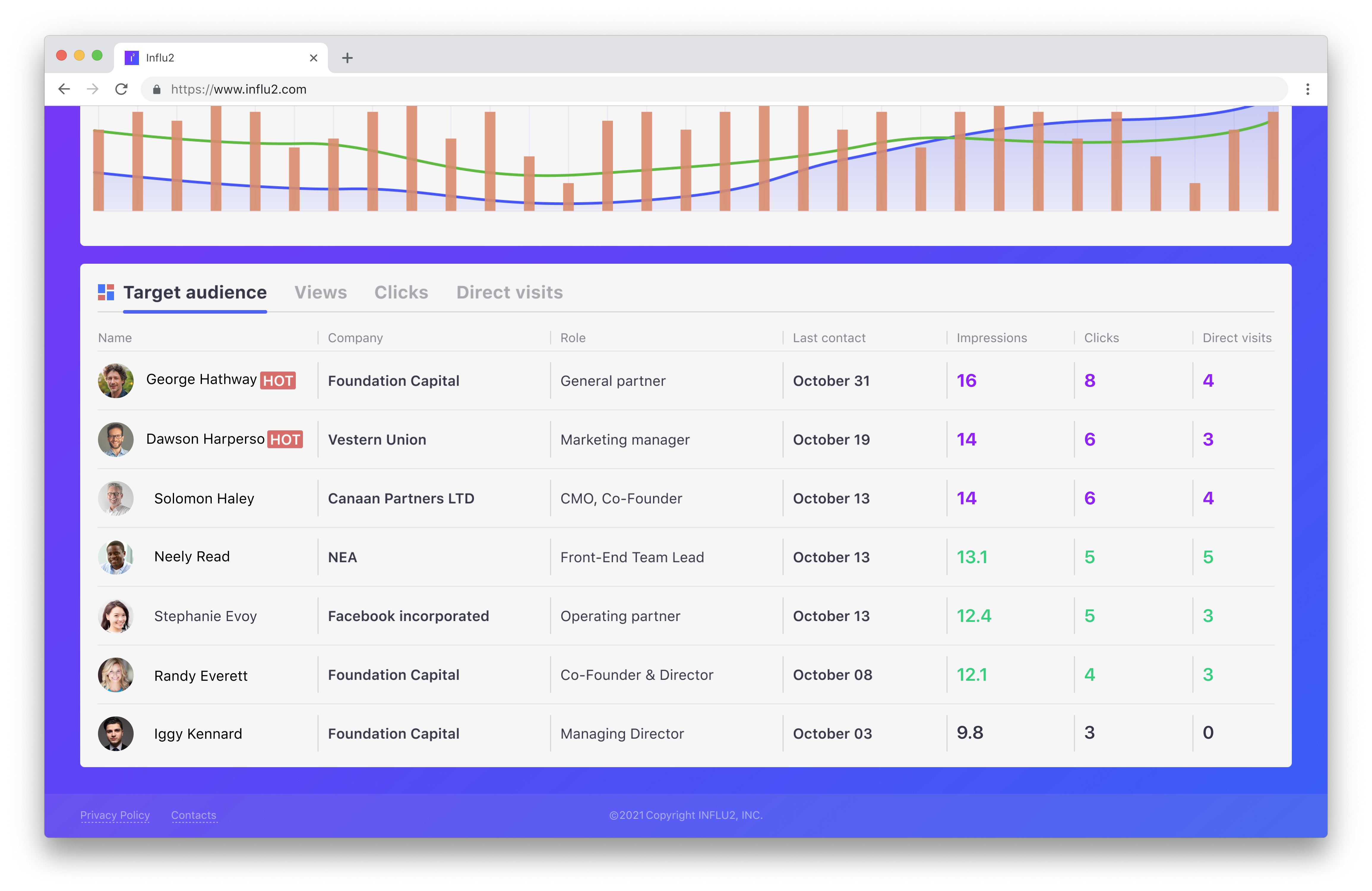
We are using Influ2 to generate demand, identify the most engaged contacts from the target audience and pass them to sales. Since we offer a variety of products, Influ2 also lets us identify buyer intent in a particular product and reach out to the prospect with the right value.