Front is a communication hub that helps businesses keep the human touch in every interaction.
$29
per month per user
Fin by Intercom
Score 8.7 out of 10
N/A
Fin is Intercom’s AI Agent for customer service, designed to deliver high-quality answers, even for complex queries. It works with any helpdesk, or it can be paired with Intercom’s next-generation Helpdesk to get the full Intercom Customer Service Suite.
$0.99
one-time fee per outcome
Zendesk Chat
Score 8.3 out of 10
N/A
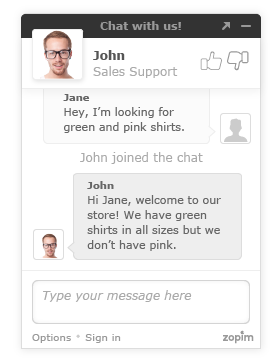
Zendesk Chat (formerly Zopim) is a live chat tool developed by the Singaporean company also called Zopim, acquired by Zendesk in April 2014.
$11.20
per month
Pricing
Front
Fin by Intercom
Zendesk Chat
Editions & Modules
Starter
$29
per month per user
Growth
$79
per month per user
Scale
$99
per month (billed annually) per user
Premier
$229
per month (billed annually) per seat (50 seat minimum)
Fin with your current helpdesk
$0.99
one-time fee per outcome
Copilot add-on
$35
per month per user
Pro
$99
per month For analysis of 1,000 conversations
Fin with Intercom’s Helpdesk
from $39 + $0.99 per Fin outcome
per month per seat
Lite
$0
per user
Basic
$14
per user
Advanced
$25
per user
Premium
$55
per user
Offerings
Pricing Offerings
Front
Fin by Intercom
Zendesk Chat
Free Trial
Yes
Yes
Yes
Free/Freemium Version
No
No
Yes
Premium Consulting/Integration Services
Yes
No
No
Entry-level Setup Fee
No setup fee
No setup fee
Optional
Additional Details
Discount for annual pricing on Starter and Growth plans. Scale and Premier plans are annual price only.
Fin comes with a 90-day money-back guarantee. Here's how it works:
Intercom states that users who sign up for the Fin Guarantee Success Program and do not achieve at least a resolution rate of 65% will be paid $1M. This program is designed for high volume customers.
Eligibility criteria:
High volume customers (over 250k monthly conversions) in North America and Europe. Intercom states that phase one of this program will admit customers on Intercom Helpdesk or Zendesk.
The pricing above is price per user per month. You will get a discount when you opt for annual payment.
Front is a flexible and quickly growing tool that integrates with almost every system we use. Front have been our go-to support system since we started and will continue to be for the foreseeable future.
Zendesk Chat provides live chat functionality and is part of the larger Zendesk suite, which includes customer support and ticketing solutions. However, we chose Intercom after careful consideration of our specific needs, budget, and the level of integration with our existing …
Verified User
Project Manager
Chose Fin by Intercom
Fin by Intercom vs. Zendesk/Salesforce - Fin by Intercom is often cheaper at low-to-mid volumes because it has a lower base platform fee (starting around $29–$39/seat). However, Zendesk AI and Salesforce Agentforce can be more predictable for massive enterprises because they …
Granted I think both Zendesk and Salesforce are very good tools, I still think that Fin by Intercom is the best I've used. Salesforce can be very laggy at times, and there's nothing that can be done about it. The interface is clunky. Zendesk is coming in at a real close second, …
Zendesk didn't have an AI to field question which is the biggest time saver Fin has given us. On my end, I think Zendesk was easier to navigate (I've been in both systems for the same amount of time atp). However, the amount of work Fin has been able to field for us is worth …
Beats them all in my opinion, Intercom's ease of use and intuitive design cannot be beat compared to others. We had a look at both Zendesk and Freshchat in the past and we saw very quickly that we're already using the best tool for the job. My only "complaint" would be the cost …
Intercom is just so much better; Our company was using both Zendesk and Intercom for two different products we offer. We brought them all over to Intercom, and they are really happy about the shift. They didn't use any AI in Zendesk, though, so Fin is their first experience …
We used it a few years ago, and it was not as feature-rich for our needs. It lacked true AI capabilities, was hard for users to understand, and created workaround issues. The internal ticket system was difficult to use and led to many missed issues and calls.
Fin by Intercom outperforms Zendesk in almost all metrics as a user-friendly, experienced-focused platform. Zendesk's chat functionality is more limited than Intercom's and the AI agent is not as helpful.
Our primary business partner uses Zendesk, and this is what we use to …
I used Zendesk briefly but found it difficult to navigate — I often couldn’t tell what was going on or how to simply reply to a ticket. In contrast, Intercom is much more intuitive and user-friendly. Its clean interface and support for multiple communication formats like …
As explained previously, most of these platforms were focused on tickets, most reports only work with tickets, there is no way to postpone a service without turning it into a ticket, and since our response time target is a maximum of 2 minutes, these platforms were unable to …
Intercom missing the merging option, it's way easier but the merging is very important. However, Zendesk is little bit old fashion and not modern like Intercom
Intercom does an exceptional job of linking my service offerings to customer support. Its proactive support is a significant differentiator among all these competitors, which sets it apart the most. It dramatically enhances customer engagement and streamlines communication …
We found Intercom's layout to be more user-friendly and the options for integration and setup to be much easier than with other products we looked for.
LiveChat was our previous solution and was so bad for us that we decided to switch - the functionalities are so basic and/or requires dev support for everything, that it was hard to maintain. Zendesk was not a flexible enough system for us and the LiveChat support was not good …
Intercom is a lot smoother and has more integration ability. It's macro features are a lot easier to navigate and control as well. The help center is also a huge bonus and the way it integrates into the chat is a lot less stressful to put together and utilize. Intercom makes …
I didn't make the call. It was my manager or leadership who decided that, so this one does not apply to me, unfortunately. However, as I've mentioned, it should've been for ease of use and efficiency. The exact reasons are not disclosed to me. Great job Intercom you're doing it …
Zendesk Chat
Verified User
Team Lead
Chose Zendesk Chat
ZD chat is much better at being streamlined with ZD email, obviously. but the functionality of Intercom and the way it worked was a lot cleaner. However, we use a round-robin style of messaging with our CSRs, and ZD chat does this much better.
I think Front is very useful for every company with multiple teams working together on different emails from clients. Not so useful if a lot of different teams need to work on a request at the same time, because when an email is sitting in multiple shared inboxes things can get messy. Also would not recommend for teams that work is individualized, as team work is the main point of Front.
FIN is great if you need someone to direct the customers based on their problems. You also have the option to use multiple languages if you have a worldwide customer base, so that's great. If you provide enough documentation to feed it, FIN can also solve tickets on its own, which enables your team to focus on other tasks. You can also have him handle conversations in other applications, such as Discord or Slack, and have them create ticket issues in JIRA if your team uses it.
Zendesk Chat is suited for all the support teams that provide real-time assistance. Like if someone wants to block the debit/credit card, it is a high-priority case that needs real-time assistance. Whereas issues like close my account, and invoice request doesn't need real-time assistance, where Zendesk tickets support will be perfect.
Even if you are just trying to compose a single email, Front gives a smart system that has options such [as] organized templates, tags, alerts, [and] changing your outbound dpt email.
Tasks- with Front you will not miss any interaction. When you are required to get assistance from a coworker, you only need to mention him/her and that notification will appear automatically in their inboxes.
Smart Notifications- sometimes we are just overwhelmed about the several notifications on our devices that we tend to miss some of them, but Front offers a new way to notify every email, discussion, mentioning, or tag that you really would not want to miss.
Their integration to Salesforce is lacking. As the owner of our productivity tools and how they are used, I have very little control over what things to enforce, or even change what objects are available. For example, we don't use Cases in Salesforce but with the Salesforce integration the Cases object shows up. There's no need to have that there. I've heard there is a roadmap improvement forthcoming.
One of our uses is for our sales development reps to prospect with visitors. Because of the high volume of inquiries it's difficult for our reps to efficiently manage all their follow ups. It would be nice if we could run a "scheduled campaign" where a predesigned cadence of email follow ups can be sent automatically. To be clear, they do have a scheduling capability, but it just can't be used as a prebuilt option.
Integrations to other systems require you have a user account to those systems. We have SSO and therefore we don't always have a user account. For example, out integration to Jira uses SSO so we don't each have individual Jira logins. This is an outage for us.
It seems some users really struggle to figure out how to escalate to a human (especially through email).
Not excited about how "soft" resolutions still count as resolutions and are paid for. Though some abandoned cases appear to be able to be concluded as "the user got the answer they needed", there are others where they clearly didn't, because they just open up another chat (or even more), trying to get more info. This pads the resolution stats and makes it seem more effective than it actually is.
Cost -- Fin is quite expensive. It helps us with scaling coverage, but we're not really saving money.
We have been and will be continuing our journey with Intercom and nothing too concerning has happened that I have experienced or heard of that has us on the edge yet. If it ever happens it will be something along the lines of "Outgrowing" the use of need of the platform.
Due to staffing issues, we have temporarily stopped offering chat as an available channel. We're also interested in the best ways to integrate chat with our FAQs and AI to provide quick responses, either during off-hours or prior to speaking with a live agent. I've also found that reporting is rather limited where some of the interesting and useful data made available and visible during the chat cannot be pulled post-chat; it would be great to pull a high-level report so we can analyze this data.
It's very easy to understand and use by new customer support agents as well. Be it a technology, product, or marketing person, we have trained most of the company folks to read and respond to customer conversations in their free time with the help of the Front app. It is also easy to set up for an admin and manage his/her team with communication rules.
The core experience is solid but the key friction across our team is that there are so many new features for improving Fin are being launched. Content improvements, guidance settings, recommendations, trends, and monitors are each useful in isolation, but they sit across separate areas of the platform with no clear starting point. The recurring feedback from my team is that it is hard to know where to focus. A consolidated "Improve Fin" section could really improve the experience, the ideal option would be a training page where our team could improve Fin in one place, ideally by answering questions and Fin would then be able to add those details in the right place, where it's creating new guidance or building procedures. I feel that would make uptake a lot quicker.
As mentioned previously, it's a clunky product that lacks user-friendliness. It feels old and behind the times compared to other products we have used. The inability to have a wrap-up time before a new chat comes in is also a big issue for our team.
The support is good, and it's definitely prompt, but still lags when it comes to technical requirements, as I guess they are slow in developing newer features fast. So no complaints in terms of responsiveness, but yeah, at times it's not very helpful when you need certain features or are blocked on things which can't be unblocked.
I can get help by asking Fin questions about itself. It answers accurately, citing its own Help Center resources with visuals. It can reason and dialogue well. But when it comes to getting human support for Fin, it is not as quick. It can sometimes take a few days. They are polite and well-meaning. Some things aren't their fault (product limitations), but there was one occasion where something took a long time to resolve with lots of back and forth but it was I who found out the error in the end that they missed, so they didn't really help resolve it.
Getting assistance and/or troubleshooting anything with Zendesk can be quite frustrating. In my years of experience with Zednesk, I have almost never found the answer to my question without going through multiple articles, ultimately getting frustrated and reaching out to our contact for more assistance. So for a consumer, the support is not as relieving as Zendesk Chat is to our customers in getting the questions answered by us.
This is something I am not familiar but it seems like it is [available] in Gmail. Thus I cannot give any feedback about it. What I am sure about is Front works for our team and I see Zoom using the service in the Customer Success Organization in a long run.
Although we have not utilised a specific chat box like Fin before in other websites, we have used ChatGPT and Claude within our general work. Our Product and Engineering team make use of Devin within Azure Dev Ops to support with their work. However, Fin is the most suitable for what our Support Team requires as this can be integrated into our chat with customers.
Zendesk Chat is far more user friendly than some of the other competitors on the market. It has a very all the features that you require to ensure your customers are contacted in 'real time'. Its main tools include a live chat interface for quick communication, customisable chat widgets to fit your brand, mobile responsiveness for all devices, and canned responses for common questions. The platform can also start chats based on visitor actions, like time on a page or exit intent. A real must for any leading company
New role opportunities — Using the “Fin-first” approach has reduced the workload for our Tier 1 team, giving them more time to focus on their own career growth. It’s also opened the door to a dedicated, AI-focused role, where a team member regularly reviews Fin’s answers and makes updates to help it perform even better.
Enabling Fin has also reduced our response time and allowed us to meet SLA's.
Positive impact - Compared to our old system, this newly updated system provides features and functionality that has increased our agent productivity and provided customer insight like we've never had before. This has resulted in fewer hold times and higher customer satisfaction.
Negative impact - Our reporting team still struggles with obtaining the right information from time to time with the chats. This leads to loss of productivity and more resources dedicated to reporting.
Positive impact - Due to Zopim's embed, we are able to more successfully place them on the appropriate self-service portals and pages, reaching a larger audience, and being more readily available to answer our client's questions. This has resulted in an increase in our self-service portal usage, driving down the phone and email support channels, which in turn reduces support costs.