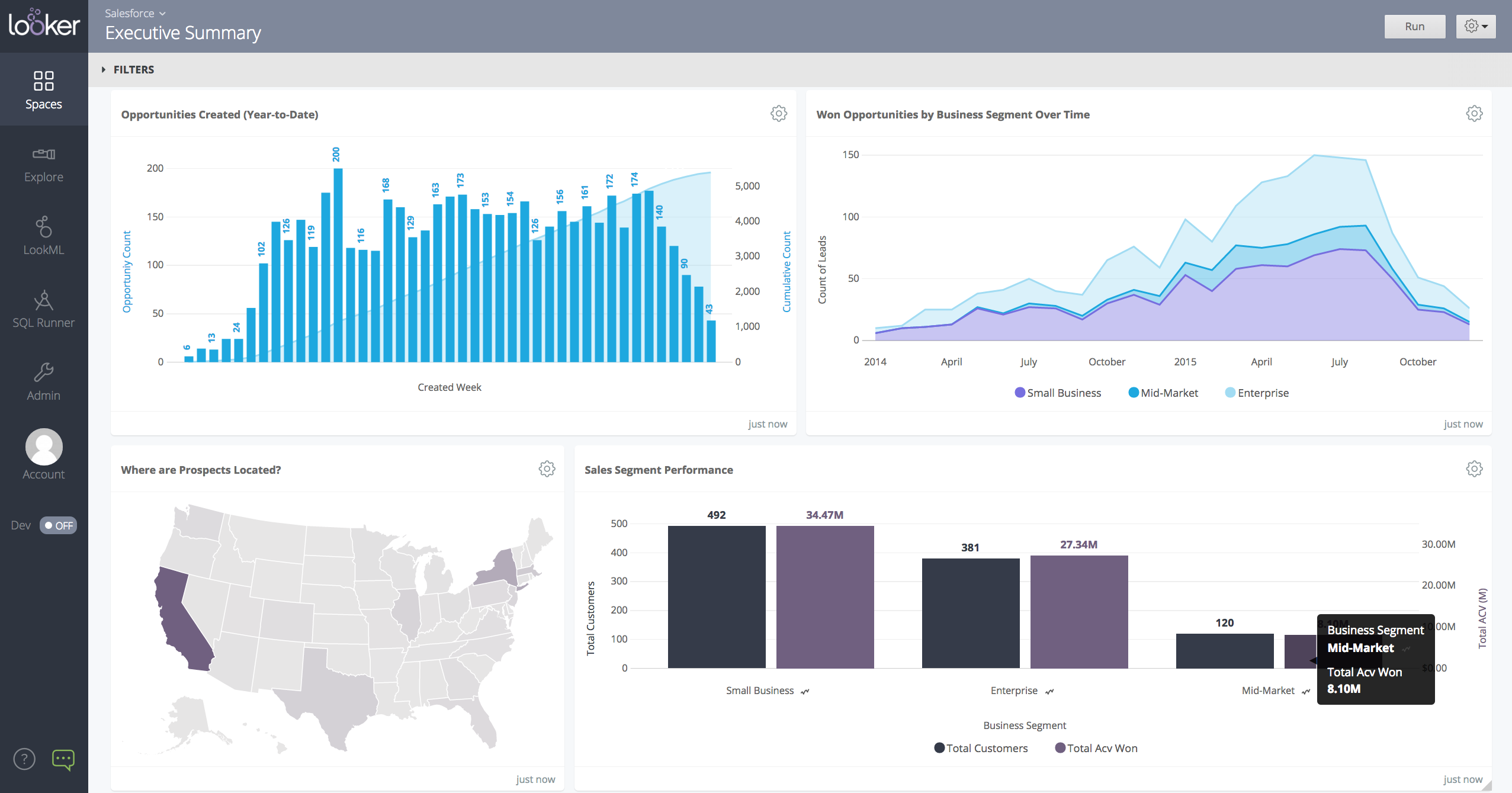
Looker is a BI application with an analytics-oriented application server that sits on top of relational data stores. It includes an end-user interface for exploring data, a reusable development paradigm for data discovery, and an API for supporting data in other systems.
N/A
Pricing
Gephi
Looker
Editions & Modules
No answers on this topic
No answers on this topic
Offerings
Pricing Offerings
Gephi
Looker
Free Trial
No
Yes
Free/Freemium Version
Yes
No
Premium Consulting/Integration Services
No
Yes
Entry-level Setup Fee
No setup fee
Required
Additional Details
Gephi is open-source and free to use.
Must contact sales team for pricing.
More Pricing Information
Community Pulse
Gephi
Looker
Features
Gephi
Looker
BI Standard Reporting
Comparison of BI Standard Reporting features of Product A and Product B
Gephi
6.7
3 Ratings
20% below category average
Looker
7.4
134 Ratings
10% below category average
Pixel Perfect reports
4.01 Ratings
6.5110 Ratings
Customizable dashboards
8.02 Ratings
8.3133 Ratings
Report Formatting Templates
8.03 Ratings
7.5115 Ratings
Ad-hoc Reporting
Comparison of Ad-hoc Reporting features of Product A and Product B
Gephi
4.3
3 Ratings
60% below category average
Looker
6.8
132 Ratings
16% below category average
Drill-down analysis
8.02 Ratings
6.4128 Ratings
Formatting capabilities
2.23 Ratings
6.6130 Ratings
Integration with R or other statistical packages
5.01 Ratings
5.655 Ratings
Report sharing and collaboration
2.01 Ratings
8.8131 Ratings
Report Output and Scheduling
Comparison of Report Output and Scheduling features of Product A and Product B
Gephi
4.0
3 Ratings
69% below category average
Looker
7.9
128 Ratings
4% below category average
Publish to Web
2.01 Ratings
7.7105 Ratings
Publish to PDF
8.02 Ratings
7.8113 Ratings
Report Versioning
2.01 Ratings
7.984 Ratings
Report Delivery Scheduling
00 Ratings
8.3110 Ratings
Data Discovery and Visualization
Comparison of Data Discovery and Visualization features of Product A and Product B
It is well suited for projects that are more discovery related. If this is a one-time project that we create a visual for, this would definitely make sense to use. If this is an ongoing analysis (monthly for example), we might look to another software that we would be able to automate a little further in how the visualization comes together
When data drives potential for new orders, Looker earns its place in our tech stack. If, on the other hand, we are hoping for pipeline generation, Looker is useful if you are willing to repeatedly go check customer utilizations .... it is not appropriate if you are hoping to automate data analysis for this purpose.
In comparison to other tools such as GraphWiz or Circos, Gephi comes with an intuitive, easy-to-use interface that makes it easy to load your data, and quickly start building all sorts of different graphs. There's absolutely no code that needs to be written for either loading or modeling. And without downloading additional plug-ins, Gephi ships with quite a few standard graph models, as well as some "fun" extras such as the Sierpinski triangle, and a variety of force atlas types.
Most of the layout types (maybe all) are highly configurable, which can make for extremely customized and unique displays of your data. Again, none of this requires the user to write any code. That said, it is possible to script custom functionality for your models, or even update the Java source code yourself, if you feel like getting technical. Gephi builds are available on GitHub, and the developers encourage people to contribute ideas, improvements, and plug-ins.
There's a plug-in for Gephi that allows for streaming data to update your model. This essentially allows you to create near realtime graphs of your data in motion. This plug-in was by far the biggest reaston we invested time in the product; to create animated data visualizations without exhaustive hours in development.
Show visited pages - sessions, pageviews - which programs are viewed the most.
Displays session source/medium views to see where users are coming from.
It shows the video titles, URLs, and event counts so we can monitor the performance of our videos.
It gives a graphic face to the numbers, such as using bar charts, pie graphs, and other charts to show user trends or which channels are driving engagement.
Our clients like to see the top pages visited for a month.
I like the drop-and-drag approach, and building charts is a little easier than it was before.
I (and many others) have had to expand Gephi's memory manually by experimenting with the configuration file. I'm glad it's possible, but it should be easier.
Gephi sometimes crashes inexplicably and loses your work, so I have developed a habit of explicitly exporting versions of my graphs as csv's, but I think this should be handled automatically in Gephi.
Because it is prone to crash, ideally, Gephi would help the user manage his/her use, by estimating processing and memory for very large tasks and prompting the user to confirm their requests before executing. Instead, I just tend to avoid certain functions.
While Gephi isn't perfect, it's a powerful tool for mathematical graph modelling that's hard to find in other products, particularly by way of its interface. It grants non-software developers access to a point-and-click way of creating accurate, beautiful visualizations that would normally take hours in other applications. The fact that it allows for live streaming data is also something that's hard to come by, at least for visualization software
I give it this rating because it deems as effective, I am able to complete majority of my tasks using this app. It is very helpful when analyzing the data provided and shown in the app and it's just overall a great app for Operational use, despite the small hiccups it has (live data).
Gephi is very intuitive and the fact that it shows its process helps the user understand what's going on. However, the animation features can really slow it down and there isn't a way to shut them off. Furthermore, the failures on saving mean you frequently have to start over. These problems disrupt the workflow and can be frustrating.
Looker is relatively easy to use, even as it is set up. The customers for the front-end only have issues with the initial setup for looker ml creations. Other "looks" are relatively easy to set up, depending on the ETL and the data which is coming into Looker on a regular basis.
Somehow resources heavy, both on server and client. I recommned at least 50Mbs data rate and high performance desktop comouter to be abke to run comolex tasks and configure larger amount of data. On the other hand, the client does not need to worry when viewing, the performance is usually ok
Never had to work with support for issues. Any questions we had, they would respond promptly and clearly. The one-time setup was easy, by reading documentation. If the feature is not supported, they will add a feature request. In this case, LDAP support was requested over OKTA. They are looking into it.
The interactivity in Gephi and the quality of the output figures are impressive. However, the selling point was the fact that we were able to link Gephi into our pipeline using Java's interface. Other products were less customizable and lacking of the sophistication Gephi provided without too much pain during the liking process.
Looker Studio, you can easily report on data from various sources without programming. Looker Studio is available at no charge for creators and report viewers. Enterprise customers who upgrade to Looker Studio Pro will receive support and expanded administrative features, including team content management. So it's good.
I have only used the product for education purposes. I will not be the best person to provide details about ROI and business efficiency and customer service. I was personally very excited about the tool and am continuing my work on the tool.
Looker has a poignant impact on our business's ROI objectives. As an advertising exchange we have specific goals for daily requests and fill, and having premade Looks to monitor this is an integral piece of our operational capability
To facilitate an efficient monthly billing cycle in our organization, Looker is essential to track estimated revenue and impression delivery by publisher. Without the Looks we have set up, we would spend considerably more time and effort segmenting revenue by vertical.
Looker's unique value proposition is making analytical tools more digestible to people without conventional analytical experience. Other competing tools like Tableau require considerably more training and context to successfully use, and the ability to easily plot different visualizations is one of its greatest selling points.