IBM API Connect is a scalable API solution that helps organizations implement a robust API strategy by creating, exposing, managing and monetizing an entire API ecosystem across multiple clouds. As businesses embrace their digital transformation journey, APIs become critical to unlock the value of business data and assets. With increasing adoption of APIs, consistency and governance are needed across the enterprise. API Connect aims to help businesses…
$83
per month
Anypoint Platform
Score 7.9 out of 10
N/A
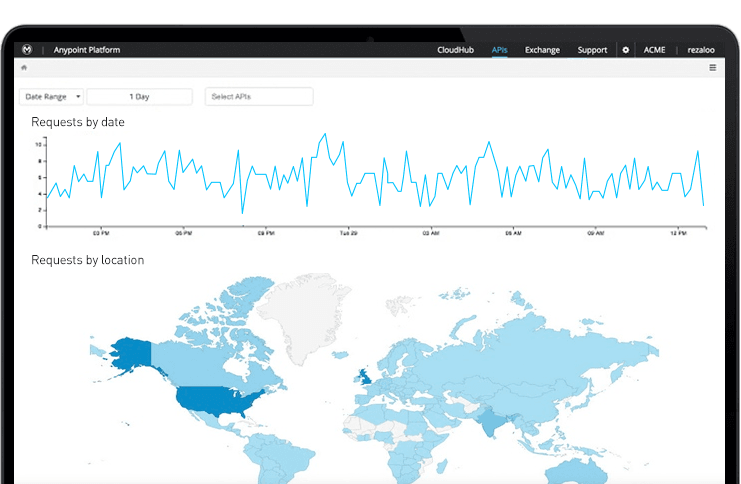
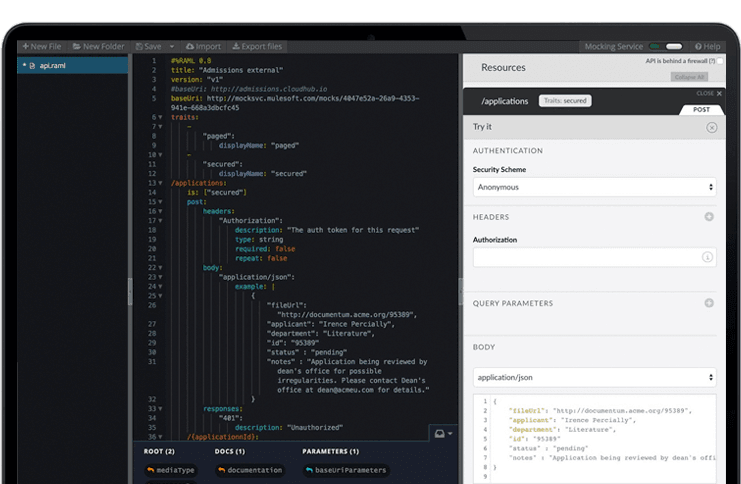
The Anypoint Platform developed by MuleSoft and acquired by Salesforce in early 2018 is designed to
connect apps, data, and devices anywhere, on-premises or in the cloud. This platform was built to
offer out-of-the-box connectors as well as tools that architects and developers can adopt quickly to
design, build and manage the entire lifecycle of their APIs, applications, and products.
N/A
Oracle Integration (OIC)
Score 7.9 out of 10
N/A
The Oracle Integration Cloud Service is an iPaaS providing prebuilt integration flows between applications, including other Oracle products. The Integration Cloud Service is scaled for enterprises, with prebuilt codeless adapters for on-premises and SaaS systems and low-code automation capabilities.
Prior to adopting IBM API Connect, there were two main competitors, MuleSoft. Although in the integration capabilities MuleSoft seemed to have an advantage, and regarding developer experience, IBM API Connect had a set of enterprise features for the API management.
Mulesoft seemed to take a lot longer to implement and reach any real ROI attribution. For the other competitors, I'd say they are easier to administrate, but this isn't as important to us as a business user. It was easier to explore APIs with IBM than it was with others.
Based on our experience, IBM API Connect clearly excels in large enterprises navigating complex B2B ecosystems, especially within the Fintech and Banking sectors. Its capabilities are particularly valuable for achieving Open Banking compliance, facilitating the monetization of data and services, and seamlessly operating in hybrid cloud environments. However, it's crucial to understand that IBM API Connect primarily functions as an API management and orchestration tool. This means that backend integrations with providers like databases are best handled by dedicated integration middleware, such as IBM App Connect, allowing API Connect to then securely and efficiently expose those functionalities to external entities.
MuleSoft Anypoint Platform is best tool in the market for developing APIs with complex structures communicating with various different types of applications including web applications as well as legacy applications. Also applications including database connectivity for fetching and updating data in the DB tables. I cant think of any scenario which MuleSoft Anypoint Platform could not be used for developing the integrations.
Oracle Process Cloud is suited for medium-sized companies and up who want to create applications that can automate tasks without the need of recruiting more software developers. With a couple hours of training, any member of the organization's business team will be well-equipped with all of the knowledge that is needed to use Oracle Process Cloud effectively. If your IT team is large and able to take upon the task of making the given application, then something like Oracle BPM is a better solution.
New enhanced activities that are targeted to reduce the integration pain. For example, file stage activity reduces the pain of chunking the input file while sending and mapping the data to the target application. Stage activity takes care of it automatically for the customer. Similarly, recommendation on the mapper is a huge plus for people looking for common integration.
There are around 50 adapters available including dedicated out of the box application adapters and generic technologies adapters on OICS. The best part of these application adapters is that they are designed considering LOB users. Most of the time integration implementor does not require, application knowledge to perform the integration. OICS has some of Oracle Cloud applications adapters which make integration much easier may not be available in other integration platforms.
Inbuilt diagnostic dashboard and error hospital makes this product lucrative. OICS also comes with integrated Process Cloud and Visual Builder at the same cost. the customer can have seamless integration with Apiary and SSI on demand.
Has more features than what we really need so we're paying for more than we use. Sort of like paying for an Abrams tank when all we really need is a Toyota Corolla.
Not a value product, tends to be expensive.
Takes a while for developers to learn to use Mulesoft Anypoint.
Currently, it is not retaining the logs for more than 3 days, which it needs to address.
We also need some functionality inside the interface to re-push the same transaction again so that it will be helpful while testing and fixing the issue.
Also, some log errors are not giving the correct details. Oracle needs to rectify those.
I can honestly say that the availability of the platform has been incredible, with almost no disruptions during the two years of the implementation. Availability is provided through the distributed architecture that may be deployed in multiple zones. We have had almost no cases of unplanned outages, and most maintenance operations were done during planned downtimes.
There’s a lot of learning curve at the beginning when it comes to building the code and everything. In terms of usability, I’d say once you get used to it, it’s fine — but it’s not very easy during the initial stages.
Anypoint Platform support is very responsive. There is also a huge knowledge base and an active online forum where answers to most questions can be found. When needed support engages the engineering group so adequate solutions or workarounds are always provided.
IBM API Connect and Apigee are both robust API management platforms. IBM API Connect was selected for its strong integration capabilities, hybrid cloud deployment options, and comprehensive analytics. It aligns well with organizations seeking flexibility and control over their API ecosystems, especially when dealing with complex integration scenarios across diverse environments.
Once we have moved all of our system integration APIs to the MuleSoft Anypoint Platform, we will need to communicate with a wide variety of external systems. All of our business and service logic is stored in the aforementioned core systems. Anypoint Platform (and all of our APIs) makes it easy to connect to various other platforms. In order to link to these many other systems, connectors and/or components are utilized, and they are simple to configure and integrate.
The nearest thing I have used to OIC is UiPath, as it is often used as a tool to integrate software together. However, it is much more suited to legacy software which have little to no API endpoints. If the infrastructure already exists I understand why people use RPA for integration, however for when API's are easily accessible and you're using Oracle tools, OIC is better.
Our company benefited from IBM API Connect's assistance in establishing cooperation with our outside providers and efficiently managing the API. As a result, we were able to expand our vendor ecosystem.
Additionally, creating APIs and implementing them on the goods was not too difficult. Additionally, we were able to ensure that only appropriate people could publish the APIs following evaluation by using role-based access control.
Our teams were able to reuse and share departmental APIs and services with each other thanks to the simple, self-service developer site.
The modern and advanced analytical abilities in Oracle Process Cloud are also a missing element that should be catered to.
This tool is used greatly for IT departments at a lower level with some very basic and limited access for general employees only.
Oracle Process Cloud has many advantages like it offers some very great and scalable solutions.
I find Oracle Process Cloud pretty straightforward and easy as compared to the different options available. Lastly, I think that as it is just one platform, managing the Oracle Process Cloud is pretty easy too.