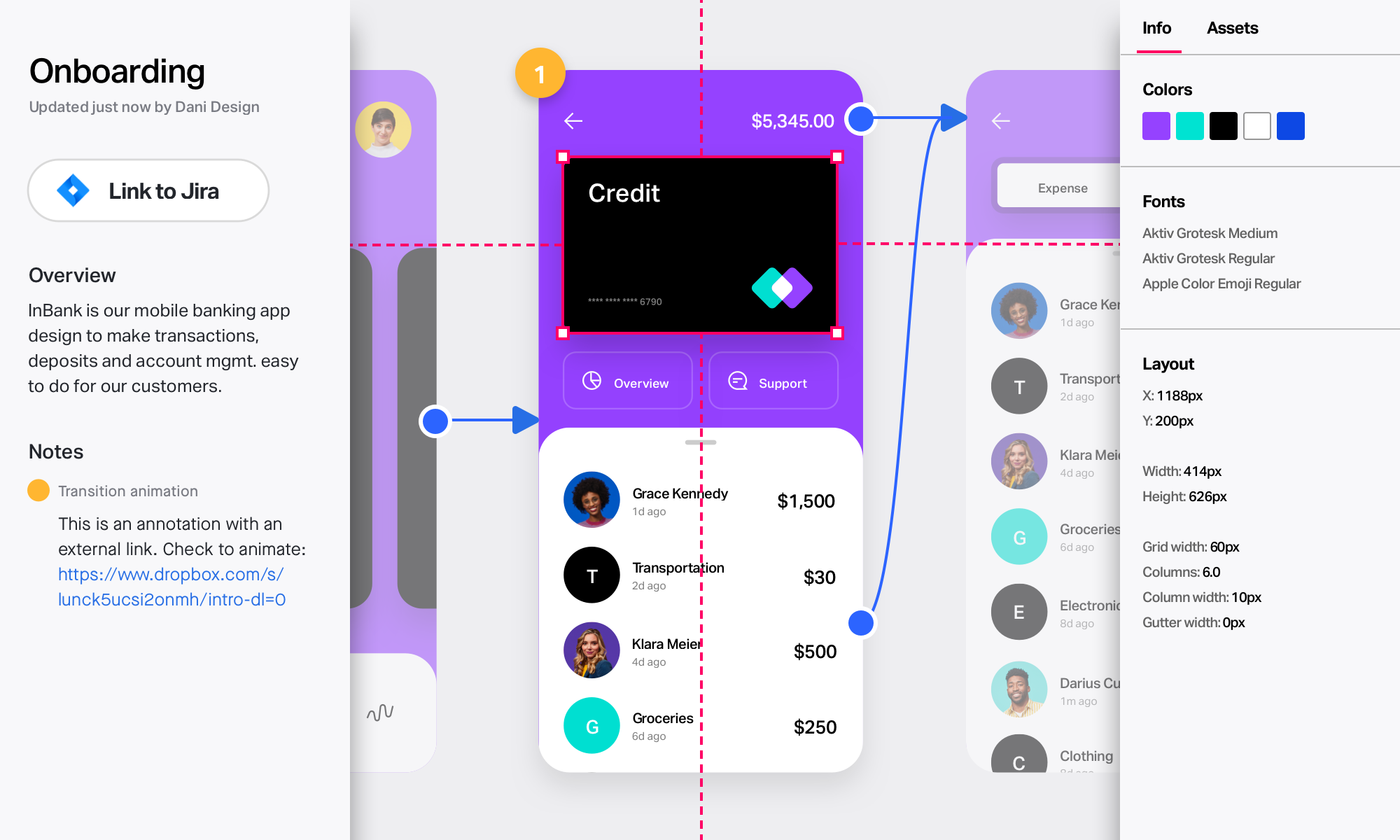
InVision is a collaborative design and prototyping platform with features such as freehand drafting mode and interactive mockups, collaboration, idea management, user testing, and integration with Slack and other collaboration tools. According to the vendor, 1 million designers are using the free version.
$0
Splunk Enterprise Security
Score 8.3 out of 10
N/A
Splunk Enterprise Security is an analytics-driven SIEM that helps to combat threats with actionable intelligence and advanced analytics at scale.
N/A
UXPin
Score 7.9 out of 10
N/A
UXPin is a UX design platform with wireframing, prototyping and interactive mockup features.
UXPin and Pidoco are more standalone where you can prototype AND wireframe in the same tool. InvisionApp is only for prototyping but it has the flexibility of working with your final design files or your wireframe files.
InVision is a great tool to use and well worth the price. However, if you're looking for some variety, UXPin and Figma are worth looking into too. While UXPin may be a tad simplistic in the design ability, Figma is a great competitor to InVision. Both tools are worth looking …
Compared to other tools, InVision is a very solid tool with a great reputation and prototyping functionalities to back it up. InVision was the first prototyping tool we purchased, and it’s served us really well. However, more and more design tools are now also providing …
InVision is super easy to learn and deploy compared to other tools. In fact other tools are following InVision and trying to match InVision. InVision support is tremendous even for a free license, you get a full support within a few hours. Special thanks to all those support …
Quick to prototype, easy to share, multiple devices, fully responsive breakpoints, export CSS, publishing from the tool, Photoshop integration. Has a fairly easy to use interface when compared to InVision and quite easy to integrate with other tools and collaboration solutions …
The first thing I’ll say is the learning curve is way lighter on UXPin. Also UXPin updates their app, and performance routinely and adds new features based on community needs.
It’s the first web-based tool that outputs code rendered in the browser from a design created in a …
Verified User
Professional
Chose UXPin
There are definitely pros to these other tools, but UXPin gains a significant edge by providing tools to perform several significant steps of the design workflow in one place. For instance, we could wireframe in Lucidchart, prototype in Marvel, then manually perform user …
Between UXPin and Balsamiq, I think UXPin gives you better control over the designs and iterations. UXPin seems to continuously iterate on their own product to make it better. I like how UXPin fits in nicely with my workflow.
InVision is well suited for design reviews and immersing yourself in the experience of an app-to-be. As a Product Manager, it's difficult to take abstract concepts, user pain points, and business needs, and produce a vision for an app without a visual aid to communicate a vision. InVIsion offers PMs, designers, and developers the opportunity to sketch a vision, communicate about it with inline commenting, and shareable with other stakeholders.
Based on my experience, Splunk is a strong git for some environments and a poor match for others. The distinction is primarily based on infrastructure complexity and budget. It's perfect for large enterprises with a mix of on-prem/cloud infrastructure. It's not a perfect match for small teams with restricted resources.
UXPin is an excellent resource for creating website and app flows and to better help our clients understand how their websites and apps will function. It also gives them a visual reference and some real-life application. It can be difficult for clients to truly understand how a website or an app flows from one page or screen to another via a phone call or web conference. UXPin helps us to illustrate these flows in a hands-on, visual format. UXPin also helps our clients understand the purpose of a sitemap. We used to send our clients a sitemap in an outline format. While many understood that the top-level items on the outline were the main navigation of their website and other items were child pages, several did not. We have found that using UXPin to show the main level navigation, how in-page navigation and child pages (drop-down menus from the main navigation) work has been an integral step in getting approval on sitemaps.
Writes Powerful Queries: The queries that can be written using the Splunk Query Language are very powerful and highly customizable to meet every need. Ex: Writing queries to search the intersection of two different sources like Network and Endpoint Logs.
Offers Dashboard Abilities: Helps build complex panels for Dashboards in addition to providing several out-of-the-box panels. Ex: creating panels to calculate the performance of analysts in a given timezone.
Helpful Search Aids: It helps to set up complex custom alerts very easily. The interesting fields section is very helpful while threat hunting. Ex: It shows all the users and the frequency of each in a failed login event. The user list on the interesting fields is useful to look for suspicious logins.
Smart elements are super nice because they allow me to create complicated features that will appear on every page. When the client wants to change something it is very easy to do so in one place.
Working on grid is important to me. Having the ability to change and manipulate that grid in UXPin is just what I need.
There are tons of add on features like Font Awesome icons and prebuilt stuff that not only looks great, but also just lets me get ideas across fast without committing to what the final design is going to look like.
I love the ability to edit things if I want. I can control several details, but it's not too overwhelming. They include various font options from Google fonts as well. You can design as much or as little as you want. The interface doesn't get in the way. It's there if you want it but has a simplicity that is nice.
Having a link on a live webpage is a necessity. As soon as you make changes, they are live. No more worrying about which is the latest version.
I'm a photoshop user so it has a few keyboard commands that are familiar like hold 'alt', click and drag to duplicate is nice!
Improved User Interface Customization: While the interface is generally intuitive, providing more options for users to customize their dashboards and views would enhance the overall user experience. Tailoring the interface to specific roles or use cases could be a valuable addition.
Simplified Alert Management: Streamlining the process of managing alerts, such as grouping or categorizing them based on severity or type, would make it easier for security teams to prioritize and respond to incidents effectively.
Expanded Threat Intelligence Feeds: Increasing the variety and sources of threat intelligence feeds available within ES would provide a broader context for identifying and mitigating emerging threats, ensuring a more comprehensive defense against evolving attack vectors.
No search and replace for fonts (missing or just to replace).
Tool is built for design/dev teams but does not integrate content teams in well.
If you are not careful you can get lost in designing interactions when you should be just creating building blocks - don’t over animate!!!
There is currently no “scrub” or click-drag interaction which limits touch capability testing/concepts.
Editing adaptive versions of designs is very time consuming, edits to not ripple through from master viewport size. All updates are manual, even when creating an adaptive version.
When a library item is updated, it can revert changes you have made unknowingly.
Video integration is limited to online video host aggregators such as IMGR, YouTube, and Vimeo.
Not a ton of info for a designer on how to use the expressions effectively.
Prototypes with a lot of interactions can get slow, especially on computers with a lot of security software. It’s best to work with UXPin to figure out what is blocking APIs, and JS.
We'll definitely continue to use UXPin. Right now it provides us with everything we need in order to deliver quality projects to our clients. If at any point in time, UXPin doesn't provide us with what we need, we'll start vetting other software out there that may be similar. My guess is that UXPin will continue to make updates and improvements so we'll likely stick with it for quite some time.
Easy for prototyping, sharing for comments and review changes with version. lags a bit when the design is heavy and large design models learning curve is shorter so saves time with new stakeholders responsiveness could be better and auto modeling can be introduced Not much advance features that can be used
Maintaining hundreds or even 1000+ SOC use cases is really difficult, considering that the Data sources may not always send the data. A module that detects data freshness issues and detect data format changes would be a great help. the main challenge today using Splunk Enterprise Security is making sure that the detection rules are still working properly given all the changes that occur in data source applications. Also, maintaining the data collects on tens of thousands of servers and more than 100k workstations is a real company IT challenge: the splunkbase forwarder may not support old OS anymore, while these are the most important to monitor. Moving to the Open Telemetry collector has become essential so that only 1 agent is required for both SIEM and application observability.
It takes a long time for items to load if you are just generally searching through logs. It is best to use the data models which load faster but can be strange in terms of what is coming from which logs where. Yes, you can look it up, but this also requires familiarity with where things are and how to look them up.
I didn't need to contact InVision support, as I've never needed it. They have an intuitive UI, and most of the questions are answered in their help portal or in tutorials online. Since many people use it, there a great resources available on for example YouTube. No problems so far with InVision.
It's good when it's responsive, but I've had times where I had to wait quite a while for a response. But these are typically the exceptions rather than the rule. When you do get a response it is always well-informed and appropriate. I would say they've been trending better over time with this.
As far as I know, my teams have only had to use the UXPin support once. The experience went really well. We just needed a bit of assistance with using the Documentation feature. UXPin's support was quick and helped my team in a matter of minutes. We will definitely reach out to their support without hesitation in the future.
I experienced only on-line training, but the trainers were very professional and competent. Maybe it could be more useful if they also have an experience in projects because sometimes they didn't have a real project experience to communicate to the students. Anyway, it was very interesting and I learned many thing that's very difficoult (or maybe impossible!) to have by myself, aven if I have more than 10 years of Splunk activity experience.
It was very interesting and I learned many thing that's very difficoult (or maybe impossible!) to have by myself. The only problem was that, when I worked with the Splunk Professional Services, I found some difference between the training contents and the information from PS. In addition is required a long experience on Splunk Enterprise for the data ingestion part, in other words I'm able to work with ES because I'm worling on Splunk since 11 years, otherwise I'd some problem.
We only tested out using Adobe XD for similar uses and found it to be more challenging to fit within our processes. It didn't have as robust a set of capabilities as InVision and wasn't as easy to use enterprise wide. I recall also having issues with working with Sketch.
Splunk enterprise is the only solution that we’ve been able to identify that provides risk based alerting, which allows our SOC to reduce analyst fatigue which would be a huge problem without it. Before RBA, there were thousands of alerts a day and it was impossible to review all of them
Adobe XD is so much more than UXPin, with Adobe Cloud you can easily share designs as well. We used Adobe XD before changing to UXPin. At first UXPin seems so advanced and helpful, but don't get fooled. You're heavily limited in the long run, and after all the training and implementation of UXPin (both app-wise for IT but also training designers etc) it is not worth your time.
for my exterience, unit pricing and billing frequency are correct. As I already said, I hint to have more discount flexibility, expecially with new customers, because there are competitors less expensive and very aggressive that are dangerous. In addition the possibility to don't pay the license for the development period could be a very interesting feature for the final customers.
- 8 out of 10 and took 2 for the data pipeline and administration part. Even if you'd like to improve yourself or your team, you have to pay a lot of money and it could be more than GIAC education + cert. - Normalization for Data models and CPU-based searches can be a problem sometimes.
I had a fantastic experience with Splunk Professional Services: they worked with us in our last SON project (a SOC migration for a very large customer) and helped to build a multi tenent environment even if ES isn't a multi tenant platform. Th Splunk PS was a very professional and competent people, he is italian and was able to speak with our italian customers.
InVision helps our team better and more professionally portray the value and the work we do as designers, leading to more company buy-in in supporting and funding our work. In the past, we would create PowerPoints with screenshots to portray a user workflow that we would share out to stakeholders. Once we began to use this app, where stakeholders could click through and comment as though they were “real” users, stakeholders began to better understand our work, designs, and workflows. This has led to more productive conversations that, in turn, lead to more effective end products that have more consistently served our business goals in tangible ways.
InVision helps us save production time, effort, and cost, as we are able to solve design issues early in the process by having clickable prototypes to show to internal stakeholders and external users. It’s, understandably, difficult for people to provide effective feedback on screenshots. Using the clickable prototypes we created in InVision, we are able to get more effective feedback to solve user workflow issues before we spend time and money developing problematic designs (and later having to redesign them).
It’s easier to market designs to potential buyers with clickable prototypes than with screenshots. With these prototypes, we’ve been able to sell more digital products before product release dates, which has helped to secure many contracts and new business relationships that continue to this day.
We have a 100% success rate on all our ES implementations due to the amazing documentation and Splunk enablement on the subject.
Our Splunk ES business has grown 100% YoY for the last 3 years.
In terms of long term management and maintenance, ES has been highly stable and predictable, reducing our overhead on costly services team for ad hoc maintenance work.
Saving money by using one tool for lo-fi wireframing, high fidelity wireframing, prototyping, and user testing, rather than four separate tools.
The ability to create and use team libraries enables us to create visually consistent designs with less effort than creating every single design from scratch, which allows us to save considerable time (and therefore money!)
In-platform collaboration saves our team a lot of time and energy. With everything in one place (wireframes, prototypes, user feedback, collaboration comments), we can all be on the same page about the design workflow and pinpoint discussion points that are based on up-to-date designs.