Ivanti Endpoint Manager increases user and IT productivity by helping IT administrators gather detailed device data, automate software and OS deployments, and quickly fix user issues.
N/A
SolarWinds Server & Application Monitor
Score 7.7 out of 10
N/A
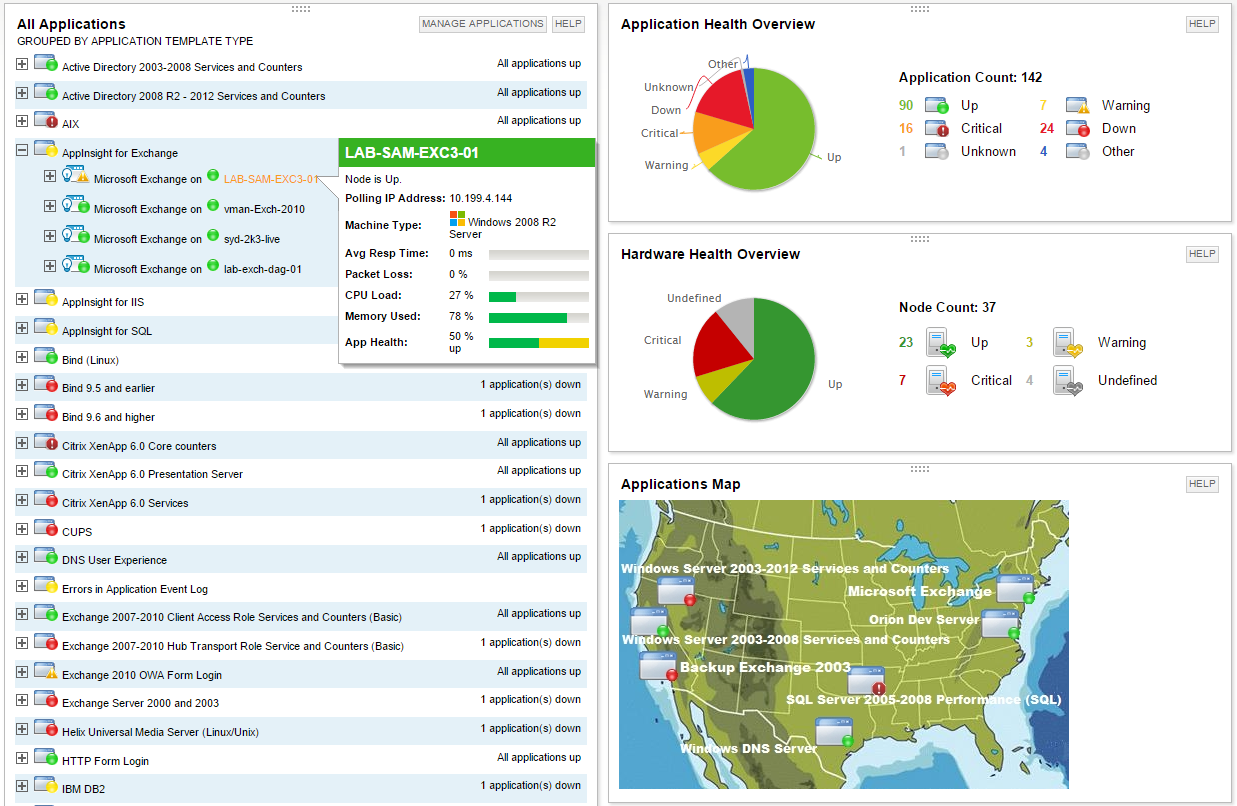
SolarWinds Server & Application Monitor (SAM) delivers application and server monitoring capabilities. SAM allows for self-service for easy setup, 1200+ monitoring templates, and customization options, as well as integrate with other SolarWinds products.
N/A
Pricing
Ivanti Endpoint Manager
SolarWinds Server & Application Monitor
Editions & Modules
No answers on this topic
No answers on this topic
Offerings
Pricing Offerings
Ivanti Endpoint Manager
SolarWinds Server & Application Monitor
Free Trial
No
Yes
Free/Freemium Version
No
No
Premium Consulting/Integration Services
No
No
Entry-level Setup Fee
No setup fee
No setup fee
Additional Details
—
SAM pricing starts at $2,995.
More Pricing Information
Community Pulse
Ivanti Endpoint Manager
SolarWinds Server & Application Monitor
Features
Ivanti Endpoint Manager
SolarWinds Server & Application Monitor
Application Performance Management
Comparison of Application Performance Management features of Product A and Product B
There is no direct replacement for the on-prem Ivanti [Unified Endpoint Manager (formerly LANDESK Management Suite)] solution. Ivanti has a companion product called Neurons, but that is in additional cost, and requires configuration with your on-prem [Unified Endpoint Manager] instance to perform basic functions. If cloud-based is a requirement for your organization, this is likely a dealbreaker. You can implement [Unified Endpoint Manager] in a cloud instance such as AWS, but the support for this appears limited. If on-prem is not an issue for you, this is a great tool for device management. It has robust features, impressive inventory, massive customization options, and excellent vendor support. If Patch Management is a problem in your company right now, this is the first product I would evaluate.
It is a well-suited software for monitoring and surveillance of your deployed nodes. The error-readability and filter options for filtering out logs and errors could be improved. But overall, it has a good UI design, is user-friendly, and is very easy to learn and access for new users.
Patch(Security) is done really well. You can use roll out projects or built-in automation as well as the use of groups and scopes to design pilot and other use cases.
It takes a solid inventory of what you have of your endpoints and can do an agentless scan as well if you need to collect data that way as well.
Provisioning is rather simple and even allows you to use other products' software for the image or the built-in if you wish to do so.
Software distribution works well and has a lot flexibility built into the module.
Setup - Boy it is a pain to configure everything correctly. Be aware that you'll probably be giving an AD service account some God rights to get everything working....and security just loves that....
Cost - Boy you have to pay for everything. I suppose it lets you buy into just what you want but having repeated items go through procurement is a pain if your procurement branch is a pain.
We are happy with the product but the support and development process is far superior to any other company we have worked with. Having a good support structure is very important in today's marketplace of products that do so many things and have so many robust options and capabilities. We are very satisfied with our contract, pricing, support and product execution.
We are heavily invested in Solarwinds products for a reason. They are generally easy to setup and run with, requiring only some interfacing with support or help articles on rare occasions. They do what we bought them to do and we can't ask for more.
Items are logically laid out and most are easy to find. The more advanced stuff can be trickier, but it is still not hard to find. There are a lot of options though, so remembering where some settings are, especially if you do not alter them often, can take a minute, but you will get to them fairly qiickly.
SolarWinds Server & Application Monitor is quite easy to use and super versatile. It allows you to do just about anything you can through premade templates or through scripting. You can use an agent on the servers if you want to, or you can monitor through WMI or SNMP credentials. You can customize thresholds for alerting quickly, and you can configure alerts to be as complex or as simple as you want.
The graphical interface and the performance of the database leave a little to be desired, they could be better explored.Some functionality and screens do not work well depending on the browser used. The integrations never had any problems or caused crashes in other systems.
TRM\TAM support has been generally very good. Getting reported bug fixes, design changes, UX problems resolved has been a pain. It is often difficult to get problems escalated beyond the TRM\TAM level. Support is fantastic when you can get it, getting it can often require more work than it should, and that is probably our biggest issue.
I think there was only a couple times I had to open a support case for SAM and one time they got multiple engineers on the phone to get a better idea what I was trying to monitor and was able to point me in the best direction to monitor that system.
It's been many years since I did a full evaluation of other products but at the time we purchased it, the main competitors were Microsoft's SMS and Alteris. SMS just looked horribly ugly and complicated (which fit in very well with Microsoft's other server tools) and Alteris looked okay but had a piecemeal approach where even a basic deployment meant purchasing a half dozen or more components. LANDesk had one bundle for all the tools we were looking for and had a great interface for presenting the data.
Nagios requires far more manual work to configure than SolarWinds does, though that also encourages customization and perfect-fit solutions. Nagios also requires far, far fewer resources to run than SolarWinds: SolarWinds wants great gobs of memory and disk, while Nagios is refreshingly humble. Nagios starts working from the first minute, too, whereas SolarWinds needs lots of set-up time.