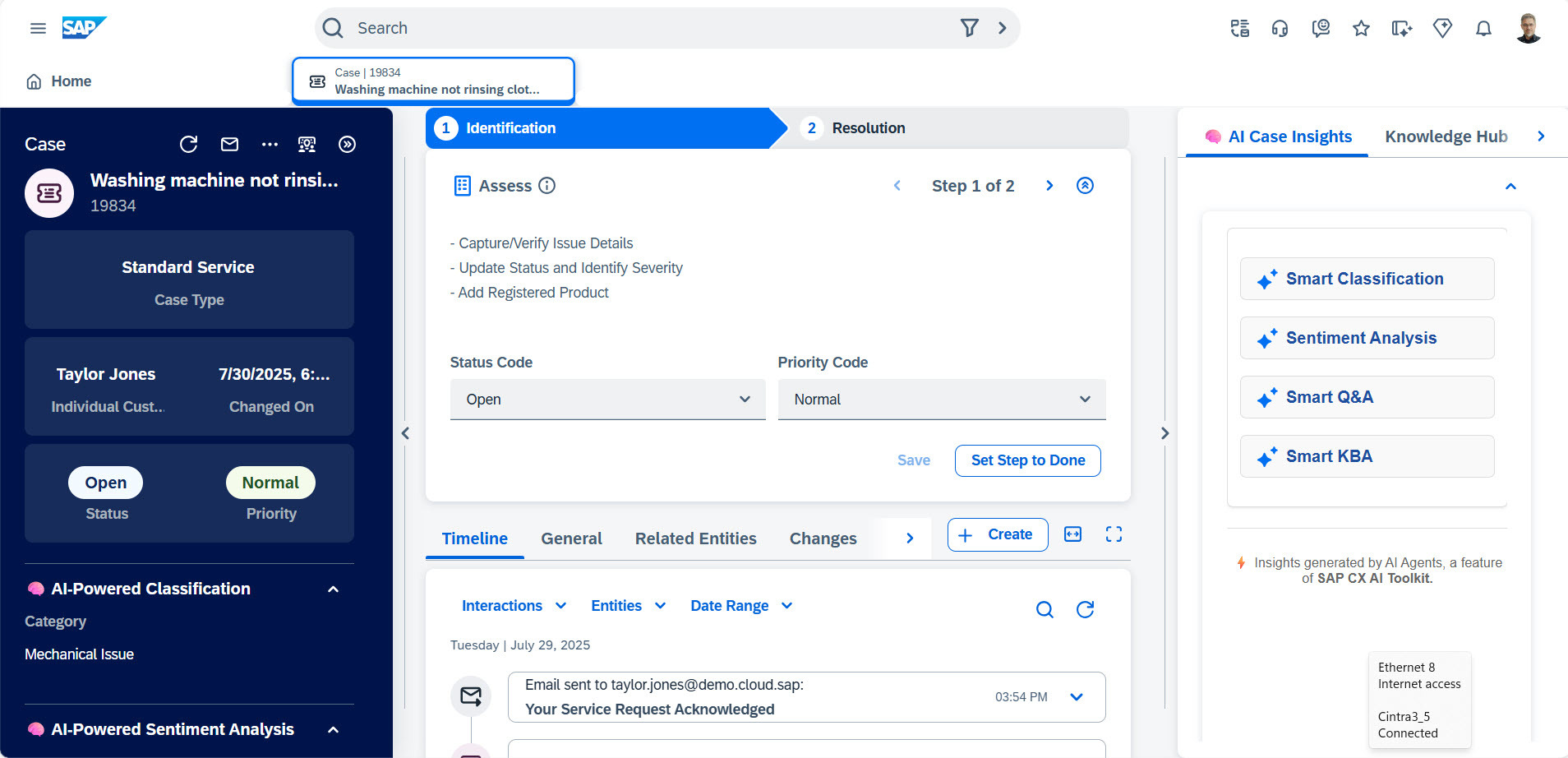
SAP Service Cloud helps deliver customer value and protect the brand with intelligent customer service. It enables the user to engage with customers at their convenience, connect service with the value chain and deliver greater profitability.
N/A
Shopify
Score8.7 out of 10
N/A
Shopify is a commerce platform designed for both online stores and retail locations. Shopify offers a professional online storefront, a payment solution to accept credit cards, and the Shopify POS application to power retail sales.
SAP Service Cloud is well-suited for handling a large number of customer complaints. For example, as a financial company, we receive customer inquiries about transaction failures. Once the client reaches us, we assign the problem to the right team and people, and that is all thanks to SAP Service Cloud, which helps ensure customer problems are solved in the best possible time.
A de minimis incentive was given to thank the reviewer for their time. The incentive was not used to bias or drive a particular response, nor was the incentive contingent on a positive endorsement. TR verified that a representative sample of customers was invited. More Info
Shopify allowed us to handle matrix items and combined listings. Both of which we could not do on our previous platform. There was some customization involved but overall, it did what we needed it to. The one downside was that if we want to change anything we would have to reload the entire set of matrix items manually.
A de minimis incentive was given to thank the reviewer for their time. The incentive was not used to bias or drive a particular response, nor was the incentive contingent on a positive endorsement. More Info
A de minimis incentive was given to thank the reviewer for their time. The incentive was not used to bias or drive a particular response, nor was the incentive contingent on a positive endorsement. TR verified that a representative sample of customers was invited. More Info
It's base security and integration with trusted security partners (such as NoFraud) is a game-changer when it comes to reliability and a "hands off approach" for our IT department. The up-time is also very good.
It offers a wide range of verified plugins that are (for the most part) easy to install and use for any specific scenario you're looking for.
It's Analytics area in the admin is actually nice and offers a wide variety of reports that you can run.
A de minimis incentive was given to thank the reviewer for their time. The incentive was not used to bias or drive a particular response, nor was the incentive contingent on a positive endorsement. More Info
While SAP Service Cloud offers a wealth of features, its interface can sometimes feel overwhelming. For newcomers, especially those not tech-savvy, a more intuitive or simplified layout would be beneficial.
While it allows for some level of personalization, making deep customizations can be challenging. Given the unique requirements of our client's customer service, having more flexibility in tailoring the tool to our exact needs would be nice.
While SAP Service Cloud integrates well within the SAP ecosystem, it can sometimes be less smooth when linking up with non-SAP third-party tools. Enhancing these integrations would streamline our operations, especially when using other software tools alongside it.
A de minimis incentive was given to thank the reviewer for their time. The incentive was not used to bias or drive a particular response, nor was the incentive contingent on a positive endorsement. More Info
I would love it if Shopify built an in house app which helped us post UGCs and social proof from platforms such as Instagram, Youtube etc. more seamlessly on our website. Right now, we are able to do it through third party apps but the look and feel is just okay.
A de minimis incentive was given to thank the reviewer for their time. The incentive was not used to bias or drive a particular response, nor was the incentive contingent on a positive endorsement. More Info
SAP Service Cloud offers sturdy competencies for case control, workflow automation, and purchaser engagement. However, since our organization continues to be within the early assessment section, we have not but experienced its complete potential. Once fully applied and custom designed to our desires, the score can also increase as we investigate usability and integration with other SAP solutions.
A de minimis incentive was given to thank the reviewer for their time. The incentive was not used to bias or drive a particular response, nor was the incentive contingent on a positive endorsement. TR verified that a representative sample of customers was invited. More Info
Nothing we have used in the past or have seen thus far even comes close to offering what we get with Shopify Plus, especially for the price. You cannot even come close to getting what we are getting at the price we pay. We are beyond thrilled and Shopify Plus meets and exceeds all of our needs and expectations. We love it!
A de minimis incentive was given to thank the reviewer for their time. The incentive was not used to bias or drive a particular response, nor was the incentive contingent on a positive endorsement. More Info
It is fairly easy to use Shopify regardless of what task you are attempting to perform. Most things are customizable to a degree without requiring coding ability. I have very limited coding experience and have still been able to navigate my way around changing features of the website that require edits to the code with the use of AI and trial-and-error. This previously wasn't possible with the WooCommerce platform.
A de minimis incentive was given to thank the reviewer for their time. The incentive was not used to bias or drive a particular response, nor was the incentive contingent on a positive endorsement. More Info
A de minimis incentive was given to thank the reviewer for their time. The incentive was not used to bias or drive a particular response, nor was the incentive contingent on a positive endorsement. More Info
A de minimis incentive was given to thank the reviewer for their time. The incentive was not used to bias or drive a particular response, nor was the incentive contingent on a positive endorsement. More Info
I have found that sometimes issues reported to the SAP takes more time also they lack system support with respect to the priority . Also we don't see RCA for the issues raised. Also turn around time for the issues is not fixed as the support is global sometimes the issues float here and there.
A de minimis incentive was given to thank the reviewer for their time. The incentive was not used to bias or drive a particular response, nor was the incentive contingent on a positive endorsement. More Info
In terms of support I give Shopify a 9 out of 10 because they're always very friendly and thorough, and they personally can't solve my problem for me they always point me in the proper direction with the proper information I need to move forward
A de minimis incentive was given to thank the reviewer for their time. The incentive was not used to bias or drive a particular response, nor was the incentive contingent on a positive endorsement. More Info
Shopify offered us several trainings to setup a Shopify store, how to build a brand, SEO, product photography etc. All this content have been super helpful in our journey.
A de minimis incentive was given to thank the reviewer for their time. The incentive was not used to bias or drive a particular response, nor was the incentive contingent on a positive endorsement. More Info
A de minimis incentive was given to thank the reviewer for their time. The incentive was not used to bias or drive a particular response, nor was the incentive contingent on a positive endorsement. More Info
Zoho Desk is the ultimate software for clear communication, but when we compared these two according to our needs, we found out that SAP Service Cloud is the best option for us. Since it provides everything in one location, Zoho Desk is somewhat lacking in this area. That was the reason for choosing SAP Service Cloud.
A de minimis incentive was given to thank the reviewer for their time. The incentive was not used to bias or drive a particular response, nor was the incentive contingent on a positive endorsement. TR verified that a representative sample of customers was invited. More Info
Big Commerce and SAP Hybris are two other platforms we've investigated and Shopify is by far easiest to use and customize. While it doesn't do everything out of the box, the apps do fill in many gaps. The cost however, is probably the biggest selling point against these other two options.
A de minimis incentive was given to thank the reviewer for their time. The incentive was not used to bias or drive a particular response, nor was the incentive contingent on a positive endorsement. More Info
A de minimis incentive was given to thank the reviewer for their time. The incentive was not used to bias or drive a particular response, nor was the incentive contingent on a positive endorsement. More Info
A de minimis incentive was given to thank the reviewer for their time. The incentive was not used to bias or drive a particular response, nor was the incentive contingent on a positive endorsement. More Info
It got the store up quickly so the client could start selling. She was previously selling products on Etsy and Facebook and wanted to consolidate everything onto one website, so the main thing Shopify solved was to reduce the store owner's time in managing all her products on multiple sites. Also, we had previously built a website on Wix with all the custom functionality and branding she needed - a truly great, high-end website - but it performed so slowly that it was unusable. So the speed at which Shopify can be set up and then works on the page is appreciable.
The website was manageable by the client - she could figure the system out herself after a while so she saved money on costs for hiring developers. She did have to hire developers to customize some of the plug-ins but costs are all relative; it wasn't a high investment compared to building a full e-commerce website. With the complexity and size of her product base and the functionality and branding she wanted to have in a website, and the potential of her business, she would have needed to invest well over $10,000 to get to where she really needs to be. In the end she kept the budget under $5000.00.
Costs kept climbing with plug-ins having to be added with everything. My client became more involved in building the website and began to try multiple plugins, and she did not have the skill base to evaluate the plugins functionalities so she chose plugins that did not do everything she needed, and then ended up paying the plugin developers to customize the plugins. So on one hand, it's pretty amazing to be able to bring up an e-commerce website as quickly as a week or so, but on the other hand if you need anything customized or deeper functionality in regards to product searching and filtering on the web page, and management on the backend, it quickly goes beyond the skills of the average person to manage, and above their expected budget as well. In the end my client really did not get anything close to the functionality for the website we had originally envisioned.
Shopify was the easiest way we could find to bring the client's products to a global market. We evaluated several other platforms and the functionality simple did not seem to be adequate, so Shopify seemed like the only solution that could do enough of what we needed and still stay within this client's budget. Really the problem in this project was not platform per se but that the budget wasn't large enough. Shopify managed to provide a solution for an ecommerce store with thousands of products on a tiny budget, so in the sense of pure functionality it provided the best value of all the platforms we evaluated. The solution still isn't big enough for this client's business though so, without having insights into this client's post-build sales results, my guess is that because her new website did not make her products easier to sort through, and she likely didn't have much more budget left to invest in SEO and other marketing of the website, her sales probably didn't increase substantially as a result of having built the website. So I think this project all in all did not likely have a high ROI.
A de minimis incentive was given to thank the reviewer for their time. The incentive was not used to bias or drive a particular response, nor was the incentive contingent on a positive endorsement. More Info