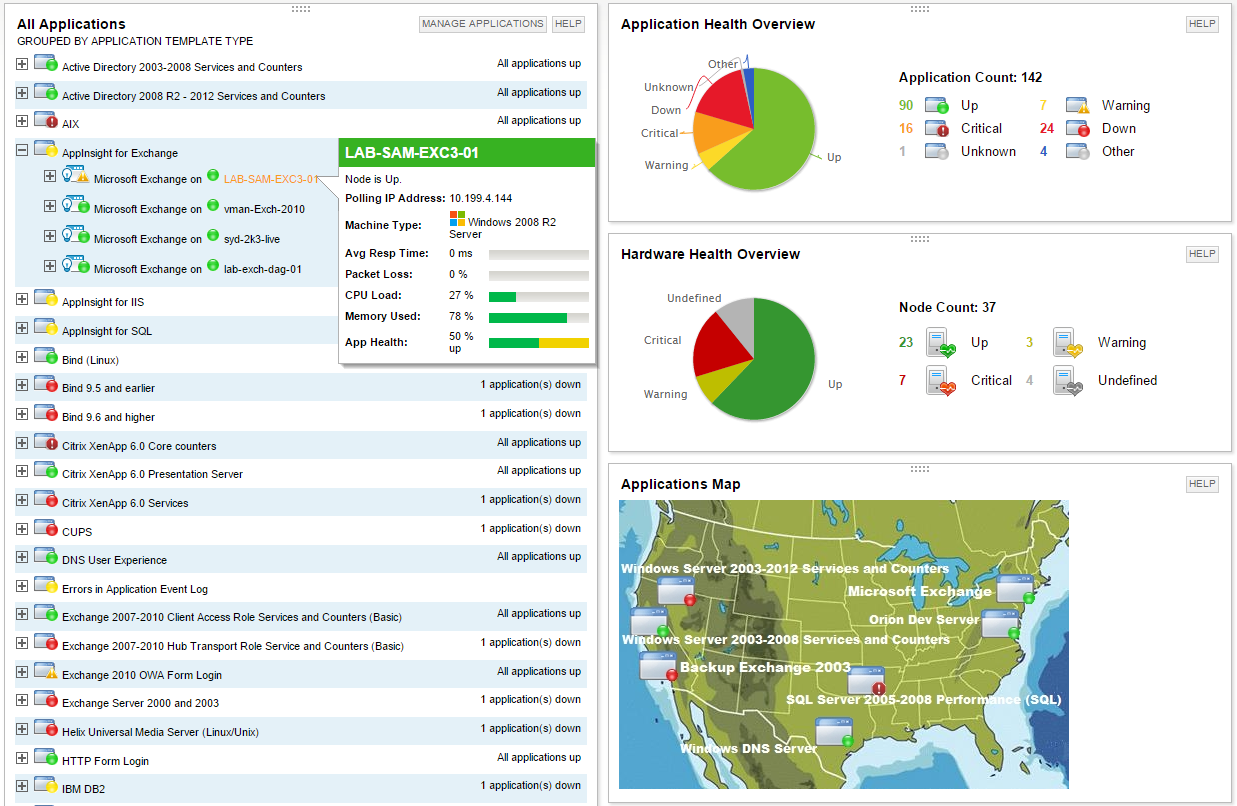
SolarWinds Server & Application Monitor (SAM) delivers application and server monitoring capabilities. SAM allows for self-service for easy setup, 1200+ monitoring templates, and customization options, as well as integrate with other SolarWinds products.
N/A
SolarWinds Virtualization Manager (VMAN)
Score 10.0 out of 10
N/A
SolarWinds® Virtualization Manager (VMAN) is a tool for monitoring, performance management, capacity planning and optimization for on-premises or cloud-based virtual environments. It also integrates with other SolarWinds products.
I run quite a suite of SW tools. I have found them all to so tightly integrate that you have trouble telling which module a specific task actually came from. All you know is it all runs very well together!
We actually did a side-by-side test and compare with another similar product called What's Up Gold. Solarwinds was more robust and was able to monitor and analyze everything we we needed it to.
To be honest we never looked into any other products. We already made use of SolarWinds SAN, and once we found out SolarWinds was also able to monitor our virtual environment, we immediately had a trial of the software. We were very happy with what the VMAN component had to …
SolarWinds is far superior to the base tools. Every manufacture has a management tool that often has really good benefits to using it, however with VMAN you get a single pane of glass for so much more than just Virtual Machines and or storage. You gain total control of your …
We're also a Veeam customer and have assessed Veeam ONE. We found the interface to be lacking and the contents misleading. Having VMAN in a single pane of glass integrated with the rest of our Orion products makes life very easy and everything very clear. The features that VMAN …
VMware vCenter Server accommodates only VMware hosts and guests. The dashboards are not customizable and require a lot of clicks to get the necessary information on a host or guest.
MS Configuration Manager and Virtual Machine Manager are cumbersome when compared to VMan. The …
We did test two other alternatives since we used other SolarWinds products, the Virtualization Manager was a natural extension of the existing platform.
We are fairly heavily invested in other SolarWinds packages already so why add another software package when I can plug a module into a proven framework I'm already running.
It is a well-suited software for monitoring and surveillance of your deployed nodes. The error-readability and filter options for filtering out logs and errors could be improved. But overall, it has a good UI design, is user-friendly, and is very easy to learn and access for new users.
On the whole, Solarwinds Virtualization Manager (VMAN) is an excellent product which gives us a single point to monitor our virtual environment. After our initial trial I was sold on the product and what it had to offer. Immediately after implementing VMAN, we were able to spot virtual machines with old snapshots which were never deleted and no longer needed, we could spot virtual machines which either had over allocated resources or under allocated resources meaning we could make changes and fine tune them for best performance. We could also monitor virtual machine latency, IOPS, and show us where our bottlenecks were.
I created custom dashboards, to view the different elements of the virtual environment. For example, you can view the number of online VMs and those off, or disconnected. You can also choose to see the status of every virtual cluster, the storage disk usage on every VM, the RAM usage, CPU usage.
I used this application to see the growth of virtual memory in each cluster and accordingly do forecasting for future growth. A capacity planner included in this application would help in doing accurate estimations and setting a future upgrade budget.
Another powerful tool was the customized reports, where i could generate reports on any element of the VM or cluster. Reports can be exported to Excel or PDF and are very useful for sharing information with colleagues and management.
Alerts can be customized. For example, you can set a rule to get an email alert if any virtual server RAM usage exceeds 85% and send a text message if RAM usage exceeds 90% for more than 10 minutes.
We did have issues during the setup, with successfully connecting to some of our hosts and vCenters and we found support were just sending us back to articles we had already read, it was also taking long periods before getting a response. The issue is still ongoing, in fact.
We are heavily invested in Solarwinds products for a reason. They are generally easy to setup and run with, requiring only some interfacing with support or help articles on rare occasions. They do what we bought them to do and we can't ask for more.
Currently, there is no other tool that gives us what we need to monitor a geographically disperse environment with multiple non-related instances of VM clusters. In addition, the level of reporting, historical data trending, and alerting that VMAN provides is essential for our business process. Lastly, the effort to customize and set up any monitoring system is not trivial. This makes switching to any other product very difficult without being able to clearly demonstrate a ROI.
SolarWinds Server & Application Monitor is quite easy to use and super versatile. It allows you to do just about anything you can through premade templates or through scripting. You can use an agent on the servers if you want to, or you can monitor through WMI or SNMP credentials. You can customize thresholds for alerting quickly, and you can configure alerts to be as complex or as simple as you want.
SolarWinds VMAN is easy to use for everyone. When I say everyone which literally means anyone e.g. Virtualization Environment SME, Consultant, Support Team, Management Officers etc. Anyone who have worked on IT technologies could easily deploy SolarWinds by reading videos, Thwack posts or Virtual Classrooms (Custom Success Centers) - this makes this application easy to operation and for maintenance support is always there.
The graphical interface and the performance of the database leave a little to be desired, they could be better explored.Some functionality and screens do not work well depending on the browser used. The integrations never had any problems or caused crashes in other systems.
I think there was only a couple times I had to open a support case for SAM and one time they got multiple engineers on the phone to get a better idea what I was trying to monitor and was able to point me in the best direction to monitor that system.
SolarWinds gives good support. I have never had a time when i was working through a support case where I did not get the support I needed for the required issues to be resolved. I have always had resolutions from SolarWinds support. They are top notch. Issues once had are no more.
Its really the best product on the market for someone looking to have total control over their VM environment. anyone interested should download a demo and try it, I know you will buy it after you do. It changing the way you have to manage on a daily basis
Nagios requires far more manual work to configure than SolarWinds does, though that also encourages customization and perfect-fit solutions. Nagios also requires far, far fewer resources to run than SolarWinds: SolarWinds wants great gobs of memory and disk, while Nagios is refreshingly humble. Nagios starts working from the first minute, too, whereas SolarWinds needs lots of set-up time.
The operation began using Nagios XI, after a year of use, and based on the results obtained, we realized that what our client wanted was not fully met. Our client asked us to use WhatsUp, however, SolarWinds covered in a more efficient way what was required by our client (IT) and even more.
VMAN has been used for reports provided to executive-level meetings. These reports showed our growth patterns, allowing for easier decisions on purchasing additional hardware.
VMAN has provided a positive impact on allowing for near real-time monitoring of resources, able to pinpoint when services are using more memory than expected, not running at all, or other options as defined.
VMAN was purchased to help monitor our VMware platform, the added abilities for AWS allowed us to migrate clients from on-prem to cloud-based with the same views.