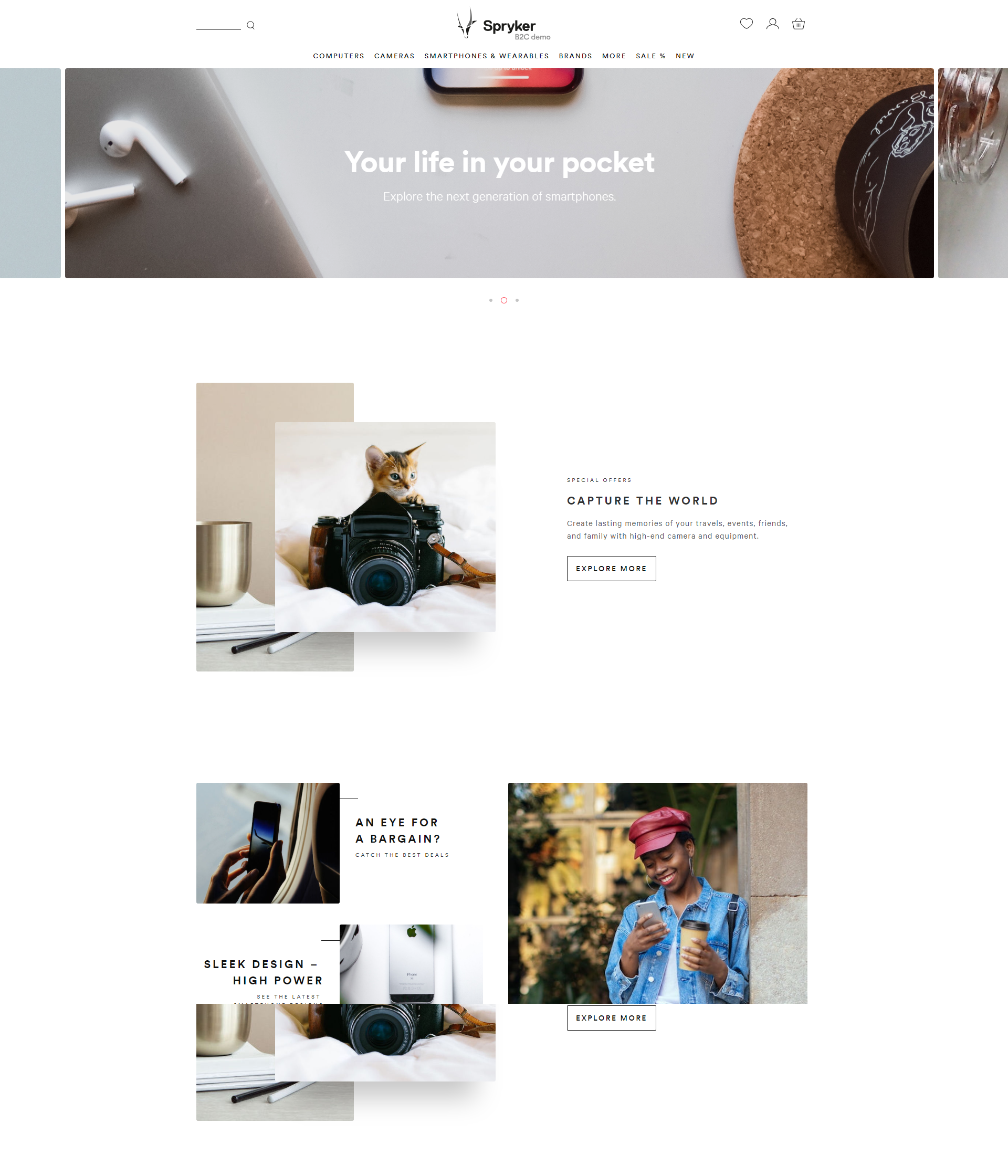
Spryker Cloud Commerce OS is a modular Commerce System that enables B2B, B2C, and Marketplace business models through any customer interface, touchpoint, and device. Boasting extensibility, best-in-class performance, and fast time-to-market, the vendor states Spryker is trusted by brands such as TOYOTA, HILTI, and TomTailor. The Spryker Cloud Commerce OS NOW version has been specifically developed for manufacturers and brands who want to reach customers directly online.
$900,000
12 month contract
Volusion
Score4.8 out of 10
N/A
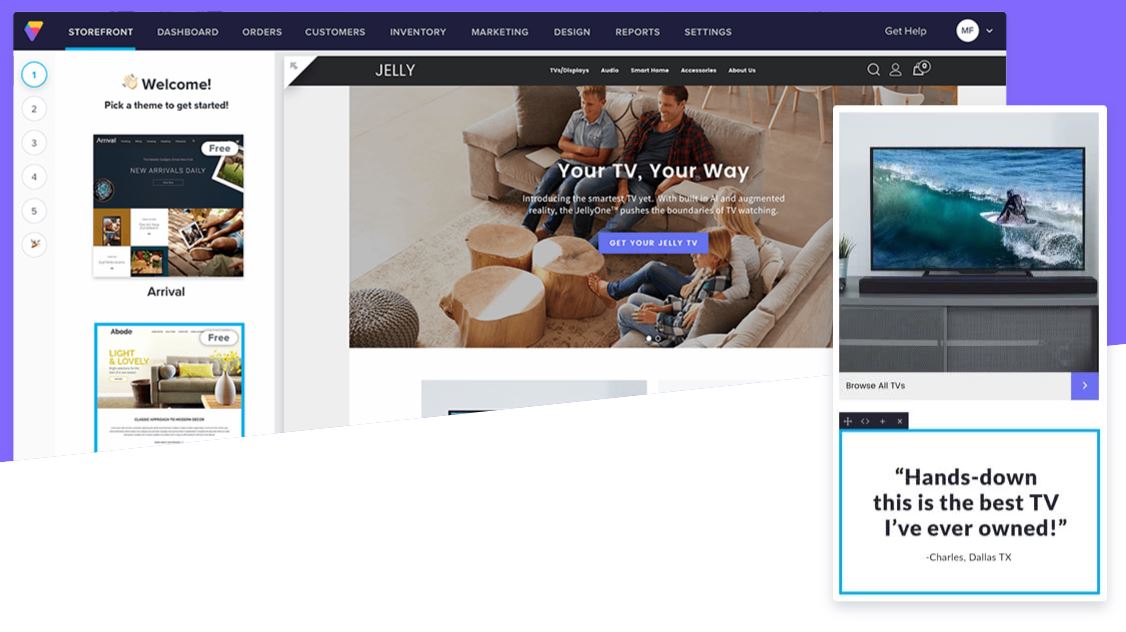
Volusion is a cloud-based ecommerce solution from the company of the same name in Austin, TX. It features an intuitive dashboard, built-in marketing and promos, SEO, templates, and tools to customize look and appearance.
Pricing is based on the duration and terms of your contract with the vendor. This entitles you to a specified quantity of use for the contract duration. If you choose not to renew or replace your contract before it ends, access to these entitlements will expire.
Spryker is very well suited (B2C and/or B2B) for big companies with complex and individual business models or also if your company needs a certain level of customization. Very good fit, if you need a scalable system. It is rather not the perfect fit for small companies or companies with very basic E-Commerce needs.
Volusion is a good company if you're starting out. The problem is that, if you want more complexity out of the program, you're kind of stuck. Also the regular time out errors and slow downs can be very frustrating. Packages that miss overnight deadlines because your system stops working can cost you customers. In today's highly competitive market, that's just something that's hard to put up with. If you have a lower volume of business you might be able to work around these issues.
A de minimis incentive was given to thank the reviewer for their time. The incentive was not used to bias or drive a particular response, nor was the incentive contingent on a positive endorsement. More Info
A de minimis incentive was given to thank the reviewer for their time. The incentive was not used to bias or drive a particular response, nor was the incentive contingent on a positive endorsement. More Info
Templates are pre-built for a good end user experience. I've gone through the process of building custom sites as well as tweaking both free and paid templates that Volusion's design team provides.
Their support team didn't use to be as helpful, but in recent years have answered nearly all questions I've had. Their support section within the database provides detailed walkthrus as well.
Order processing is easy once you've been trained on the system. We got to a point where nearly the entire process was automated from initial purchase through shipping.
A de minimis incentive was given to thank the reviewer for their time. The incentive was not used to bias or drive a particular response, nor was the incentive contingent on a positive endorsement. More Info
Content - content administration is not a strong part of Spryker, although it improved over the years. I still see room for improvement in the world of bigger CMS systems being able to also do "commerce".
Backoffice-usability - for non-technical users the first few days, weeks and month[s] can be full of surprises. An extended documentation, or more intuitive handling on the backoffice could serve every party on Spryker.
Off-the-shelf internationalization - Spryker right now comes with an initial data set in English and German, which is for a German based company already a pretty stable starting point. Extension on the base data for Europe-wide used countries would be very helpful - French, Italian, Polish, Russian, etc.
A de minimis incentive was given to thank the reviewer for their time. The incentive was not used to bias or drive a particular response, nor was the incentive contingent on a positive endorsement. More Info
API calls use the previous call as a reference, even if you weren't the one we made the previous call. Can lead to data gaps, so you often have to set a manual date range to look back to make sure you aren't missing any data.
A de minimis incentive was given to thank the reviewer for their time. The incentive was not used to bias or drive a particular response, nor was the incentive contingent on a positive endorsement. More Info
When you spend so much time with a product like this and not only have you witnessed its growth, but you almost feel like you are next those that make the decisions of building features a certain way, you can't help but want to stay and be a part of their continued growth. It's simply a great product. Can it improve? By all means! But it will only improve because of users and avid resellers like me.
Spryker's usability depends a lot on custom development. Therefore, I would like not to consider usability as something that comes with Spryker Cloud Commerce OS. Spryker Cloud Commerce OS; however, brings all the tools needed to design a solution with great usability.
A de minimis incentive was given to thank the reviewer for their time. The incentive was not used to bias or drive a particular response, nor was the incentive contingent on a positive endorsement. More Info
Support suffered from Spryker Cloud Commerce OS's rapid growth. Contacts, department heads, and support systems changed frequently. Support processes as well as documentation are rather poor. One notices that they are putting more effort into the customers recently, but in the course of growth, there is still a lack of focus here. As a customer, I would like to see growth at a slower pace and a phase of stabilization.
A de minimis incentive was given to thank the reviewer for their time. The incentive was not used to bias or drive a particular response, nor was the incentive contingent on a positive endorsement. More Info
You have to wait on hold for at least 45 minutes every call—the tech support person never knows the answer right away so they put you on 10 minute holds only to come back and say they're still looking for answers. The chat function could take days to get a response. Our "Dedicated Account Manager" never checks in or answers, nor are they ever in the office when we call. It's like they try to be as unavailable as possible until you forget why you even called in the first place. Insane.
A de minimis incentive was given to thank the reviewer for their time. The incentive was not used to bias or drive a particular response, nor was the incentive contingent on a positive endorsement. More Info
It is best to use the built-in features and recommended services for the most turn-key experience (ie. Skipjack for payment processing so that it can all be done from the Volusion backend).
If you compare Spryker with commerce solutions on the market, you will notice that the focus is not on the front end. Spryker assumes that the store is only one of many possible channels through which customers order today and in the future. To understand the differences, one must therefore take a look at Spryker's architecture. This is divided into the Spryker [Cloud] Commerce OS (the backend with all process-related components), the front-end modules for B2C and B2B, as well as the integration modules (middleware) and interfaces (Glue API).
While k-eCommerce was very glamorous to us because it integrates with our main workflow, it just didn't have some of the marketing features that are so integral to the way we do business online. The set-up costs were also way too high. Volusion is so affordable and feature heavy, it makes it very difficult for any shopping cart provider to compete. You can find others who are competitively priced and have similar features, but they simply aren't as robust (at least for the way we use it)
Extending the reach and visibility of the brand through content and commerce.
Increased customer satisfaction through better accessibility (self-service) and easy access to important product information (CAD data, technical documentation, etc.).
Rapid deployment thanks to packaged business capabilities and clear development leads to fast ROI and low TCO.
A de minimis incentive was given to thank the reviewer for their time. The incentive was not used to bias or drive a particular response, nor was the incentive contingent on a positive endorsement. More Info
Honestly, when you're in the dashboard, the UX is simply horrendous. I mean, everything that should be 1-2 clicks away is 4-6 clicks away, and each pages takes at least four seconds to load. You just find yourself wasting a lot of time waiting for things to load. This should be more simple.