Overview
ProductRatingMost Used ByProduct SummaryStarting Price
Airbrake
Score 8.0 out of 10
N/A
Airbrake, now from LogicMonitor (acquired February 2021) is an error monitoring and performance insight tool. Airbrak offers real-time error alerts, rich contextual data about why errors are occurring, integration into an existing workflow, and application performance insights to enable users to identify, diagnose, and fix problems - before users get annoyed.
$0
per month
Datadog
Score 8.6 out of 10
N/A
Datadog is a monitoring service for IT, Dev and Ops teams who write and run applications at scale, and want to turn the massive amounts of data produced by their apps, tools and services into actionable insight.
$18
per month per host
Sentry
Score 8.7 out of 10
N/A
Sentry provides engineering teams with tools to detect and solve user-impacting bugs and other issues.
$26
per month
Pricing
AirbrakeDatadogSentry
Editions & Modules
Free
$0
per month
Basic
$19
per month
Pro
$38
per month
Log Management
$1.27
per month (billed annually) per host
Infrastructure
$15.00
per month (billed annually) per host
Standard
$18
per month per host
Enterprise
$27
per month per host
DevSecOps Pro
$27
per month per host
APM
$31.00
per month (billed annually) per host
DevSecOps Enterprise
$41
per month per host
Team
$26
per month
Business
$80
per month
Developer
Free
Enterprise
Contact sales team
Offerings
Pricing Offerings
AirbrakeDatadogSentry
Free Trial
YesYesYes
Free/Freemium Version
YesYesYes
Premium Consulting/Integration Services
NoNoNo
Entry-level Setup FeeNo setup feeOptionalNo setup fee
Additional DetailsAirbrake offers plans that include up to 200M errors, plus unlimited on-demand errors. Start your free trial and find the plan that right for your needs. 10% discount available for annual pricing.Discount available for annual pricing. Multi-Year/Volume discounts available (500+ hosts/mo).
More Pricing Information
Community Pulse
AirbrakeDatadogSentry
Considered Multiple Products
Airbrake
Chose Airbrake
I chose Airbrake over Sentry and Rollbar primarily because I’m most familiar with Airbrake, I’ve been using it for many years now so it’s well-established and I know what I’m getting and that it works.
Chose Airbrake
There is too much info available in Datadog so finding errors sometimes becomes harder.
Chose Airbrake
We use them in combination but I would say it’s the exception and stick trace details and the focus on that.
Chose Airbrake
We use Airbrake alongside monitoring and alerting platforms. Airbrake is good for tracking small bugs down but it would be nice if it integrated more seamlessly with other performance monitoring platforms.
Chose Airbrake
Airbrake boasts a beautiful user interface that gives easy access to features such as intelligent error grouping and application insights, session details, and backtraces. All these allow you to squash those bugs at a much faster pace.
Chose Airbrake
Airbrake was chosen prior to those systems and prior to my start at the company so I don't know the reasons for choosing it.
Datadog
Chose Datadog
We've completely replaced New Relic with Datadog and find it easier to use and more comprehensive. Our AWS and Sentry usage will continue for now. But Datadog gives us a much broader coverage - we can monitor our AWS services and many other services that interact with them. …
Chose Datadog
I think Datadog and Sentry serve different needs. I like Sentry to keep track of errors on our systems. And then I'll jump into Datadog to investigate those issues.
Chose Datadog
Datadog is a more complex but complete solution than any of the other Log Aggregation, monitoring, or general observabilty tools that we have trialed. I found it easier to setup following useful and up-to-date documentation provided directly by Datadog instead of scattered …
Chose Datadog
ease of use and implementation, other than New Relic (which I think is terrible in every possible way), the other two support opentelemetry better, have more manageable costs and comparable basic services, but they do not have the breadt of services dd does.
Chose Datadog
Datadog crushed the competition on price and offering more solutions in one product cutting down on implementation time and effort while ensuring that the "integration" between one of their offerings was completely compatible with any of the others. I'm sure it's not the case …
Sentry
Chose Sentry
It is cheaper and offers better support for front-end applications for enterprise large environments with more then 30 scrum teams and hundreds of micro frontend applications. The configuration options, both with the agent and from the user interface, are superior to other …
Best Alternatives
AirbrakeDatadogSentry
Small Businesses
GitLab
GitLab
Score 8.7 out of 10
InfluxDB
InfluxDB
Score 8.8 out of 10
GitLab
GitLab
Score 8.7 out of 10
Medium-sized Companies
GitLab
GitLab
Score 8.7 out of 10
Sumo Logic
Sumo Logic
Score 8.8 out of 10
GitLab
GitLab
Score 8.7 out of 10
Enterprises
GitLab
GitLab
Score 8.7 out of 10
NetBrain Technologies
Score 9.2 out of 10
GitLab
GitLab
Score 8.7 out of 10
All AlternativesView all alternativesView all alternativesView all alternatives
User Ratings
AirbrakeDatadogSentry
Likelihood to Recommend
7.9
(16 ratings)
9.4
(55 ratings)
9.0
(15 ratings)
Usability
-
(0 ratings)
9.2
(34 ratings)
8.0
(3 ratings)
Support Rating
-
(0 ratings)
8.9
(6 ratings)
-
(0 ratings)
User Testimonials
AirbrakeDatadogSentry
Likelihood to Recommend
LogicMonitor
Airbrake is very good at what it does, I don’t really have any criticism at all on that front. It’s less well-suited when bugfixing goes beyond the immediate error and means looking at a lot of context (particularly asynchronous context) like logs.
Read full review
Datadog
Datadog may be better suited for teams that have a more out-of-the-box infrastructure, on the primary platforms Datadog supports. You may also have better results if you have a bigger team dedicated to devops and/or a bigger budget. We found that trying to adapt it to our use case (small team, .NET on AWS Fargate) wasn't feasible. We continually ran into roadblocks that required us to dig through documentation (and at times, having to figure out some documentation was wrong), go back and forth with support, and in my opinion, waste money on excessive and unintended usages due to opaque pricing models and inaccurate usage reports, as well as broken/non-functional rate sampling controls.
Read full review
Sentry
Great for standard web application performance monitoring, analytics and error reporting. Shows line level code errors, gives insight into performance issues (plugins, API issues, etc.). Automation and scheduled scanning in production gives client visibility into 'after deployment' value. Also lets a relatively small number of developers keep tabs on a handful of different site/applications without needing a bunch of tools. The UI is pretty complicated and can be overwhelming for new users. Documentation could be better for the learning curve,
Read full review
Pros
LogicMonitor
  • Integration with most of languages and frameworks as well support via existing logging configs.
  • Aggregations on occurrences which helps to understand and analyse issues better.
  • Web UI displays all error related parameters which I never could have figured out in manual debugging.
Read full review
Datadog
  • The thing which Datadog does really well, one of them are its broad range of services integrations and features which makes it one step observability solution for all. We can monitor all types of our application, infrastructure, hosts, databases etc with Datadog.
  • Its custom dashboard feature which helps us to visualize the data in a better way . It supports different types of charts through those charts we can create our dashboard more attractive.
  • Its AI powered alerting capability though that we can easily identify the root cause and also it has a low noise alerting capability which means it correlated the similar type of issues.
Read full review
Sentry
  • Great web interface. Lots of data available in a really clean format, with filtering options and more.
  • Per-user exception tracking. User is complaining about something being broken? Look up their account ID in Sentry and you can see if they've run into any exceptions (with device information included, of course).
  • Source map uploading. Took a little while to figure this out but now we have our deploy script upload sourcemaps to Sentry on each deployment, meaning we get to see stack traces that aren't obfuscated!
  • Very generous free tier – 10,000 events per month. We're nowhere near that yet.
Read full review
Cons
LogicMonitor
  • We use Airbrake in conjunction with OpsGenie, but I feel like there could be more room for integration between the two.
  • I think it would also be nice if there was a GitHub integration that would comment on recently merged error-prone PRs, currently, we need to dig into the error to find the commit.
  • Generally, more integrations would be nice as people often forget about Airbrake when they are stressed out about an issue.
Read full review
Datadog
  • Alert windows cause lag in notifications (e.g. if the alert window is X errors in 1 hour, we won't get alerted until the end of the 1 hour range)
  • I would appreciate more supportive examples for how to filter and view metrics in the explorer
  • I would like a more clear interface for metrics that are missing in a time frame, rather than only showing tags/etc. for metrics that were collected within the currently viewed time frame
Read full review
Sentry
  • Alert Configuration. Would be really helpful to have multiple logical groupings within the "If" section of a single configurable alert.
  • Alert Copying. Being able to copy an alert from one project to another would be super beneficial.
  • Alert Tags. Better UI around how we select which tags are getting sent with each alert instead of a tiny text box.
Read full review
Likelihood to Renew
LogicMonitor
No answers on this topic
Datadog
Definitely will not revisit after our issues and, in my opinion, poor support.
Read full review
Sentry
No answers on this topic
Usability
LogicMonitor
No answers on this topic
Datadog
There are so many features that it can be hard to figure out where you need to go for your own use case. For example, RUM monitoring us buried in a "Digital Experience" sidebar setting when this is one of our key use cases that I sometimes struggle to find in the application. It appears that ECS + Fargate monitoring was recently released which is great because we had to build a lambda reporting solution for ephemeral task monitoring. But this new feature was never on my radar until I starting clicking around the application.
Read full review
Sentry
Its incredibly versatile, but that leads to complexity for the uninitiated, which can be intimidating. Nevertheless its a well polished product, in our case leading to only using it for a focus on frontend is still more cost effective than buying a one-to-rule-them-all tool...
Read full review
Support Rating
LogicMonitor
No answers on this topic
Datadog
The support team usually gets it right. We did have a rather complicate issue setting up monitoring on a domain controller. However, they are usually responsive and helpful over chat. The downside would be I don’t think they have any phone support. If that is important to you this might not be a good fit.
Read full review
Sentry
No answers on this topic
Implementation Rating
LogicMonitor
No answers on this topic
Datadog
Documentation was difficult to work through, rollout was catastrophic (completely outage)
Read full review
Sentry
No answers on this topic
Alternatives Considered
LogicMonitor
I love to use Airbrake and New Relic in conjunction. New Relic has better metrics and data that you can really dig into (especially for optimizations), but the error part has always been kinda meh. I fee like Airbrake has done an awesome job at this
Read full review
Datadog
Our logs are very important, and Datadog manages them exceptionally well. We frequently use Datadog services for our investigations. Use case: Monitor your apps, infrastructure, APIs, and user experience.


Key features:


Logs, metrics, and APM (Application Performance Monitoring)


Real-time alerting and dashboards


Supports Kubernetes, AWS, GCP, and other integrations


RUM (Real User Monitoring) and Synthetics


✅ Best for backend, server, and distributed systems monitoring.
Read full review
Sentry
It is cheaper and offers better support for front-end applications for enterprise large environments with more then 30 scrum teams and hundreds of micro frontend applications. The configuration options, both with the agent and from the user interface, are superior to other tools, and the documentation is also very easy to use.
Read full review
Return on Investment
LogicMonitor
  • Hugely reduced frontend errors in devices we don’t often test: means more conversions and sales
  • Lets us know immediately when there is an error: shorter error durations also means higher sales
  • Ultimately once we’ve solved all the most common bugs: more time for developers to focus on other things
Read full review
Datadog
  • Saved us (time & money) from developing our own monitoring utilities that would pale in comparison
  • Alerts allow us to remedy issues before our customers even know about them
  • Tracking resource usage over time allows us to better plan for future needs, before it becomes a pain-point.
Read full review
Sentry
  • So it has helped us for quick error resolutions.
  • From dashboard we are able to assign errors to particular member and see when its resolved.
  • Without customer informing us about errors we know what happened in real time helps in customer service also.
Read full review
ScreenShots

Airbrake Screenshots

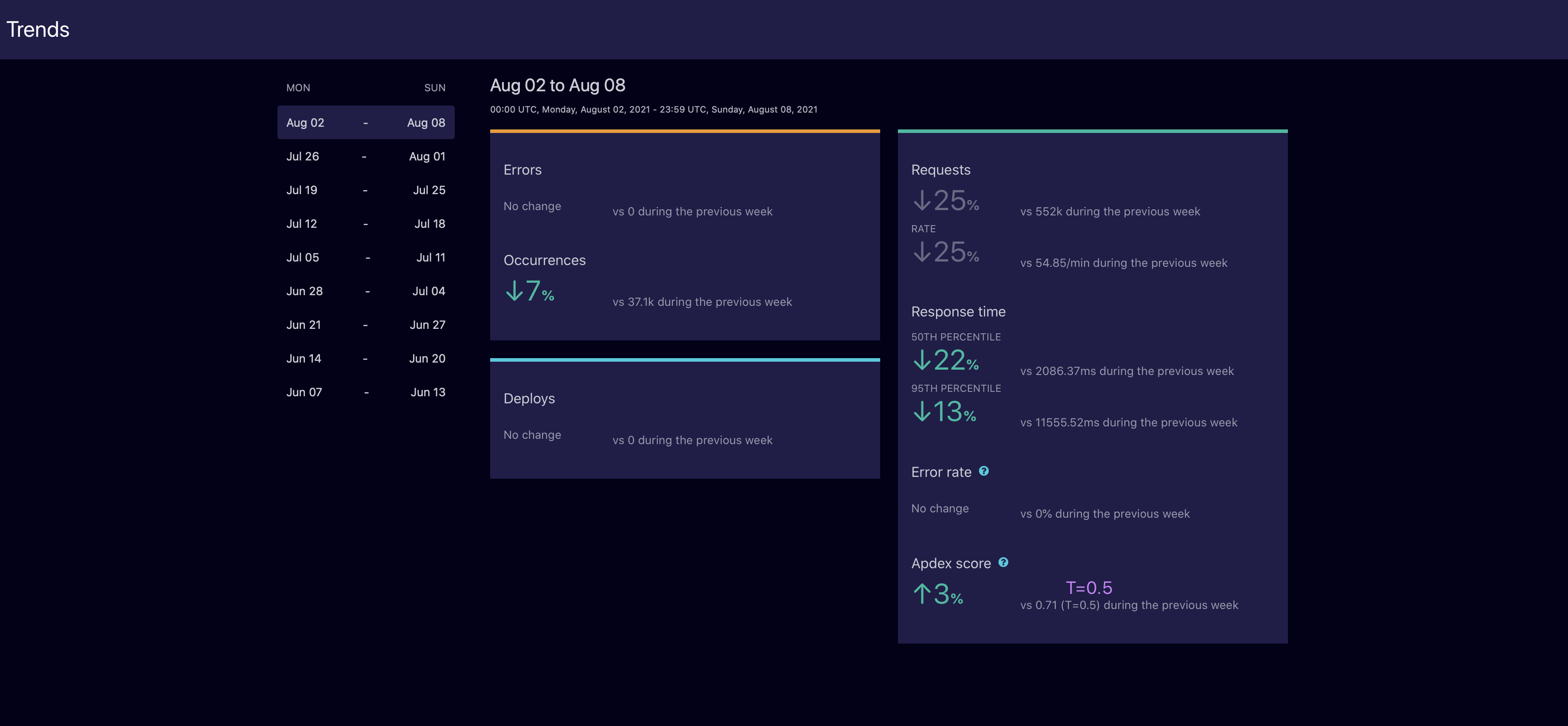
Screenshot of Airbrake Account DashboardScreenshot of Deploys DashboardScreenshot of Performance DashboardScreenshot of Trends TabScreenshot of Breadcrumbs feature

Datadog Screenshots

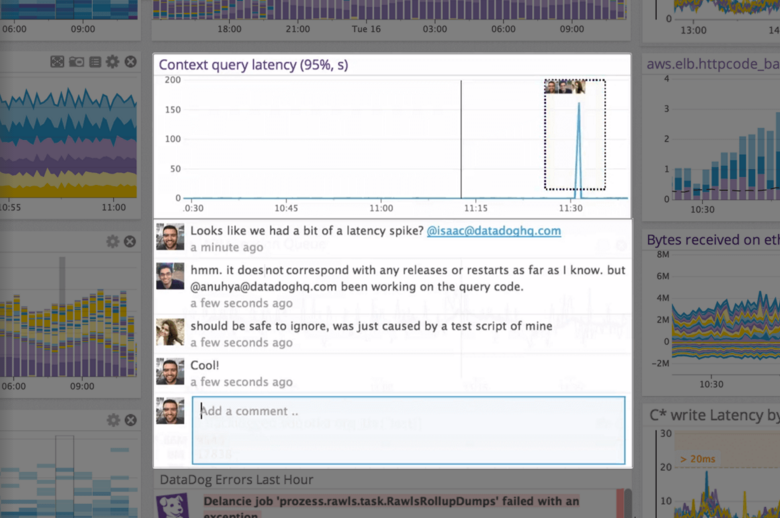
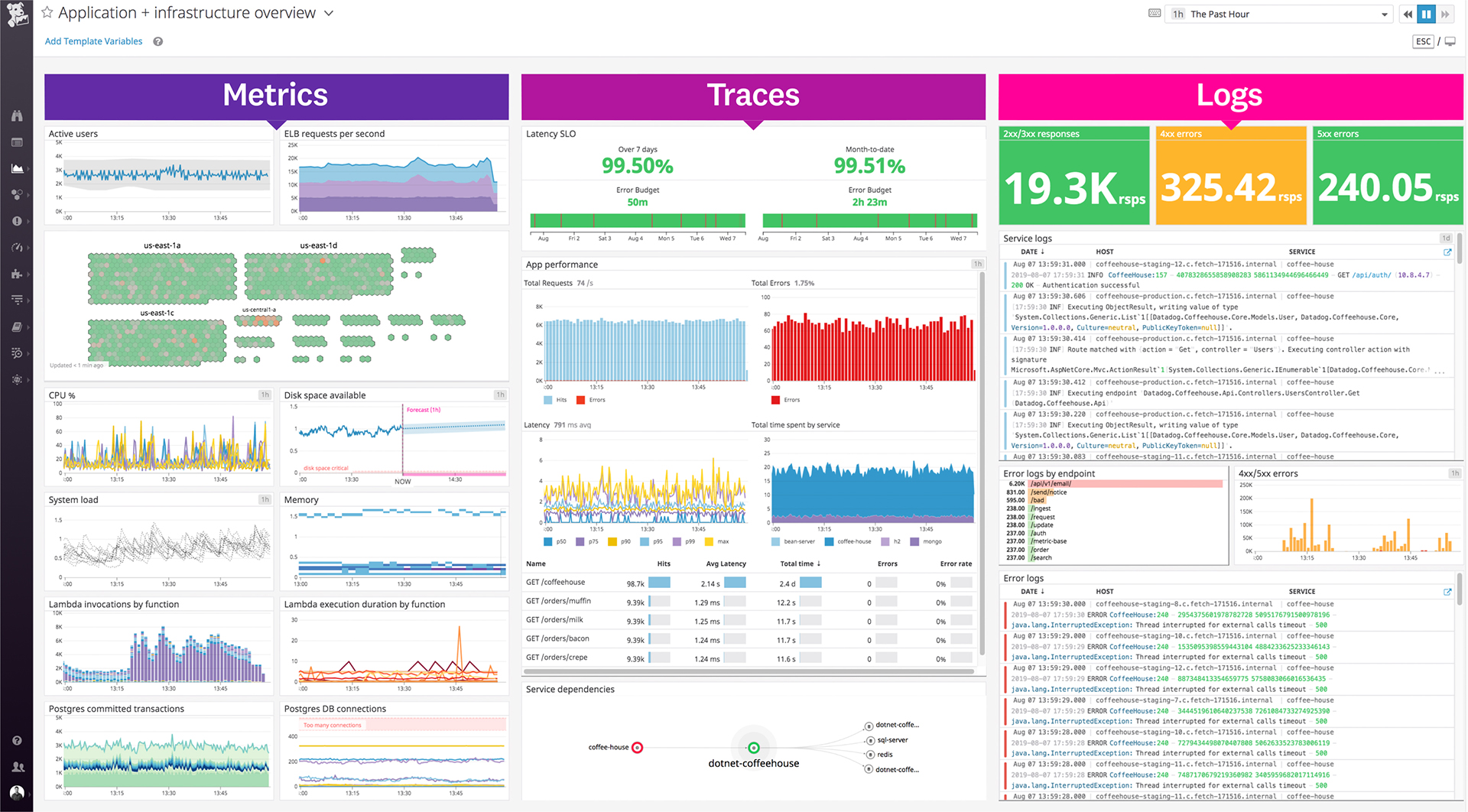
Screenshot of the out-of-the-box and customizable monitoring dashboards.Screenshot of Datadog's collaboration features, where users can discuss issues in-context with production data, annotate changes and notify their teams, see who responded to that alert before, and discover what was done to fix it.Screenshot of where Datadog unifies traces, metrics, and logs—the three pillars of observability.Screenshot of some of Datadog's 400+ built-in integrations.Screenshot of Datadog's Service Map, which decomposes an application into all its component services and draws the observed dependencies between these services in real timeScreenshot of centralized log data, pulled from any source.