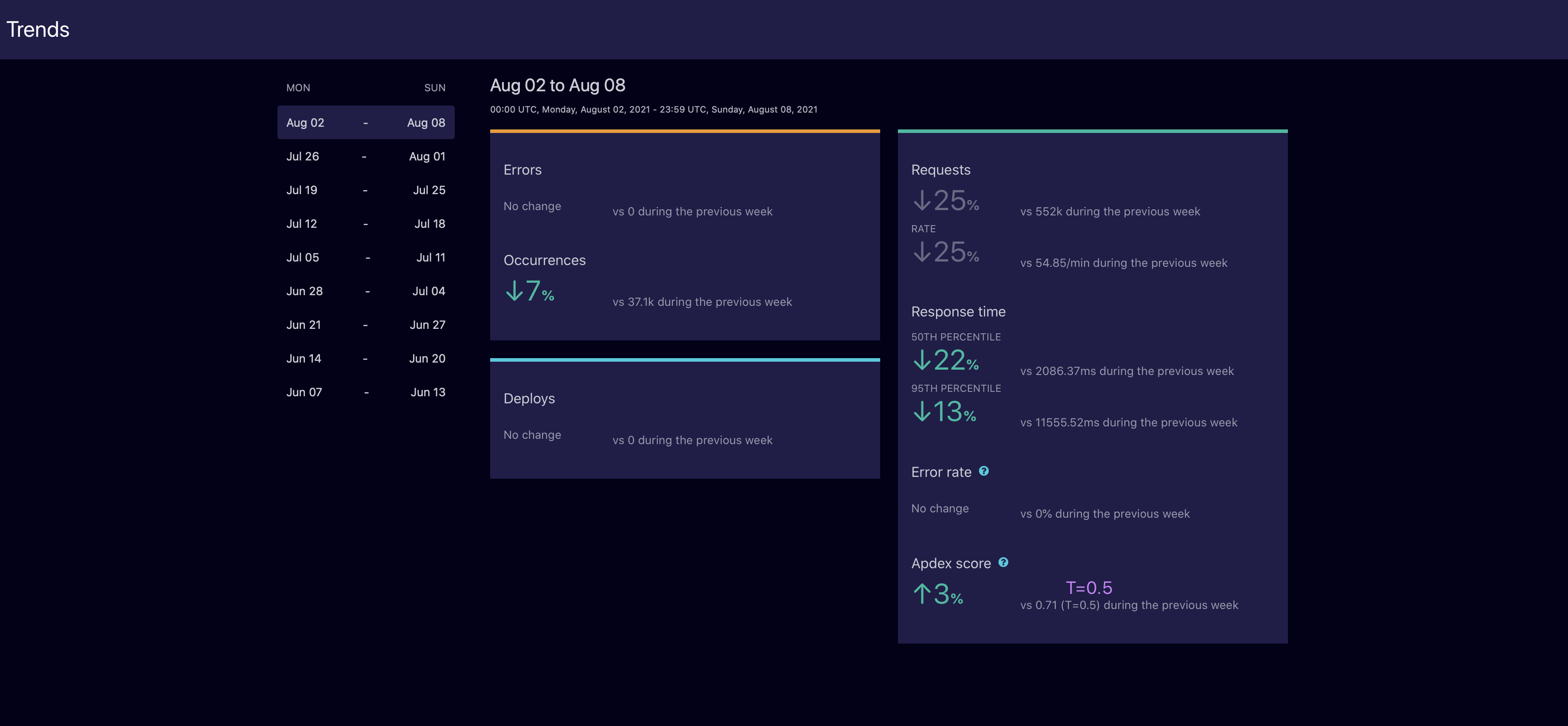
Airbrake, now from LogicMonitor (acquired February 2021) is an error monitoring and performance insight tool. Airbrak offers real-time error alerts, rich contextual data about why errors are occurring, integration into an existing workflow, and application performance insights to enable users to identify, diagnose, and fix problems - before users get annoyed.
$0
per month
Sentry
Score 8.7 out of 10
N/A
Sentry provides engineering teams with tools to detect and solve user-impacting bugs and other issues.
$26
per month
Splunk Observability Cloud
Score 8.4 out of 10
N/A
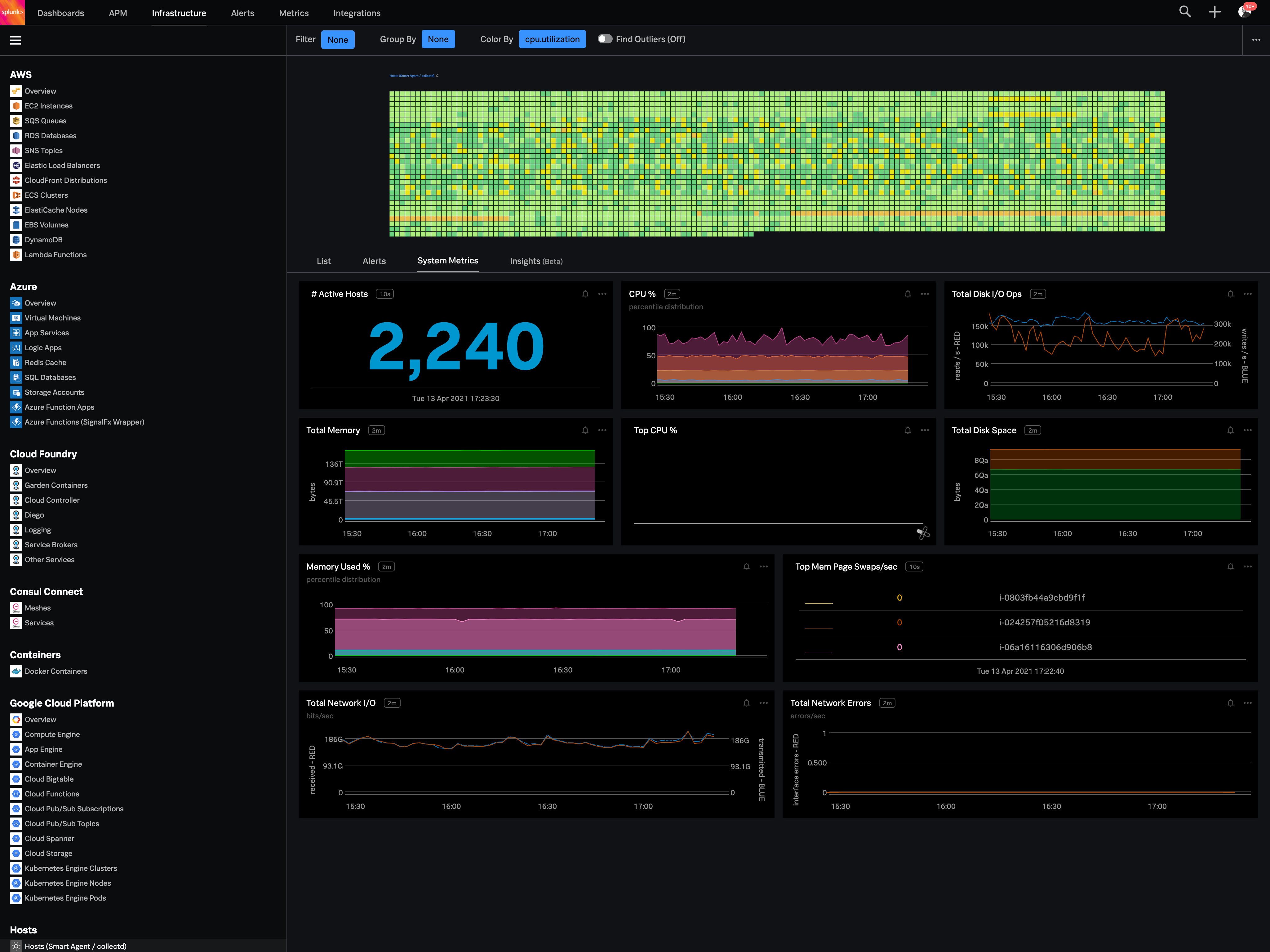
Splunk Observability Cloud aims to enable operational agility and better customer experience through real-time AI-driven streaming analytics allowing accurate alerts in seconds. It is designed to shorten MTTD and MTTR by providing real-time visibility into cloud infrastructure and services.
$180
per year per host
Pricing
Airbrake
Sentry
Splunk Observability Cloud
Editions & Modules
Free
$0
per month
Basic
$19
per month
Pro
$38
per month
Team
$26
per month
Business
$80
per month
Developer
Free
Enterprise
Contact sales team
Infrastructure
$15
per month (billed annually) per host
App & Infra
$60
per month (billed annually) per host
End-to-End
$75
per month (billed annually) per host
Offerings
Pricing Offerings
Airbrake
Sentry
Splunk Observability Cloud
Free Trial
Yes
Yes
Yes
Free/Freemium Version
Yes
Yes
No
Premium Consulting/Integration Services
No
No
No
Entry-level Setup Fee
No setup fee
No setup fee
No setup fee
Additional Details
Airbrake offers plans that include up to 200M errors, plus unlimited on-demand errors. Start your free trial and find the plan that right for your needs. 10% discount available for annual pricing.
I chose Airbrake over Sentry and Rollbar primarily because I’m most familiar with Airbrake, I’ve been using it for many years now so it’s well-established and I know what I’m getting and that it works.
Airbrake boasts a beautiful user interface that gives easy access to features such as intelligent error grouping and application insights, session details, and backtraces. All these allow you to squash those bugs at a much faster pace.
Airbrake is very good at what it does, I don’t really have any criticism at all on that front. It’s less well-suited when bugfixing goes beyond the immediate error and means looking at a lot of context (particularly asynchronous context) like logs.
Great for standard web application performance monitoring, analytics and error reporting. Shows line level code errors, gives insight into performance issues (plugins, API issues, etc.). Automation and scheduled scanning in production gives client visibility into 'after deployment' value. Also lets a relatively small number of developers keep tabs on a handful of different site/applications without needing a bunch of tools. The UI is pretty complicated and can be overwhelming for new users. Documentation could be better for the learning curve,
Its great if you need real-time visibility across complex or regulated environments. Also strong for hybrid or multi-cloud setups where uptime, observability and fast IR are required. It’s probably overkill for smaller teams or environments that don’t have constant changes or compliance reporting needs. It's expensive and has a steep learning curve. Also, in my opinion, do not get yourself into a consumption based model. Costs can certainly get out of control quickly.
Great web interface. Lots of data available in a really clean format, with filtering options and more.
Per-user exception tracking. User is complaining about something being broken? Look up their account ID in Sentry and you can see if they've run into any exceptions (with device information included, of course).
Source map uploading. Took a little while to figure this out but now we have our deploy script upload sourcemaps to Sentry on each deployment, meaning we get to see stack traces that aren't obfuscated!
Very generous free tier – 10,000 events per month. We're nowhere near that yet.
The first one is its Kubernetes container monitoring.
I really like this features because as we know how much K8s is vast and to manually monitor each part of the Kubernetes it takes so much time but Splunk Observability Cloud makes it easier. And even once we integrate K8s with Splunk Observability Cloud it gives us some prebuilt dashboards which gives holistic view of our Cluster and its nodes, pods, etc.
The dashbaord feature of Splunk Observability Cloud, it gives us full flexibility to customize our dashboard with a wide range of predefined chart types.
Now it also supports OTEL, which is a plus point for observability. As now everyone is moving towards Otel and in current market there are only few tools who supports OTEL based integrations, Splunk Observability Cloud is one out of them.
We use Airbrake in conjunction with OpsGenie, but I feel like there could be more room for integration between the two.
I think it would also be nice if there was a GitHub integration that would comment on recently merged error-prone PRs, currently, we need to dig into the error to find the commit.
Generally, more integrations would be nice as people often forget about Airbrake when they are stressed out about an issue.
You can use table-like functionality to generate dashboards, but these queries are heavy on the system.
It could be easier to give insight into what type of line parsing is used for specific documents in a company-managed environment and/or show ways to gain the insights needed.
I would like to see ways to anonymize specific data for shared reports without pre-formatting this in a dashboard on which reports could be based.
Good: Stable system with low error rate Easy to use for simple use cases Bad: UI is not very clear for complex usage Mobile view (when logged in from phone) is bad No library for .net
Its incredibly versatile, but that leads to complexity for the uninitiated, which can be intimidating. Nevertheless its a well polished product, in our case leading to only using it for a focus on frontend is still more cost effective than buying a one-to-rule-them-all tool...
When there is an issue, it’s a win if one can easily identify the root cause. To do the same, it should allow the user to dig deep with multiple data points and compare the data and identify the anomaly. In this use case, it’s good to drive from Splunk 011y.
I love to use Airbrake and New Relic in conjunction. New Relic has better metrics and data that you can really dig into (especially for optimizations), but the error part has always been kinda meh. I fee like Airbrake has done an awesome job at this
It is cheaper and offers better support for front-end applications for enterprise large environments with more then 30 scrum teams and hundreds of micro frontend applications. The configuration options, both with the agent and from the user interface, are superior to other tools, and the documentation is also very easy to use.
Splunk Infrastructure Monitoring provides far superior options for anybody using a complex hybrid multi-cloud environment and allows both your SOC and NOC to work together on the same data while driving their own insights. We found other products are still in the old world view of servers and agents residing together within a single data centre, but modern apps are no longer like this.