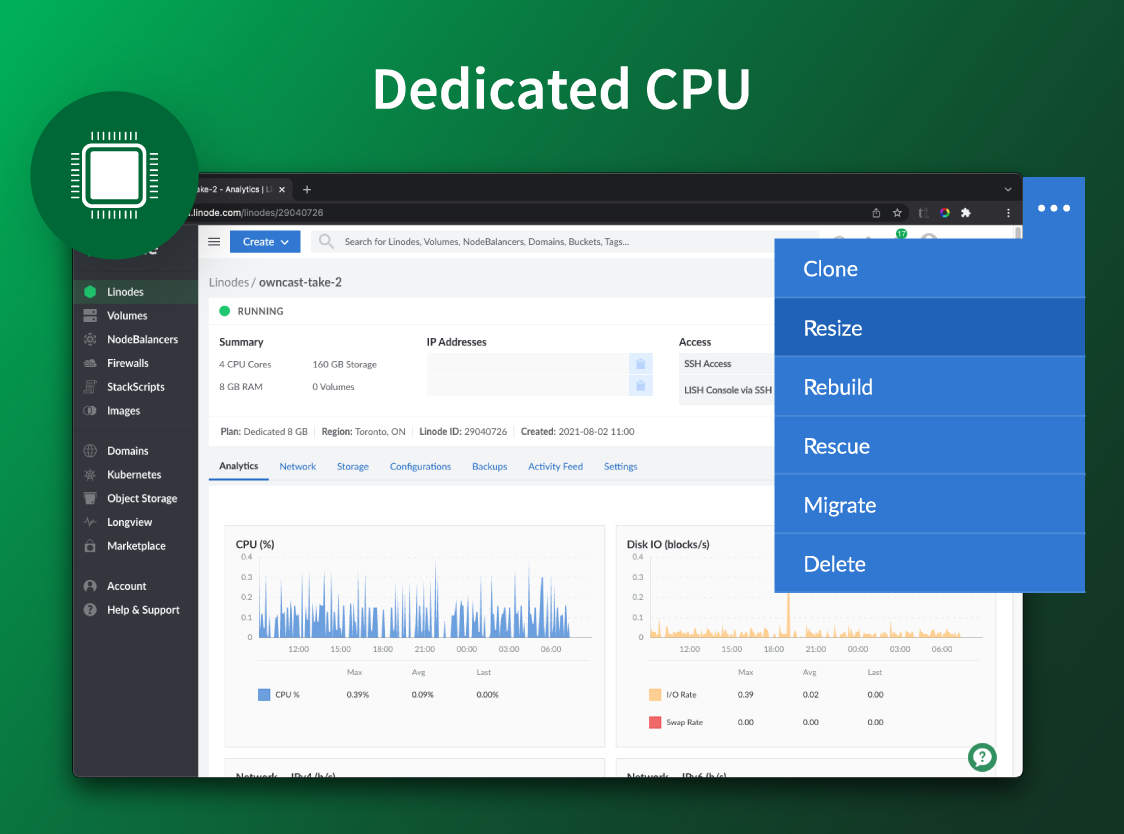
Akamai Cloud Computing (formerly Linode) include scalable and accessible Linux cloud solutions and services. These products and services support developers and enterprises as they build, deploy, secure, and scale applications.
$5
per month
Verizon Cloud Portfolio
Score 7.0 out of 10
N/A
The Verizon Cloud is a cloud storage solution, integrating technologies from CloudSwitch (acquired in 2011).
N/A
Pricing
Akamai Cloud Computing
Verizon Cloud
Editions & Modules
No answers on this topic
No answers on this topic
Offerings
Pricing Offerings
Akamai Cloud Computing
Verizon Cloud Portfolio
Free Trial
Yes
No
Free/Freemium Version
No
No
Premium Consulting/Integration Services
Yes
No
Entry-level Setup Fee
Optional
No setup fee
Additional Details
CPU, transfer, storage, and RAM are bundled into one price. Storage capacity can be increased with additional Block Storage or S3-compatible Object Storage. Instant Backups can be added with complete independence to the stack. Linode NodeBalancers ensure applications are available.
—
More Pricing Information
Community Pulse
Akamai Cloud Computing
Verizon Cloud
Features
Akamai Cloud Computing
Verizon Cloud
File Sharing & Management
Comparison of File Sharing & Management features of Product A and Product B
Akamai Cloud Computing
-
Ratings
Verizon Cloud
6.9
2 Ratings
19% below category average
Video files
00 Ratings
7.42 Ratings
Audio files
00 Ratings
5.62 Ratings
File search
00 Ratings
6.72 Ratings
Device sync
00 Ratings
8.02 Ratings
Cloud Storage Security & Administration
Comparison of Cloud Storage Security & Administration features of Product A and Product B
Akamai Cloud Computing
-
Ratings
Verizon Cloud
6.8
2 Ratings
24% below category average
User and role management
00 Ratings
7.02 Ratings
File organization
00 Ratings
7.02 Ratings
Device management
00 Ratings
6.32 Ratings
Cloud Storage Platform
Comparison of Cloud Storage Platform features of Product A and Product B
Akamai Connected Cloud Linode would be a good service to host a content delivery network (CDN) because of its edge network but I'd prefer not to use Akamai Connected Cloud Linode for tasks that need GPU power such as Machine Learning or Artificial Intelligence (AI) because Akamai Connected Cloud Linode lacks deep GPU compute compared to AWS or Google Cloud or Microsoft Azure
I think this service works very well for me, but I have been a Verizon customer for almost 15 years. If you are someone who hops carriers it may not be the best fit. I also like that you can easily use it with all of your employees regardless if they prefer Android or Apple phones. (Whereas using Apple's or Google's services may not work seamlessly for all phones.) I think it still has room for improvement, and sometimes I worry about the longevity of utilization due to the nature of cell phone carriers constantly changing prices, plans, and every option under the sun to make a buck that we could be very screwed in the future if Verizon does something stupid (because historically, they all have)
The home screen shows a little bit of everything, but being a control freak, I would like to be able to customize it. (Granted, it would most likely have most of the same elements, but, for example, I don't need photos scrolling across the top. I'd rather have buttons like quick links to jump directly to what I want or to see a further bird's eye view of the content.
I like receiving notifications that a back-up is complete, but I would like to be able to set what other notifications are and aren't allowed to push to my phone.
I have set Verizon Cloud to back up on wifi OR using the data network. But if you are using wifi while doing a content restore and you lose that connection, either by leaving the building or the local wifi dropping out momentarily, the entire content restore will stop and need to be restarted. This can be very frustrating.
I've been with them a long time. They provide me with the capabilities I need coupled with knowledgeable support that's not pay-for-extra. However, if I move to a non-Linux OS, the level of support by necessity will drop off. I can still ask questions about the infrastructure but I my ability to ask about OS features will decrease.
Simple and clear, no BS interface. From a design perspective it's no Apple or Stripe, but it does what it needs without making me want to stick a fork in my eyes, like when being forced to use Azure, AWS or GCP.
There is very little planned downtime. Whenever planned downtime is necessary I'm always given lots of advanced notice and an explanation that I can pass along to my users that they'll understand. I really appreciate that Linode appreciates my commitment to reliable service to my users. It shows that they believe they've been successful when I'm successful.
Servers are well dimensioned and price performant. Of course one always wants more, so if they were to upgrade their hardware for the same price I'd consider moving more workloads. Networking - never had an issue. Hardware speeds - disks are fast and can grow to great size.
Support was excellent and fast. The documentation is extensive and helpful. I learned many things from their online documentation. I did not contact them by phone, but email took a day or less. Complex problems would probably need a service contract. I liked the friendly and polite tone of the support.
We got kick started with an initial walkthrough along with some free credits. The initial walkthrough helped us to understand Linode's ecosystem and start our hands on with Linode. We tried out some apps from Marketplace initially with the free credits, which not only helped us understand Linode better, but also those apps. We had implemented many such apps to our customers with Linode
We're a small organization. The implementation of our Linode solution was trivial. Once I justified a cloud server to my bosses over a co-location -- the co-lo wasn't as fast as our linode server in load tests -- it was a matter of moving one Linux implementation to another. Trivial.
We switched to Linode from Namecheap due to poor uptime, and never had any issues with stability ever again after switching. We also cut our costs in half by switching. We compared Linode to DigitalOcean and Vultr, with the primary factor that caused us to go with Linode initially being their documentation. After using Linode for 3 years, their amazing support is another reason why we wouldn't consider anyone else at this point.
All of the others provide more free storage. Verizon should out best or at least equal the best when you are already a Verizon data subscriber. It seems that by not doing this that they want to "nickle-and-dime" their already loyal customer base
Although I use only a fraction of their product offerings, the total set makes scalability an easy goal to shoot for. As I said, I have a few customers that use the services my Linode provides...and I like it that way. However, should I need to scale up, I can...without incurring any more cost than I need to.
Thus far is has been a positive experience, and has saved a lot of man hours of both employees who replaced their phones to the IT department trying to help them put everything back no longer needs to go through a lengthy process.
The cost of this option is a bit higher than I'd like. I think Verizon is a little too proud of a product that every company is now starting to offer.
There is a free version with limited space, so at least trying it out to see how it will fit with your needs isn't much of a risk.