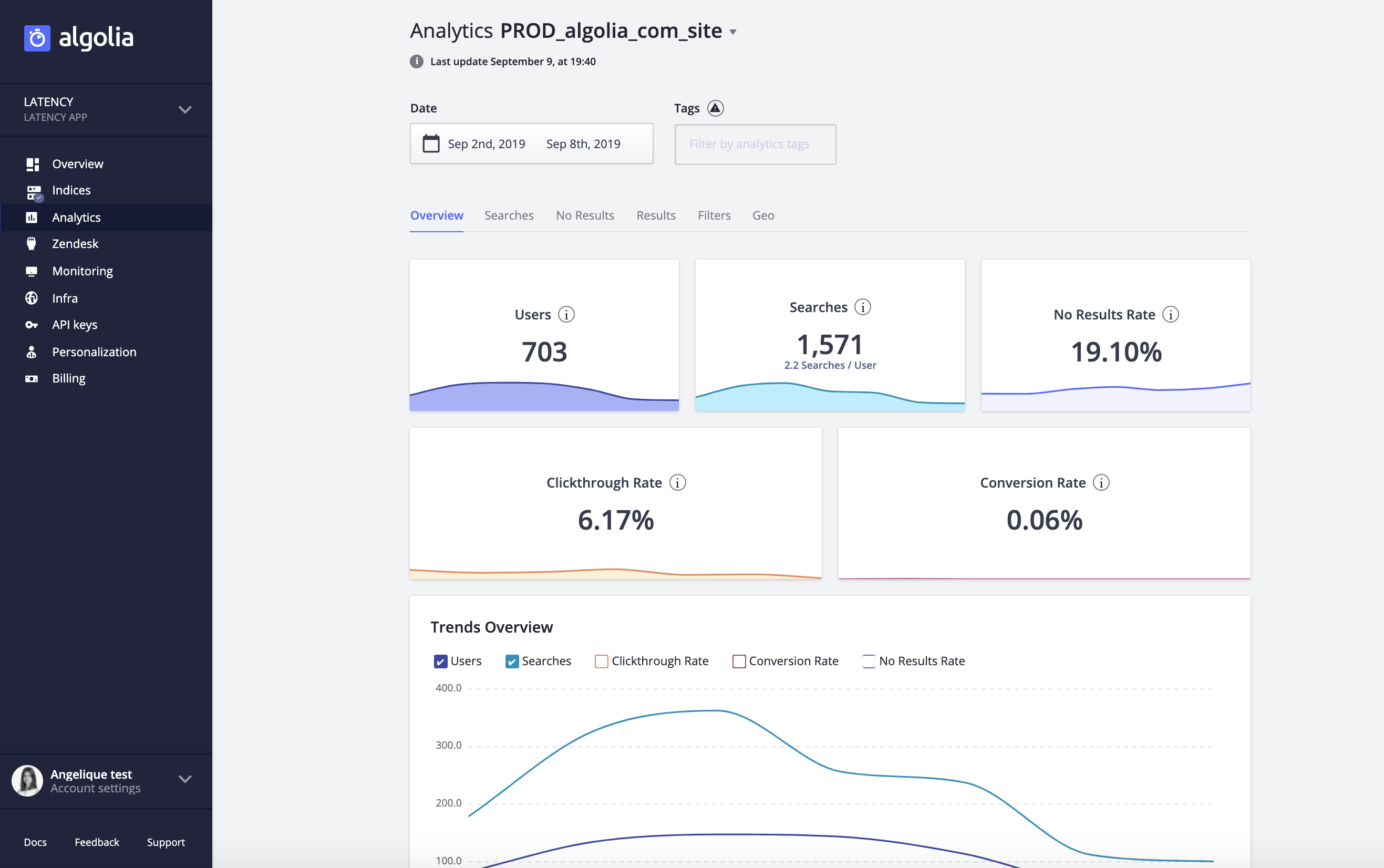
Algolia offers AI-powered solutions to improve online search and discovery experiences, with tools for business teams and APIs for developers that help to improve user engagement and conversions across websites, apps, and e-commerce platforms.
$0
for 10k search requests + 100k records per month
Wyng
Score8.8 out of 10
Enterprise companies (1,001+ employees)
Wyng is used to build interactive digital experiences that engage customers at the right moments, collect their preferences and other zero-party data, and personalize their website experiences in real time. Whether the experience is a product finder quiz, promotion, or preference center, Wyng experiences are designed to be well-timed and user-friendly while offering genuine value to consumers.
N/A
Pricing
Algolia
Wyng
Editions & Modules
Build
Free
Up to 10,000 search requests + 1 Million records
Grow Plus
Free to start, then pay-as-you-go
10,000 search requests/month and 100,000 records included; $1.75 per additional 1K search requests and $0.40 per additional 1K records
Grow
Free to start, then pay-as-you-go
10,000 search requests/month and 100,000 records included; $0.50 per additional 1K search requests and $0.40 per additional 1K records
Elevate
custom
per year
Elevate
Custom
Custom Custom search requests and records; volume-based discounts available
No answers on this topic
Offerings
Pricing Offerings
Algolia
Wyng
Free Trial
Yes
Yes
Free/Freemium Version
Yes
No
Premium Consulting/Integration Services
Yes
Yes
Entry-level Setup Fee
Optional
No setup fee
Additional Details
Pay as you go, scale instantly, or upgrade anytime for advanced features and capabilities.
Algolia is perfect if you need an excellent search engine and want to transfer your PLP management (browsing) to a third party. Algolia is good at mixing products, user behavior, interests, and business rules. Maybe it's less appropriate if you are using an all-in-one e-commerce platform where you get a good search engine or a marketing platform that also connects other features like a client database, first-party data, recommendation services, etc., all included in the same bill/integration.
A de minimis incentive was given to thank the reviewer for their time. The incentive was not used to bias or drive a particular response, nor was the incentive contingent on a positive endorsement. TR verified that a representative sample of customers was invited. More Info
They have a variety of offerings so the best approach is to have a clear idea of what type of results you're looking to achieve. They can offer advice on which modules will help you achieve those goals.
Users get instant feedback as they type, even with complex filters like brand, model, price range, and financing eligibility. This speed significantly improves engagement and reduces bounce.
A user searching for “Camry 2020” or even “Camary 20” still sees relevant Toyota Camry listings from 2020. This reduces friction, especially on mobile where spelling errors are common.
Algolia handles multi-faceted filters efficiently. For example, a user can filter by location, transmission type, color, or inspection status without any lag.
We fine-tune the ranking of search results based on what matters to our business—like prioritizing cars with higher margins or better availability in key cities.
We can experiment with different ranking formulas or UI variations to improve KPIs like lead conversion or time-to-first-interaction.
A de minimis incentive was given to thank the reviewer for their time. The incentive was not used to bias or drive a particular response, nor was the incentive contingent on a positive endorsement. More Info
A de minimis incentive was given to thank the reviewer for their time. The incentive was not used to bias or drive a particular response, nor was the incentive contingent on a positive endorsement. More Info
Better integration of features (ex. synonyms feature is great but isn't respected by their re-ranking product)
Tooling to reduce spam search queries being triaged by system/logged to analytics panels
More automated summaries of analytics (ie. recommend synonyms to add, trends noticed in search volume in specific areas of site, easier ways to leverage API vs using website UI)
A de minimis incentive was given to thank the reviewer for their time. The incentive was not used to bias or drive a particular response, nor was the incentive contingent on a positive endorsement. More Info
My role is mostly involved with social media analytics; measuring campaigns. Offerpop could improve in how they track views. I would like to see the number of views and unique views captured each day versus just the total number of views since the start of the campaign.
For our Facebook sign up campaigns, I would like to see more reporting on the information captured in the form fields. For example: the total number of entries, unique entries, bounce rate (how many people viewed the form but didn't complete/submit it).
In addition, I would like to see reporting on how some of our questions within the lead form were answered. The number of entrants who selected various options from our drop down lists.
After working 8 years and through 100+ implementations on international sites, Algolia beats the alternatives on several grounds. It offers a fair price that brings a ROI ; It has the financial backbones and the interest in investing in R&D more than any other competitors. It is a true specialized and not an add-on, and thus benefits from a very strong engineering and innovative approach. The tool is very reliable and fast
A de minimis incentive was given to thank the reviewer for their time. The incentive was not used to bias or drive a particular response, nor was the incentive contingent on a positive endorsement. TR verified that a representative sample of customers was invited. More Info
I dont get a lot of great feedback from our social media department. I dont think the issues and concerns where addressed in detail before signing up and before launch
Most of the setup is easy enough if you have some technical/web dev/IT background, but once it's set up, you can have end/power users maintain some settings, like adding search terms. Algolia is a powerful search tool and integrates easily with Shopify.
A de minimis incentive was given to thank the reviewer for their time. The incentive was not used to bias or drive a particular response, nor was the incentive contingent on a positive endorsement. TR verified that a representative sample of customers was invited. More Info
A de minimis incentive was given to thank the reviewer for their time. The incentive was not used to bias or drive a particular response, nor was the incentive contingent on a positive endorsement. TR verified that a representative sample of customers was invited. More Info
Performance is always a major concern when integrating services with our client's websites. Our tests and real-world experience show that Algolia is highly performant. We have more extremely satisfied with the speed of both the search service APIs and the backend administrative and analytic interface.
A de minimis incentive was given to thank the reviewer for their time. The incentive was not used to bias or drive a particular response, nor was the incentive contingent on a positive endorsement. More Info
It’s non existent. No tech support and no customer service… my application was blocked and is currently inactive causing huge business disruption, and I’m still waiting days later for a response to an issue which could be resolved very very quickly if only they would respond. Very poor from a company of that size
Algolia gives way more control for a non-developer than AWS Elasticsearch Service. Previously we'd have to have our developers make adjustments to site search relevancy, typos, prioritizing certain attributes over others, etc. but now the marketing and website team can do that themselves in the Algolia dashboard
A de minimis incentive was given to thank the reviewer for their time. The incentive was not used to bias or drive a particular response, nor was the incentive contingent on a positive endorsement. More Info
While Rafflecopter was free to use, I didn't like the bulky box that sat in the middle of our web pages. Wildfire rates were just too high to justify continuing to use them, especially as OfferPop interface was so simple and streamlined
Algolia has been a consistent product that works flawless with very few errors or downtime. With the plan options it’s very easy for us to scale especially with this usage pricing. We have 100% gotten our ROI on this product.
A de minimis incentive was given to thank the reviewer for their time. The incentive was not used to bias or drive a particular response, nor was the incentive contingent on a positive endorsement. TR verified that a representative sample of customers was invited. More Info
Users who had abandoned our product (attributing slow search speeds as the reason) returned to us thanks to Algolia
We used Algolia as our product's backbone to relaunch it, making it the center of all search on our platform which paid off massively.
Considering we relaunched our product, with Aloglia functioning as its engine, we got a lot of press coverage for our highly improved search speeds.
One negative would be how important it is to read the fine print when it comes to the technical documentation. As pricing is done on the basis of records and indexes, it is not made apparent that there is a size limit for your records or how quickly these numbers can increase for any particular use case. Be very wary of these as they can quite easily exceed your allotted budget for the product.
A de minimis incentive was given to thank the reviewer for their time. The incentive was not used to bias or drive a particular response, nor was the incentive contingent on a positive endorsement. More Info