AppFog was a cloud-agnostic application and infrastructure management platform used to manage workloads across on-premises and third-party cloud environments. It has been discontinued.
$0
BMC FootPrints
Score 8.2 out of 10
N/A
BMC FootPrints is an IT service management (ITSM) solution featuring workload automation.
N/A
Splunk Observability Cloud
Score 8.4 out of 10
N/A
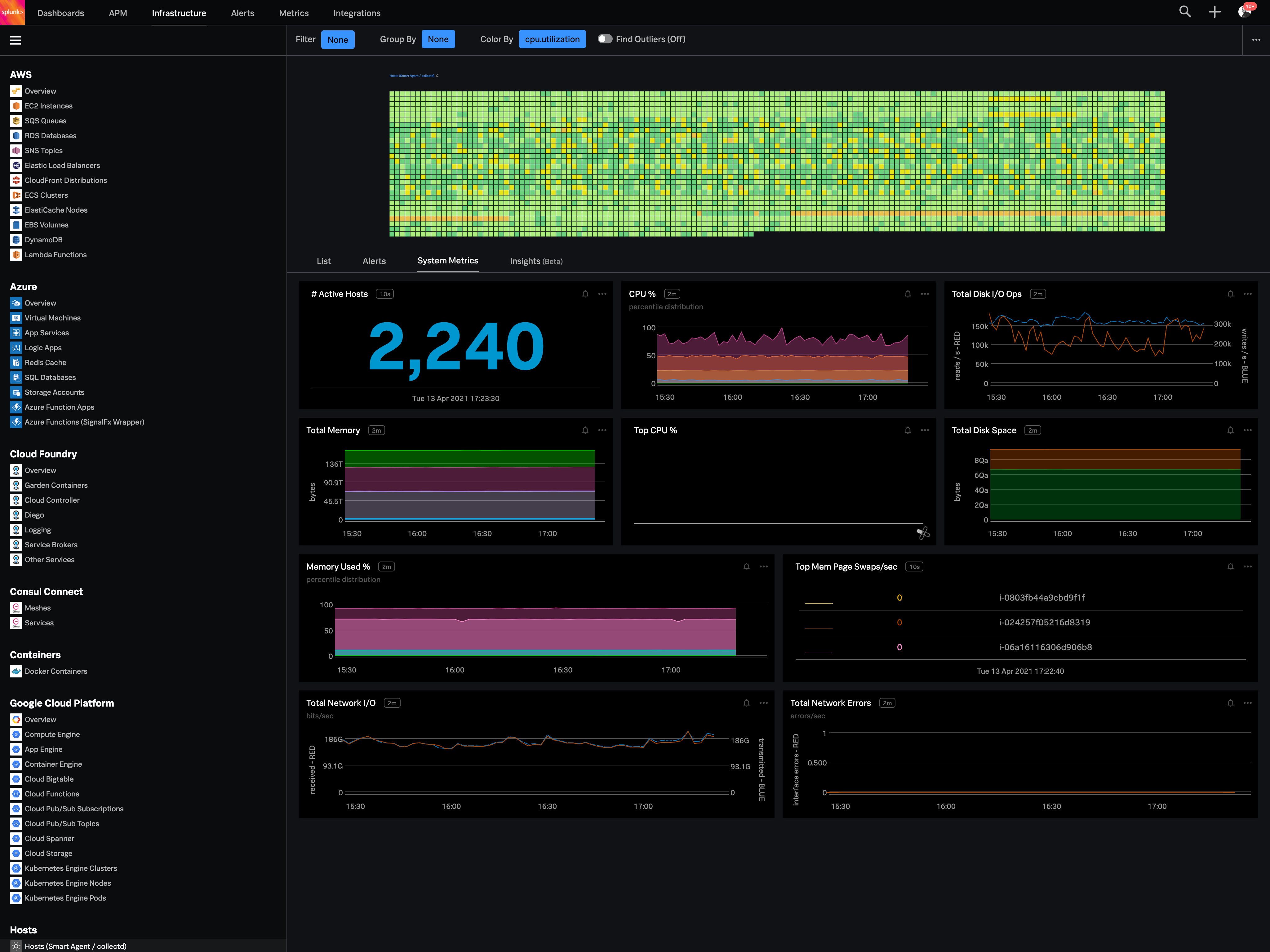
Splunk Observability Cloud aims to enable operational agility and better customer experience through real-time AI-driven streaming analytics allowing accurate alerts in seconds. It is designed to shorten MTTD and MTTR by providing real-time visibility into cloud infrastructure and services.
It was very good to use in small scale projects. Considering the high end projects with many instances and multi-platform architectures, it is better to test before the application is deployed. I think few of the questions can be general - who are the system users and what size is the application focussing on? How much resources are required? Will the application require any additional services?
BMC Footprints is so well suited to keep the documentation easy to read and find, as same as typification. You can find specific documentation for an audit so fast and export a report using the specific criteria that you need to comply with your boss or audit needs. As I told before, BMC footprints need to be more friendly to the end users because they get lost many times trying to track some ticket or typing documentation.
Its great if you need real-time visibility across complex or regulated environments. Also strong for hybrid or multi-cloud setups where uptime, observability and fast IR are required. It’s probably overkill for smaller teams or environments that don’t have constant changes or compliance reporting needs. It's expensive and has a steep learning curve. Also, in my opinion, do not get yourself into a consumption based model. Costs can certainly get out of control quickly.
Documentation. We try to reduce the amount of paperwork needed for staff to do their job, so by automating certain tasks, we are able to speed up the resolution process for trouble tickets.
Reporting. We'll use the reporting tool to get the number of tickets opened, response times and can go into granular reports.
Surveys. When tickets are closed, we automatically send out surveys to end users to get valuable feedback on how we did and what we can improve.
The first one is its Kubernetes container monitoring.
I really like this features because as we know how much K8s is vast and to manually monitor each part of the Kubernetes it takes so much time but Splunk Observability Cloud makes it easier. And even once we integrate K8s with Splunk Observability Cloud it gives us some prebuilt dashboards which gives holistic view of our Cluster and its nodes, pods, etc.
The dashbaord feature of Splunk Observability Cloud, it gives us full flexibility to customize our dashboard with a wide range of predefined chart types.
Now it also supports OTEL, which is a plus point for observability. As now everyone is moving towards Otel and in current market there are only few tools who supports OTEL based integrations, Splunk Observability Cloud is one out of them.
Purpose based configuration- It would be beneficial to see a more purposed based, out of the box, configuration option. For example, if you need PCI compliance, more intuitive reporting would make managing compliance much easier.
Initial design and implementation- Don't think that your experience as an IT professional will allow you to stand this system up on your own. To properly configure Footprints and set yourself up for success down the road, get Professional Services with this one.
Somewhat behind the times- Service Core is making a huge leap forward with the latest version, 12, but Asset Core is far behind. There are quite a few quirks to how the application works and how it is used.
You can use table-like functionality to generate dashboards, but these queries are heavy on the system.
It could be easier to give insight into what type of line parsing is used for specific documents in a company-managed environment and/or show ways to gain the insights needed.
I would like to see ways to anonymize specific data for shared reports without pre-formatting this in a dashboard on which reports could be based.
It has been the business decision to go with them and that is what we will do. Going back, this would have not been the choice, but nothing can be done about it now. We are stuck with this application for years to come. Wish there were other possibilities that could be done.
Good: Stable system with low error rate Easy to use for simple use cases Bad: UI is not very clear for complex usage Mobile view (when logged in from phone) is bad No library for .net
It's so simple to use and customize however you want. You can create new workspaces and workflows with ease, set up new users, incoming email rules, customize the layout of the forms, and even change the colors and logos. It's just very easily customizable overall. It's also really straightforward to figure out how to use, you really almost don't have to show somebody how to use it. If you just sit them down in front of it and let them look it over, they could figure it out themselves easily.
When there is an issue, it’s a win if one can easily identify the root cause. To do the same, it should allow the user to dig deep with multiple data points and compare the data and identify the anomaly. In this use case, it’s good to drive from Splunk 011y.
I've had no issues with the support for FootPrints. We haven't really had to use them all that much over the years, but when needed they have always been prompt and knowledgeable at dealing with any issue. I've worked with a lot of different support teams over the years, and they have been one of my favorites to work with.
Primarily because it used to have a good free tier earlier, which it does not anymore. It's simple, and things are available to use. Compared to it's competitors, it does has less features, but that kind of acts in its favor. That adds to the simplicity, and ease of use for a new user.
I was not involved in the selection process but in my opinion either SQL or Access databases would have worked just as well without the same amount of cost. These two systems would have been much easier to manage and would have tracked the same information in a less convoluted process and expense.
Splunk Infrastructure Monitoring provides far superior options for anybody using a complex hybrid multi-cloud environment and allows both your SOC and NOC to work together on the same data while driving their own insights. We found other products are still in the old world view of servers and agents residing together within a single data centre, but modern apps are no longer like this.