Aptible Deploy (formerly Aptible Enclave) is a container orchestration platform built for developers that automates security best practices and controls needed for deploying and scaling Dockerized apps in regulated industries. Aptible Deploy is ISO 27001-certified and can be used to support requirements for HIPAA, ISO 27001, SOC 2, NIST 800-53, and other frameworks.
N/A
Heroku Platform
Score 7.8 out of 10
N/A
The Heroku Platform, now from Salesforce, is a platform-as-a-service based on
a managed container system, with integrated data services and ecosystem for deploying modern apps. It takes an app-centric
approach for software delivery, integrated with developer tools and
workflows. It’s three main tool are: Heroku Developer Experience (DX), Heroku
Operational Experience (OpEx), and Heroku Runtime.
Heroku Developer Experience (DX)
Developers deploy directly from tools like…
$85
per month
Splunk Observability Cloud
Score 8.4 out of 10
N/A
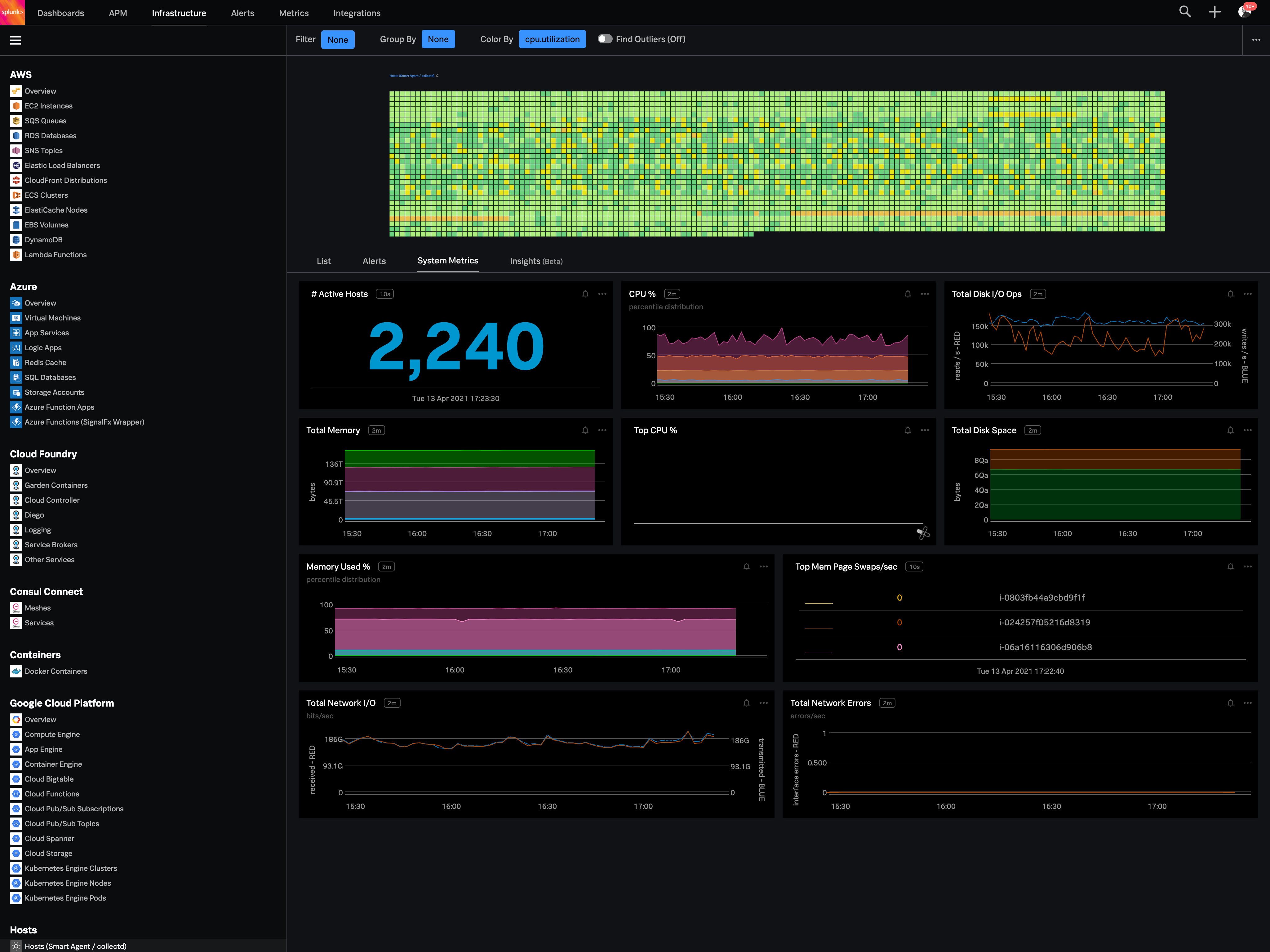
Splunk Observability Cloud aims to enable operational agility and better customer experience through real-time AI-driven streaming analytics allowing accurate alerts in seconds. It is designed to shorten MTTD and MTTR by providing real-time visibility into cloud infrastructure and services.
Aptible is basically like Heroku for highly regulated environments. It's not quite as mature a product as Heroku in terms of a broad feature set. Still, for most applications, it will have the necessary features, along with automatic compliance controls.
For a different project, Aptible surpassed Heroku when it came to meeting HIPAA-related requirements, though it offers much less flexibility with add-on services (for obvious reasons). Google App Engine had a much more complicated deployment model and seemed unnecessarily …
I would recommend Aptible Deploy to my colleagues because of its responsiveness and efficiency for environment and application provisioning. The product is extremely useful for creating health applications due to its built-in security and compliance protocols for HIPAA and HITRUST. The automated database backups were also a nice touch for failover scenarios, as is the included horizontal scaling. The horizontal scaling automatically defaults toward high availability as well.
Heroku is very well suited for startups looking to get a server stack up and running quickly. There is little to no overhead when managing your instances. However, you'll need a background in basic DevOps or system management to make sure everything is set up correctly. In addition, it's easy to accidentally go crazy on pricing. Make sure you're only creating the server instances you need to run the base application and set up an auto-scaler plugin to handle peaks.
Its great if you need real-time visibility across complex or regulated environments. Also strong for hybrid or multi-cloud setups where uptime, observability and fast IR are required. It’s probably overkill for smaller teams or environments that don’t have constant changes or compliance reporting needs. It's expensive and has a steep learning curve. Also, in my opinion, do not get yourself into a consumption based model. Costs can certainly get out of control quickly.
Heroku has a very simple deployment model, making it easy to get your application up-and-running with minimal effort. We can focus on our efforts the unique aspects of our application.
The robust add-on marketplace makes it easy to try out new approaches with minimal effort and investment -- and when we settle on a solution, we can easily scale it.
Heroku's support is quite good -- their staff is quite technical and willing to get into the weeds to diagnose even complicated problems.
The first one is its Kubernetes container monitoring.
I really like this features because as we know how much K8s is vast and to manually monitor each part of the Kubernetes it takes so much time but Splunk Observability Cloud makes it easier. And even once we integrate K8s with Splunk Observability Cloud it gives us some prebuilt dashboards which gives holistic view of our Cluster and its nodes, pods, etc.
The dashbaord feature of Splunk Observability Cloud, it gives us full flexibility to customize our dashboard with a wide range of predefined chart types.
Now it also supports OTEL, which is a plus point for observability. As now everyone is moving towards Otel and in current market there are only few tools who supports OTEL based integrations, Splunk Observability Cloud is one out of them.
Large price jumps between certain resource tiers (2x Dyno for $50 per month versus Performance Dyno for $250). Free Postgres next jumps to $50 per month.
Marketing/Branding to non-technical stakeholders. As the years pass, I've had to fight more to convince stakeholders on the value of Heroku over AWS.
Improve Buildpack documentation. This is one area where Heroku's documentation is fairly confusing.
You can use table-like functionality to generate dashboards, but these queries are heavy on the system.
It could be easier to give insight into what type of line parsing is used for specific documents in a company-managed environment and/or show ways to gain the insights needed.
I would like to see ways to anonymize specific data for shared reports without pre-formatting this in a dashboard on which reports could be based.
Heroku is easy to use, services a ton of functions for you out of the box, and provides a means to get a software product off the ground and managed quickly and easily. The tools provide allows a small to medium size org to move very quickly. The CLI tools provided make managing an entire technical infrastructure simple.
Good: Stable system with low error rate Easy to use for simple use cases Bad: UI is not very clear for complex usage Mobile view (when logged in from phone) is bad No library for .net
Easy to use web based console and easy to use command line tools; deployment is done directly from a GIT repository. What more could you ask for? The one thing that keeps me from giving it a 10 is that custom build packs are almost incomprehensible. We used one for a while because we needed cairo graphics processing. Fortunately, I was able to figure out a different way to do what we needed so that we could get off the custom build pack.
When there is an issue, it’s a win if one can easily identify the root cause. To do the same, it should allow the user to dig deep with multiple data points and compare the data and identify the anomaly. In this use case, it’s good to drive from Splunk 011y.
Heroku availability correlates pretty strongly to AWS US EAST availability. We had a couple of times where there was a Heroku-specific issue but not for the last 7-8 months.
I've used it for many years without facing any major problem. It's not hard at all to get used to it, it's documentation is outstanding and simple. We are close to 2020 and I don't think most of the existing companies or startups should still face old problems such as wasting time deploying code and calculate computing resources.
Be ready to pay a bit more than expected in the beginning if you're migrating from a big server. The application is probably not ready for the change and you have to keep improving it with time.
It's also important to consider that you can't save anything to the disc as it will be lost when your application restarts, so you have to think about using something like S3.
Aptible makes managing HIPAA/HITRUST compliance simpler when compared to Microsoft Azure. Passing audits is technically easier when using Aptible. Aptible provides a log drain to deliver logs via Syslog or HTTPS for long-term log storage. Microsoft Azure does not have a portal specifying when controls are in place, something which Aptible does.
Heroku is the more expensive option for hosting compared to some of the cloud platforms we investigated, but it's worth it for us because of the plug-and-play nature of Heroku deployment. We can be up and running in a few minutes and know with precision how much it will cost us each month to run the application, unlike Amazon Web Services where you have to go to great pains to configure it correctly or else you might end up with a shocking monthly bill. Overall, spending the time to configure Amazon Web Services or one of its competitors is likely the more affordable and powerful choice, because you have control over so many specifics of the configuration. But it also requires the burden of continuing to maintain and update your AWS instance, whereas with Heroku they take care of security fixes and platform upgrades. It's a great service and we are happy to pay the extra cost for the value-adds Heroku provides.
Splunk Infrastructure Monitoring provides far superior options for anybody using a complex hybrid multi-cloud environment and allows both your SOC and NOC to work together on the same data while driving their own insights. We found other products are still in the old world view of servers and agents residing together within a single data centre, but modern apps are no longer like this.
Less time in configuring servers. This is essentially a server-less platform.
Cost savings by using usage-based cloud
CLI can be scripted to provide full automation, even though a deployment takes about 20 minutes; that time can be even further reduced and spent elsewhere