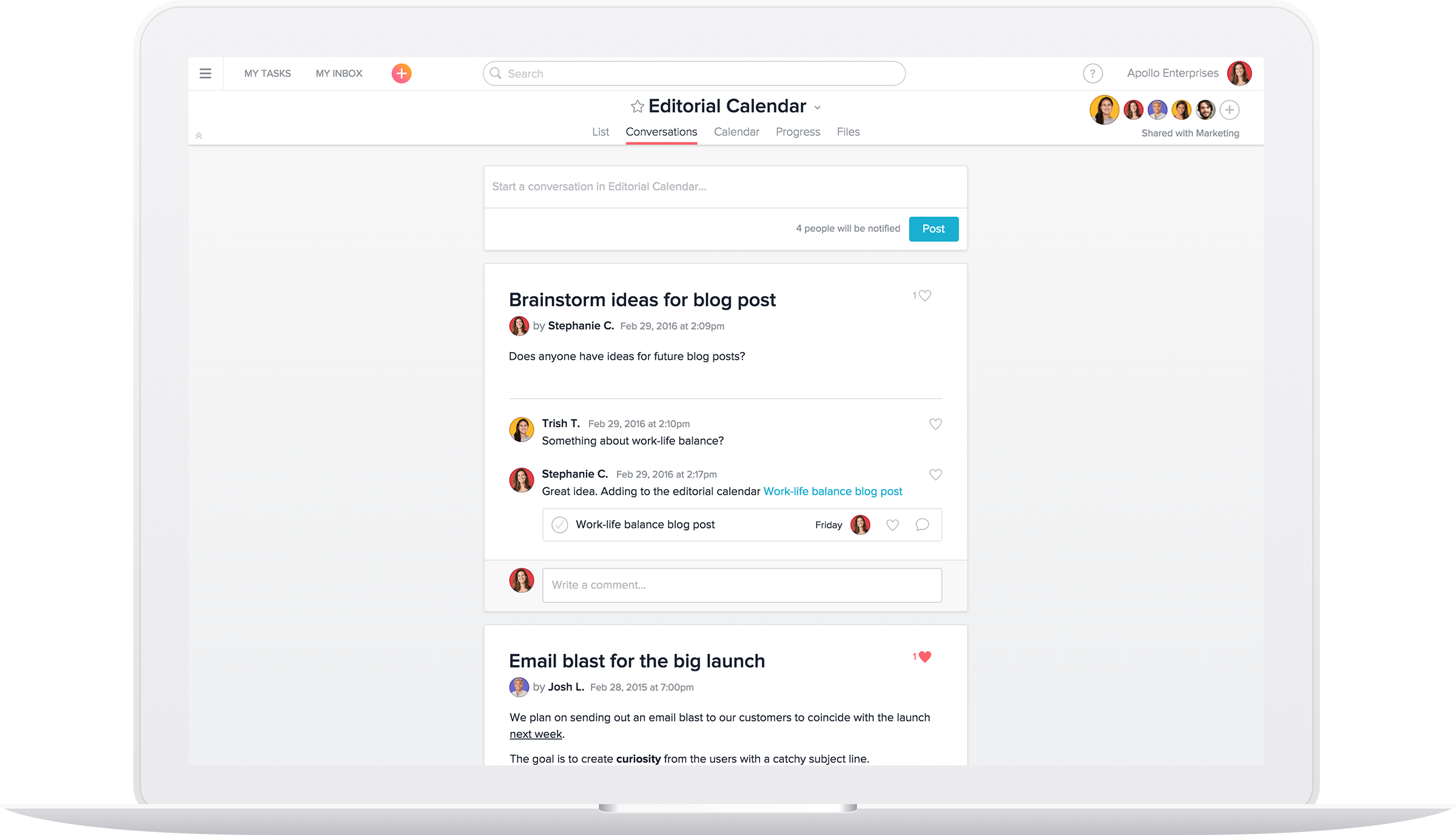
Asana is a web and mobile project management app. With tasks, projects, conversations, and dashboards, Asana lets an entire team know who's doing what by when, enabling workload balancing. Users can also add integrations for GANTT charts, time tracking and more.
$13.49
per month per user
Canvas
Score 8.6 out of 10
N/A
Instructure is an educational software company based in Sandy, Utah. It is the developer of the Canvas learning management system, which is a comprehensive software package that competes with such systems as Blackboard Learning System, SumTotal and Saba.
Asana is a highly effective instrument for managing teams and projects. The paid edition provides a multitude of features that can be tailored and used in accordance with the organisation's specific requirements.
Email integration facilitates notifications that remind team …
Overall for the money Asana brings a lot of value for organizations who want to do more with less and need a task and project management solution as a small company is growing and scaling to get to the next level. In the space when we evaluated didn't find a lot of other …
Against Jira it offers a more modern experience with less complex user interfaces. The admin and setup experience is also way faster with less (or no) legacy complexity.
Against other modern players like Linear and Basecamp it offers way more integrations so we can pull in data …
Asana is a top-tier project management software that helps us organize and track projects from start to finish. It allows us to apply tasks/to-dos to multiple projects without duplication, divide complex projects into smaller tasks, and track project progress. It also helps us …
Asana provides a mix of features between notion and Jira. Unlike Notion, it helps ease up the collaboration on vast projects and between multiple teams. Jira proved to be a little expensive with similar set of features if not more and which is why we thought of going with Asana.
I believe that Asana is more professional than Trello. I used Trello a long time ago, but it looked more suitable for a student project rather than for a professional team or business environment. I believe it has great features to help companies in different stages and of …
Since I have tried the two applications and saw their advantages and disadvantages, I see that Asana is much better in terms of dealing with files, ease of use, and the many features and characteristics that it has. Also, I noticed that it does not consume much space on my …
Side by side with the other two Asana by far beats Monday.com and is comparable and slightly better than ClickUp. Monday is completely browser-based and is hard to navigate and figure out how to set up. Asana and ClickUp are the exact opposite. Both are easy to set up and …
I like how extensive the capabilities are for Asana. With other softwares it seems there are many things lacking. I feel like Asana is also a very user friendly platform and aesthetically pleasing which is important in a modern office. We have many young people entering our …
Asana compared to Jira is certainly better in terms of user experience, since most of the people can start using it basically without having any kind of training or previous explanation, which makes it really useful not only for people already used to project management but …
Asana is amazing for a remote team, that we are currently as its accessible seamlessly to all our team member no matter where they are in the world. Its very easy to onboard new members to this platform as its very intuitive and easy for new people to get a hang of it. It has …
Basecamp was a great tool, but it was paid and things like recurring tasks and opening new projects was a pain. Asana, as a free tool, has been better for our organization as it serves the basic functions very well and is not complicated otherwise. I really like the …
This is much easier to use than Blackboard. Everything is easy to locate. The interface is clean and intuitive, which makes navigation smooth for both instructors and students. Assignments, grades, and messages are all centralized, reducing confusion. Setup is quick, and the …
Canvas is much more robust, has more features, and is more accessible. In canvas it can be specified to your specific organization and have its own domain which I do not think that Coursera can do. Coursera is good for sharing a single course or CEU but does not have the same …
Canvas is in the experience way better than Google Classroom. Canvas has a
more robust agenda system that also allows adding in new personal
deadlines. [Assignments] can be submitted past [the] deadline (if allowed),
Canvas is more secure, has a cleaner design, and has more features. For the features, they have in common canvas still stacks up against [Smart school] by going for the extra mile. Besidfor e that, [the] canvas looks a lot more [professional] than [Smart school]. I didn't make …
Canvas is a stronger platform. I used it as a teacher AND as a student in graduate school, and it is just the most put-together, professional version of a learning management system that I've used or seen. I do assume that Canvas is more expensive than its competitors, which …
Moodle is open source and it is free. So we can implement our own server with Moodle very easily. But it is not very customizable. When we need a new feature, it is very hard to change as we do not have the ability to change. Canvas has been great help in this because we can …
Canvas is a powerful learning management tool that combines so many key elements of an actual classroom and allows teachers to mirror their classroom environment into a virtual platform. It is simply amazing what can be done on Canvas. Grading systems/analysis, progress …
Canvas takes the better parts of both Skyward and Google Classroom and combines them to work pretty seamlessly - grading, assignments, attendance, document/file sharing - all integrated into one platform. In addition, the internal communication feature makes communication …
Canvas was far easier to use, more feature rich, and much better supported. Teachers and students prefer it to the other solutions we've evaluated or used in the past. Anything that kids can use with minimal instruction is a major win for schools.
How content is delivered using Moodle is not up to the mark when compared to Canvas. The user interface is clunky when compared to a much simple and easy to understand user interface that of Canvas. Configuring Moodle can be quite tedious if one comes from a non-IT background. …
I was not part of the team that selected Canvas, however, I used Blackboard as a student and very little as a staff member. Blackboard was especially difficult in navigating organizations or shared sites. I used it to organize mandatory training for students in one of my …
Canvas has some unique features that are superior to Google Classroom, but I prefer Google Classroom because of its ease of use. It does have some of the same problems as Canvas though in terms of assigning work to particular students.
I have not used any other platforms for this type of experience. I appreciated the thorough introduction that was offered to onboard onto the platform. It made it easy to use right off the bat.
Canvas surpasses Blackboard not only visually, but technically as well. It offers more customization options, as well as more features for students and teachers a like in regard to grading, notifications, and uploading files. It also seems to stream videos more successfully, …
Canvas is a pricey option, at least when compared to something open source like Moodle. Personally, I don't feel that Canvas has the same ability to customize as Moodle. However, the customer support from Canvas makes it stand out. With an open-source platform, it might be …
Canvas is more cost-effective when compared to Blackboard Learn. Canvas has lately worked on features improvement especially in the grade center, for example, moving columns around like an Excel sheet, a feature not found in Blackboard Learn.
The Canvas interface is easier for students to use and navigate. It is also cleaner so students enjoy using the tool more than Sakai. Canvas was easier for our IT department to implement. Training faculty on how to use Canvas was easier than Sakai. The analytics in Canvas are …
Canvas's ease of use and ease of administration were huge deciding factors in the decision to use Canvas as our preferred LMS. We found that on average Canvas took 1/3 the clicks to accomplish the same tasks as Blackboard, and the structure of data in Canvas is far superior to …
I believe Canvas out does all of these because of its robustness. It allows for more design opportunities including HTML and HTML5 and has many built-in features that are not offered by all of the other LMSs. Some of those features are discussions, assignments, pages, quizzes, …
The usability of Asana is broad since it's available in a variety of platforms that are widely used nowadays. I think that it would be great for people who are constantly on the move and switching devices, since it has allowed me to work from my phone, too. I also think that Asana has proven itself to handle a large quantity of work
If you have a school you can let teachers easily create new deadlines which [automatically] get shown in the calendar. Teachers can also [temporarily] hide deadlines [until] they've given the explanation about the tasks. [Besides] that the teacher can also choose what should be uploaded, should it be a link, file, pdf, link,...
Learning management - Even as the educational landscape rapidly shifts due to current events, Canvas is a great LMS for providing a consistent learning environment for students.
Mobile accessibility - Students can access their courses on Canvas from a variety of devices, including their smartphones.
Rich content - Instructors have the ability to create dynamic and engaging content for their courses.
I just can't see us getting it off of Asana any time soon, despite the many headaches it has caused us. We have too much data in there, too much time & training invested into it, too much at stake to move. If we were just starting out today, fresh, I don't know for certain that I would absolutely go the same direction, but I *think* I still would. I just haven't seen anything better yet. Maybe if Podio's support staff hadn't treated me like a worthless nuisance to them, I might feel differently, but the fact is that their task management is simply inferior to Asana's. That can't be denied, and in fact Podio said it themselves: "Tasks are a simple function. They cannot be customized. Tasks in Podio can be used for quick to-do's for you and your team members." In our operation, however, prompt task completion is a big deal; one task can't be completed until another one is done first, and closing the gaps between those tasks is critical in meeting deadlines and servicing our customers. Asana gets us there, the others don't.
Several factors contribute to my "10" rating. First, our university just made an enormous switch to Canvas, after we were with Blackboard for almost a decade. So garnering buy-in was critical, and not something we took lightly. After nearly 18 months (start to finish) of training faculty, educating stakeholders, and migrating courses, I am not looking to make a change again anytime soon. But I am happy with the result and the product overall and that is also demonstrated in my rating.
It is very user-friendly. Takes a new employee an hour to start figuring out how the system works. That's an important factor. You don't want to encounter the issue where employees need a week to understand how the system works. For example, JIRA, I tried using it for a week and I still don't understand the complicated layout. Asana has a simple interface. Once you see it, you get it type of program.
The functions in Canvas are well integrated and consistent across the application, and mostly intuitive. Overall navigation and setup is streamlined through integrated features and navigation. The feedback we've gotten from our program participants is that it is easy to learn to use. It also integrates well with third party software like Google Docs and Blackboard Collaborate web conferencing software
I haven't had to use their support so I can't rate it. The fact that I haven't needed them reflects the ease of use of the product. I would recommend that any new users schedule a complete demo of the product to ensure that they are using it to it's fullest (there's a lot of useful features).
I do not personally use Canvas support since we have a central office that helps us. However, our central office always has the answers we need and are always able to solve our issues - so I would assume that get great support from the Canvas team on their end. They also offer great training, which uses materials directly from Canvas
Once you purchase and sign the contract there is nothing to install or hardware to buy. You can almost immediately start using it and have courses up and going within weeks. We signed in December and had pilot courses online ready to go for the start of school in January
Asana is a top-tier project management software that helps us organize and track projects from start to finish. It allows us to apply tasks/to-dos to multiple projects without duplication, divide complex projects into smaller tasks, and track project progress. It also helps us organize work on Kanban boards or linear lists. It stands out from the crowd in a big way compared to the competition.
Canvas is in the experience way better than Google Classroom. Canvas has a more robust agenda system that also allows adding in new personal deadlines. [Assignments] can be submitted past [the] deadline (if allowed), this isn't allowed by Google [Classroom], If you're too late you can't submit anything anymore. In Classroom [assignments], presentations/theory, and [announcements] are all put in 1 feed instead which gets confusing way faster.
Teachers have consolidated their content onto one platform which has decreased reliance of students on so much support staff assistance to access content.
Canvas has helped make technology transitions more seamless for the school community.
Once teachers have set up their page, Canvas really takes care of it all- they have much more time to focus on content creation and synthesis rather than the actual learning management system.