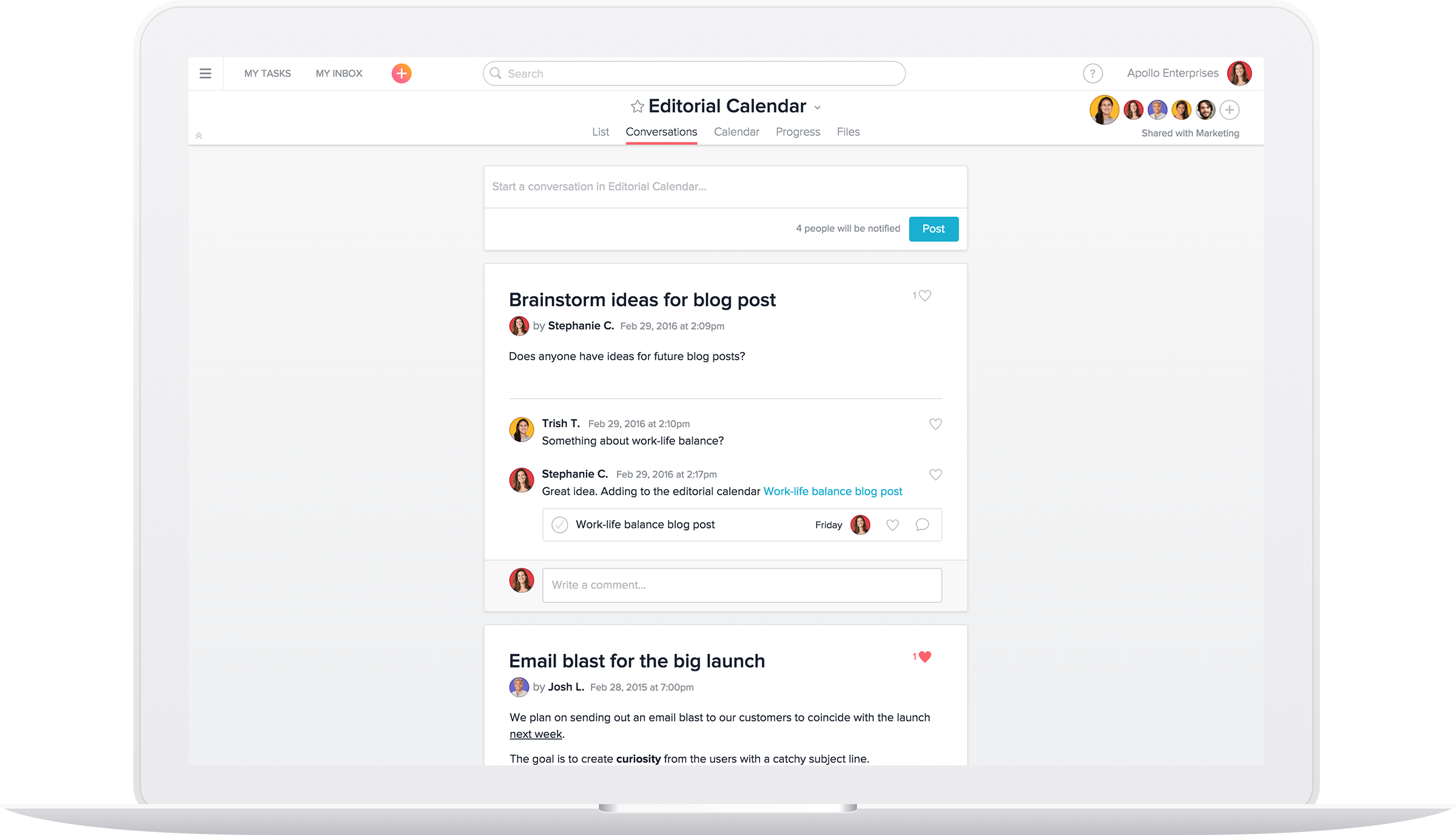
Asana is a web and mobile project management app. With tasks, projects, conversations, and dashboards, Asana lets an entire team know who's doing what by when, enabling workload balancing. Users can also add integrations for GANTT charts, time tracking and more.
$13.49
per month per user
Hive
Score 9.0 out of 10
N/A
Hive Technology offers their eponymous project management and process management application, providing integrations with many popularly used applications for productivity, cloud storage, and collaboration.
$24
per month per user
Lytho Workflow
Score 9.7 out of 10
N/A
Lytho Workflow is a creative project management software built specifically for the needs of creative and marketing teams. Combining elements of task and workflow management with the collaborative features of online proofing, Lytho Workflow helps teams get more content produced - faster. The key components of Lytho Workflow are Request Intake, Project Management, Review & Approval, and Reporting. From the initial creative brief, Lytho Workflow's request forms ensure…
N/A
Pricing
Asana
Hive
Lytho Workflow
Editions & Modules
Starter
$13.49
per month per user
Advanced
$30.49
per month per user
Enterprise
Contact Sales
Personal
Free
Free
$0
Lite
$24
per month per user
Growth
$34
per month per user
Pro
$59
per month per user
Elite
Contact Sales
No answers on this topic
Offerings
Pricing Offerings
Asana
Hive
Lytho Workflow
Free Trial
Yes
Yes
No
Free/Freemium Version
Yes
Yes
No
Premium Consulting/Integration Services
Yes
No
No
Entry-level Setup Fee
Optional
No setup fee
No setup fee
Additional Details
A discount is offered for annual billing.
A discount is offered for annual pricing.
No two teams are alike. So why offer “one size fits all” pricing plans? They just don’t work – teams are locked out of features they need while they get features they don’t need. We do things differently. We create individual pricing based on your team’s specific needs and budget.
I would say that in comparison to Asana, Hive is a better interface an UI. I think Asana is more robust in terms of what it can do in conjunction with Confluence but I think Hive is a better entry-level model for new employees. Hive is much simpler and more straight forward and …
Hive is a bit different than Jira and Monday, which I used mostly. Overall does a great job managing project and helps with team communication. Removes dependency of asking team members for updates by going to conference rooms. With Hive, the team updates the status, and we …
So far Hive is the total package for our needs. Offering request forms and proofing/approval out of the box without third party integrations has been a huge upgrade for us along with incredibly reasonable pricing. The support for onboarding has been fantastic and we haven't …
The usability of Asana is broad since it's available in a variety of platforms that are widely used nowadays. I think that it would be great for people who are constantly on the move and switching devices, since it has allowed me to work from my phone, too. I also think that Asana has proven itself to handle a large quantity of work
Hive is a powerful tool for data analysis and management that is well-suited for a wide range of scenarios. Here are some specific examples of scenarios where Hive might be particularly well-suited: Data warehousing: Hive is often used as a data warehousing platform, allowing users to store and analyze large amounts of structured and semi-structured data. It is especially good at handling data that is too large to be stored and analyzed on a single machine, and supports a wide variety of data formats. Batch processing: Hive is designed for batch processing of large datasets, making it well-suited for tasks such as data ETL (extract, transform, load), data cleansing, and data aggregation.Simple queries on large datasets: Hive is optimized for simple queries on large datasets, making it a good choice for tasks such as data exploration and summary statistics. Data transformation: Hive allows users to perform data transformations and manipulations using custom scripts written in Java, Python, or other programming languages. This can be useful for tasks such as data cleansing, data aggregation, and data transformation. On the other hand, here are some specific examples of scenarios where Hive might be less appropriate: Real-time queries: Hive is a batch-oriented system, which means that it is designed to process large amounts of data in a batch mode rather than in real-time. While it is possible to use Hive for real-time queries, it may not be the most efficient choice for this type of workload. Complex queries: Hive is optimized for simple queries on large datasets, but may struggle with more complex queries or queries that require multiple joins or subqueries.Very large datasets: While Hive is designed to scale horizontally and can handle large amounts of data, it may not scale as well as some other tools for very large datasets or complex workloads.
It's a flexible program that can be molded to fit most businesses. It's geared towards agencies but we've been able to use it successfully as an in-house solution. It's pretty intuitive for the most part and is easy for new hires or clients to get up and running pretty quickly.
Through it, we were able to communicate and cooperate with the rest of the team to complete the work in the required manner and at the appropriate time.
Simplicity, it offers a clean environment without risking the outcome. An example of this are the timesheets that allow a fast way to keep track of progress
Interaction, the different options make it faster and easier to interact and collaborate in the development of a product. An example of this would be Hive Notes for meetings
The different visualisations it offers allow to explore the best ways to affront your projects. I really like the Gantt mappings view to understand who can be contacted at each point
Requests - Request forms are set up so that certain fields are required and there's a minimum turnaround time. This prevents others from submitting an incomplete request or requesting things last minute.
Proofing - Chasing after people to approve a proof is always a pain, but the simplicity of Lytho Workflow makes it less of a pain. I can quickly remind people in the route to review the proof by clicking a button.
Templates - I use templates so that a list of tasks is created for me when I accept a job. It also creates a timeline for when each task needs to be done.
It is very user-friendly. Takes a new employee an hour to start figuring out how the system works. That's an important factor. You don't want to encounter the issue where employees need a week to understand how the system works. For example, JIRA, I tried using it for a week and I still don't understand the complicated layout. Asana has a simple interface. Once you see it, you get it type of program.
I haven't had to use their support so I can't rate it. The fact that I haven't needed them reflects the ease of use of the product. I would recommend that any new users schedule a complete demo of the product to ensure that they are using it to it's fullest (there's a lot of useful features).
Our CSR is easily accessible and they have support built into the app itself. They also have a pretty robust support site. We also took advantage of the free trial and learned so much by putting Hive through the paces and figuring out the best way to mold it to our needs.
Asana is a top-tier project management software that helps us organize and track projects from start to finish. It allows us to apply tasks/to-dos to multiple projects without duplication, divide complex projects into smaller tasks, and track project progress. It also helps us organize work on Kanban boards or linear lists. It stands out from the crowd in a big way compared to the competition.
Hive is a bit different than Jira and Monday, which I used mostly. Overall does a great job managing project and helps with team communication. Removes dependency of asking team members for updates by going to conference rooms. With Hive, the team updates the status, and we can easily track it.
By consolidating the requests, project management, and proofing without features we didn't need like invoicing it was an easy fit for us. We were able to quickly develop a comprehensive workflow and the gains to efficiency were immediate. Pricing was competitive (at least at the time) and the implementation was very good as well.
I wasn't working for the company when they first started using Lytho Workflow workflow, so I can't say what impact it has had. However, I do see the product as a necessity in the fast-paced environment that is retail marketing. The introduction of the new "change request" feature has saved countless hours of miscommunication and confusion when project objectives change.