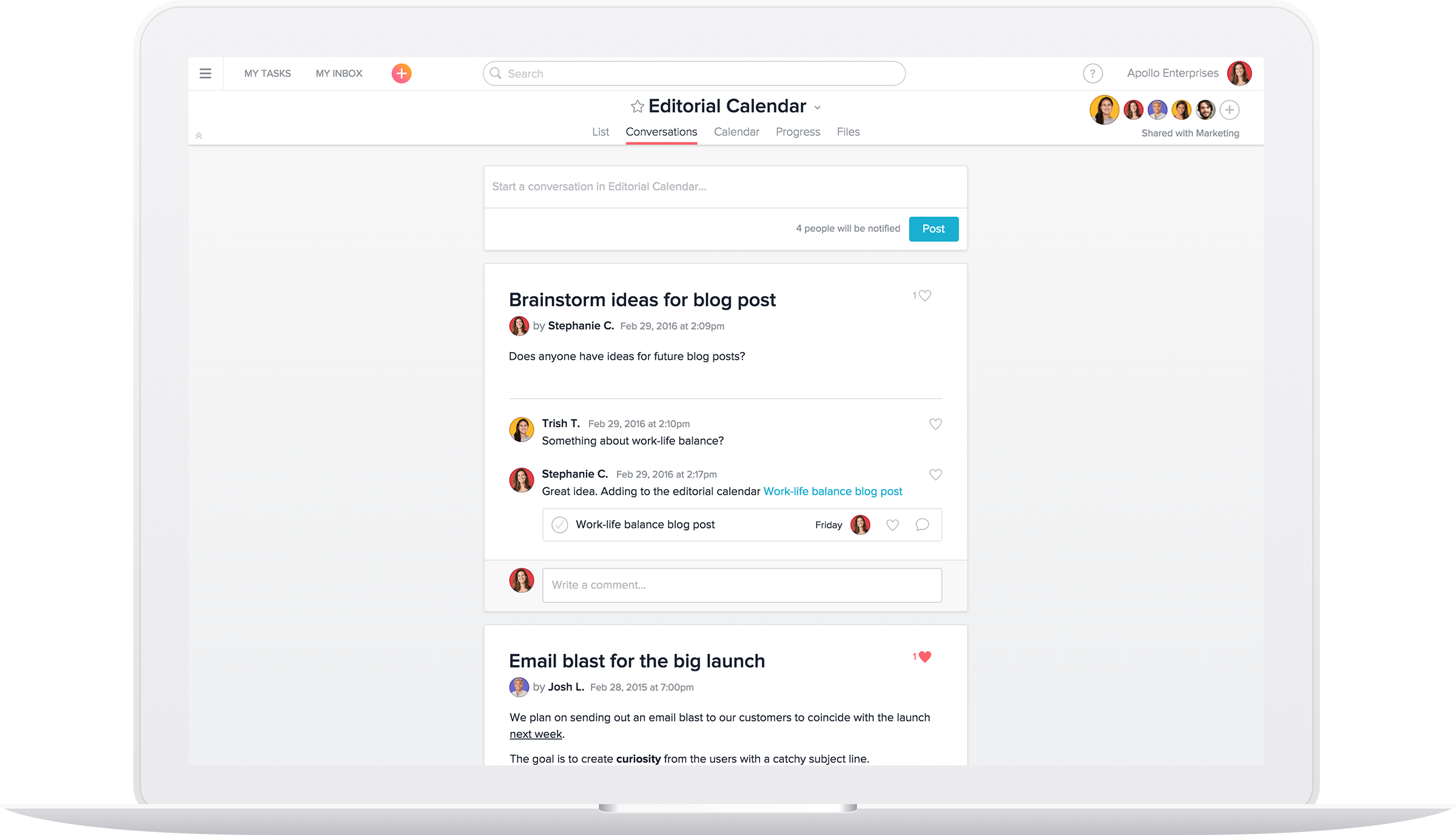
Asana is a web and mobile project management app. With tasks, projects, conversations, and dashboards, Asana lets an entire team know who's doing what by when, enabling workload balancing. Users can also add integrations for GANTT charts, time tracking and more.
$13.49
per month per user
OneNote
Score7.8 out of 10
N/A
Microsoft's OneNote is a digital note-taking app, supporting photos, annotating, web page clipping, emailing, and synchronizing notes across devices.
N/A
Pricing
Asana
OneNote
Editions & Modules
Starter
$13.49
per month per user
Advanced
$30.49
per month per user
Enterprise
Contact Sales
Personal
Free
Microsoft OneNote
Free
Offerings
Pricing Offerings
Asana
OneNote
Free Trial
Yes
No
Free/Freemium Version
Yes
Yes
Premium Consulting/Integration Services
Yes
No
Entry-level Setup Fee
Optional
No setup fee
Additional Details
A discount is offered for annual billing.
—
More Pricing Information
Community Pulse
Asana
OneNote
Considered Both Products
Asana
Verified User
Chose Asana
Within our organization, most have fallen back to their old way of tracking tasks, which varies between paper and pen notes on sticky notes to OneNote to Microsoft To-Do, to Outlook Tasks, to Windows 10 Sticky Notes. These other tools have familiarity, ease of use, and …
A de minimis incentive was given to thank the reviewer for their time. The incentive was not used to bias or drive a particular response, nor was the incentive contingent on a positive endorsement. More Info
Microsoft
Verified User
Chose OneNote
For me, OneNote is way simpler and easier to use. Furthermore, the storage options was one of the key factors that I choose OneNote. Since it's a software for my PC, I can just store all the documents on my computer and I will never have the fear of running out of space and …
A de minimis incentive was given to thank the reviewer for their time. The incentive was not used to bias or drive a particular response, nor was the incentive contingent on a positive endorsement. More Info
The usability of Asana is broad since it's available in a variety of platforms that are widely used nowadays. I think that it would be great for people who are constantly on the move and switching devices, since it has allowed me to work from my phone, too. I also think that Asana has proven itself to handle a large quantity of work
In my opinion OneNote is a must for anyone who does business. It’s versatile, stable and sustainable. It can keep private information private - like passwords. It can be used for collaborative work - like standard operating procedures. It is fairly easy to use and far superior to pen and paper. When used for meeting notes, it can be flagged with icons that are searchable - like ideas or important items. You can even create Outlook tasks on the fly
A de minimis incentive was given to thank the reviewer for their time. The incentive was not used to bias or drive a particular response, nor was the incentive contingent on a positive endorsement. More Info
Through it, we were able to communicate and cooperate with the rest of the team to complete the work in the required manner and at the appropriate time.
Because of its flexibility and ability to hold different types of content (text, images, tables), it is a great tool for collecting content from different resources and organizing it in one place.
Technical support analysts are using sections for their support case analysis; they paste pieces of logs, screen-shots, document their steps in troubleshooting etc., all in one section, to get the full picture yet stay organized.
The logic of content structure; Notebook>Section>Page>Paragraph, allows you to manage and collect all needed information by the areas of the user's responsibility. For example; each of my projects has its own section, in which each page is a task.
A de minimis incentive was given to thank the reviewer for their time. The incentive was not used to bias or drive a particular response, nor was the incentive contingent on a positive endorsement. More Info
A de minimis incentive was given to thank the reviewer for their time. The incentive was not used to bias or drive a particular response, nor was the incentive contingent on a positive endorsement. More Info
The table editing tools are too simplistic and lack the features found in other Office products.
Some content loses its rich text formatting when being pasted into OneNote. A workaround is to paste the content first into Outlook or Word and then copy/pasting that into OneNote.
Microsoft is moving away from a local install of OneNote, which means notebooks have to be in the cloud in Office 2019. This will actually reduce the usefulness of OneNote in some environments and opens the door to competitor products.
Update: Microsoft has now announced that it will continue to support OneNote 2016 through 2023. https://techcommunity.microsoft.com/t5/Office-365-Blog/Your-OneNote/ba-p/954922
A de minimis incentive was given to thank the reviewer for their time. The incentive was not used to bias or drive a particular response, nor was the incentive contingent on a positive endorsement. More Info
A de minimis incentive was given to thank the reviewer for their time. The incentive was not used to bias or drive a particular response, nor was the incentive contingent on a positive endorsement. More Info
As this is not a compulsory tool in our organization, I would say all depends on the decision makers, however since this is a part of MS Office, I am sure we will have it for as long as we will possibly need it. However, I would not be so sure, if it was a separate product
It is very user-friendly. Takes a new employee an hour to start figuring out how the system works. That's an important factor. You don't want to encounter the issue where employees need a week to understand how the system works. For example, JIRA, I tried using it for a week and I still don't understand the complicated layout. Asana has a simple interface. Once you see it, you get it type of program.
A de minimis incentive was given to thank the reviewer for their time. The incentive was not used to bias or drive a particular response, nor was the incentive contingent on a positive endorsement. More Info
I find OneNote incredibly usable. I'm fairly middle of the road when it comes to tech savvy-ness. The platform was very easy to learn and explore. I like that OneNote is no clunky and offers a clean interface. This is important when it comes to deciding if a tool is usable for multiple people.
A de minimis incentive was given to thank the reviewer for their time. The incentive was not used to bias or drive a particular response, nor was the incentive contingent on a positive endorsement. More Info
Overall, I rate OneNote's performance highly. In general, notebooks, sections and pages load quickly. OneNote integrates with other apps and info ca easily be shared/copied to and from the tool to other tools. Moreover, Notebooks tend to sync quickly meaning shared notebooks are up to date almost immediately provided there are no syncing issues.
A de minimis incentive was given to thank the reviewer for their time. The incentive was not used to bias or drive a particular response, nor was the incentive contingent on a positive endorsement. More Info
I haven't had to use their support so I can't rate it. The fact that I haven't needed them reflects the ease of use of the product. I would recommend that any new users schedule a complete demo of the product to ensure that they are using it to it's fullest (there's a lot of useful features).
A de minimis incentive was given to thank the reviewer for their time. The incentive was not used to bias or drive a particular response, nor was the incentive contingent on a positive endorsement. More Info
Since it is part of Microsoft Office and used across the globe there are a lot of support options available. It's quickest to just do a google search which will have plenty of articles to help you since there are so many OneNote users but as an Office customer you also have access to Microsoft support and I have had good experiences with their support (probably because I'm with a large company who is a large customer to them).
A de minimis incentive was given to thank the reviewer for their time. The incentive was not used to bias or drive a particular response, nor was the incentive contingent on a positive endorsement. More Info
Asana is a top-tier project management software that helps us organize and track projects from start to finish. It allows us to apply tasks/to-dos to multiple projects without duplication, divide complex projects into smaller tasks, and track project progress. It also helps us organize work on Kanban boards or linear lists. It stands out from the crowd in a big way compared to the competition.
I tried using Evernote and it is an equally usable tool, however, I prefer the interface and capabilities of OneNote. OneNote seems much easier to use and understand. I think that may primarily be because OneNote is a Microsoft application and I am very used to using Microsoft applications such as Word, Excel, etc. I also use OneNote to keep my grocery list. It does as good of a job as the grocery list applications out there, only I like the flexibility I have with OneNote and how I specifically do my shopping.
A de minimis incentive was given to thank the reviewer for their time. The incentive was not used to bias or drive a particular response, nor was the incentive contingent on a positive endorsement. More Info
A de minimis incentive was given to thank the reviewer for their time. The incentive was not used to bias or drive a particular response, nor was the incentive contingent on a positive endorsement. More Info
OneNote has become our organizational standard method of taking electronic notes (though some still prefer pen and paper.) It has been a zero cost outlay due to its freely available nature.
Its integration with other Microsoft Office products makes it easy to share notes and content between products, allowing for easy collaboration where needed.
OneNote's integration with OneDrive ensures that individual's notes are always safe and secure, taking away the tedious responsibility of backup from the user, and makes it happen seamlessly in the background.
A de minimis incentive was given to thank the reviewer for their time. The incentive was not used to bias or drive a particular response, nor was the incentive contingent on a positive endorsement. More Info