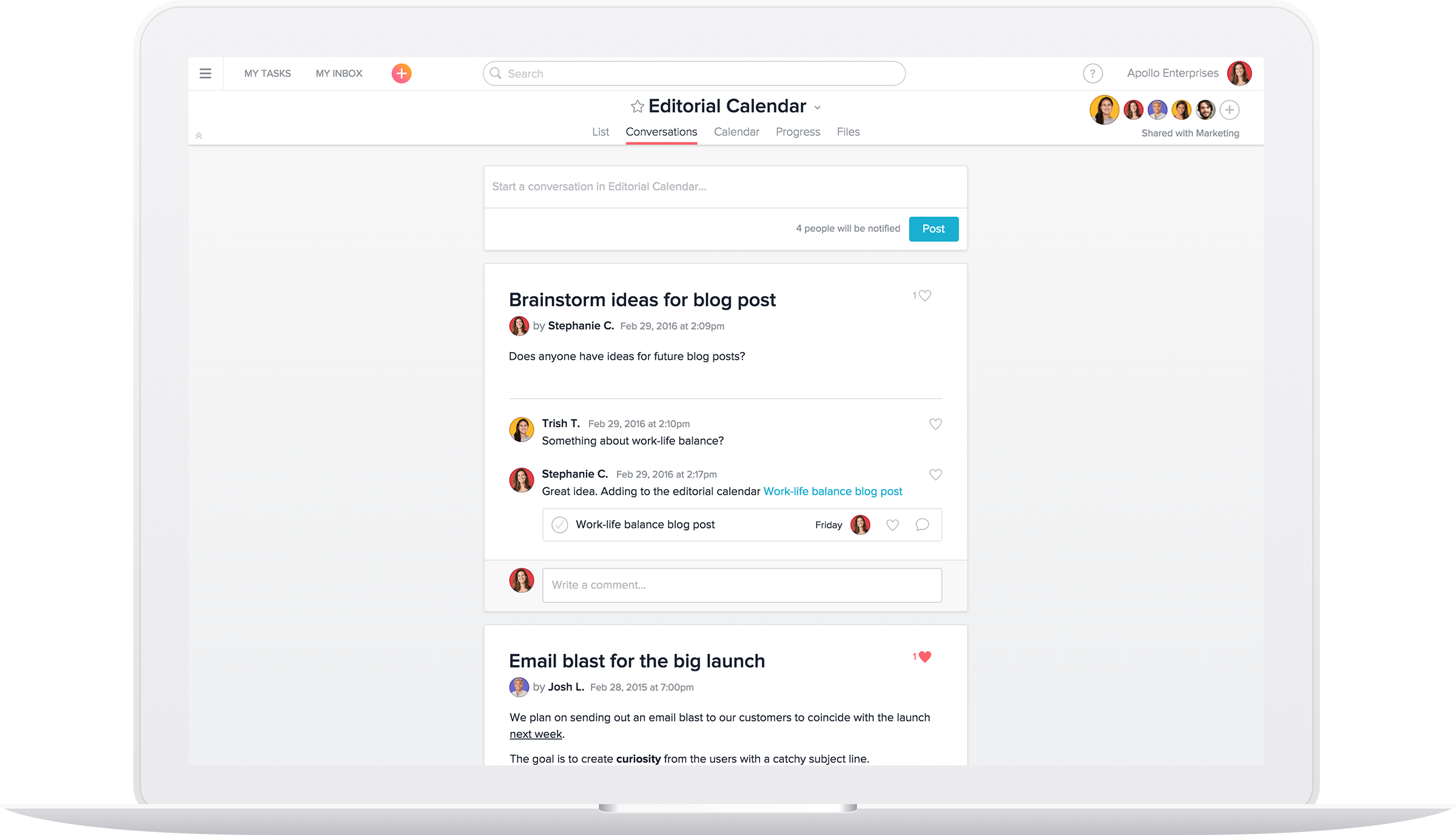
Asana is a web and mobile project management app. With tasks, projects, conversations, and dashboards, Asana lets an entire team know who's doing what by when, enabling workload balancing. Users can also add integrations for GANTT charts, time tracking and more.
$13.49
per month per user
Project Insight
Score4 out of 10
N/A
Project Insight is a web-based project and portfolio management software. Project teams can access, edit and update their projects information anytime, anywhere, with any supported browser, tablet and mobile device. Features for experienced project managers include: MS Project import/export, intelligent scheduling, resource allocation, Outlook integration, document management, approvals, time/expense tracking, issue management, 100s of dashboards and advanced permissions.
The usability of Asana is broad since it's available in a variety of platforms that are widely used nowadays. I think that it would be great for people who are constantly on the move and switching devices, since it has allowed me to work from my phone, too. I also think that Asana has proven itself to handle a large quantity of work
My rating would vary depending on the types of projects that need to be managed. Since I am in software, I don't think it was an excellent fit to manage software projects unless they are small projects with only a few tasks. On the other hand, if you are needing to manage a wide range of departments that are working on a single project with many moving pieces, then I would think that PI might be a better fit. Think of it as a jack of all trades, but master of none.
A de minimis incentive was given to thank the reviewer for their time. The incentive was not used to bias or drive a particular response, nor was the incentive contingent on a positive endorsement. More Info
Through it, we were able to communicate and cooperate with the rest of the team to complete the work in the required manner and at the appropriate time.
A de minimis incentive was given to thank the reviewer for their time. The incentive was not used to bias or drive a particular response, nor was the incentive contingent on a positive endorsement. More Info
A de minimis incentive was given to thank the reviewer for their time. The incentive was not used to bias or drive a particular response, nor was the incentive contingent on a positive endorsement. More Info
A de minimis incentive was given to thank the reviewer for their time. The incentive was not used to bias or drive a particular response, nor was the incentive contingent on a positive endorsement. More Info
A de minimis incentive was given to thank the reviewer for their time. The incentive was not used to bias or drive a particular response, nor was the incentive contingent on a positive endorsement. More Info
It is very user-friendly. Takes a new employee an hour to start figuring out how the system works. That's an important factor. You don't want to encounter the issue where employees need a week to understand how the system works. For example, JIRA, I tried using it for a week and I still don't understand the complicated layout. Asana has a simple interface. Once you see it, you get it type of program.
A de minimis incentive was given to thank the reviewer for their time. The incentive was not used to bias or drive a particular response, nor was the incentive contingent on a positive endorsement. More Info
I haven't had to use their support so I can't rate it. The fact that I haven't needed them reflects the ease of use of the product. I would recommend that any new users schedule a complete demo of the product to ensure that they are using it to it's fullest (there's a lot of useful features).
A de minimis incentive was given to thank the reviewer for their time. The incentive was not used to bias or drive a particular response, nor was the incentive contingent on a positive endorsement. More Info
I found Project Insight somewhat opaque overall. I thought the training was sparse and answers to questions few and far in between. There was a lot of power there for the dedicated user/administrator. For me, who was a casual user and administrator, I found support lacking. I didn't administer Project Insight much, just some work on integrations with other tools.
A de minimis incentive was given to thank the reviewer for their time. The incentive was not used to bias or drive a particular response, nor was the incentive contingent on a positive endorsement. More Info
Asana is a top-tier project management software that helps us organize and track projects from start to finish. It allows us to apply tasks/to-dos to multiple projects without duplication, divide complex projects into smaller tasks, and track project progress. It also helps us organize work on Kanban boards or linear lists. It stands out from the crowd in a big way compared to the competition.
When I got to the company where I used Project Insight, we had our own custom tool that fit the tasks that it was designed for but wouldn't grow with the company unless resources were put onto expanding capabilities. We needed something more.
We replaced that tool with Redmine. It worked well and was easy to use, but it looked pretty dated when we got it, and since we didn't have many resources for managing, it looked dated after a few years without receiving upgrades. It was a decent tool for small teams that were focused on similar tasks. Redmine was much more straightforward than Project Insight and felt more reliable since we never had an issue with our internal servers. On the other hand, Redmine felt dated and didn't fit as many of the tasks that were needed. Redmine's price was right if you installed it locally and was probably still cheaper if you used their SAAS version.
Jira, on the other hand, felt like an excellent tool for software teams. Jira had a great project and task management and felt right for a software team. Jira also had useful integrations, even with Project Insight. Jira seemed pretty unreliable, worse than Project Insight. Our team would have preferred Jira, but I think it didn't work for other teams.
A de minimis incentive was given to thank the reviewer for their time. The incentive was not used to bias or drive a particular response, nor was the incentive contingent on a positive endorsement. More Info
A de minimis incentive was given to thank the reviewer for their time. The incentive was not used to bias or drive a particular response, nor was the incentive contingent on a positive endorsement. More Info
A de minimis incentive was given to thank the reviewer for their time. The incentive was not used to bias or drive a particular response, nor was the incentive contingent on a positive endorsement. More Info