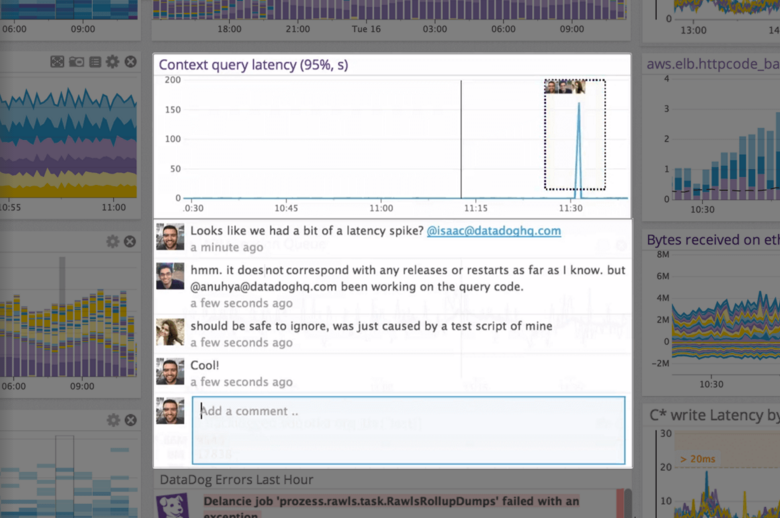
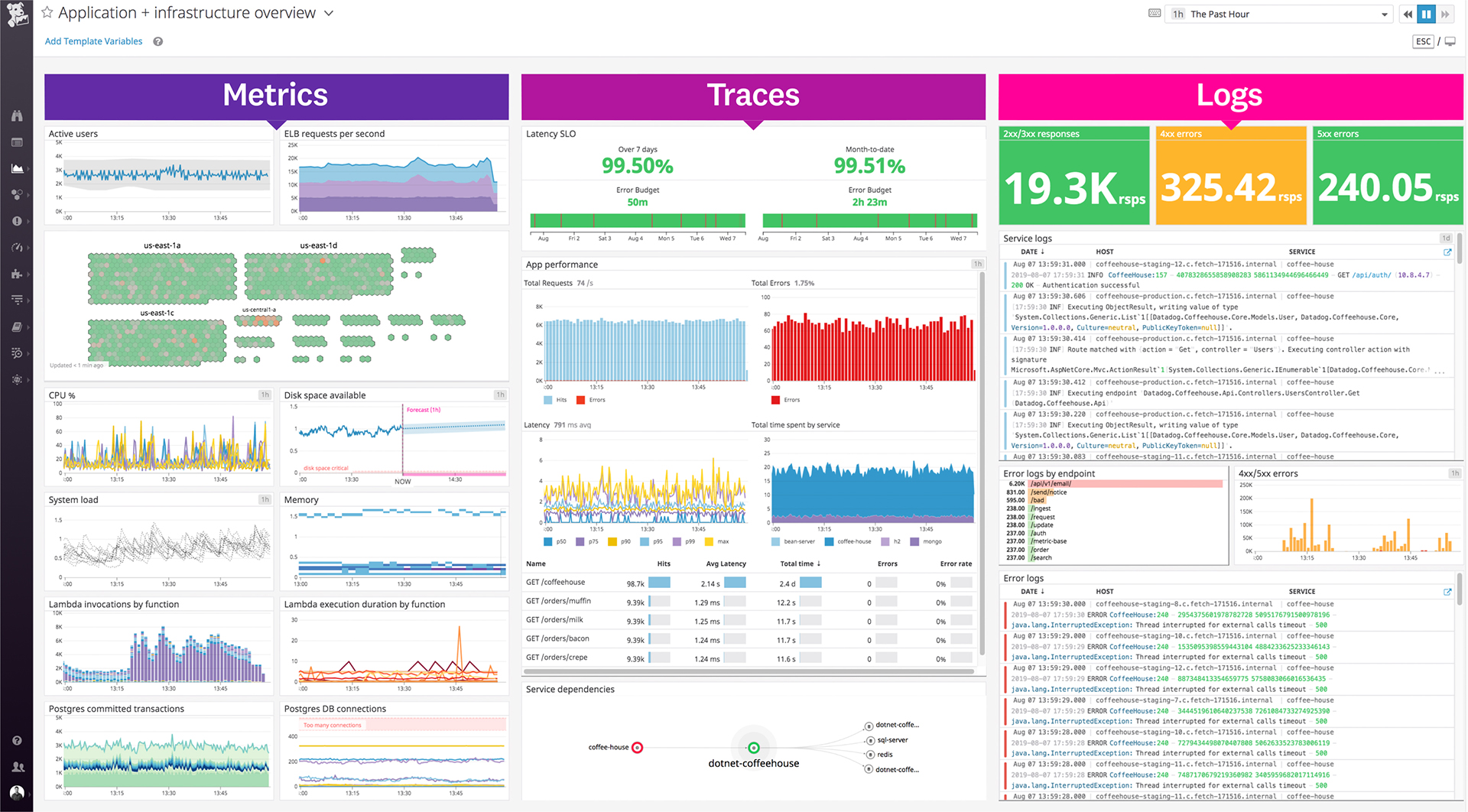
Datadog is a monitoring service for IT, Dev and Ops teams who write and run applications at scale, and want to turn the massive amounts of data produced by their apps, tools and services into actionable insight.
$18
per month per host
Riverbed Aternity
Score 5.0 out of 10
N/A
Riverbed Aternity delivers AI-enabled insights based on real end user experience data and high-fidelity telemetry across endpoints, application, infrastructure and network.
N/A
Pricing
Datadog
Riverbed Aternity
Editions & Modules
Log Management
$1.27
per month (billed annually) per host
Infrastructure
$15.00
per month (billed annually) per host
Standard
$18
per month per host
Enterprise
$27
per month per host
DevSecOps Pro
$27
per month per host
APM
$31.00
per month (billed annually) per host
DevSecOps Enterprise
$41
per month per host
No answers on this topic
Offerings
Pricing Offerings
Datadog
Riverbed Aternity
Free Trial
Yes
No
Free/Freemium Version
Yes
No
Premium Consulting/Integration Services
No
No
Entry-level Setup Fee
Optional
No setup fee
Additional Details
Discount available for annual pricing. Multi-Year/Volume discounts available (500+ hosts/mo).
Datadog may be better suited for teams that have a more out-of-the-box infrastructure, on the primary platforms Datadog supports. You may also have better results if you have a bigger team dedicated to devops and/or a bigger budget. We found that trying to adapt it to our use case (small team, .NET on AWS Fargate) wasn't feasible. We continually ran into roadblocks that required us to dig through documentation (and at times, having to figure out some documentation was wrong), go back and forth with support, and in my opinion, waste money on excessive and unintended usages due to opaque pricing models and inaccurate usage reports, as well as broken/non-functional rate sampling controls.
We are a services organization and we use Riverbed SteelCentral AppInternals with our customers. It has allowed us to expand the footprint in the application management business with virtually all of our major accounts. We were able to expand and go into other applications that we weren't in or offering previously. Now, we have a new value proposition for our customer enhanced visibility, enhanced stability, and we can reduce our cost to them because our cost structure is reduced by using Riverbed SteelCentral AppInternals.
The thing which Datadog does really well, one of them are its broad range of services integrations and features which makes it one step observability solution for all. We can monitor all types of our application, infrastructure, hosts, databases etc with Datadog.
Its custom dashboard feature which helps us to visualize the data in a better way . It supports different types of charts through those charts we can create our dashboard more attractive.
Its AI powered alerting capability though that we can easily identify the root cause and also it has a low noise alerting capability which means it correlated the similar type of issues.
Alert windows cause lag in notifications (e.g. if the alert window is X errors in 1 hour, we won't get alerted until the end of the 1 hour range)
I would appreciate more supportive examples for how to filter and view metrics in the explorer
I would like a more clear interface for metrics that are missing in a time frame, rather than only showing tags/etc. for metrics that were collected within the currently viewed time frame
The tool demands High CPU resources to perform monitoring which reduces the overall performance and the user experience is sluggish
Also a good amount of training is required to set up the different use cases and monitoring parameters which in return demands a dedicated resource to work on the tool
There are so many features that it can be hard to figure out where you need to go for your own use case. For example, RUM monitoring us buried in a "Digital Experience" sidebar setting when this is one of our key use cases that I sometimes struggle to find in the application. It appears that ECS + Fargate monitoring was recently released which is great because we had to build a lambda reporting solution for ephemeral task monitoring. But this new feature was never on my radar until I starting clicking around the application.
The support team usually gets it right. We did have a rather complicate issue setting up monitoring on a domain controller. However, they are usually responsive and helpful over chat. The downside would be I don’t think they have any phone support. If that is important to you this might not be a good fit.
The support I give the highest rating because it is really amazing. Every time we triggered the tool support, we were very well served very quickly and efficiently. The problems were solved quickly and without stress. The staff helped us within minutes and had a lot of patience with us
Our logs are very important, and Datadog manages them exceptionally well. We frequently use Datadog services for our investigations. Use case: Monitor your apps, infrastructure, APIs, and user experience.
Key features:
Logs, metrics, and APM (Application Performance Monitoring)
Real-time alerting and dashboards
Supports Kubernetes, AWS, GCP, and other integrations
RUM (Real User Monitoring) and Synthetics
✅ Best for backend, server, and distributed systems monitoring.
There is a wide variety of APM solutions out there for companies to pick from. Riverbed AppInternals sits near the top of the stack certainly. We already deploy steelhead units across the estate with client licenses, that aided us in our decision to select AppInternals. We found the costs of AppDynamics and New Relic ( which we had trials for) both costly against AppInternals.
This product has really wonderful features and one of the most valuable ones is the transaction searches into TTW.
This will show you the operations that occurred under conditions that the user specifies, giving you the opportunity to drill down on the things that are more important and affecting system performance.
Besides that, the capability of analyzing each individual transaction captured to a very low-level detail (method call/line of code). This ability empowers the testing teams to provide more visibility to developers on how they can improve.