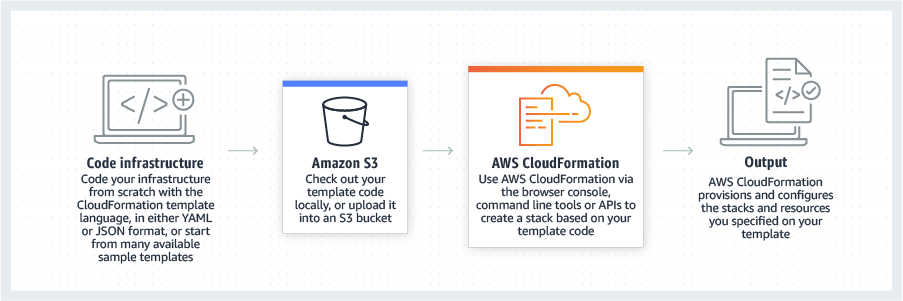
AWS CloudFormation gives developers and systems administrators a way to create and manage a collection of related AWS resources, provisioning and updating them in a predictable fashion. Use AWS CloudFormation’s sample templates or create templates to describe the AWS resources, and any associated dependencies or runtime parameters, required to run an application. Users don’t need to figure out the order for provisioning AWS services or the subtleties of making those dependencies work.…
$0
IBM Terraform
Score 8.8 out of 10
N/A
IBM Terraform (formerly Hashicorp Terraform) is a cloud infrastructure automation tool used to create, change, and improve production infrastructure, and it allows infrastructure to be expressed as code. It is available Open Source, and via Cloud and Self-Hosted editions.
$0
MindTouch
Score 7.0 out of 10
N/A
MindTouch is a customer experience management platform with content management and help authoring capabilities. Formerly known as MediaWiki, it is optimized for building knowledge bases for customer self-service and agent assistance purposes.
N/A
Pricing
AWS CloudFormation
IBM Terraform
MindTouch
Editions & Modules
Free Tier - 1,000 Handler Operations per Month per Account
$0.00
Handler Operation
$0.0009
per handler operation
Open Source
$0
Team & Governance
$20/user
per user/per month
Enterprise
Contact sales team
No answers on this topic
Offerings
Pricing Offerings
AWS CloudFormation
IBM Terraform
MindTouch
Free Trial
Yes
No
Yes
Free/Freemium Version
Yes
Yes
No
Premium Consulting/Integration Services
Yes
No
Yes
Entry-level Setup Fee
No setup fee
No setup fee
No setup fee
Additional Details
There is no additional charge for using AWS CloudFormation with resource providers in the following namespaces: AWS::*, Alexa::*, and Custom::*. In this case you pay for AWS resources (such as Amazon EC2 instances, Elastic Load Balancing load balancers, etc.) created using AWS CloudFormation as if you created them manually. You only pay for what you use, as you use it; there are no minimum fees and no required upfront commitments.
When you use resource providers with AWS CloudFormation outside the namespaces mentioned above, you incur charges per handler operation. Handler operations are create, update, delete, read, or list actions on a resource.
The only real comparison would be to Terraform, which is another IaC technology at the infra level. Terraform is cloud-agnostic, which means most popular cloud providers are supported. While AWS CloudFormation is AWS-only. Although, if you consider CDK, CDK for Terraform …
Since the product I'm involved is primarily hosted on AWS we use CloudFormation but in some other products where we have hybrid cloud deployments we prefer Terraform which is opensource.
As we have our whole infrastructure on AWS, that is why we selected AWS CloudFormation. AWS CloudFormation is better integrated with AWS services than other available products and also provides visibility and tracking on AWS. AWS CloudFormation is free while Terraform …
We didn't look into anything else as Cloudformation was "built-in" for AWS, it just kind of made sense to go with that. Terraform was something that we briefly looked into Terraform but decides to stick with Cloudformation because our task was relatively "simple". Apparently if …
AWS CloudFormation is better if you just want to stick with AWS because it's integration with AWS is better, provides auto-rollback in case of failures, and has GUI to manage and view the stacks built. Terraform is better when we want to stay cloud-agnostic. Terraform is better …
HashiCorp Terraform is much better than Cloud Formation. For one, the language is just easier to use, but more importantly, the provider ecosystem is much better in HashiCorp Terraform than in Cloud Formation.
CloudFormation is only for AWS so if you're trying to deploy to another cloud provider then Terraform is your product. Terraform has lots of public support so you can find answers to questions by Googling. CloudFormation is easy to view the resources/services that are …
I still give it an 8 because it's one of those tools that just quietly does the heavy lifting for you but it can really test your patience when it breaks esp with deep nested stacks. It's perfect for projects where we need clean consistent environments every time. It's less ideal for quick experimental setups like new EC2 configs or Lambda permission tweaks.
Anything that needs to be repeated en masse. Terraform is great at taking a template and have it be repeated across your estate. You can dynamically change the assets they're generating depending on certain variables. Which means though templated assets will all be similar, they're allowed to have unique properties about them. For example flattening JSON into tabular data and ensuring the flattening code is unique to the file's schema.
If a company doesn't want to make their knowledge base public-facing, you lose a lot of the value of using MindTouch in a closed environment. MindTouch is not ideal for extremely structured content management scenarios that are strong DITA advocates. Companies that require localization might not be good fits either.
The language itself is a bit unusual and this makes it hard for new users to get onboarded into the codebase. While it's improving with later releases, basic concepts like "map an array of options into a set of configurations" or "apply this logic if a variable is specified" are possible but unnecessarily cumbersome.
The 'Terraform Plan' operation could be substantially more sophisticated. There are many situations where a Terraform file could never work but successfully passes the 'plan' phase only to fail during the 'apply' phase.
Environment migrations could be smoother. Renaming/refactoring files is a challenge because of the need to use 'Terraform mv' commands, etc.
When we do have a support issue, we frequently need to go through multiple people, contacts, ways of explaining things, etc,. before someone on their end actually understands our problem. It's rare that the first person we talk to understands the big picture or appreciates our use case.
The draft functionality is a promising start but lacks some key features that cause us regular frustration. For example, you can only create one draft of a page at a time. This is fine if changes come to you in perfect sequential order, but it makes it impossible for us to update a live page while a draft exists. More specifically, if we're working on updating content on a page for a new feature being released next month, but then we notice a typo today, we can't fix the typo in production without first deleting the draft or doing some hacky workaround of temporarily copying/pasting the source HTML of the draft page and saving it someplace else.
Existence of, or integration with, true source control would be a huge win, but it's something currently lacking in the product. MindTouch's content reuse feature is helpful in the right situations, but it's not robust enough to scale well for lots of content.
Version history of page changes is not 100% reliable. Sometimes items don't show up at all or there is a delay before the diff is visible. Also, creating a draft does not register at all in the page version history.
In-site search is poor, unless you know the *exact* title of what you're looking for. We tell our customers to use Google, not the MindTouch search. Google is excellent at searching our MindTouch site.
We've put lots and lots of content into the MindTouch system, of course, so that makes it harder to opt out, but we're also very pleased with their rate of development and weekly pushing of improvements, as well as their response and solutions to our questions and input All in all, a winning combination.
It's easy enough to get a shared template & apply it. You don't even have to download-then-upload or copy-and-paste, a publicly-accessible url works.
Diving deeper, it has enough powerful capabilities to make the life of a platform / DevOps engineer bearable.
However, you need equally deep knowledge to troubleshoot issues, when they inevitably pop up. This is the same for all IaC technologies, as they are additional abstraction layers on top of the native API provided by the cloud providers.
I love Terraform and I think it has done some great things for people that are working to automate their provisioning processes and also for those that are in the process of moving to the cloud or managing cloud resources. There are some quirks to HCL that take a little bit of getting used to and give picking up Terraform a little bit of a learning curve, thus the rating
The site is responsive across multiple devices and screens. It has a clear path to contact support. The articles are searchable. Site users do have trouble navigating the site and finding what they need. That may be due to the architecture of the site, but it'd be nice if MindTouch offered more solutions are this. Our content is organized by product line. And many of those product lines have overlapping training content, so we have extensive duplicate content.
Terraform's performance is quite amazing when it comes to deployment of resources in AWS. Of course, the deployment times depend on various parameters like the number of resources to deploy and different regions to deploy. Terraform cannot control that. The only minor drawback probably shows up when a terraform job is terminated mid way. Then in many cases, time-consuming manual cleanup is required.
MindTouch is a hosted site, so as a heavy user there are times when I notice that pages are slow to load, or something happens like Amazon Web Services crashing the entire east coast for a few hours, that you do notice even if it isn't actually the fault of the MT tool itself. It's the risk of using a hosted tool, but the benefits are pretty amazing and outweigh these performance issues.
I have yet to have an opportunity to reach out directly to HashiCorp for support on Terraform. However, I have spent a great deal of time considering their documentation as I use the tool. This opinion is based solely on that. I find the Terraform documentation to have great breadth but lacking in depth in many areas. I appreciate that all of the tool's resources have an entry in the docs but often the examples are lacking. Often, the examples provided are very basic and prompt additional exploration. Also, the links in the documentation often link back to the same page where one might expect to be linked to a different source with additional information.
It's good. Pretty solid. We got a lot of input to get up and running, but did a lot of the setup and customization work ourselves, because of our high standards. We've gotten good response and results on specific projects related to customization and our CSM is also pretty responsive. Overall, I think that the jobs of CSMs and support folks would be easier if the product weren't wonky in some ways. They seem to have to do more "workarounds" for basic functionality that should just work out of the box
Written documentation and videos are very good and have helped on numerous occasions when I've had to look up how to accomplish a certain task. The reason I have not given a full score is mainly because there have been some inaccuracies in the documentation because updates to the MindTouch framework have slightly changed the way things work. But this is usually the same type of challenges I face when making documentation for the software solution we develop. So all in all I'm very satisfied with both the personal webinars and the online documentation MindTouch provides for their service.
Just know that there is so much more involved than adding your content. There are so many pieces to launching your site -- especially if you are moving from another platform. If you are not a person who typically works in the "website" realm, do your homework, ask your web people, engineers, etc., because there's a lot to do that you won't know about until you are unexpectedly smacked in the face with it. Learn from my mistakes! We are very happy now, but it was a long road getting to launch day for us
Cloning a virtual machine creates a virtual machine that is cloning a virtual machine creates a virtual machine that is a copy of the original. The new virtual machine is configured with the same virtual hardware, installed software, and other properties that were configured for the original virtual machine. For information about persistent memory and PMem storage, see the vSphere Cloning a virtual machine creates a virtual machine that is a copy of the original. The new virtual machine is configured with the same virtual hardware, installed software, and other properties that were configured for the original virtual machine. For information. Management guide.For information copy of the original. The new virtual Cloning virtual machine creates a virtual machine that is a copy of the original. The new virtual machine is configured with the same virtual hardware, installed software, and other properties that were configured for the original virtual machine. For information about persistent memory and PMem storage, see the vSphere Resource Management Guide. For information is configured with the same virtual hardware, installed software, and other properties that were configured for the original virtual machine. For information about persistent memory and PMem storage, see the vSphere Resource Management Guide. For information
Terraform is the solid leader in the space. It allows you to do more then just provisioning within a pre-existing servers. It is more extensible and has more providers available than it competitors. It is also open source and more adopted by the community then some of the other solutions that are available in the market place.
I will be brief. DealerTeam is built upon Salesforce and we try to support native apps. We used Desk.com first for basic Help Ticket management. The product did not satisfy how our customers were looking for information. We upgraded to Service Cloud with Knowledge Base and spent one year writing content and developing our support agency. Again, our customers were upset about submitting help tickets and waiting for answers. They wanted access to self-help while working with a customer. Today we continue to use Service Cloud with MindTouch integration and have found complete success. There is simply no other solution I know of that is a flexible and easy to use as MindTouch when it come to providing customer success and product support
we are able to deploy our infrastructure in a couple of ours in an automated and repeatable way, before this could take weeks if the work was done manually and was a lot of error prone.
having the state file, you can see a diff of what things have changed manually out side of Terraform which is a huge plus
if state file gets corrupted, it is very hard to debug or restore it without an impact or spending hours ..
writing big scale code can be very challenging and hard to be efficient so it's usable by the whole team
Our operational efficiently has improved significantly. Prior to Mindtouch, we managing duplicate content in two separate authoring solutions. Delivering content predictably and consistently was difficult and stressful for writers. In Mindtouch, we were able to optimize our content (remove redundancies) giving us more time to test, review, and improve content quality.
Traffic to our knowledge center is increasing monthly.
Internally, SMEs and customer-facing teams are recognizing the value Mindtouch brings through self-service knowledge. These SMEs want to contribute more to content, either as contributing writers or collaborators with tech writers.