Cisco's Catalyst is one of that company's brand of network switches.
N/A
Cisco Nexus Series Switches
Score 9.3 out of 10
N/A
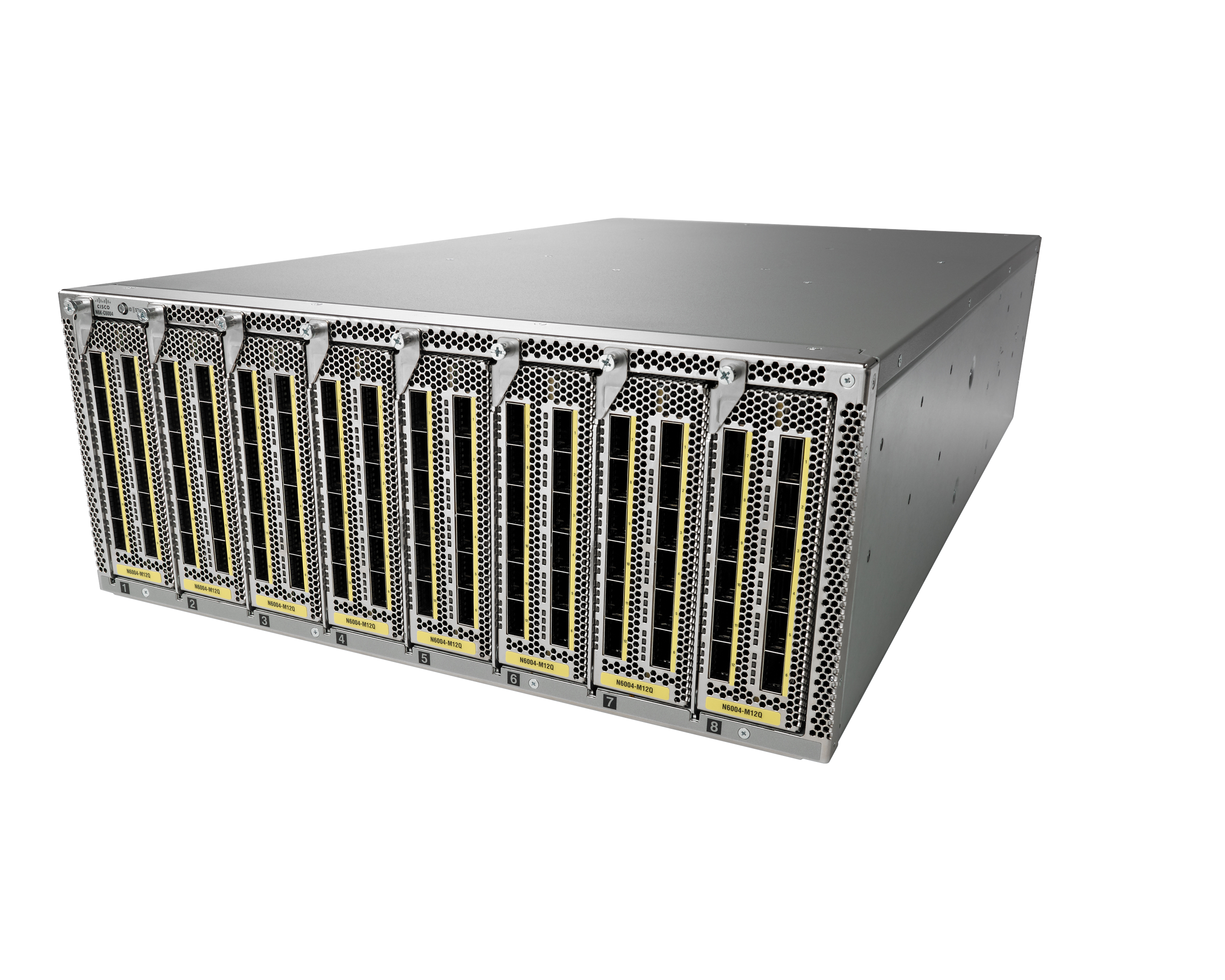
Cisco Nexus is a series of network switches.
N/A
HPE Aruba Networking Switches
Score 8.5 out of 10
N/A
For campus, branch, and data centers, HPE's Aruba CX switches are presented as a flexible, programmable, and cloud-native ASIC design solution, boasting the power, precision, and versatility of a microservices-based wired architecture.
$503.63
one-time fee
Pricing
Cisco Catalyst Switches
Cisco Nexus Series Switches
HPE Aruba Networking Switches
Editions & Modules
No answers on this topic
No answers on this topic
HPE Aruba Networking CX 6000 Switch Series
Starting at $503.63
one-time fee
HPE Aruba Networking CX 6100 Switch Series
Starting at $935.20
one-time fee
HPE Aruba Networking CX 6200 Switch Series
Starting at $1,054.12
one-time fee
HPE Aruba Networking CX 6300 Switch Series
Starting at $4,483.55
one-time fee
HPE Aruba Networking CX 5420 Switch Series
Starting at $3,158.76
one-time fee
HPE Aruba Networking 2930F Switch Series
Starting at $574.72
one-time fee
HPE Aruba Networking CX 6400 Switch Series
Starting at $7,394.82
one-time fee
HPE Aruba Networking CX 8100 Switch Series
Starting at $19,102.26
one-time fee
Offerings
Pricing Offerings
Cisco Catalyst Switches
Cisco Nexus Series Switches
HPE Aruba Networking Switches
Free Trial
No
No
No
Free/Freemium Version
No
No
No
Premium Consulting/Integration Services
No
No
No
Entry-level Setup Fee
No setup fee
No setup fee
No setup fee
Additional Details
—
—
HPE Aruba Ethernet Switch prices vary significantly based on features, model, and quantity purchased.
After evaluating both vendor, we chose Cisco Catalyst Switches becuase of, 1-We need the Power stacking features and Aruba doest not support Power stacking. 2-MACSEC to protect senstive data
Our engineers are more familiar with Cisco IOS. Cisco Catalyst switches are number one in the Campus network environment and they just work out of the box. We known that we won't go wrong with Cisco Catalyst switches if we use then in our network. Another thing we consider is …
We are predominantly a Cisco house for networking, so the risk raised by introducing the split switching was too high. We also found there are more Cisco engineers available than Aruba/HPE switching engineers. The lifetime warranty from HPE was a major factor in considering the …
Cisco Catalyst switches are a better and more consistent product. Published design guides, multivendor SFP support and configuration consistency with other Cisco products in fleet make them better for the org.
Cisco is still easy enough to configure, with options in both console as well as web to get set up and deploy. Experience is almost always the same, unless some commands have been updated or added to the OS, but it's still always consist which is great.
The equipments that we use to compare are very similar in a question of compatibility and speed. The Cisco Catalyst Switches was the standard for the years in the company and the robusts of the equipment brings the advantage to this family of products that we decided to use to …
We selected Cisco Catalyst Switches over the HPE Aruba switches due to the end-to-end solution that Cisco has been building and improving upon over the last 5+ years. We can now utilize the same security tagging and posturing from our access layer all the way up through our …
The monitoring of Cisco devices is easy and have various monitoring tools available. The products offered for the Cisco Catalyst Switches work well hand in hand.
Using Cisco Catalyst Switches we get a homegenous network for easy central administration and integration with our tool set. We also know that replacing a product series with another from Cisco always provide roughly the same form factor and physical requirements so we don't …
I believe Cisco is a market leader with a strong reputation for delivering reliable networking solutions. The Catalyst series is widely adopted in enterprise settings. Cisco also provides a global network of certified partners and offers comprehensive support and services, …
Easier configuration, no need for special stack cables when using multi-chassis ether channel and extremely high speed interfaces (1/10/25/40/50/100/400/800 Gbit/s). Cisco Nexus Series Switches is capable of both being a L2 switch and L3 switch at the same time. Possibility to …
It's different requirement where Catalyst Switches are designed for Campus Network while Cisco Nexus Series Switches are well builded for DCN. Cisco Nexus Series Switches are made for servers that handle large amounts of data traffic, vm compute, virtual network and storage. …
Cisco Nexus Series Switches are reliable and scalable for data and security center operation. Cisco Nexus Series Switches give competition to other sw vendor on feature and continuous functionality like VPN feature, High Data Bandwidth, required less maintenance over year.
I like Cisco Nexus and the CLI is very similar to Cisco Catalyst so the majority of this is interchangeable but with the Dell networking, it is a totally different world and requires a lot of searching and assistance to learn, and even then some issues are caused by the …
The HPE Aruba Switches are definitely easier to setup than Cisco Catalyst Switches. We prefer to have a managed interface, so the HPE Aruba Switches are a better option than most Netgear or D-Link switches. Compared to HPE Networking Switches, the Aruba models typically are …
HPE switches are much more cost-effective than Cisco and others with a much more gentle learning curve. Aruba switches can be implemented by users with very little networking experience.
I think the most suited ones will be of course, for example, a supermarket where you have more than 50 plus devices because there are like 48 ports in a switch. We can just use a lot of devices and connect them to it. A less use case will be, I think it depends at the end of the day how your topology looks like. If you have a very few devices, you shouldn't be going for these catalyst switches because they are of course much bigger, more processing power and all those things. If you have, again, it comes to topology. If you have the number of users who are using these switches is less than 15, it's less than 15, then you can just go for any other option and not use them.
It fits perfectly in all our data centers where we are using it. For small companies or smaller racks or something. I don't think it fits there because Cisco Nexus Series Switches is a big one. It's the most advanced one.
These devices are rock solid, you will se them up once and not have to mess with them for years. They are work horses that don't die. We use them in an office environment and have only ever had 1 fail due to a PSU issue, we got a replacement next day and it's been working great.
One of the things that it does well, it's not something major, but there's a light tracking feature that the 9300 comes with that you can turn on the light and that has become critical in a data center environment where you want to help someone to make sure that you're talking about the same switch, you can turn the light on and off something that is not available in other versions of Cisco switches before the 9300. So it's not as major, but it's quite critical when you're dealing with multiple systems and multiple switches.
Maintenance, upgrades, and software certification can be performed without service interruptions because of the modular nature of NX-OS and features such as In-Service Software Upgrade (ISSU) and the capability for processes to restart dynamically
FabricPath:
Enables each device to build an overall view of the topology; this is similar to other link state routing protocols. Each device in the FabricPath topology is identified by a switch-id. The Layer 2 forwarding tables are built based on reachability to each switch-id, not by the MAC address. Eliminates spanning-tree to maximize network bandwidth and flexibility in topological configurations, as well as simplify operational support and configuration. This enables a tremendous amount of flexibility on the topology because you can now build FabricPath topologies for Layer 2-based networks the same as for Layer 3-based networks
Overlay Transport Virtualization (OTV): Enables the Layer 2 extension between distributed data centers over any transport Layer 3 network
Wireless Access Points (APs) zero touch provisioning
Its high-end family (running the AOS-CX firmware) supports a virtualization technology called VSX (Virtual Switching Extension) which allows 2 switches to present itself as one virtualized switch under Layer 2, and as 2 separate routers under Layer 3; thereby providing high availability.
Functionality. Well, one of the functions that we are missing is a faster route based on OSPF. Other than that, it could provide an upgrade without a hitless upgrade. Well, now it is a very fast upgrade, which is also okay. We had a case when the platform crashed, but that was a specific case. We were happy with this product.
Implementing jumbo frames on interfaces of its fabric extender series (N2k, etc.) by editing the network QoS does not have to be a global configuration that would affect all its interfaces. It can be improved to become just an interface configuration.
Licensing on the NXOS is a bit complicated and expensive. I understand that the Nexus is made for core data center switching but it does not have to break the bank.
OTV technology is for Nexus only. Based on the advantage of the technology, it should be made vendor-neutral to accommodate other vendor devices.
I have had issues finding monitoring software that natively supports Provision/Aruba OS. Most are designed primarily with Cisco in mind.
HPE/Aruba switches have historically had issues with corrupt flash. This seems to be less common in more recent models.
HPE/Aruba's switching portfolio can be confusing. Some models run on the Aruba OS while some others run on Comware. There is some overlap in these model lines so at times is can be tough to tell which switch is right.
They are consistently reliable and this switch in particular is a very affordable solution. We can place the Cisco Catalyst 1000 Series Switches gear in areas that we normally would not place a switch because it is affordable enough to make it justifiable. And because it is a reliable solution, we are confident it will continue to provide service over the long haul.
Actually if we need to implement or develop our actual DC we will use Cisco Nexus Series Switches again. The solution is well known and we will be able to interconnect easily the switches, as we're not using all the possibilities of features we know what is solution is a long term solution.
Cisco by and far does a great job with the Catalyst line. From a layer 2 dumb switch all the way up to ISP carrier grade switching within the Catalyst portfolio. The best part about it is command parity among the various tiers of product. The only differences are going to lie in what features are available per switch.
The platform has a good performance. The major issue is all the bugs you can discover across the operations, and it can be a big challenge depending on the number of Cisco Nexus Series Switches you have deployed. In our case, we own more than 200 Cisco Nexus Series Switches 9k, and we face an upgrade process, it could be a long time project to grant a new software deployment in all our switches platform.
I have not had that many issues with these products. Aruba Central has been really helpful. The Integration Capabilities allows us to use Clearpass . For individuals new to enterprise-grade networking, there can still be a learning curve associated with understanding the concepts and the specifics of the Aruba configuration.
We have very few is any outages due to a Cisco hardware failure. Some of our gear is exposed to some pretty harsh environments, and they keep on ticking!
No, the packets flow. Sometimes you will see collisions and broadcast storms can happen which will slow performance but that can be fixed and the packets will flow.
These switches are very fast. They've been designed to work within the data center. We connect them to Cisco UCS-B Mini servers with the storage being directly attached. They are able to handle the data traffic pretty easily. We can also move servers pretty fast from data center to data center without overloading them. This has allowed our company to stay running during any kind of conditional outage. We have come to really rely on them for business continuity.
We rarely have issues with the product. I have only had to contact support one time since we put it in and that was to see if another vendor was giving me accurate information on an issue I was having.
Overall, Cisco has great products and I believe that they believe in the philosophy of a great customer experience. Although there have been a few technical support issues that caused a lot of company anxiety, in most cases, Cisco has gone above and beyond in making a valiant effort to help the customer solve any issues.
HPE Support is very easy to reach. A knowledgable rep can be reached in a few minutes. After some basic troubleshooting if the failure is due to hardware I can receive a replacement within a day or even in a few hours.
Cisco Networking Academy partners with many local Colleges and High Schools to provide great hands-on training. You do need to drive to learn the topic. The in-class session only go so far. You really need to apply this to the real world. Cisco makes it easy for business to connect via CLC or Cisco Learning Credits.
The implementation of the Cisco Catalyst 1000 Series Switches is fairly seamless, especially if you are familiar with Cisco products. We have had Brocade switch gear in place too, and the differences between the manufacturers [are] not a major issue.
We do have other vendors. For example, Juniper, Fortinet, and there are quite a few others. And Cisco is pretty good because we know the workflow, we know how the operating system works. We are much more familiar with Cisco products and we know the support system behind it. So in terms of comparing with others, I think it stands out. It's one of our top products to go to
The Cisco 9000 stacks up quite well against the Cisco Catalyst 3850 switches. The additional features available in the Nexus 9000, such as VPN, FCoE, 40 gigabits, give us the ability to support the future needs of the company in our data center. The Nexus 9000 allowed us to condense our core and aggregation environment that comprised of 2 Catalyst 6504 and 2 Catalyst 6509 to a port of Nexus 9000. Although the Catalyst 3850 would be sufficient to handle routing, those features in the Nexus 9000 made it the clear choice for us.
We used to have a lot of Cisco switches which are great, but the support contracts and other expenses mount up quickly; one of the main reasons for switching to HP for networking was the cost, but the hardware and software have gotten so much better over the years.
I can’t see us changing network hardware unless the price increases dramatically.
We recently use the entreprise agreement on another perimeter, I could say that is linked to the typology of deployment. On our nexus perimeter, pricing and contract terms are defined without any evolution also is quite simple.
We are exclusive Cisco at our organization. In truth part of the reason is, with one type of switch and one manufacturer, it is easier to support. It is also easier to give consistent training to our staff in our tech department
The Nexus 3000 series switches are data center switches, so I would say they have similar security ability to other switches in this segment. I don't have a lot of experience doing more than basic ACL security on switches, but I know these can be integrated into other security solutions like Cisco ISE and 802.1x authentication. It could also be integrated into an ACI solution to add micro segmentation, which would bring in other security functions.
I really like the idea of paying for the switches one time and just pay for support going forward. The prices are on the high end but I think it is worth it. I wish they would include all the features in one go so we would not have to pay for every new feature.