Clay is a GTM enrichment product that combines access to 100+ data sources and AI agents with automated workflows to build any growth use case. Companies use it for tasks like recurring CRM enrichment to targeted outreach.
$149
per month 2000 credits per month
Heyflow
Score 8.3 out of 10
N/A
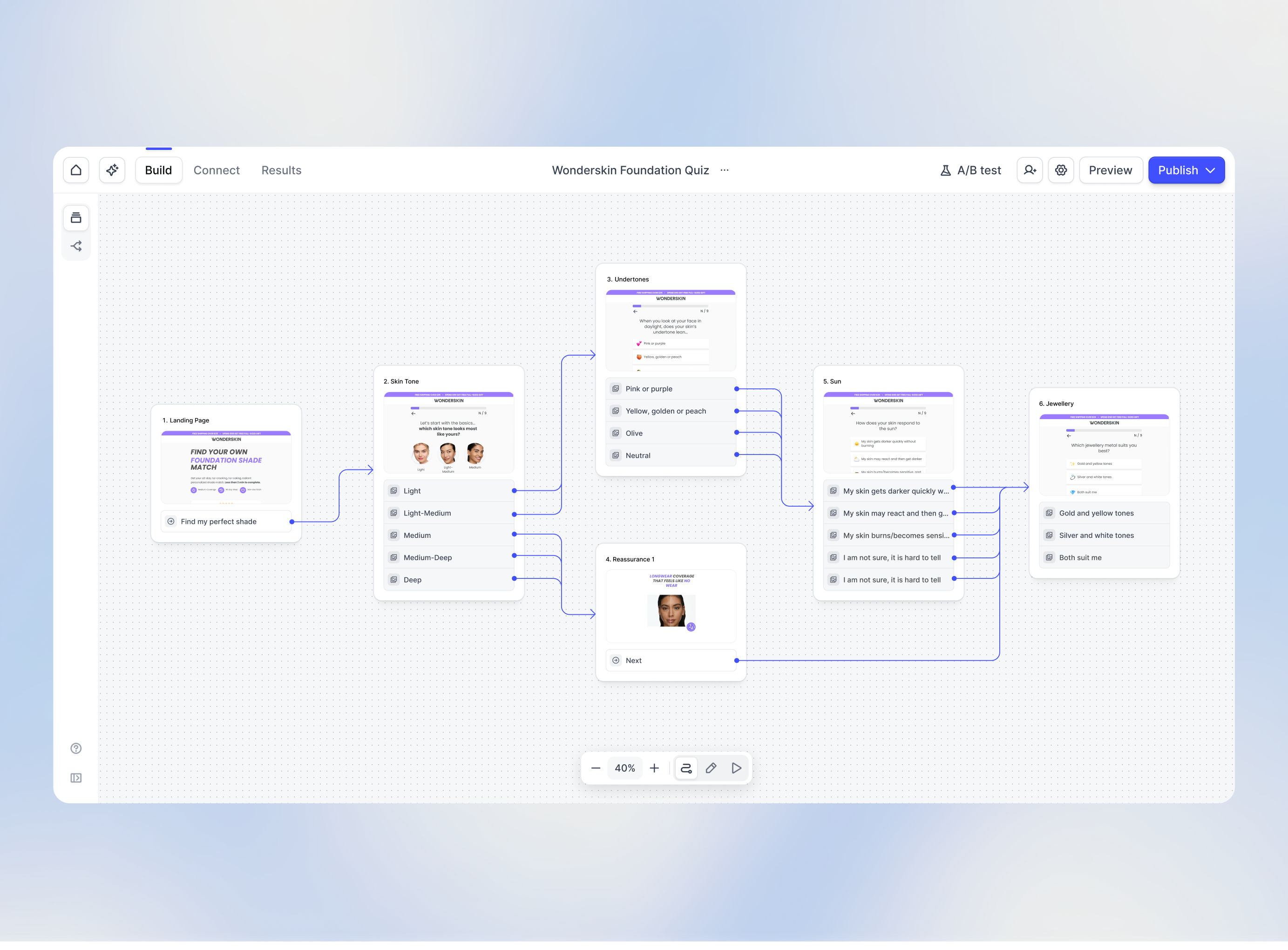
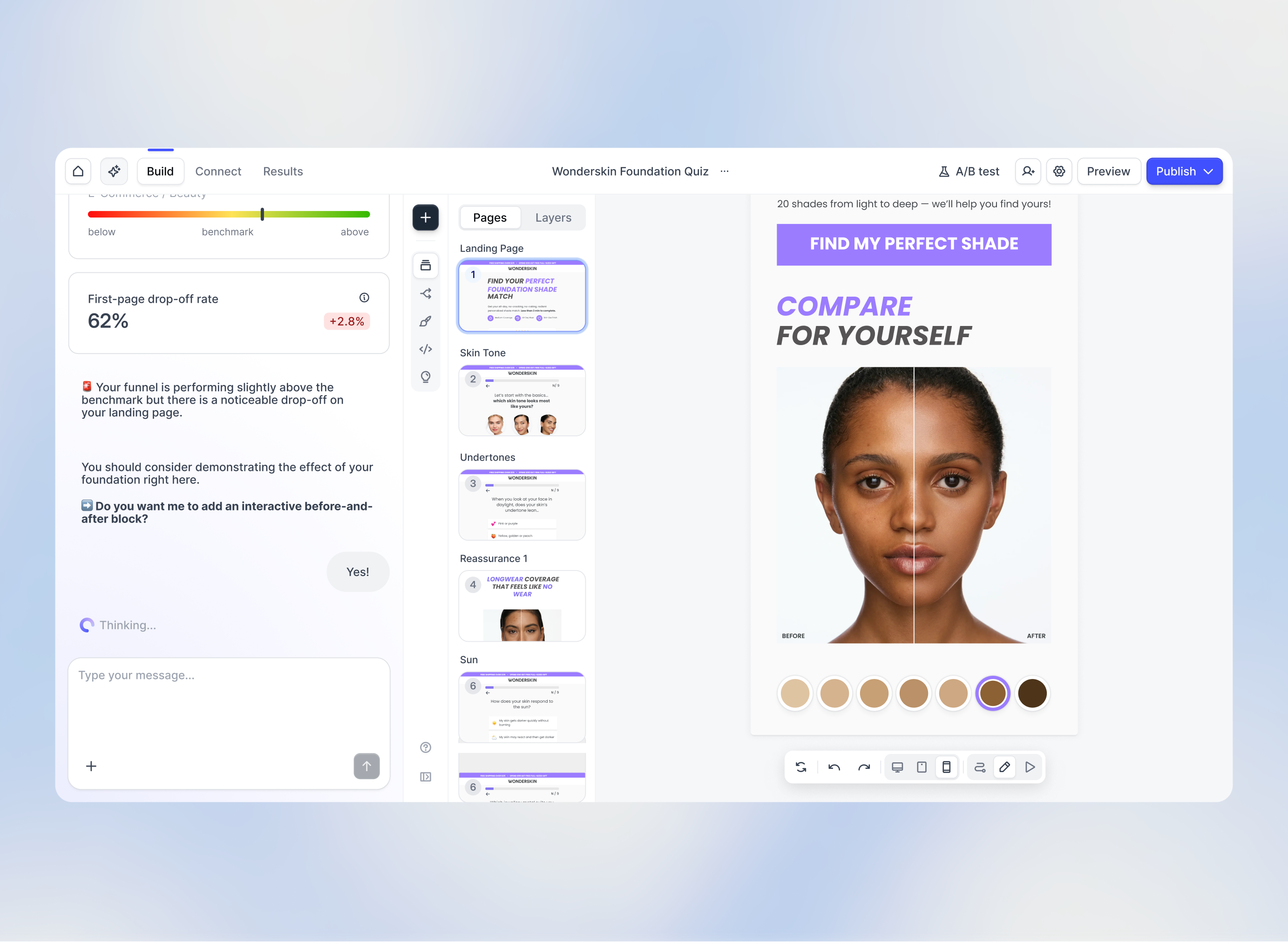
Heyflow is a funnel platform used to build highly converting funnels, landing pages, advertorial and pre-sell pages, quizzes, and anything else that needs to convert. With an AI trained on 150,000+ real funnels and $2B+ in ad spend, it recommends the right questions, proof points, and sequencing before a single test is run. Performance marketers, agencies, ecom brands, and growth teams can use Heyflow to drive higher CVR, better ROAS, and lower CAC.
$89
per month
Pricing
Clay
Heyflow
Editions & Modules
Starter
$149
per month 2000 credits per month
Explorer
$349
per month 10,000 credits per month
Pro
$800
per month 50,000 credits per month
Enterprise
Custom Pricing
Starter
$89
per month
Growth
$149
per month
Scale
$299
per month
Enterprise
from $1100
per month (billed annually)
Offerings
Pricing Offerings
Clay
Heyflow
Free Trial
Yes
Yes
Free/Freemium Version
Yes
No
Premium Consulting/Integration Services
No
Yes
Entry-level Setup Fee
No setup fee
No setup fee
Additional Details
Discount available for annual pricing.
Discount available for annual subscription as well as for start ups.
More Pricing Information
Features
Clay
Heyflow
Prospecting
Comparison of Prospecting features of Product A and Product B
Clay
8.2
95 Ratings
6% above category average
Heyflow
-
Ratings
Advanced search
8.393 Ratings
00 Ratings
Identification of new leads
8.287 Ratings
00 Ratings
List quality
7.986 Ratings
00 Ratings
List upload/download
9.083 Ratings
00 Ratings
Ideal customer targeting
8.01 Ratings
00 Ratings
Load time/data access
7.688 Ratings
00 Ratings
Sales Intelligence Data Standards
Comparison of Sales Intelligence Data Standards features of Product A and Product B
Clay
8.3
86 Ratings
7% above category average
Heyflow
-
Ratings
Contact information
8.186 Ratings
00 Ratings
Company information
8.685 Ratings
00 Ratings
Industry information
8.284 Ratings
00 Ratings
Data Augmentation & Lead Qualification
Comparison of Data Augmentation & Lead Qualification features of Product A and Product B
Clay
8.0
84 Ratings
7% above category average
Heyflow
-
Ratings
Lead qualification process
8.578 Ratings
00 Ratings
Smart lists and recommendations
8.01 Ratings
00 Ratings
Salesforce integration
8.266 Ratings
00 Ratings
Company/business profiles
8.382 Ratings
00 Ratings
Data hygiene
8.180 Ratings
00 Ratings
Automatic data refresh
7.01 Ratings
00 Ratings
Filters and segmentation
8.01 Ratings
00 Ratings
Sales Intelligence Email Features
Comparison of Sales Intelligence Email Features features of Product A and Product B
Clay
7.9
64 Ratings
6% above category average
Heyflow
-
Ratings
Sales email templates
7.964 Ratings
00 Ratings
Lead Management
Comparison of Lead Management features of Product A and Product B
Clay
-
Ratings
Heyflow
7.6
7 Ratings
1% below category average
Automated sales alerts and tasks
00 Ratings
8.06 Ratings
Automated follow-ups
00 Ratings
7.14 Ratings
Lead Management Integrations
Comparison of Lead Management Integrations features of Product A and Product B
Clay
-
Ratings
Heyflow
8.2
18 Ratings
9% above category average
Integrations with advertising platforms
00 Ratings
8.214 Ratings
Integrations with CRMs
00 Ratings
7.816 Ratings
Integrations with data storage tools
00 Ratings
8.114 Ratings
Integrations with lead automation tools
00 Ratings
8.813 Ratings
Conversion Rate Optimization
Comparison of Conversion Rate Optimization features of Product A and Product B
Clay
-
Ratings
Heyflow
7.5
20 Ratings
10% below category average
KPI analytics
00 Ratings
7.318 Ratings
Drop-off analytics
00 Ratings
7.520 Ratings
A/B tests
00 Ratings
7.915 Ratings
Form Building
Comparison of Form Building features of Product A and Product B
Sales automation is the most suited use case of Clay. You could generate GTM motions that are auto triggered by the signals, so you could actually create workflows that are triggered on specific signals. For example, a company gets new funding, you can reach out to the company within in a matter of minutes and you can track a lot of news that's happening on Google or using RSS feeds. You can patch that news into Clay and then manipulate that and get insights out of it. The second best use case is the data enrichment or data cleanup. Usually companies have CRMs with messy data. You can import that. Clay has native integrations with Salesforce, HubSpot, Pipedrive, Marketo, and you can import those lists into Clay and then clean the data, enrich the data, and then push that forward, update the data in the CRMs. That's the second best use case that I use it for and would recommend it for.
Heyflow is very well suited for creating landing pages or simple forms for recruiting employees. It's also excellent as an order form for generating leads. However, it's not suitable for surveys or appointment requests. Furthermore, it's very easy to use, even for users with no prior experience in this area.
Pros, I think there are a lot of pros, so I mentioned a couple of them already, so being able to use different data providers. I think being able to massage the data, I call it a data orchestration where I can get different points of inputs of data. I can throw everything in Clay and then I can make all the changes before I use them for campaigns, for email, for LinkedIn, for whatever reason I'm going to use my data, but it's really easy to enrich, it's really easy to do research. It's really easy to build agents that tie to each row in your dataset, like there are a lot of things that you could use it for that are huge pros.
A max column limit. I run into the column limit all the time and kind of have to figure out using multiple tables. Just bugs really. I mean if you start getting too crazy on it, I feel like takes a long time. You can't really identify that it's working or if it's not. So that kind of slows things down a little bit.
Restricted webhook functionality, wed like to be able to map fields without having to post the full request and change the receiving webhook our end to cater to Heyflow
a/b testing, not being able to 'keep' older variants which we may want to retest later
little things like we only do uk market so all phone numbers start with 01 or 07 so we want to have a placeholder example thats familiar to the user eg 07766554433 but the system is restricted to +447766554433 which is a conversion factor for us
The software is well suited in lead scoring and workflows management. Product reliability in customer outreach management and segmentation. The product is worth it from pricing to quality ecommerce services and automation of processes.
Heyflow hat mich von Anfang an begeistert – und das nicht nur wegen der intuitiven Benutzeroberfläche. Die Plattform schafft es, komplexe Prozesse wie Leadgenerierung, Qualifizierung oder Terminvereinbarungen in einfache, interaktive und visuelle Erlebnisse zu verwandeln.
In wenigen Minuten lassen sich Flows erstellen, anpassen und live schalten – ohne auf Entwickler warten zu müssen.
Mit Features wie progressiver Datenerfassung, A/B-Testing, personalisierter Ansprache und reibungsloser UX steigern wir messbar die Conversion Rates. Ich kann CI-konforme, moderne und mobiloptimierte Flows gestalten, die genau zu der Zielgruppe passen. Für mich ist Heyflow nicht nur ein Tool, sondern ein echter Gamechanger im digitalen Marketing. Es verbindet Effizienz mit Kreativität – und das mit einem Wow-Effekt für Nutzer und Kund:innen
I think it's actually before the launches today, I would say eight, but after they launch, what's the name of the product? I dunno if it was the web intent or the sculpture. 10, because I think that the sculpture was the missing part of plates till now.
Heyflow is very user-friendly and intuitive, especially for non-technical users. The drag-and-drop interface makes it easy to design and launch interactive flows quickly, and the real-time preview feature is a big plus. I’m giving it an eight because while it’s great for most standard use cases, there are some limitations in advanced logic, dynamic behavior, and custom styling that can require workarounds.
There have been no notable outages of HEyflow to date, not even in the past. If an outage is imminent, HEyflow will announce it in good time. If it occurs unexpectedly, SUpport will find a solution as quickly as possible. In some cases, a different server solution has been offered temporarily to minimize downtime. All in all, the response times of the support team are excellent.
Heyflow's performance is truly exemplary and fast. We have never had any performance issues, regardless of how many visuals or videos we used. Unfortunately, we cannot comment on integrations, as we do not use any except for a Meta Pixel. However, even this has not affected our performance so far.
Heyflow's support is truly world-class. Whether via chat or email, you'll receive genuine help. If a problem can't be resolved immediately, they'll look into it and usually get back to you the next day. Their response time is generally very fast compared to other companies. It's also possible to book a free appointment at any time, during which a representative will contact you by phone to offer advice and assistance on how to improve your performance.
I had already used Heyflow at my previous company because I was familiar with it from a service provider. Therefore, it was an easy decision to implement Heyflow again. The implementation was very straightforward, just as planned. There were absolutely no problems, and it worked perfectly from the start. But that's precisely what makes Heyflow so great!
So in a sense, there is a large community, and because of the community you also learn multiple workflows and how to use it better. You can kind of democratize or source knowledge more easily on how to use the product, and also transfer it so other people can use it more easily. So in a sense, that works.
Heyflow Vs. Typeform = Heyflow wins because of design flexibility as TF is very stuck in their typical classical look. Heyflow also comes with a plethora of more options to improve lead quality and has drop-off analytics as standard. Heyflow Vs. Growform = This one is tougher as I think Growform is very competitive with what you get value-wise like no charge for phone and email network validations against Twilio and Neverbounce API's. Also Growform comes with a much more generous submission count for their smaller tiers AND I'm not capped by the amount of forms.
No, I wouldn't change any of Heyflow's terms and conditions or price. The price-performance ratio is simply impressive. I don't know of any other provider that offers a platform that allows you to start from scratch without any prior knowledge and gives you top-notch support at all times, helping you optimize your flows and get even more out of them.
The overall scalability is excellent in Heyflow. We have the ability to work across locations as a team without any limitations; it doesn't matter how many team members we have or how many customers we cover. The scalability and flexibility also allow us to serve our customers with the same account and thus cover different business segments when it comes to online forms.
Without Clay we would probably have our agency, but not with the level of sophistication we have right now or really one of our USP that we are certified by Clay. That's how we get a lot of inbound leads as well. So that of course leads to a very healthy ROI. If we look at inbound.
I think negative as terms in negative ROI, I think this is a nice one to touch on. Expectation management for tooling such as Clay is extremely difficult because people see a lot of stuff happening on LinkedIn from the top 1% of Clay experts and they look at us and "hey, we want the same thing," basically. That's quite a challenge. So that's really a good conversation to have with your potential client as well. Like, "Hey, I know, tell me what you've seen. We're going to see what we can do if that's reasonable or not." Set realistic expectations there and don't expect to go from zero to 100 within a very small time window. So that was something we had to learn. We had a lot of unrealistic expectations for what we can do. We can improve your business, but we can't do it with a factor of X or in a period of eight weeks.