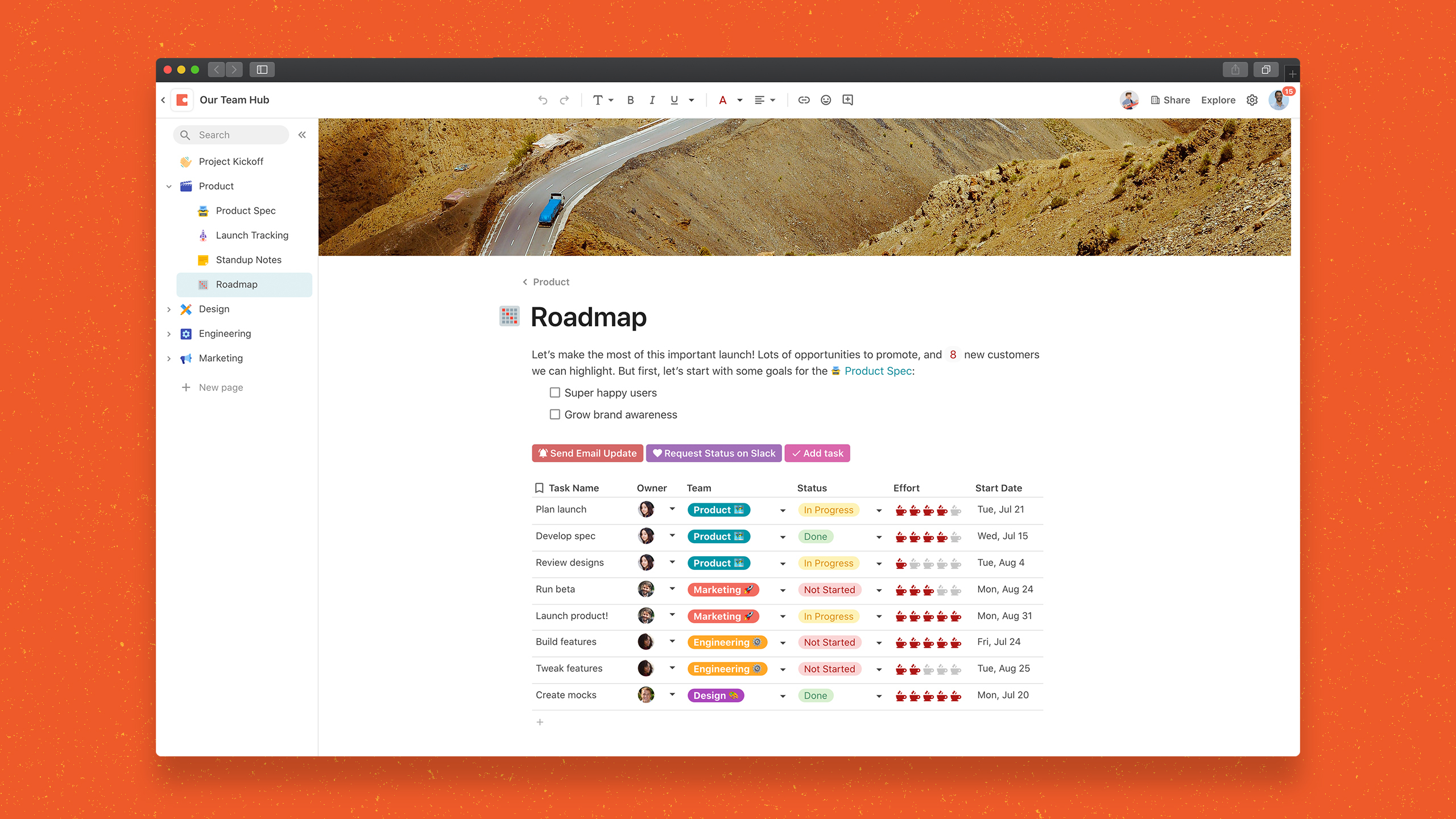
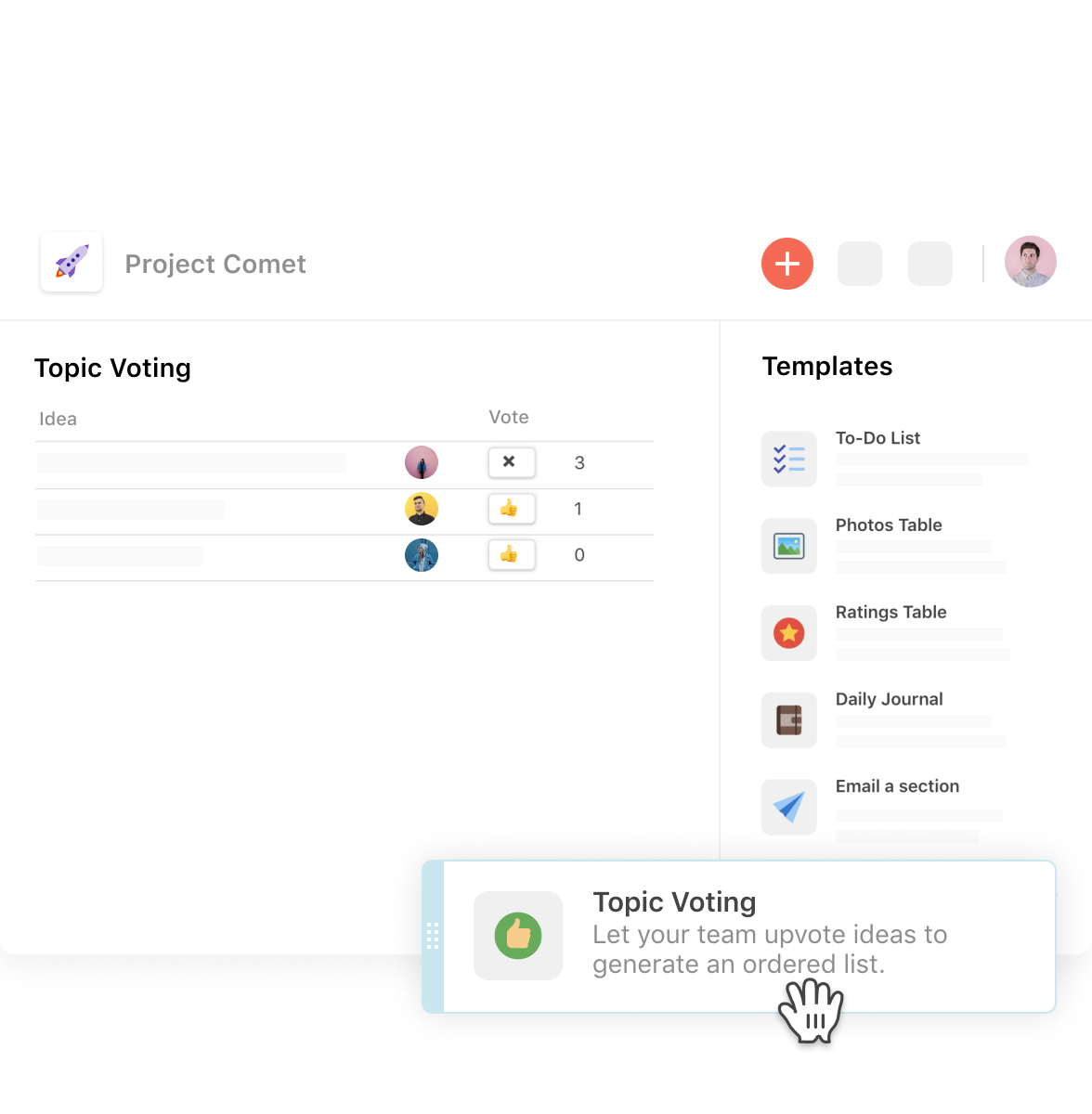
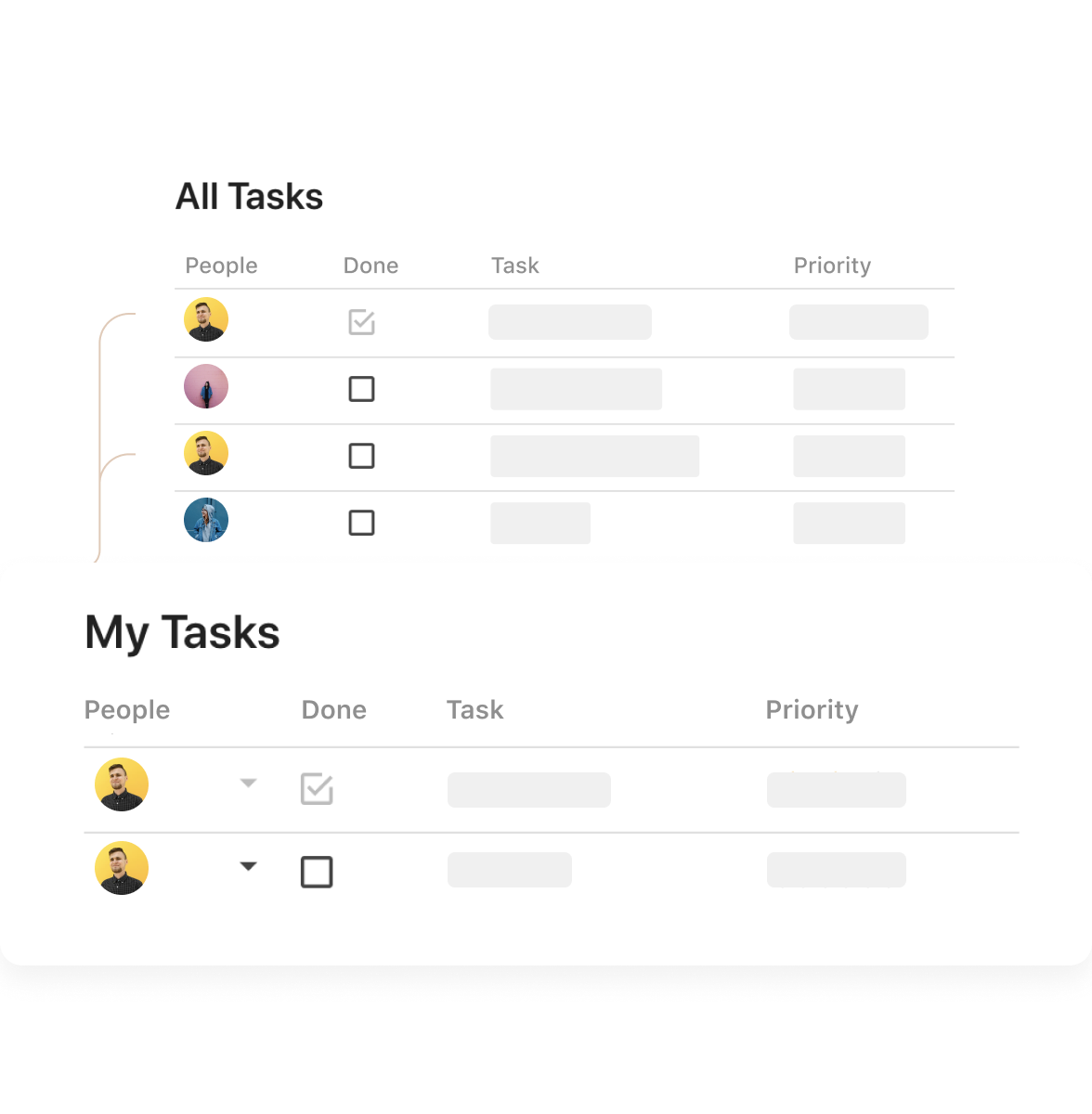
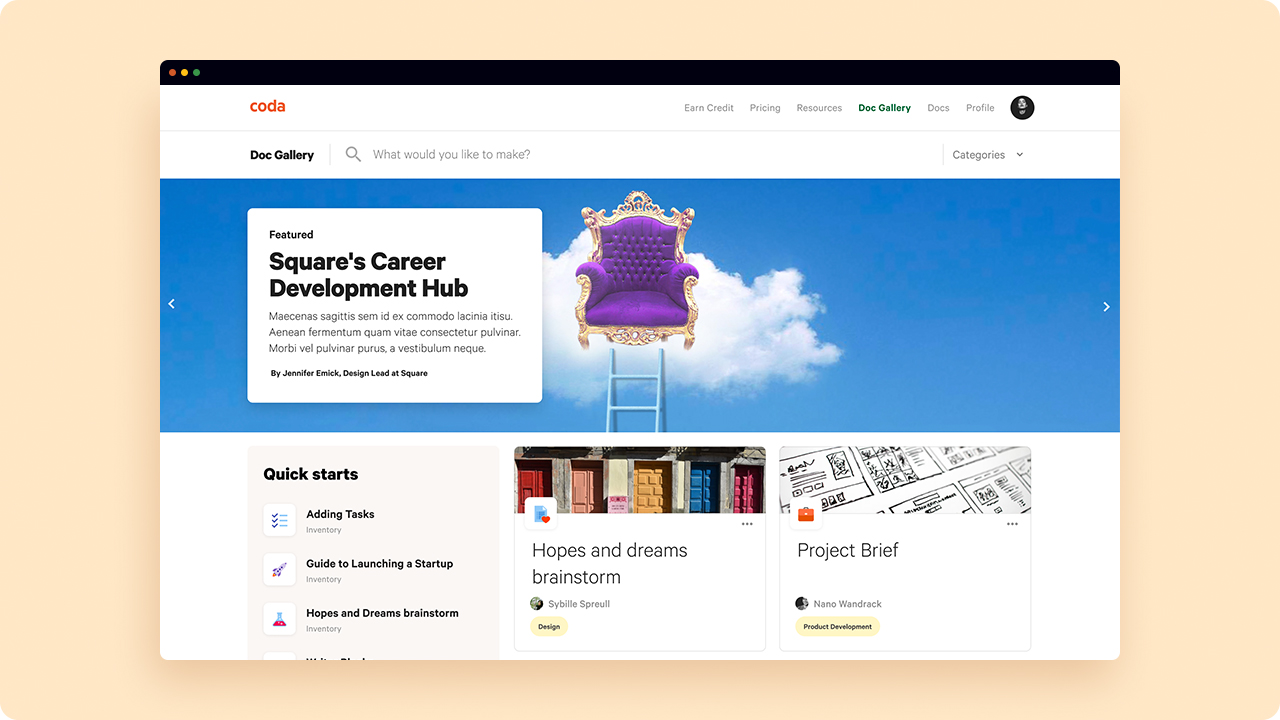
Coda, acquired by Grammarly in early 2025, is a template-based document creation and collaboration solution, supporting a variety of use cases.
$0
per month
Rally Software
Score 7.7 out of 10
N/A
Rally Software headquartered in Boulder, Colorado developed the Rally agile software development / ALM platform which was acquired by CA Technologies and rebranded as CA Agile Central. After CA's acquisition by Broadcom the software was once again rebranded as Rally.
N/A
Trello
Score 8.4 out of 10
N/A
Trello from Atlassian is a project management tool based on a Kanban framework. Trello is ideal for task-management in a to-do list format. It supports sharing boards and cards across users or teams. The product offers a free version, and paid versions add greater automation, collaboration, and administrative control.
$6
per month per user
Pricing
Coda by Grammarly
Rally Software
Trello
Editions & Modules
Free
$0.00
per month
Pro
$10.00
per month per doc maker; unlimited editors (paid annually)
Team
$30.00
per month per doc maker; unlimited editors (paid annually)
Enterprise
Custom Pricing
No answers on this topic
Standard
$6
per month per user
Premium
$12.50
per month per user
Enterprise
$17.50
per month per user
Free
Forever Free
Offerings
Pricing Offerings
Coda by Grammarly
Rally Software
Trello
Free Trial
Yes
No
No
Free/Freemium Version
Yes
No
Yes
Premium Consulting/Integration Services
Yes
No
No
Entry-level Setup Fee
No setup fee
No setup fee
No setup fee
Additional Details
With Coda, you only pay for Doc Makers.
Often one person creates a doc, others edit it, and some simply observe from afar. Instead of charging for everyone, we only charge for the people who create docs.
Interested in enterprise pricing? Visit coda.io/enterprise
—
A discount is offered for annual billing and for larger numbers of users.
I did not select Rally; it was chosen by the organization. If I were choosing what to use within my own team, I would use Trello. It's free, very simple to use, and has a much nicer user interface. My company previously used VersionOne however, and I prefer Rally over that …
Our evaluation was done many years ago, but at the time Rally provided the best mix of SCRUM-driven features, visibility and economy for our product engineering teams.
Trello gives a better visibility and Freemium account to start with
Verified User
Engineer
Chose Trello
Trello has less integrated features but is a very intuitive platform for task management for no cost. Its mobile app is a superb product that is invaluable for staying on top of your day to day tasks. Rally often gets bogged down by some of its complexity, but that is not the …
Coda is great to build a place for your users to go to and see information. It is easy to navigate through and the variety of content creation is great. However, it is not always easy to create what you want and there is a lot of playing around and learning. Coda also sometimes misses some functionality which is expected. For example, downloading a list of users that have access to the platform. Being able to send push notifications when a new page has been created etc. Overall it is a good tool to use just be prepared to invest time!
Rally Software is well suited for large Agile or scrum teams who do sprints and it helps managing sprints and backlogs. It is well suited for organizations who want visibility into work being done and progress. Suitable for tracking is user stories, defects and release planning. Works well with CI CD too. It would not be suitable for small teams or startups. For teams that don't use agile. Teams who want lightweight tools like Jira. Companies with a limited budget.
For teams or individuals with lots of individual tasks/details to track, Trello is perfect! It basically removes the need for a paper checklist. For those that need an overall project management tool that requires less tasks and more overarching goals, collaboration amongst various teams, and gantt charts I would suggest monday.com
There are dashboards that provide friendly and useful metrics at the team, program and portfolio levels which help get an easy and quick visual representation of what's going on.
Story management made easier, It offers a quick way of quickly entering a number of user stories without losing the overview, by just typing the title and selecting a few attributes directly in the overview screen.
Sprint management is seamless in CA Agile Central . It allows you to drag stories from the backlog to the sprints and back again. When a story is dragged into an sprint, it automatically checks the velocity for that sprint and indicates how many more story points can be chipped in. No more manual checking needed by scrum master with respect to allocation and team velocity.
Though CA Agile Central has many inbuilt apps, but it also has an App-SDK that allows you to build free app extensions using JavaScript and HTML. So, as per their needs, teams can customize & build various apps & dashboards.
Dashboard is an awesome feature which allows you to select and drag panels with all kinds of graphical information about the current sprints and releases.
It offers tremendous support for scaled Agile & almost all scaling frameworks are supported specifically tuned to SAFe .
CA Agile Central includes several applications but it also integrates well with Jira, Confluence, Jenkins, Eclipse, Subversion, IBM, HP, Salesforce.com and many other products to allow users to organize projects to their specifications. So you can still use Jira at a team level & CA Agile Central at the program & portfolio level for efficient tracking & management.
The custom tags are very helpful in segregating the user stories based on the project needs. Even though it's a very small feature, it is very effective ( you will realize why specifically if you are using Jira).
CA Central Agile enables agile delivery with ease and provides comprehensive features to track time-boxes, Work In Progress items of the forecast increments.
Backlog management is hassle free since you can either drag and drop your user stories to the desired position on the backlog, or change a setting and manually enter priorities as a number.
It takes getting used to in terms of how the formulas per column is implemented, in contrast to how we build tables in Excel. For organization/team purchase, it would be worth considering having a training for the core team of users. Right now, we do a lot of self-learning.
Inability to email charts or image without these objects being hosted on a third party. The community has been great in providing workarounds but it would be much more convenient to be able to have such ability natively.
APAC Support. I'm based in Malaysia, due to timezone differences, even with a livechat implemented, the support for each step and conversation takes up to 24 hours per response. Having some hours covered in our timezone would greatly improve customer support experience.
User management is pretty basic and could be better. For example more filters and reports and more ability to do mass updates.
The report generator is very, very basic and is not WYSIWYG. It has limited filters to generate reports. Often a Scrum master will need to export data to Excel or a tool like Crystal Reports to get enhanced reporting capability.
Coda is definitely something that has been proven to drive positive impact in our organization. We have many divisions that can benefit from this that we have yet to explore. It would definitely be worth renewing.
I am very likely to renew Trello, because it doesn't cost anything to do so. I am also very likely to use Trello's upgraded features in the future because a lot of my team's data is stored on there and they have already gotten used to the platform. Trello is very easy for new team members to pick up, making the onboarding and usability very streamlined.
There is a little bit of a learning curve on where to point and click to add in different elements and make edits. But it is still very manageable once you get the hang of it. I do still have some issues with some of my connected pages updating each other when I don't want them to sync. So I'll end up editing one page, and it will make the same edits on another page.
Great UI, recent refresh was terrific. Great graphs and metrics, inline editing for updates, and a multitude of views on sprint progress make for a great team collaboration experience. There is also an active community and forums so that if you do need help, it is readily available
Trello is incredibly intuitive, both on desktop and mobile right away. It is also full of helpful features that make it even easier to use, and is flexible enough to suit almost any organizational need. Onboarding for the software is thorough, but concise, and the service is frequently updated with even more QOL improvements.
We haven't done any integrations - the initial part of our experience we found that for docs with complex formulas, the page tends to load slowly but in recent months, Coda has improved and optimized the loading times in general and we generally don't find any problems in terms of speed anymore.
The screens render relatively quickly but many actions that you would expect to require a single click require multiple clicks and pop-up windows. The extra windows and clicks make the product feel ponderous.
Mainly due to timezone differences. I think Coda's support in general is well implemented and executed. They know their stuff and are helpful. But since I'm not in the same timezone, solution rates are slower for me, and that's not something I prefer. I work in customer service, too, and more often than not, time is important. Shortening the solution time would be a much greater experience.
I've had to use support only one time and my issue was eventually resolved but not because of my ticket--because others complained about the functionality taken away so they brought it back. My ticket was never answered or addressed. So I can't really say much for the support factor for Rally.
I haven't reached out to their support very often and their support is very limited anyway for the free users. They do have tons of great articles and videos in their Help Center and constantly send emails with updates and add-ons to the product. The fact that I've barely ever had to contact their support team means that they've developed a great product.
It more or less confirmed that we are using it the way they had in mind. We were hoping for a epiphany in terms of how we could use it better.
They also want to be a go to source for agile processes and have an online resource center. It’s not that great but had a couple of nuggets. It hasn’t really helped us too much and we are not too far off from the classical interpretation of agile.
I would recommend training, in particular for organizations that multiple on-going projects. The product seems optimized for larger, more complex teams and getting proper training on how to configure, administer and use the system would be beneficial
I'm relatively inexperienced but this experience is meaningful. It would have been nice to have some guidance from Coda so that we understood more on Coda's purpose and potential.
Implementation of RALLY services and program satisfaction among various group,... 1) Dev Outcomes: How were our resiliencies, development, learning & practitioners “make them do the work,” but that they ask you to do it “in a way like before. 2) The Ops group: Just wish to make sure any change won't break current production envirements All the stake holders has to be on the same page
For our small business, getting a few of us started well on Trello was the key, I think. As long as a couple of us were really comfortable with the interface, we could lead others and help them with any questions. From now on, anyone who works with us just naturally uses Trello for information sharing - it's just part of what we do.
While all of the products listed have great features and platforms, there was always one thing missing from them that I would need to get from another application. Coda was the first one we used that really combined some of the best parts of those products and allowed us to use it in one place. I also appreciate the flexibility of creating your own framework and workflow, unlike in other tools where you have to follow how they capture data and organize projects.
Rally and Asana have comparable features and are both valuable project management tools, but Asana's user interface is well-organized and highly intuitive. It's easy to add tasks and collaborators, edit due dates, indicate progress on tasks, close out projects, etc. However, Rally's interface is somewhat cluttered and difficult to navigate. My team ended up choosing Asana over Rally due to these concerns.
Trello is more simple and not as "robust" as the other tools, but it's easier to use and manage and understand and ACTUALLY get stuff done with. It's simplicity is part of the beauty of using it. You don't need a million options that nobody uses, you just need to get stuff done.
I think scalability is definitely good here since it's based on number of doc makers. Implementation into each dept becomes simpler. That being said, due to the nature of our work, we find it easier that we have a "super user" and then a team of other doc makers. This would make the doc creation and management more efficient.
it helped organizing many of the processes management use to communicate tasks with engineers, and provided detailed charts on the speed/blockage during any iteration
with time Rally became the main tool we used to track and report tasks/defects in our projects, but frequent service outages made it very hard to continue consider as a reliable solution
too much features is good, but for engineers a few features (User Stories section, iterations, defects, and Kanban boards) are necessary and the rest is just noise
Trello keeps me organized, focused, and on track. I could filter the Trello board to only see my issues and understand what I needed to work on and when.
Trello helped our team implement an agile structure. It's a very simple kanban method of viewing all of your team's tasks and statuses. You can completely customize the columns to your team's specific workflow and create tags relevant to your work.
Trello helps reduce unnecessary communications between teams. When I want to request translations, I simply create a card on the localization Trello board -- no need to directly message anyone on the team, and I can watch the status of the card change from "in progress" to "in review" to "translated," all without having to directly ask for updates.