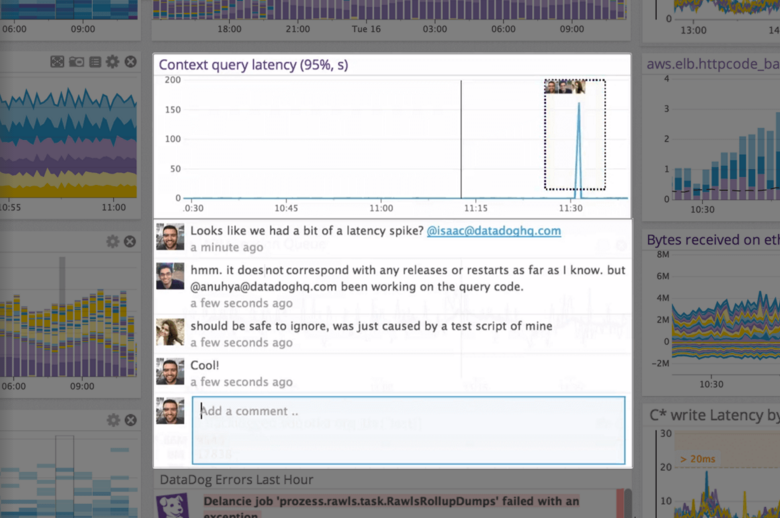
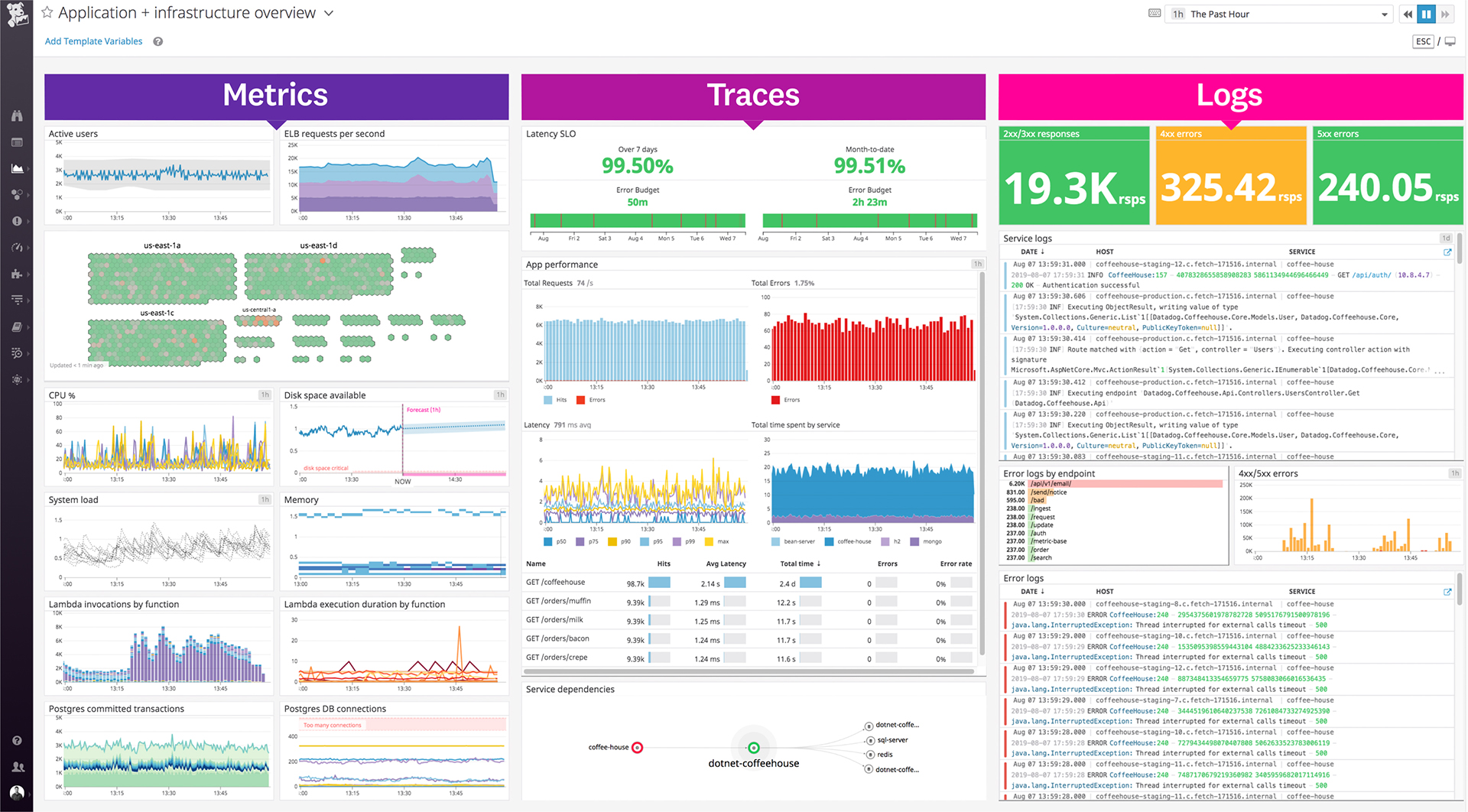
Datadog is a monitoring service for IT, Dev and Ops teams who write and run applications at scale, and want to turn the massive amounts of data produced by their apps, tools and services into actionable insight.
$18
per month per host
Nutanix Cloud Infrastructure
Score9 out of 10
N/A
Nutanix in San Jose, California offers their software-defined Enterprise Cloud as a hyper-converged infrastructure solution. The Nutanix Cloud Infrastructure solution combines the Nutanix Acropolis virtualization solution, Nutanix AHV hypervisor (though Acropolis works with other hypervisors), Prism cluster manager, Nutanix Calm and Nutanix Flow server management, and is available on the Nutanix NX series of server hardware appliances, as well as third-party OEM appliances.
N/A
Pricing
Datadog
Nutanix Cloud Infrastructure
Editions & Modules
Log Management
$1.27
per month (billed annually) per host
Infrastructure
$15.00
per month (billed annually) per host
Standard
$18
per month per host
Enterprise
$27
per month per host
DevSecOps Pro
$27
per month per host
APM
$31.00
per month (billed annually) per host
DevSecOps Enterprise
$41
per month per host
No answers on this topic
Offerings
Pricing Offerings
Datadog
Nutanix Cloud Infrastructure
Free Trial
Yes
No
Free/Freemium Version
Yes
No
Premium Consulting/Integration Services
No
No
Entry-level Setup Fee
Optional
No setup fee
Additional Details
Discount available for annual pricing. Multi-Year/Volume discounts available (500+ hosts/mo).
Datadog may be better suited for teams that have a more out-of-the-box infrastructure, on the primary platforms Datadog supports. You may also have better results if you have a bigger team dedicated to devops and/or a bigger budget. We found that trying to adapt it to our use case (small team, .NET on AWS Fargate) wasn't feasible. We continually ran into roadblocks that required us to dig through documentation (and at times, having to figure out some documentation was wrong), go back and forth with support, and in my opinion, waste money on excessive and unintended usages due to opaque pricing models and inaccurate usage reports, as well as broken/non-functional rate sampling controls.
A de minimis incentive was given to thank the reviewer for their time. The incentive was not used to bias or drive a particular response, nor was the incentive contingent on a positive endorsement. TR verified that a representative sample of customers was invited. More Info
For an organization that requires top-notch performance HCI, Nutanix is the best. You may start with 3 nodes and expand the cluster as required. The management through Nutanix Prism Central and Element was so easy that even a Junior Engineer was able to handle it. The Nutanix platform is not suitable for organizations with a small budget and fewer requirements for high-performance infrastructure, as the Nutanix solution itself is suited for enterprises.
A de minimis incentive was given to thank the reviewer for their time. The incentive was not used to bias or drive a particular response, nor was the incentive contingent on a positive endorsement. TR verified that a representative sample of customers was invited. More Info
The thing which Datadog does really well, one of them are its broad range of services integrations and features which makes it one step observability solution for all. We can monitor all types of our application, infrastructure, hosts, databases etc with Datadog.
Its custom dashboard feature which helps us to visualize the data in a better way . It supports different types of charts through those charts we can create our dashboard more attractive.
Its AI powered alerting capability though that we can easily identify the root cause and also it has a low noise alerting capability which means it correlated the similar type of issues.
A de minimis incentive was given to thank the reviewer for their time. The incentive was not used to bias or drive a particular response, nor was the incentive contingent on a positive endorsement. TR verified that a representative sample of customers was invited. More Info
One-click upgrades; whether it's hypervisor, firmware, disk or other updates. This feature has drastically decreased complexity and administration time.
Data Locality. Not all hyperconverged technology is created equal. When I first purchased Nutanix they were the only vendor (and as far as I know, still are) that made sure the storage a VM used was on the same host that VM was running on. Given a normal operating state, the [storage] network is literally only used for replication data.
They got rid of traditional RAID. Nutanix uses software to determine where a VM's storage should be written and replicated to. This dramatically decreases I/O when changing the number of nodes in a cluster, be it on purpose or during a failure scenario. Ex. adding a new node: If one uses RAID arrays then enough space has to be set aside to create a new array that includes the new node, then all the information has to be copied over, and the old array destroyed. RAID arrays do not grow and shrink gracefully so Nutanix has designed a better solution.
The Nutanix management interface was built on HTML5. No more flash headaches!
A de minimis incentive was given to thank the reviewer for their time. The incentive was not used to bias or drive a particular response, nor was the incentive contingent on a positive endorsement. More Info
Alert windows cause lag in notifications (e.g. if the alert window is X errors in 1 hour, we won't get alerted until the end of the 1 hour range)
I would appreciate more supportive examples for how to filter and view metrics in the explorer
I would like a more clear interface for metrics that are missing in a time frame, rather than only showing tags/etc. for metrics that were collected within the currently viewed time frame
A de minimis incentive was given to thank the reviewer for their time. The incentive was not used to bias or drive a particular response, nor was the incentive contingent on a positive endorsement. More Info
The one downside I have working with Nutanix is the sales team. They seem to try to add in extra goodies to sales quotes or push for extras that you don't really need and you have to tell them to take them out. Don't be afraid to push back on them.
Need to analyze sizing with sales team to ensure right sizing.
A de minimis incentive was given to thank the reviewer for their time. The incentive was not used to bias or drive a particular response, nor was the incentive contingent on a positive endorsement. More Info
A de minimis incentive was given to thank the reviewer for their time. The incentive was not used to bias or drive a particular response, nor was the incentive contingent on a positive endorsement. TR verified that a representative sample of customers was invited. More Info
AOS definitely make our dev/test virtual environment management much easier than before. And the consolidation the test/dev environment from Azure and Cisco UCS, we have less need to transfer large amount of data between different hardware platforms which was very big challenge. To expand the capacity is very easy to archive as well.
A de minimis incentive was given to thank the reviewer for their time. The incentive was not used to bias or drive a particular response, nor was the incentive contingent on a positive endorsement. More Info
There are so many features that it can be hard to figure out where you need to go for your own use case. For example, RUM monitoring us buried in a "Digital Experience" sidebar setting when this is one of our key use cases that I sometimes struggle to find in the application. It appears that ECS + Fargate monitoring was recently released which is great because we had to build a lambda reporting solution for ephemeral task monitoring. But this new feature was never on my radar until I starting clicking around the application.
A de minimis incentive was given to thank the reviewer for their time. The incentive was not used to bias or drive a particular response, nor was the incentive contingent on a positive endorsement. More Info
It's not out of the box easy, but once you get the fundamentals the steep learning curve flattens out and the processes to get things done and how it works becomes very apparent. It's wrapping the slight change in workflow from prior VM management methods took time to unbox and apply the Nutanix Cloud Infrastructure way
A de minimis incentive was given to thank the reviewer for their time. The incentive was not used to bias or drive a particular response, nor was the incentive contingent on a positive endorsement. TR verified that a representative sample of customers was invited. More Info
A de minimis incentive was given to thank the reviewer for their time. The incentive was not used to bias or drive a particular response, nor was the incentive contingent on a positive endorsement. More Info
The performance is nothing short of amazing. This is an HCI solution, and as any all-flash HCI solution is amazingly fast, Nutanix AOS fills local IO requests until its local IO is saturated before reaching out over the network. This lowers latency substantially compared to vSAN.
The support team usually gets it right. We did have a rather complicate issue setting up monitoring on a domain controller. However, they are usually responsive and helpful over chat. The downside would be I don’t think they have any phone support. If that is important to you this might not be a good fit.
A de minimis incentive was given to thank the reviewer for their time. The incentive was not used to bias or drive a particular response, nor was the incentive contingent on a positive endorsement. More Info
Our implementation team were great and worked with us and got the program up and running very easily. Every time we called post implementation we immediately talked to an Engineer, which is so unusual in dealing with companies. Everything they have promised they have full filled. I think their support is top notch.
A de minimis incentive was given to thank the reviewer for their time. The incentive was not used to bias or drive a particular response, nor was the incentive contingent on a positive endorsement. More Info
A de minimis incentive was given to thank the reviewer for their time. The incentive was not used to bias or drive a particular response, nor was the incentive contingent on a positive endorsement. More Info
A de minimis incentive was given to thank the reviewer for their time. The incentive was not used to bias or drive a particular response, nor was the incentive contingent on a positive endorsement. More Info
A de minimis incentive was given to thank the reviewer for their time. The incentive was not used to bias or drive a particular response, nor was the incentive contingent on a positive endorsement. TR verified that a representative sample of customers was invited. More Info
IPv6 is needed for link local discovery. We do not have IPv6 configured on our network so the easiest way to get our nodes configured and discovered by foundation was to configure the IPv4 addressing within the node prior to trying to discover with foundation.
A de minimis incentive was given to thank the reviewer for their time. The incentive was not used to bias or drive a particular response, nor was the incentive contingent on a positive endorsement. More Info
Our logs are very important, and Datadog manages them exceptionally well. We frequently use Datadog services for our investigations. Use case: Monitor your apps, infrastructure, APIs, and user experience.
Key features:
Logs, metrics, and APM (Application Performance Monitoring)
Real-time alerting and dashboards
Supports Kubernetes, AWS, GCP, and other integrations
RUM (Real User Monitoring) and Synthetics
✅ Best for backend, server, and distributed systems monitoring.
A de minimis incentive was given to thank the reviewer for their time. The incentive was not used to bias or drive a particular response, nor was the incentive contingent on a positive endorsement. More Info
Nutanix integrates very well with Rubrik for backup and protection of the environment. Nutanix gave us simplicity and scalability compared to VMware and allowed us to extend our infrastructure into the cloud using EC2. One unified management pane for all our workloads, unlike VMWare.
A de minimis incentive was given to thank the reviewer for their time. The incentive was not used to bias or drive a particular response, nor was the incentive contingent on a positive endorsement. TR verified that a representative sample of customers was invited. More Info
A de minimis incentive was given to thank the reviewer for their time. The incentive was not used to bias or drive a particular response, nor was the incentive contingent on a positive endorsement. More Info
A de minimis incentive was given to thank the reviewer for their time. The incentive was not used to bias or drive a particular response, nor was the incentive contingent on a positive endorsement. More Info
We find that return on investment is probably a better metric in most cases.
ROI analysis is more than an exercise. Companies must outline what their future looks like, even if it’s vastly different from what they’re used to and comfortable with.
As good as your financial analysis might be, displacing status quo infrastructure has a lot of emotions tied to it.
A de minimis incentive was given to thank the reviewer for their time. The incentive was not used to bias or drive a particular response, nor was the incentive contingent on a positive endorsement. More Info