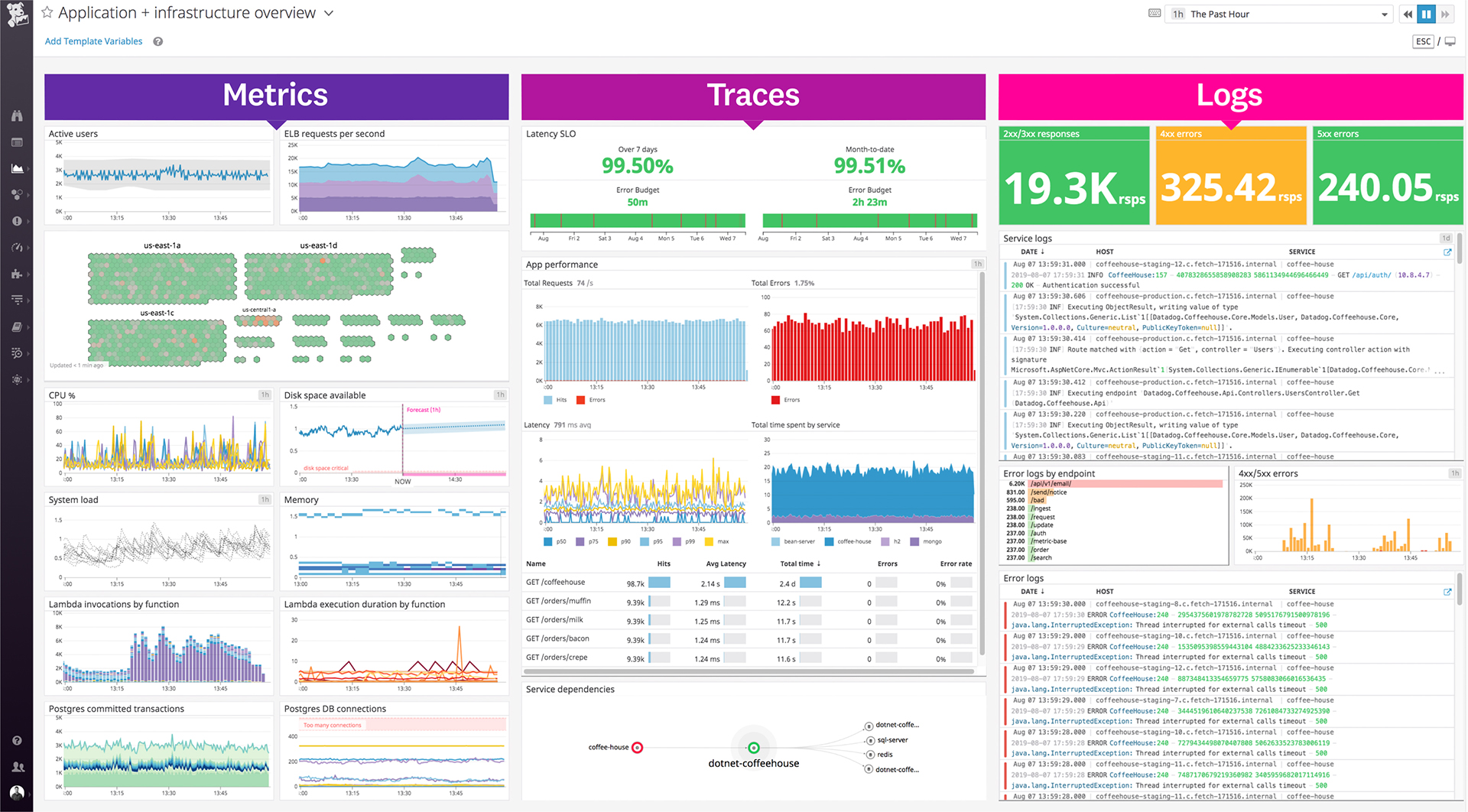
Datadog is a monitoring service for IT, Dev and Ops teams who write and run applications at scale, and want to turn the massive amounts of data produced by their apps, tools and services into actionable insight.
$18
per month per host
Splunk AppDynamics
Score 8.2 out of 10
N/A
AppDynamics is an APM and Mobile APM program, with application mapping and predictive capabilities. These capacities enable automated remediation and code-level diagnostics in real time. It can be deployed on-premise or as a SaaS.
N/A
Splunk Cloud Platform
Score 8.0 out of 10
N/A
Splunk Cloud Platform is a data platform service thats help users search, analyze, visualize and act on data. The service can go live in as little as two days, and with an IT backend managed by Splunk experts.
N/A
Pricing
Datadog
Splunk AppDynamics
Splunk Cloud Platform
Editions & Modules
Log Management
$1.27
per month (billed annually) per host
Infrastructure
$15.00
per month (billed annually) per host
Standard
$18
per month per host
Enterprise
$27
per month per host
DevSecOps Pro
$27
per month per host
APM
$31.00
per month (billed annually) per host
DevSecOps Enterprise
$41
per month per host
No answers on this topic
No answers on this topic
Offerings
Pricing Offerings
Datadog
Splunk AppDynamics
Splunk Cloud Platform
Free Trial
Yes
Yes
No
Free/Freemium Version
Yes
Yes
No
Premium Consulting/Integration Services
No
Yes
No
Entry-level Setup Fee
Optional
No setup fee
No setup fee
Additional Details
Discount available for annual pricing. Multi-Year/Volume discounts available (500+ hosts/mo).
The first reason for selecting Datadog was of course it's pricing which is quite better in terms of competitor like AppDynamics and splunk. Second thing is versatile services which they are offering on one platform which means entire end to end services can be monitor at one …
It's a one-stop solution for all our needs whereas in other open-source tools, we have an operational overhead to keep and manage the uptime of these tools as well and also manage their versioning, upgrade, and patching cycle. Also if there are any bugs then we have to raise an …
Datadog has been harder to setup out-of-the-box compared to its alternatives, although it's graphs and dashboards have been more useful. Other tools handle individual tasks better. For example, Splunk has been the best logging tool I've used, and New Relic is great for CPU and …
We are still trying other products, but people still like Datadog. After setting up a dashboard, it's great for monitoring instances on Datadog. Also, the DevOps team had a good time setting up Datadog. It means Datadog was way easier to set up compared to those others.
We use Splunk, a lot, and I feel that the two applications complement each other well. AppDynamics is not as good at finding problems or errors in logs, and Splunk is very easy to set up visualizations. However, where AppDynamics excels is in the level of detail about …
Vice President, Chief Architect, Development Manager and Software Engineer
Chose Splunk AppDynamics
Datadog was easy to install on some devices but harder on others based on the OS. We were never able to get Datadog to work in our environment for all devices and apps. AppDynamics works across 100%.
Datadog is a great product in comparison to AppDynamics and matches up to it. However, AppDynamics is used by many in the industry and is the best for our applications. There was lots of experience in the WorkForce with AppDynamics, so it was a better choice than Datadog. Datado…
AppDynamics is almost the same as New Relic and I would say they both are at the same level. Datadog is infrastructure monitoring and AppDynamics can catch up on this impact.
AppDynamics is easy to use when compared with Datadog and provide rich user interface. We prefer AppDynamics as it gives more data insight. We can easily install the AppDynamics agent and integrate with application. Also AppDynamics subscription cost was in budget with our …
Unfortunately, I wasn't in the company when the decision was made, hence can tell just because. What I can tell from my experience, it was not a bad choice and alternatives like New Relic or Datadog provide more or less similar functionality. In most cases the main reasons are …
At that time, AppDynamics was performing well and securely in the enterprise environment and was well adapted to all monitoring and observability features, so AppD was chosen over Datadog. Now the organization has started using Datadog for a few applications.
Splunk AppDynamics is a quite renowned player and can be called legacy in front of them and apart from that, its integration with various services is unmatched.
Splunk AppDynamics is ideal for enterprises seeking business-centric observability with fast, out-of-the-box performance monitoring. It connects application health to business outcomes through Business iQ, enabling real-time insights for stakeholders. With broad technology …
It is distinguished from these programs because the platform provides visualizations of application processes, showing the interplay between various parts and services. Understanding the architecture of complicated apps and finding their weak spots is greatly aided by this.
I have used Splunk for a short period. It was difficult to connect with the server and it takes much time to connect with the central server but AppDynamics is quite fast in it. Plus the service handlers for Splunk were a little ignorant their response was usually late in …
Verified User
Team Lead
Chose Splunk AppDynamics
Ease of use, the fast pace of the product growth.
Analytics and BiQ is a huge bonus for adding value to Business who ultimately are the owners as they pay for AppDynamics.
AppDynamics is more a graphical representation of data, where as other tools like Splunk shows data in a table format using Query structure. AppDynamics helps is in analyzing system performance, but other tools just help to log the data and send alerts upon manual setting. …
AppDynamics falls under Cisco's Full Stack Observability and is now deeplyintegrated with Thousand Eyes, Secure App and Intersight covering addional monitoring layes that no other solution out there does well.
We actually have different development teams using both of these tools currently. They are both very good at providing application monitoring. They in some ways have the same flaws. App Dynamics seems very focused on the end-to-end evaluation of the application and New Relic …
AppDynamics is still a good solution as this is one the earliest tool available in the APM space and people are used to this Application usage. However other products are also doing great as Dynatrace is the biggest competitor since it adds on all the AppDynamics features plus …
Data dog, it's not an APM to me, yet. It's more like a Nagios or PRTG. And New Relic, it was good. Now it's poor in setup a .Net application. AppDynamics is simply perfect in setup, usage, tips, alarms. It's really what we needed for our environment. All in a single …
Ease of usage. Views key metrics of any application you can think of. Analyzes transactions easily. Helps resolve performance issues. Server and application performance management is now very easy with this tool. End user monitoring. Deep code level diagnostics in real time.
AppDynamics automatically discovers and monitors every dependency and business transaction out of the box (no manual instrumentation required). AppDynamics proprietary Dynamic Baselining takes the seasonality of your application into account and proactively alerts you on every …
We selected Splunk Cloud due to the simplicity to use and get data in. We found that Splunk Cloud gives a unified simple searching and dashboarding interface which can be used to search and visualise data from multiple systems with ease.
I feel that the alternatives are great products and they are also things we use in our own monitoring in addition to Splunk. However, when it comes to finding things in the data as opposed to just looks for trends the competition just doesn't even come close. Splunk has become …
Other solutions weren't able to consume the volume of logs that we were producing on a daily basis. Searching was difficult because of proprietary or simply confusing search mechanisms. Splunk simplified the searching by using regular expressions. Although the cost of Splunk …
Datadog may be better suited for teams that have a more out-of-the-box infrastructure, on the primary platforms Datadog supports. You may also have better results if you have a bigger team dedicated to devops and/or a bigger budget. We found that trying to adapt it to our use case (small team, .NET on AWS Fargate) wasn't feasible. We continually ran into roadblocks that required us to dig through documentation (and at times, having to figure out some documentation was wrong), go back and forth with support, and in my opinion, waste money on excessive and unintended usages due to opaque pricing models and inaccurate usage reports, as well as broken/non-functional rate sampling controls.
Platforms for software as a service (SaaS) frequently cater to a large number of users with a variety of needs and usage patterns. Because AppDynamics offers multi-tenant monitoring capabilities to track performance across various customer environments, it is a good choice for SaaS platform monitoring. SaaS providers can maximize resource utilization, proactively detect and resolve performance issues, and provide a dependable and consistent user experience for their clients with AppDynamics.
Splunk is excellent when all your data is in one location. Its ability to correlate all that data is intuitive (once the hurdle of learning the query language is overcome). It is also easy to standardize the presentation of information to the company. When data is siloed/standalone, other systems can be cheaper and faster to implement.
The thing which Datadog does really well, one of them are its broad range of services integrations and features which makes it one step observability solution for all. We can monitor all types of our application, infrastructure, hosts, databases etc with Datadog.
Its custom dashboard feature which helps us to visualize the data in a better way . It supports different types of charts through those charts we can create our dashboard more attractive.
Its AI powered alerting capability though that we can easily identify the root cause and also it has a low noise alerting capability which means it correlated the similar type of issues.
Business Transaction Monitoring is one of its signature strengths. This represents a major differentiator from generic infrastructure monitoring tools.
AI‑driven anomaly detection and intelligent alerting provide a significant advantage over traditional monitoring.
When combined with Splunk AppDynamics, full‑stack observability becomes a key part of Cisco/Splunk’s unified observability strategy.
This SIEM consolidates multiple data points and offers several features and benefits, creating custom dashboards and managing alert workflows.
Splunk Cloud provides a simple way to have a central monitoring and security solution. Though it does not have a huge learning curve, you should spend some time learning the basics.
Splunk Cloud enables me to create and schedule statistical reports on network use for Management.
Alert windows cause lag in notifications (e.g. if the alert window is X errors in 1 hour, we won't get alerted until the end of the 1 hour range)
I would appreciate more supportive examples for how to filter and view metrics in the explorer
I would like a more clear interface for metrics that are missing in a time frame, rather than only showing tags/etc. for metrics that were collected within the currently viewed time frame
AppDynamics may enhance its capacity to track transactions through complex distributed systems and microservices, offering a more comprehensive understanding of application behavior.
Better search and filtering capabilities would enable engineers to quickly obtain deeper context by drilling down into individual data points.
AppDynamics might be more widely available to engineers and organizations if it offered subscription plans or tiered pricing options.
On a scale of 1 to 10, I would rate our likelihood to renew Splunk AppDynamics as a 10. Our leadership is fully committed to the State of Indiana’s Application Performance Monitoring (APM) Program, which has become a national leader within the SLED (State, Local, and Education) vertical. AppDynamics plays a critical role in our ability to deliver reliable, high-performing digital services to citizens and stakeholders. Its capabilities align closely with our strategic goals around operational excellence, proactive incident management, and data-driven decision-making, making it an indispensable part of our technology ecosystem.
There are so many features that it can be hard to figure out where you need to go for your own use case. For example, RUM monitoring us buried in a "Digital Experience" sidebar setting when this is one of our key use cases that I sometimes struggle to find in the application. It appears that ECS + Fargate monitoring was recently released which is great because we had to build a lambda reporting solution for ephemeral task monitoring. But this new feature was never on my radar until I starting clicking around the application.
Since I'm a regular user of appD and have been using it for the last 3 years, I believe it does pretty well for what it's designed to do. It works well for monitoring and tracking issues, working on load testing - checking traffic, request failure, and improving, so overall I'm satisfied, and it really helped a lot to improve our application overall, so happy to review and rate it.
On a scale of 1 to 10, I would rate the availability of Splunk AppDynamics as a 9. Overall, the platform has proven to be highly reliable and is available when we need it. It consistently supports our monitoring and performance management needs across critical applications and infrastructure. There have been occasional issues with platform availability, such as intermittent application errors or brief unplanned outages. However, these instances have been infrequent and typically resolved quickly, minimizing any significant impact on operations. The stability and uptime of the platform have met our expectations, and we continue to rely on it as a core component of our APM strategy.
On a scale of 1 to 10, I would rate the performance of Splunk AppDynamics as a 6. While the platform generally delivers the expected functionality, we’ve experienced periodic slowness—particularly with page loads and report generation. These performance issues can be frustrating, especially when trying to quickly access critical data during incident response or analysis. One contributing factor may be our use of a shared controller environment with other enterprises, which can introduce resource contention and impact overall responsiveness. In some cases, this has led to delays in accessing dashboards or completing complex queries. Despite these challenges, the platform remains a valuable tool, and we’re exploring options to improve performance, including potential changes to our deployment model and support agreements.
The support team usually gets it right. We did have a rather complicate issue setting up monitoring on a domain controller. However, they are usually responsive and helpful over chat. The downside would be I don’t think they have any phone support. If that is important to you this might not be a good fit.
AppDynamics has its own community site that includes forums and a knowledge base. On the forums, you can converse with other members of the community and ask technical questions as you have them. Though this forum isn’t filled with people there are active members for you to gain some valuable insights.
Splunk Cloud support is sorely lacking unfortunately. The portal where you submit tickets is not very good and is lacking polish. Tickets are left for days without any updates and when chased it is only sometimes you get a reply back. I get the feeling the support team are very understaffed and have far too much going on. From what I know, Splunk is aware of this and seem to be trying to remedy it.
On a scale of 1 to 10, I would rate the online training for Splunk AppDynamics as a 7. The training was generally acceptable and covered the core concepts and functionality of the platform. However, there were some challenges with communication during sessions—particularly around clarity and instructor engagement—which occasionally made it difficult to fully grasp certain topics. Additionally, the training could benefit from being more focused and tailored to specific roles or use cases. A more structured approach with clearer learning paths and practical, hands-on examples would enhance the overall effectiveness and help users apply the knowledge more confidently in real-world scenarios.
On a scale of 1 to 10, I would rate our satisfaction with the implementation of Splunk AppDynamics as a 9. The deployment process was smooth and well-coordinated, thanks to the collaborative efforts between Cisco Professional Services, our internal business stakeholders, and agency technical teams. Key Insights from the Implementation: Cross-functional Collaboration Was Critical: Engaging both technical and business teams early in the process ensured that the platform was configured to meet a wide range of operational and strategic needs. Value of Expert Guidance: Cisco’s Professional Services provided invaluable expertise, helping us navigate complex configurations and tailor the solution to our environment. Their involvement accelerated deployment and ensured best practices were followed. Importance of Planning and Communication: A well-defined implementation roadmap and regular communication across teams helped us stay aligned, manage expectations, and address challenges proactively. Scalable Architecture: We designed the implementation with scalability in mind, allowing us to expand usage across agencies and applications without major rework. Overall, the implementation laid a strong foundation for our APM program and positioned us for long-term success.
Our logs are very important, and Datadog manages them exceptionally well. We frequently use Datadog services for our investigations. Use case: Monitor your apps, infrastructure, APIs, and user experience.
Key features:
Logs, metrics, and APM (Application Performance Monitoring)
Real-time alerting and dashboards
Supports Kubernetes, AWS, GCP, and other integrations
RUM (Real User Monitoring) and Synthetics
✅ Best for backend, server, and distributed systems monitoring.
It is distinguished from these programs because the platform provides visualizations of application processes, showing the interplay between various parts and services. Understanding the architecture of complicated apps and finding their weak spots is greatly aided by this.
Search Processing Language really is a game changer for writing easy-to-understand and maintainable queries on your data base logs. Once understood, setting up and validating a query can be done in no time- which leaves us the option to focus on more monitoring and improved services. We have no other tools that utilizes data this efficiently
While the overall value of the Splunk AppDynamics platforms is strong, the pricing structure and contract terms can be complex and difficult to navigate. Unit pricing, licensing tiers, and billing frequency are not always intuitive, which can make it challenging to align purchases with the State’s evolving needs. I rely heavily on our Account Manager to help interpret and tailor the licensing model to our specific requirements. Their support has been invaluable in ensuring we make informed decisions. The most impactful change would be to simplify the licensing and pricing model. Clearer documentation, more transparent pricing tiers, and streamlined purchasing processes would significantly improve the experience and reduce administrative overhead.
On a scale of 1 to 10, I would rate the overall scalability of Splunk AppDynamics as a 7. The platform is designed to support enterprise-wide deployments across multiple departments and sites, and it performs well in large-scale environments. Its architecture allows for horizontal scaling and supports a wide range of application types and infrastructures. However, the agent management and deployment process can be complex and time-consuming, especially when onboarding a large number of applications or systems. Coordinating agent installation, configuration, and updates across diverse environments requires careful planning and often significant manual effort. Streamlining these processes—perhaps through more centralized management tools or automation—would enhance scalability and reduce operational overhead. Despite these challenges, once deployed, AppDynamics scales effectively and provides consistent performance and visibility across the enterprise.
Our experience with the professional services team supporting Splunk AppDynamics has been exceptional. They demonstrated deep technical expertise, strong collaboration skills, and a clear understanding of our business objectives. Their guidance was instrumental in the successful implementation of our APM program and platform integration. The rating of 9 reflects our high level of satisfaction, with a small margin left to acknowledge that continuous improvement is always possible. Overall, their support has been a key factor in the success of our deployment.
Through the identification of performance bottlenecks and efficient resource allocation, AppDynamics has contributed to cost savings and resource optimization. This has a direct positive impact on our overall return on investment.
While AppDynamics' numerous capabilities help maximize efficiency, they may place a strain on your system. Organizations with limited infrastructure capacity may have difficulties and therefore give this serious thought before implementing it.