DBeaver offers comprehensive data management tools designed to help teams explore, process, and administrate SQL, NoSQL, and cloud data sources. DBeaver is available commercially as DBeaver PRO and for free as DBeaver Community.
$11
per month per user
erwin Data Modeler
Score 10.0 out of 10
N/A
erwin Data Modeler by Quest is a data modeling tool used to find, visualize, design, deploy and standardize high-quality enterprise data assets. It can discover and document any data from anywhere for consistency, clarity and artifact reuse across large-scale data integration, master data management, metadata management, Big Data, business intelligence and analytics initiatives, accomplishing this whil esupporting data governance and intelligence efforts.
N/A
Oracle SQL Developer
Score 7.9 out of 10
N/A
Oracle SQL Developer is an integrated development environment (IDE) which provides editors for working with SQL, PL/SQL, Stored Java Procedures, and XML in Oracle databases.
N/A
Pricing
DBeaver
erwin Data Modeler
Oracle SQL Developer
Editions & Modules
Lite Edition Subscription
$11
per month per user
Enterprise Edition Subscription
$25
per month per user
Lite Edition License
$110
per year per user
Enterprise Edition License
$250
per year per user
Ultimate Edition License
$500
per year per user
CloudBeaver Enterprise
$1,000
per year per 5 users
DBeaver Team Edition
$1,280
per year per 1 administrator and 2 developers
No answers on this topic
No answers on this topic
Offerings
Pricing Offerings
DBeaver
erwin Data Modeler
Oracle SQL Developer
Free Trial
Yes
Yes
No
Free/Freemium Version
Yes
No
Yes
Premium Consulting/Integration Services
No
Yes
No
Entry-level Setup Fee
No setup fee
Optional
No setup fee
Additional Details
Discounts are available for multi-user licenses.
—
—
More Pricing Information
Community Pulse
DBeaver
erwin Data Modeler
Oracle SQL Developer
Considered Multiple Products
DBeaver
No answer on this topic
erwin Data Modeler
Verified User
Professional
Chose erwin Data Modeler
I have used few other data modeling tools like Toad Data Modeler and SQL Developer Data Modeler. erwin Data Modeler is easy to use and has additional features that make overall data modeling productive and easy to manage.
Oracle SQL Developer is better than SQL server, as it is easy to set up and install. Oracle SQL Developer is better in UI than SQL server. The features are almost the same. In comparison to DBeaver, it is much easier to set up as DBeaver's installation and setup is very …
I've used data modeling tools and in the past with varying levels of integration with the Oracle Database. SQL Developer is the most seamless and has great native extensions for DDL and SQL profiling.
If you are connecting to Snowflake and want to query from your laptop, I find that this is much easier to use than Snowflake's IDE. It allows us as a business intelligence team to more easily connect to our servers, and code with much less hassle. It would be less appropriate if you are only on an on-premises SQL server, in that case, I would just use SSMS.
I have had a chance to use few other data modeling tools from Quest and Oracle, but I am most comfortable using erwin Data Modeler. They understand your data modeling needs and have designed the software to give you a feeling of completeness when you are designing a data model.
Almost all development activities (the tool is called "SQL Developer", not "DBA Toolset") can be done easily and quick with [Oracle] SQL Developer. From data model creation (tables, views) to development (creation of procedures, functions, packages) and then testing (SQL Developer includes an easy to use debugger), all tasks can be performed in a single tool.
It may not be as complete as other solutions for DBA tasks like instance monitoring, but it is usually OK for development and testing environments if you want to do some basic troubleshooting.
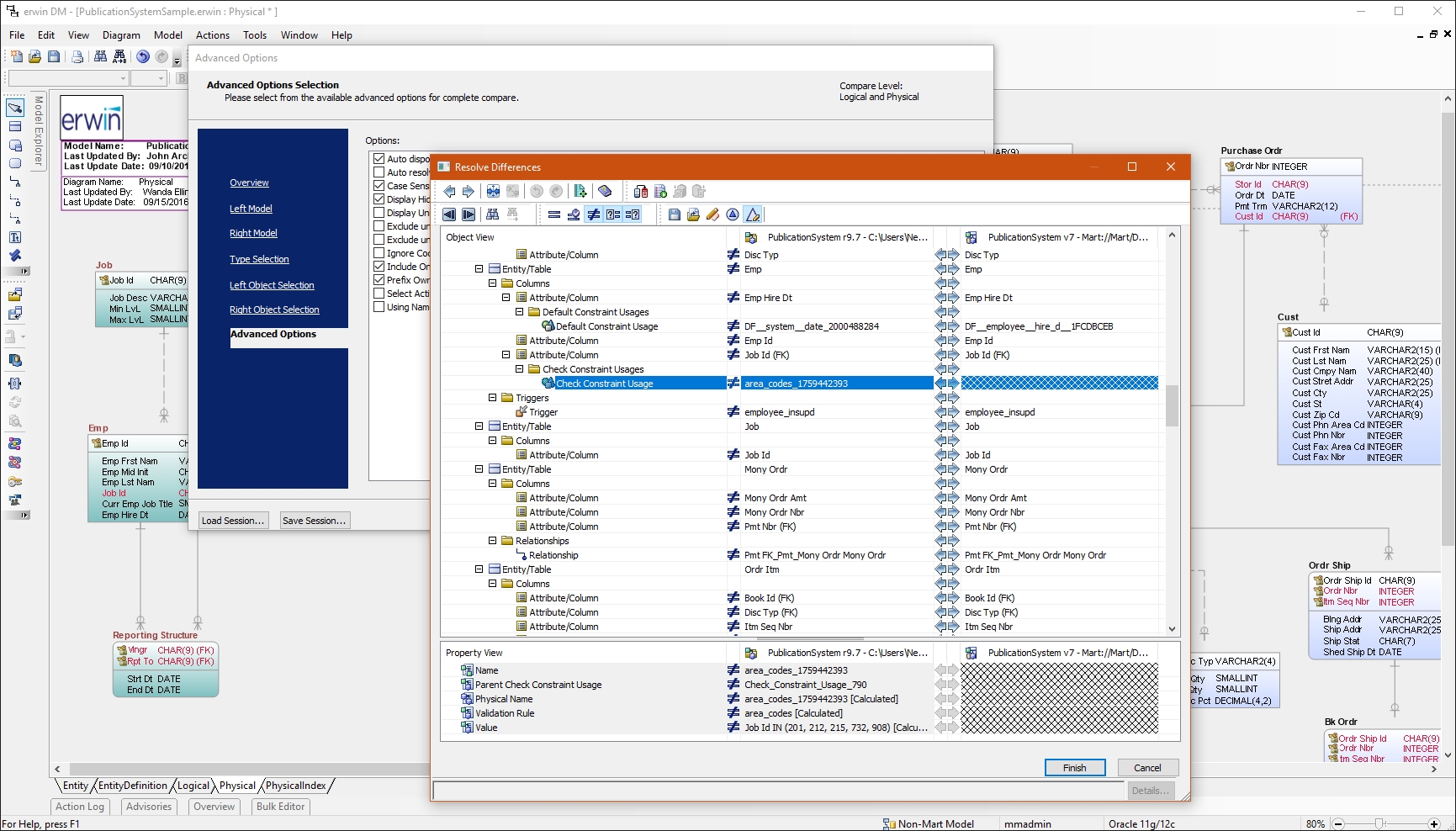
Reverse Engineering: I love the way we can import an SQL file containing schema meta data and generate ER diagram out of it. This is specifically useful if you are implementing erwin Data Modeler for an existing database.
Forward Engineering: We use this feature very frequently. Where we do database changes in our physical and logical data models and then generate deployment scripts for the changes made.
Physical vs Logical Models: I like to have my database model split into physical and logical models and at the same time still linked to each other. Any changes you make to logical model or physical model shows up in the other.
Object Browser in SQL Developer allows you to explore the contents of your database using the connection tree.
The SQL Worksheet is an editor that allows for execution of SQL statements, scripts, and PL/SQL anonymous blocks. SELECT statements can be executed to return results in a spreadsheet-like 'grid' or can be executed as a script such to emulate SQL*Plus behavior and output
DBA Console allows users with administrative privileges to access DBA features such as database init file configuration, RMAN backup, storage, etc.
Schema editing is not very intuitive. Editing a single column forces you into multiple tab windows when trying to change something simple like a column name.
Sorting and filtering in data is nice, but buried in long right-click menus.
Some things are definitely non-standard UI for a Windows application, so it might be hard for die-hard Windows fans to get used to.
Inability to run multiple queries on the same database. You can only run one query on a given database.
Analytical models created from complex tables isn't accurate, and needs work.
Inability to view multiple tables of a database side-by-side. When trying to find correlations between tables, it would help to be able to see them at once on the same page.
I had a lot of experience using erwin Data Modeler for designing data models. I think it's pretty intuitive and easy to use. It has enough features to represent your database requirements in form of a model.
Oracle SQL Developer is very easy to use and there are a wide range of courses available which can help you get started just within a day. Data can be exported in multiple formats based on user requirements. Organizational data can be stored and management effectively using Oracle SQL Developer. All the data, tables, sequences, indexes can be easily created and updated in Oracle SQL Developer.
Not a lot of users have DBeaver so fewer resources are available online to help you if you have any issues. When I was trying to figure out how to create my own ER diagrams, it was a little tough to find resources
CA customer support and our account manager have been able to support us with any issues that we have had, from managing our serial keys to issues we logged tickets to resolve. There are aspects of key management that have made it difficult over the years but support usually has worked with us.
MySQL workbench from MySQL only supports MySQL databases and it only provides basic functionality. On top of that, the user experience could be quite confusing for first-time users. SSMS from SQL server doesn't support inline editing nicely. The view for inline editing and view data is different, making it uncomfortable to use. All in all, DBeaver is the best tool when you manage a lot of databases with different types.
Not listed, but I've only used alternatives built into something like the Squirrel SQL editor. That one is semi-functional but lacking many features and, in some instances, just plain wrong. The only pro there is that it's freely available and works over ODBC. I've tried some of the other free ones like Creately but didn't have much success.
I have started to use Toad for Oracle recently because it is easier to sort and filter results, due to their memory sort feature that puts the results from your query in memory so that you don't have to rerun your query. I have used SQL Developer to easily update records in tables that I need to fix. I haven't found an easy way to do this in Toad other than writing SQL insert statements.