Egnyte provides a unified content security and governance solution for collaboration, data security, compliance, and threat detection for multicloud businesses. More than 16,000 organizations trust Egnyte to reduce risks and IT complexity, prevent ransomware and IP theft, and boost employee productivity on any app, any cloud, anywhere.
$25
per month
Splunk Observability Cloud
Score8.5 out of 10
N/A
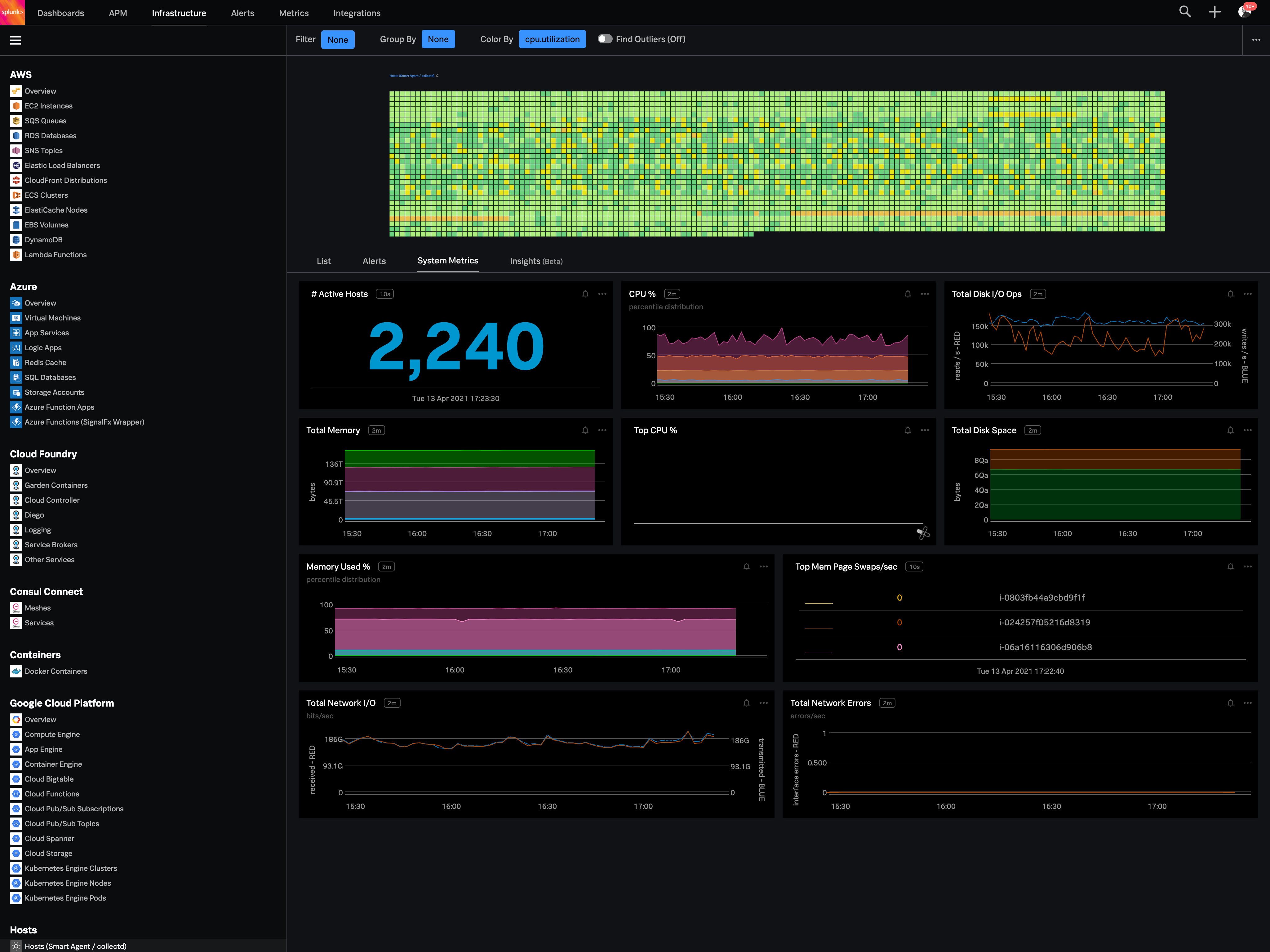
Splunk Observability Cloud aims to enable operational agility and better customer experience through real-time AI-driven streaming analytics allowing accurate alerts in seconds. It is designed to shorten MTTD and MTTR by providing real-time visibility into cloud infrastructure and services.
Egynte is best suited for companies that SharePoint is not the best fit for. This includes managers unfamiliar with SharePoint specifically, and those really looking for a replacement for a file server in the more traditional Windows sense. SharePoint has more or less done away with any management that resembles Active Directory or File Explorer. Egnyte's web portal is incredibly straightforward. I would say Egnyte is less suited for companies that have licensing access to SharePoint already and do not have a ton of files or granular sharing and security needs
Its great if you need real-time visibility across complex or regulated environments. Also strong for hybrid or multi-cloud setups where uptime, observability and fast IR are required. It’s probably overkill for smaller teams or environments that don’t have constant changes or compliance reporting needs. It's expensive and has a steep learning curve. Also, in my opinion, do not get yourself into a consumption based model. Costs can certainly get out of control quickly.
A de minimis incentive was given to thank the reviewer for their time. The incentive was not used to bias or drive a particular response, nor was the incentive contingent on a positive endorsement. TR verified that a representative sample of customers was invited. More Info
Sharing files externally with passwords, link expiration and granular control of permissions
File syncing across end-user devices using a client installed onto the computer for seamless integration for end-users as if they had mapped a drive directly to their machine
The first one is its Kubernetes container monitoring.
I really like this features because as we know how much K8s is vast and to manually monitor each part of the Kubernetes it takes so much time but Splunk Observability Cloud makes it easier. And even once we integrate K8s with Splunk Observability Cloud it gives us some prebuilt dashboards which gives holistic view of our Cluster and its nodes, pods, etc.
The dashbaord feature of Splunk Observability Cloud, it gives us full flexibility to customize our dashboard with a wide range of predefined chart types.
Now it also supports OTEL, which is a plus point for observability. As now everyone is moving towards Otel and in current market there are only few tools who supports OTEL based integrations, Splunk Observability Cloud is one out of them.
A de minimis incentive was given to thank the reviewer for their time. The incentive was not used to bias or drive a particular response, nor was the incentive contingent on a positive endorsement. TR verified that a representative sample of customers was invited. More Info
The main drawback of the system that it is lacking in managing the uploading of large or huge files, even though the large files can be easily downloadable but the upload takes a lot of time.
While uploading the system sometimes starts lagging and the file after sometimes needs to upload again.
Egnyte is lacking in syncing multiple platforms at the same time. It gives access to one platform at a time which somehow hinders the work while migrating a large amount of data.
A de minimis incentive was given to thank the reviewer for their time. The incentive was not used to bias or drive a particular response, nor was the incentive contingent on a positive endorsement. More Info
You can use table-like functionality to generate dashboards, but these queries are heavy on the system.
It could be easier to give insight into what type of line parsing is used for specific documents in a company-managed environment and/or show ways to gain the insights needed.
I would like to see ways to anonymize specific data for shared reports without pre-formatting this in a dashboard on which reports could be based.
A de minimis incentive was given to thank the reviewer for their time. The incentive was not used to bias or drive a particular response, nor was the incentive contingent on a positive endorsement. More Info
We found that usage of Egnyte in our supported clients, with sufficient bandwidth, provided all the features and stability we required. The billing setup was fair and the support provided was ample for end users and well as our in house admins. There was a concern about high usage clients but this was taken into account during the vetting process.
A de minimis incentive was given to thank the reviewer for their time. The incentive was not used to bias or drive a particular response, nor was the incentive contingent on a positive endorsement. More Info
Good: Stable system with low error rate Easy to use for simple use cases Bad: UI is not very clear for complex usage Mobile view (when logged in from phone) is bad No library for .net
A de minimis incentive was given to thank the reviewer for their time. The incentive was not used to bias or drive a particular response, nor was the incentive contingent on a positive endorsement. More Info
Really easy to use the interface. The web browser is very intuitive and I have not had any notable issues with this. It's easy to work on documents as a team, and the only issues we have to tend to come with Apple apps and downloading large files to WebEdit. It's very similar to the filing systems that come on Apple and Windows devices so not a steep learning curve.
A de minimis incentive was given to thank the reviewer for their time. The incentive was not used to bias or drive a particular response, nor was the incentive contingent on a positive endorsement. More Info
When there is an issue, it’s a win if one can easily identify the root cause. To do the same, it should allow the user to dig deep with multiple data points and compare the data and identify the anomaly. In this use case, it’s good to drive from Splunk 011y.
A de minimis incentive was given to thank the reviewer for their time. The incentive was not used to bias or drive a particular response, nor was the incentive contingent on a positive endorsement. More Info
Egnyte works very well across all platforms and as an add-on to other programs. Load time is close to nothing. Reports can be made in no time as well. All in all no performance issues. We can see that it depends on the local network connection. If you're running with fiber there won't be any issues.
A de minimis incentive was given to thank the reviewer for their time. The incentive was not used to bias or drive a particular response, nor was the incentive contingent on a positive endorsement. More Info
I never had to reach out to customer support for Egnyte. I don't know any coworkers who have had to reach out to Egnyte for support either. As far as I am concerned, the support team is doing a good job since I have not had to reach out to them.
A de minimis incentive was given to thank the reviewer for their time. The incentive was not used to bias or drive a particular response, nor was the incentive contingent on a positive endorsement. More Info
A de minimis incentive was given to thank the reviewer for their time. The incentive was not used to bias or drive a particular response, nor was the incentive contingent on a positive endorsement. More Info
A de minimis incentive was given to thank the reviewer for their time. The incentive was not used to bias or drive a particular response, nor was the incentive contingent on a positive endorsement. More Info
At the time when this was implemented (over 5 years ago and still in production), there were issues with syncing and reliability that Egnyte did not have, and have continued to impress with. Other providers have improved a lot and Egnyte is fairly costly, but switching costs would be high to move away from it to similar solutions.
A de minimis incentive was given to thank the reviewer for their time. The incentive was not used to bias or drive a particular response, nor was the incentive contingent on a positive endorsement. More Info
Splunk Infrastructure Monitoring provides far superior options for anybody using a complex hybrid multi-cloud environment and allows both your SOC and NOC to work together on the same data while driving their own insights. We found other products are still in the old world view of servers and agents residing together within a single data centre, but modern apps are no longer like this.
A de minimis incentive was given to thank the reviewer for their time. The incentive was not used to bias or drive a particular response, nor was the incentive contingent on a positive endorsement. More Info
A de minimis incentive was given to thank the reviewer for their time. The incentive was not used to bias or drive a particular response, nor was the incentive contingent on a positive endorsement. More Info
A de minimis incentive was given to thank the reviewer for their time. The incentive was not used to bias or drive a particular response, nor was the incentive contingent on a positive endorsement. More Info