Hire, by Google, was a recruiting app for G suite customers. The product includes functionality for applicant tracking, candidate relationship management, and candidate sourcing. Google sunsetted the product in late 2020.
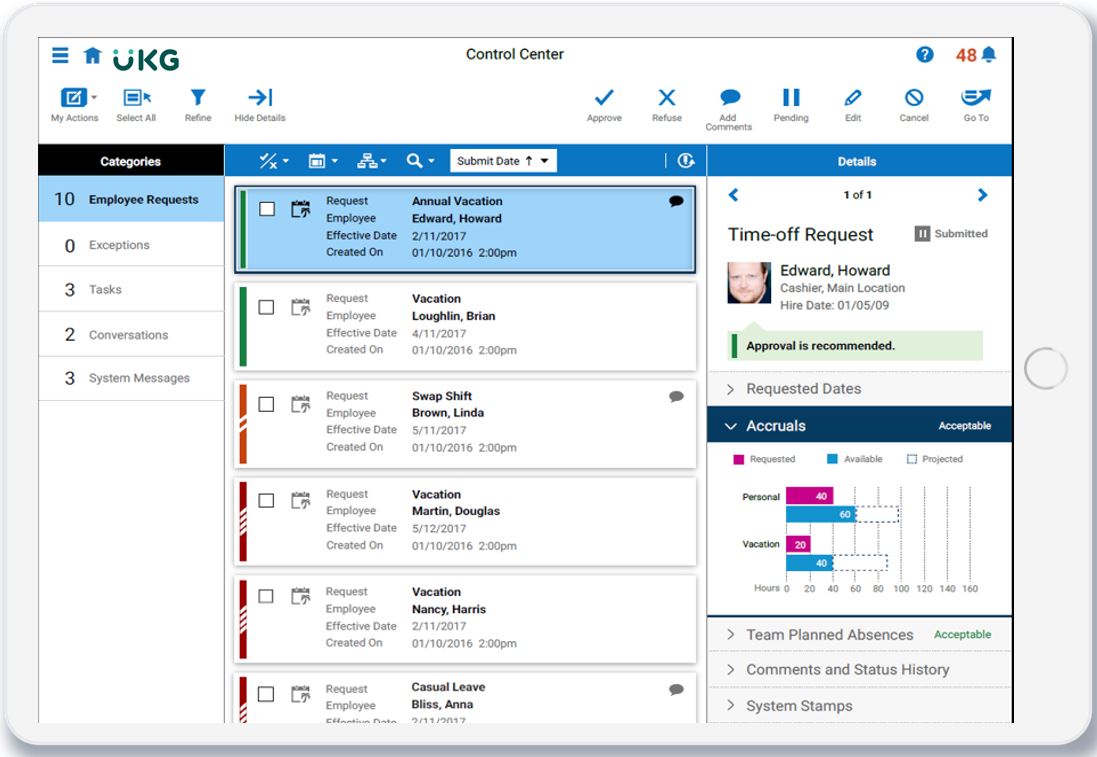
Kronos Workforce Dimensions, later UKG Dimensions was a solution used to automate critical workforce processes such as timekeeping, scheduling, and leave management. The product has been discontinued, and is no longer available for purchase.
Google Hire is very good at doing the basics well. I believe for most internal HR departments at small companies, this is all you need. It also works well for small to medium-sized staffing companies that just want something reliable and easy to use. What Google Hire doesn't do very well is be flexible. They don't have custom options, they don't have a ton of settings, and their development cycle is slow. As a result, it's pretty much what you see is what you get.
A de minimis incentive was given to thank the reviewer for their time. The incentive was not used to bias or drive a particular response, nor was the incentive contingent on a positive endorsement. More Info
UKG Dimensions will work well with a company size of [fewer] than 10,000 employees. Once you hit over 10K, you start to notice that batch jobs will time out, clocks will perform slower or become unresponsive requiring manual restarts and the employee demographic will take hours to complete. Will the vendor has on their roadmap to increase the performance of the product, it is not at that point.
A de minimis incentive was given to thank the reviewer for their time. The incentive was not used to bias or drive a particular response, nor was the incentive contingent on a positive endorsement. More Info
Google does search well so when I search through our database for candidates, I'm confident that I'm pulling up all the right people from what we have.
They have a modern and nice user interface - this is one of the biggest reasons to use it over other systems, as most ATS' are pretty ancient looking and not very pleasant to use.
Their support is very good at answering and addressing questions.
Their pricing is incredible. I'm sure at some point it will change, but for small companies paying 100+ per user for other ATS' - it's incredible to pay 100/month for the whole company.
A de minimis incentive was given to thank the reviewer for their time. The incentive was not used to bias or drive a particular response, nor was the incentive contingent on a positive endorsement. More Info
A de minimis incentive was given to thank the reviewer for their time. The incentive was not used to bias or drive a particular response, nor was the incentive contingent on a positive endorsement. More Info
Despite many many months of requests, Google still hasn't implemented ANY custom fields. This makes it tough for an external recruiting firm to track what they want (most importantly: desired salary).
The job board integration is not great for external recruiters, mostly at the fault of Indeed. Indeed flagged us as a recruiting firm and so none of our jobs actually go live. While I know this is an Indeed problem (we had the same problem when using Bullhorn), Breezy ATS never has that problem for us so I don't know what they're doing differently.
Their development cycles are quite frankly very slow. I've requested some features, and while support is great about telling me it's coming or in the pipeline, I honestly don't really see a difference in the product since we started using it. It's still great to use, and we still love the software, but there haven't been too many visible improvements that make any difference to our work.
Being Google, it can sometimes be frustrating that one arm doesn't talk to the other. For example, they announced a Gmail for Works App/Extension integration, but for some reason when they launched it, admins of a domain couldn't install it. Google Hire pointed to the Google for Works team, and it took literally months to fix. Not the end of the world, but just very silly considering they're the same company.
A de minimis incentive was given to thank the reviewer for their time. The incentive was not used to bias or drive a particular response, nor was the incentive contingent on a positive endorsement. More Info
A de minimis incentive was given to thank the reviewer for their time. The incentive was not used to bias or drive a particular response, nor was the incentive contingent on a positive endorsement. More Info
UKG Dimensions is very user-friendly from an employee and supervisor standpoint. It is very robust on an admin level and can get complicated; however, you can do so many things with it that is outweighs the complexity. The security for UKG Dimensions needs to be revamped however. It is very cumbersome and not user-friendly.
A de minimis incentive was given to thank the reviewer for their time. The incentive was not used to bias or drive a particular response, nor was the incentive contingent on a positive endorsement. TR verified that a representative sample of customers was invited. More Info
Kronos Workforce Dimensions a new product, and it has a lot of scope for improvement, with future releases. One of the best tools to perform time tracking.
Their support team is very knowledgeable, and their SLA's are pretty tight. Any query raised would be addressed in a few hours.
Timeclock configuration can be complicated; however, their support team knows the processes and guidelines.
A de minimis incentive was given to thank the reviewer for their time. The incentive was not used to bias or drive a particular response, nor was the incentive contingent on a positive endorsement. More Info
I picked Google Hire after spending about 3 months on Bullhorn. I found Bullhorn to be terrible. It's WAY more customizable and theoretically powerful, but it's also a pain to set up and maintain. Even just getting your job page set up on your own site required tech support. Getting it eventually to what you want could be a great benefit, but Google Hire does great right out of the box and is a lot cheaper. Breezy HR is a great system. It's a bit more expensive than Google Hire for multiple job postings, but their system is equally easy to use and straight forward. However, we are all in on Google Products, so it was just a no brainer to go with Hire for a better price and most likely a better search function.
A de minimis incentive was given to thank the reviewer for their time. The incentive was not used to bias or drive a particular response, nor was the incentive contingent on a positive endorsement. More Info
UKG Dimensions provides an enterprise-wide integrated suite for timekeeping, staff scheduling, and clocks. We were an existing Workforce Central customer for timekeeping only and were interested in providing holistic experience between staff scheduling and timekeeping. In addition, [UKG] Dimensions established a great foundation for transitioning our organization from departmental focused scheduling solutions to enterprise.
A de minimis incentive was given to thank the reviewer for their time. The incentive was not used to bias or drive a particular response, nor was the incentive contingent on a positive endorsement. More Info
Google Hire makes, unfortunately, a very little impact on our ROI, but I think in the ATS world that's a good thing. It simply acts as a record that we can put everything in and easily reference, and the fact that it works overall makes it a positive software product in the long run.
While the search works great, I don't know that I've ever specifically found a candidate and placed them due to it. That could be a result of our job reqs though.
The biggest most obvious impact is really just the price. We needed a tool that does what Google Hire does, reliably. Most other companies charge at least 150 or so for 2 people, whereas Google Hire is 100/month for many users. It gives us flexibility for the future and helps minimize what could be a big expense. That definitely helps our bottom line.
A de minimis incentive was given to thank the reviewer for their time. The incentive was not used to bias or drive a particular response, nor was the incentive contingent on a positive endorsement. More Info
It is neutral. We enjoy having somewhat of a seamless system between HR, PR, and timekeeping.
When a person uses the Reset Password link, the system sends the user an email with a link to set their password. Then when the person logs in with their new password, the system forces the user to change their password a second time. This second password change is unnecessary and creates confusion.
A de minimis incentive was given to thank the reviewer for their time. The incentive was not used to bias or drive a particular response, nor was the incentive contingent on a positive endorsement. More Info