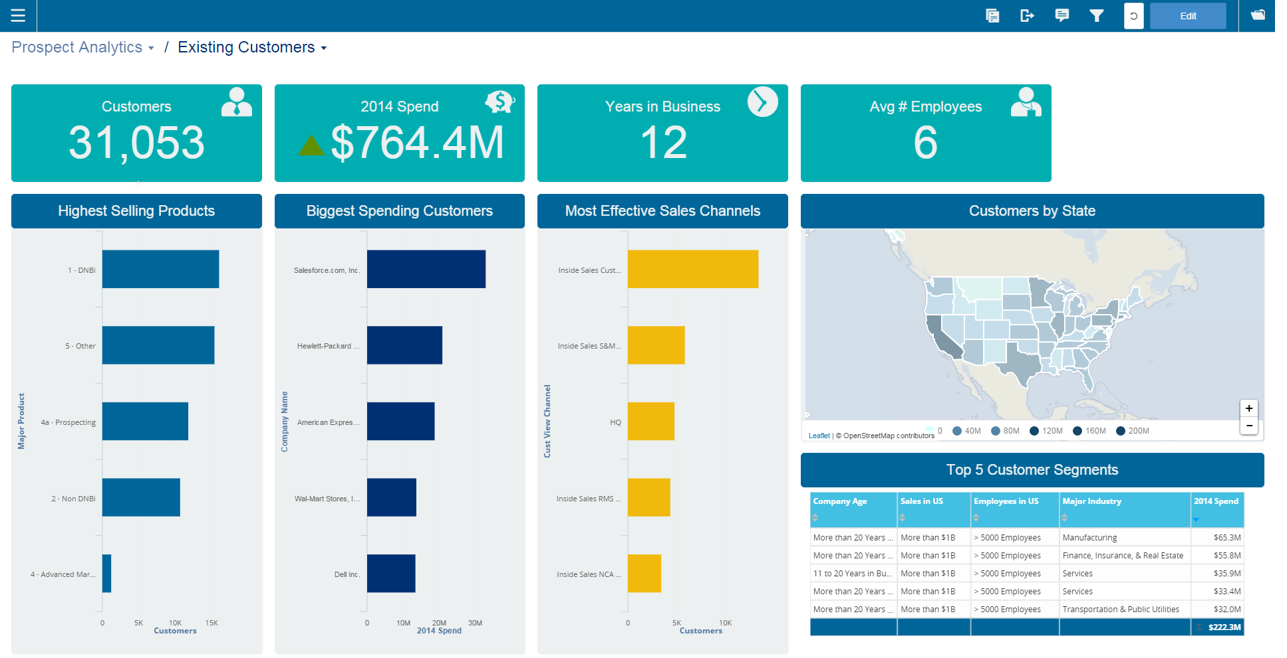
Infor Birst offers multi-tenant cloud BI for deployment in a public or private cloud, or on-premises. It provides an in-memory columnar data store and a BI layer comprising a reporting engine, predictive analytics tools, mobile native apps, dashboards, discovery tools, and an open client interface.
N/A
Informatica Cloud Data Quality
Score 6.8 out of 10
N/A
The vendor states that Informatica Data Quality empowers companies to take a holistic approach to managing data quality across the entire organization, and that with Informatica Data Quality, users are able to ensure the success of data-driven digital transformation initiatives and projects across users, types, and scale, while also automating mission-critical tasks.
N/A
Informatica Intelligent Data Management Cloud
Score 7.0 out of 10
N/A
The Informatica® Intelligent Data Management Cloud™ (IDMC) is designed to help businesses efficiently handle the complex challenges of dispersed and fragmented data to innovate with their data on virtually any platform, any cloud, multi-cloud and multi-hybrid.
N/A
Pricing
Infor Birst
Informatica Cloud Data Quality
Informatica Intelligent Data Management Cloud
Editions & Modules
No answers on this topic
No answers on this topic
No answers on this topic
Offerings
Pricing Offerings
Infor Birst
Informatica Cloud Data Quality
Informatica Intelligent Data Management Cloud
Free Trial
No
No
No
Free/Freemium Version
No
No
No
Premium Consulting/Integration Services
Yes
No
No
Entry-level Setup Fee
No setup fee
No setup fee
No setup fee
Additional Details
—
—
—
More Pricing Information
Community Pulse
Infor Birst
Informatica Cloud Data Quality
Informatica Intelligent Data Management Cloud
Considered Multiple Products
Infor Birst
Verified User
Engineer
Chose Infor Birst
We evaluated and compared Birst, OBIEE 12c, and Tableau based on several criteria such as "Data Analysis & Discovery", "Data Integration", "Security model", "Data Visualization", "User Experience" or "Infrastructure & Architecture". The only point where Birst was rated higher …
Infor Birst OEM and embedded analytics are well suited for advanced analytics and business intelligence. It has flexible deployment features and a lot of configuration ability with low code - no coding ability. Ability to ingest data from multiple live data sources. Source data from multiple sources can be segregated into multiple sections based on business criteria. Easily searchable business terms (metadata) across all enterprise analytic content.
For effective data collaboration, systematic verification of customer information, and address, among others, Informatica Data Quality is a fruitful application to consider. Besides, Informatica Data Quality controls quality through a cleansing process, giving the company a professional outline of candid data profiling and reputable analytics. Finally, Informatica Data Quality allows the simplistic navigation of content, with a dashboard that supports predictability.
Informatica Cloud is a great tool for use when data must be formatted consistently. Once configured, it is very robust and reliable. It is also well-suited for an organization without a robust IT staff to maintain a full server infrastructure. It offers a cost-effective approach to high-quality data integration for even the largest organizations. Organizations without staff experienced in data analytics may find it challenging to take advantage of the more complex results of this tool.
End-to-end solution, from raw source data, ETL, warehousing and reporting, Birst is able to do everything we need in one package instead of needing to develop and maintain multiple technologies
Intuitive report development. The drag and drop creation of reports is simple. More complicated queries are easy to generate.
Very user-friendly and interactive. A lot of nice features are available both for developers and end users to streamline the process of preparing and consuming data
Rich API which allows us to programmatically interact with Birst
The matching algorithms in IDQ are very powerful if you understand the different types that they offer (e.g., Hamming Distance, Jaro, Bigram, etc..). We had to play around with it to see which best suit our own needs of identifying and eliminating duplicate customers. Setting up the whole process (e.g., creating the KeyGenerator Transformation, setting up the matching threshold, etc..) can be somewhat time consuming and a challenge if you don't first standardize your data.
The integration with PowerCenter is great if you have both. You can either import your mappings directly to PowerCenter or to an XML file. The only downside is that some of the transformations are unique to IDQ, so you are not really able to edit them once in PowerCenter.
The standardizer transformation was key in helping us standardize our customer data (e.g., names, addresses, etc..). It was helpful due to having create a reference table containing the standardized value and the associated unstandardized values. What was great was that if you used Informatica Analyst, a business analyst could login and correct any of the values.
Once the secure connection is established it’s quite easy to operate and create new jobs. The controls are simple, and we appreciate the fact there are not a lot of complex fine-tunings required. Navigation is also easy, and we enjoy the ability to open multiple tabs in the browser to work on multiple projects.
The monitoring functionality works well to help track the progress of the jobs, again, without too much complication. In a fast dev environment, speed is essential and we quickly seeing the status/progress of jobs as well as any errors if the jobs fail helps us maintain speed.
The web interface is a lot easier to interact with than the client/on-prem version. Putting much of the heavy lifting of interacting with the tool onto the shoulders of the browser makes it easier to keep multiple sessions open and get in/out quickly without having to VPN into the office.
We have been able to overcome any of the drawbacks we've found with Birst easily and it has fulfilled almost all of our analytic needs to date. Having seen their roadmap it would be highly unlikely we would move away from this platform any time soon. You simply can't beat the functionality that Birst provides for the price and the things I see coming out of the company solidify that our decision to choose Birst was the best possible choice. We have never regretted the decision.
As pointed out earlier, due all the robust features IDQ has, our use f the product is successful and stable. IDQ is being used in multiple sources (from CRM application and in batch mode). As this is an iterative process, we are looking to improve our system efficiency using IDQ.
I would like to see additional usability put into the ETL scripting. Recently, Birst added a nice function reference inline to formula creation which has kept me from having to return to documentation so much. The same in ETL would be very beneficial. The interface problems related to the Flex framework are being addressed in a rewrite to HTML 5, but for now they are still a hindrance to a higher usability rating.
We frequently experience -103 errors due to us using the Live Connect functionality, which does not seem to handle even minor interruptions in connectivity, and treats all future connection attempts or data requests as errors, even if the issue does not exist any longer
Everything runs very fast and smoothly. The only process that I wish was faster would be processing the data after uploading new data or making changes to the existing data model. It can take 15-20 minutes (roughly) to upload and process new data once you start getting into 10's of millions of rows. Given my experience with how long it takes me to pull the same data using SQL Server Management Studio, I don't think Birst is unreasonably slow - but for me to give a higher rating, I would want it to be unreasonably fast
When we have an issue that is stopping our business from proceeding, I want answers sooner than later. While Birst does have a published response time for each case level, we always wish it could be quicker. What response improvement could there be with a larger support team? In response to first question: Blackhole of issues - Birst needs to improve upon closing issues that resolution was dependent upon code fixes or enhancements, perhaps someone to add a comment on all case tickets at least every 60 days. Escalation - I always have the ability to electronically or via phone escalate a ticket. I also have my Customer Success Manager through whom I can escalate topics.
I've never had trouble getting into contact with Informatica's support for technical help. I give it a nine because it does pretty well for mid to enterprise-scale workflows.
I have attended two different training sessions. The first one was my initial training on the system. It was well paced, clear and concise. If there were questions that were not able to be answered by the instructor, he took down the question and actually followed up and provided us a response quickly. The second session was specific to the dashboard and report design components. This training was very good though there were some attendants who had little or no experience and their questions slowed the class.
Although I found the online resources helpful, a lack of appropriate examples for certain tasks key to report creation and advanced modeling make the online training/documentation less than perfect. For an inexperienced BI professional, the online training would not enable a streamlined launch of the product.
Have clean data! Birst flexibility allows - Start small, then introduce functionality and complexity along the way. If you try to present all the functionality [bells and whistles] and wow them, but bad data is uncovered, the end user blames the new application and turns away.
Birst was better than Domo for our needs because we could get in and tinker with it. Our impression of Domo was that it had a lot of connectors and ready to go reports, but it made too many assumptions about applications we use. We customize too much to use a "ready to go" solution like that. When we looked at Tableau, we liked its visualization capabilities, but it wasn't going to help us do the extractions, ETL, and warehousing of data. It may have come some distance since then.
IDQ is used by a department at my organisation to ensure and enhance the data quality. The usage was started with address standardization and now it had been brought to altogether a next level of quality check where it fixes duplicates, junk characters, standardize the names, streets, product descriptions. In the past we had issues mainly with duplicate customers and products and this were affecting the sales projection and estimates.
First, the wizard is easy to use making the learning curve for simple ETL tasks nice. Second, since Informatica is mature there are a good variety of connectors available. Finally, we have driven some fairly complex ETL solutions using only the cloud.
we can see that loading a lot of data can cause a noticable slow down in performance. Birst support indicated that they don't really consider anything less than 30 seconds to be an issue, but that is not the case for our customers, so we have had to change some of implementation to address this
Being a manufacturing company we tend to lag behind technologically. But having all the data for different ERP systems in one place has been an eye opener for the executives. It has lessened the need to convert some legacy ERP systems.
Having such a simple reporting tool is a great asset to some of our sites that have traditionally had trouble gathering data from AS400 systems.