Jenkins is an open source automation server. Jenkins provides hundreds of plugins to support building, deploying and automating any project. As an extensible automation server, Jenkins can be used as a simple CI server or turned into a continuous delivery hub for any project.
N/A
Kubernetes
Score 9.1 out of 10
N/A
Kubernetes is an open-source container cluster manager.
N/A
OCI
Score 8.1 out of 10
N/A
Oracle Cloud Infrastructure (OCI) is Oracles's infrastructure-as-a-service (IaaS) platform which combines the utility of public cloud with the granular control, security, and predictability of on-premises infrastructure.
I have used Spinnaker as a CD tool. Though it's a very powerful CD tool we still needed Jenkins for CI, so to save some hassle for us we opt Jenkins solely.
The big difference between Jenkins and other alternative tools is that Jenkins is open source and it’s free. Jenkins is very much about simple functionality. It’s a general CI tool that offers basic automation. It’s the most common CI tool on the market with a large community …
When looking for alternatives for Jenkins we found CircleCI and TeamCity are good too. Jenkins was considered for reasons like it has a wide variety of plugins which integrate well with any kind of system. And its ease of use.
One of the other greater advantage is it is open …
Jenkins immense flexibility and its large and impressive selection of available community-driven plugins makes it ideal choice for solving non-traditional problems.
However, for CI/CD - consider the benefit of modern tools that enforce reusable, infrastructure as code design …
Docker Swarm is not as advanced as Kubernetes and there are no out of the box solutions for auto scaling and deployment strategies. Docker swarm doesnot have much experience with production deployments at scale. Swarm has a smaller community, and less frequent releases as …
We already had an enterprise Kubernetes 8 set up, so once we got our namespace it took me about 2 weeks to go from not knowing anything to having a self-contained jar in a container, running on Kubernetes 8. In comparison, it took me two weeks to install Java on a blank server …
Main benefit was costing compared to other services and we use Oracle as a database so with Oracle Cloud Infrastructure we can fully utilize the Oracle Cloud Infrastructure database which helped a lot for our products to handle major load that is one big plus because we had pay …
Right now we are evaluating the usage. Prima facie is that it will be game changer and we are supposed to start POC in next sprint. Can not put client details but on high level, clients are very excited to see if ML can predict areas of traction from where orders are created …
- Performance was big reason for choosing Oracle Cloud infrastructure over AWS Ec2 and Azure VMware Solutions.- Oracle Database as application design was another reason for choosing Oracle Cloud infrastructure over AWS Ec2 and Azure VMware Solutions.
Oracle Cloud Infrastructure provides strong and Innovative database services with its enterprise Autonomous Database and Exadata Features. Oracle Database management can make huge workloads autonomously. OCI in addition is more cheaper compared to it's other competitors in the …
Oracle Cloud Infrastructure excels in website hosting Oracle workloads. It gives optimized infrastructure and database offerings for Oracle Database, making it a natural preference for businesses heavily reliant on Oracle technology. Oracle Cloud Infrastructure's close …
Jenkins is a highly customizable CI/CD tool with excellent community support. One can use Jenkins to build and deploy monolith services to microservices with ease. It can handle multiple "builds" per agent simultaneously, but the process can be resource hungry, and you need some impressive specs server for that. With Jenkins, you can automate almost any task. Also, as it is an open source, we can save a load of money by not spending on enterprise CI/CD tools.
K8s should be avoided - If your application works well without being converted into microservices-based architecture & fits correctly in a VM, needs less scaling, have a fixed traffic pattern then it is better to keep away from Kubernetes. Otherwise, the operational challenges & technical expertise will add a lot to the OPEX. Also, if you're the one who thinks that containers consume fewer resources as compared to VMs then this is not true. As soon as you convert your application to a microservice-based architecture, a lot of components will add up, shooting your resource consumption even higher than VMs so, please beware. Kubernetes is a good choice - When the application needs quick scaling, is already in microservice-based architecture, has no fixed traffic pattern, most of the employees already have desired skills.
As per our usage Oracle Cloud Infrastructure for almost 6 years hosting 500 + customers I can say its well suited application for any small scale to larger scale application as it can handle that capacity and provide more reliable cloud service only if you need any messaging service like pub/sub or sqs better to consider other services.
Automated Builds: Jenkins is configured to monitor the version control system for new pull requests. Once a pull request is created, Jenkins automatically triggers a build process. It checks out the code, compiles it, and performs any necessary build steps specified in the configuration.
Unit Testing: Jenkins runs the suite of unit tests defined for the project. These tests verify the functionality of individual components and catch any regressions or errors. If any unit tests fail, Jenkins marks the build as unsuccessful, and the developer is notified to fix the issues.
Code Analysis: Jenkins integrates with code analysis tools like SonarQube or Checkstyle. It analyzes the code for quality, adherence to coding standards, and potential bugs or vulnerabilities. The results are reported back to the developer and the product review team for further inspection.
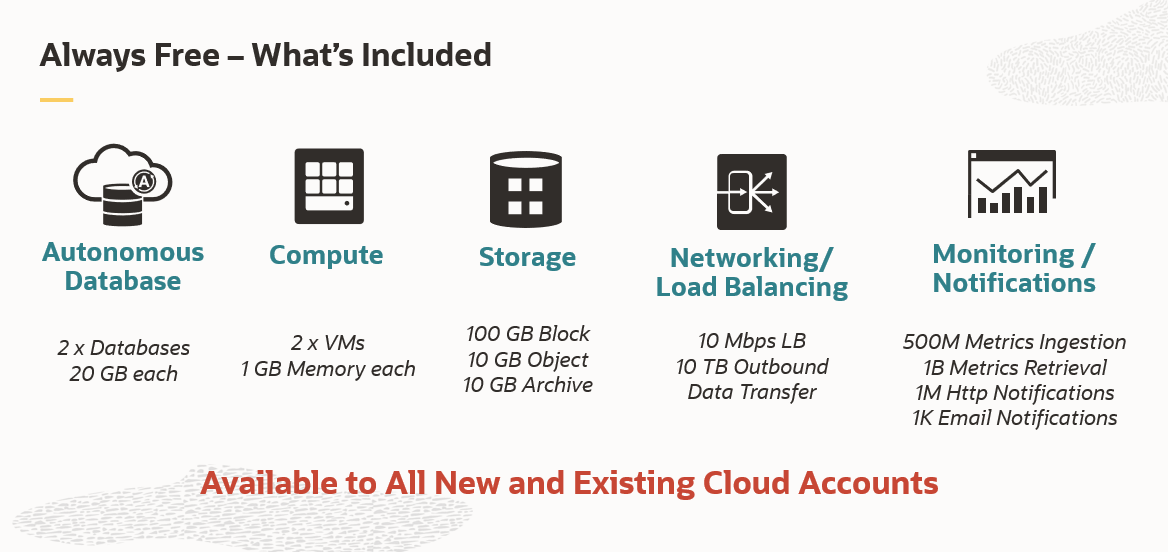
Oracle Cloud Infrastructure has a generous free tier, moreso than other hyperscalers, with an always-free tier that guarantees certain products are always free
Oracle Cloud Infrastructure allows you to size VMs with differing combinations of CPU and RAM, which is contrary to other hyperscalers that have specific pre-defined combinations only
Local development, Kubernetes does tend to be a bit complicated and unnecessary in environments where all development is done locally.
The need for add-ons, Helm is almost required when running Kubernetes. This brings a whole new tool to manage and learn before a developer can really start to use Kubernetes effectively.
Finicy configmap schemes. Kubernetes configmaps often have environment breaking hangups. The fail safes surrounding configmaps are sadly lacking.
Navigating the UI takes lots of getting used to. It reminds me of older GCP (just to get used to where everything is).
Permission for different things always seemed to be more difficult than it really needed to be. Once you got them set up you were good but updating anything or creating new permissions for just about anything took longer than I thought it should.
Based on how the buttons were laid out, it was pretty easy to delete all of your DNS records, and backing them up was not as intuitive as I'd like with the UI, but it was easy to do using a script.
We have a certain buy-in as we have made a lot of integrations and useful tools around jenkins, so it would cost us quite some time to change to another tool. Besides that, it is very versatile, and once you have things set up, it feels unnecessary to change tool. It is also a plus that it is open source.
The Kubernetes is going to be highly likely renewed as the technologies that will be placed on top of it are long term as of planning. There shouldn't be any last minute changes in the adoption and I do not anticipate sudden change of the core underlying technology. It is just that the slow process of technology adoption that makes it hard to switch to something else.
Reliability: Very dependable and stable OCI services have been for the business operations.Performance: The speed and efficiency of OCI in meeting their computing and storage needs.Scalability: The ease and effectiveness of scaling resources up or down to accommodate changing demands.Security: The robustness and effectiveness of OCI's security features in protecting their data and applications.
Jenkins streamlines development and provides end to end automated integration and deployment. It even supports Docker and Kubernetes using which container instances can be managed effectively. It is easy to add documentation and apply role based access to files and services using Jenkins giving full control to the users. Any deviation can be easily tracked using the audit logs.
It is an eminently usable platform. However, its popularity is overshadowed by its complexity. To properly leverage the capabilities and possibilities of Kubernetes as a platform, you need to have excellent understanding of your use case, even better understanding of whether you even need Kubernetes, and if yes - be ready to invest in good engineering support for the platform itself
The services & products in Oracle Cloud Infrastructure needs more improvement to beat other Cloud service providers. The price is good & Security processes are good. We are requiring to put more effort in supporting this Oracle Cloud Infrastructure than other Cloud service providers. Probably better ways are there but is not super easy to find or not super available
Yeah sometimes we had to face unplanned outages due to underlying infrastructure issues, so not every time,e but once in a while we face issues with availability. But the good thing is we have redundancy with DR setup and multi region so we can manage.
No, when we integrated this with GitHub, it becomes more easy and smart to manage and control our workforce. Our distributed workforce is now streamlined to a single bucket. All of our codes and production outputs are now automatically synced with all the workers. There are many cases when our in-house team makes changes in the release, our remote workers make another release with other environment variables. So it is better to get all of the work in control.
From the start, I was surprised by response times and image quality accessing windows VMs with RDP. GCP, Azure and -many offerings in AWS- don't perform this speed. Also, that's evident in the quality of Infrastructure Management Team, because I just received one warning regarding a region failure, what confirms that's a mature platform.
As with all open source solutions, the support can be minimal and the information that you can find online can at times be misleading. Support may be one of the only real downsides to the overall software package. The user community can be helpful and is needed as the product is not the most user-friendly thing we have used.
Overall it is amazing, there is always room for improvement. We have weekly updates that tend to slow the program used more and more. We had to change some reports within Oracle because the others wouldn’t load. This is tied to our payroll and the delays are causing many time constraint issues and panic. We have to create a new report when one breaks. Otherwise awesome!
It is worth well the time to setup Jenkins in a docker container. It is also well worth to take the time to move any "Jenkins configuration" into Jenkinsfiles and not take shortcuts.
Overall, Jenkins is the easiest platform for someone who has no experience to come in and use effectively. We can get a junior engineer into Jenkins, give them access, and point them in the right direction with minimal hand-holding. The competing products I have used (TravisCI/GitLab/Azure) provide other options but can obfuscate the process due to the lack of straightforward simplicity. In other areas (capability, power, customization), Jenkins keeps up with the competition and, in some areas, like customization, exceeds others.
Most of the required features for any orchestration tool or framework, which is provided by Kubernetes. After understanding all modules and features of the K8S, it is the best fit for us as compared with others out there.
We used Microsoft Azure and Docker earlier and faced some difficulties like Microsoft Azure and Docker. Occasionally, the generation of large images can delay deployment. It is also necessary for me to admit that Microsoft Azure and Docker have a somewhat steep learning curve. Proper paperwork needs to be there. Docker has issues with performance on a number of platforms. On the other hand, OCI is easy to deploy and easy to understand.
was not part of initial purchase team. Anyways, i think unit pricing and billing frequency is good compared to other Cloud service providers, when it comes to Cloud Capital expenditure & Operational expenditure. Would be more interested in exploring more options where customers can get more cost relaxations on trying out new cloud services in Oracle Cloud Infrastructure for example a new App or a feature
We have hosted around 500 + customers on this cloud so till day not faced any major issues, so we can use it for any kind of products and it can hold the load and easily scale based on need.
Services & Infra wise is ok to use & host applications & services. Security wise also good for a Cloud service provider. It is a interesting area to explore & using it for day to day needs can be further improvised in future probably. Modern day Services like AI and Machine learning could be improved