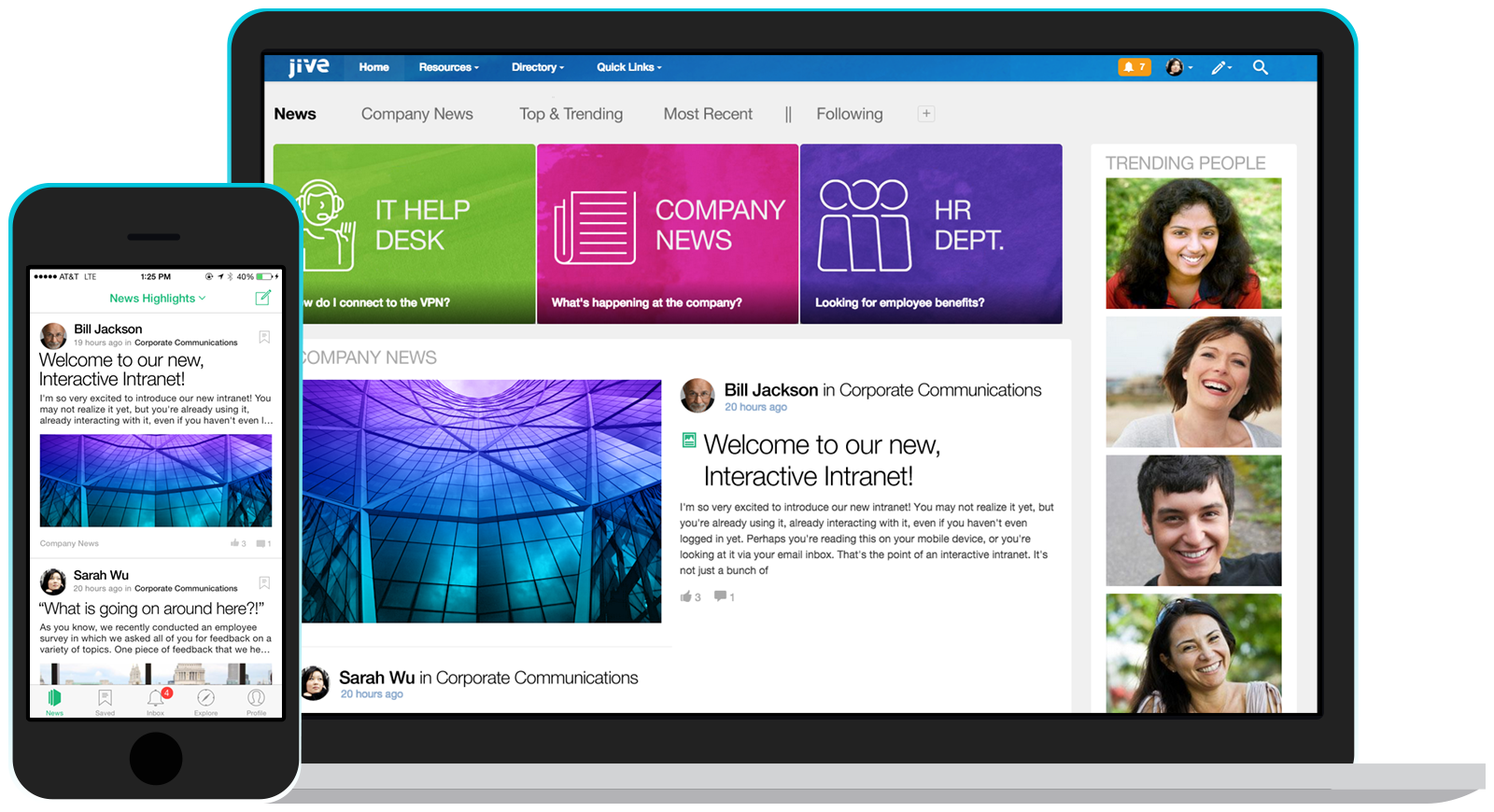
Jive Software, part of the Aurea family of customer experience solutions, provides the gateway to an organization's most important assets – its knowledge and people. Jive's interactive intranet solution promises to connect people, information and ideas to help businesses outpace their competitors. The vendor says the product has more than 30 million users worldwide across every industry, and is consistently recognized as a leader by top analyst firms.
N/A
Podbean
Score 8.2 out of 10
N/A
Podbean is presented as an easy but powerful platform for podcast hosting and monetization, from the company of the same name in New York. Additionally, the Podbean Pro edition is for business enterprises, supporting internal communications by enabling users to create, publish, manage and measure corporate audio and video podcasts at scale, to meet enterprise podcast needs.
$14
per month
Signal
Score 9.2 out of 10
N/A
Signal is an open source cross-platform messaging app featuring end-to-end encryption to keep conversations private and secure, boasting no ads, no affiliate marketers, and no creepy tracking in Signal. Users can focus on sharing the moments that matter.
N/A
Pricing
Jive
Podbean
Signal Messenger
Editions & Modules
No answers on this topic
Unlimited Audio
$14
per month
Unlimited Plus
$39
per month
Business
$129
per month
No answers on this topic
Offerings
Pricing Offerings
Jive
Podbean
Signal
Free Trial
No
Yes
No
Free/Freemium Version
No
Yes
Yes
Premium Consulting/Integration Services
No
No
No
Entry-level Setup Fee
No setup fee
No setup fee
No setup fee
Additional Details
—
—
—
More Pricing Information
Community Pulse
Jive
Podbean
Signal Messenger
Considered Multiple Products
Jive
Verified User
Anonymous
Chose Jive
We had a Google phone number set up before and Jive was a lot better option than that. It is more consistent and can be configured much easier and with more advanced settings. Additionally, based on the pricing as well as working with the rep on our account, it was a perfect …
We also use Skype to communicate in our organization. They are both useful for organizational communication. The good thing is in Jive, you will have your own personal timeline. Jive also has a newsfeed or timeline that you can browse where you can see the latest updates from …
Jive provided phone support which can be useful in case of emergency. Jive's initial pricing was free which helped jumpstart the process. It also provided JIRA integration which we needed for certain teams. Jive also had Zendesk integration which was useful for support teams to …
We use Jive to keep in touch and share mass updates/important information to the company. It's a good way to keep up to date on what's going on, read articles others share and get to know each other a little better.
We found that Jive had integrations with the existing IT infrastructure/tools which was nicely aligned with our strategy of playing nice with the existing ecosystem, rather than compete against it. Jive uses a technology stack that is well known by our organisation …
I honestly don't recall what we briefly used before Jive - it wasn't good and didn't last long. I think it was under-utilized because you couldn't really do a whole lot with it. Jive does pretty much everything we need it to do, so for that reason alone, Jive is the superior …
I was not involved in the decision to implement Jive versus competitors. My presumption is that the feature set at the time was attractive compared to options like SharePoint. Useful to note that SharePoint seems to have closed the gap in recent years.
I think Jive is a very unique platform in that it is very user intuitive, and acts just like the social networks we've all grown to love and used to. I think it's a great way for the team in disparate locations to stay in touch, and a great way for management to monitor …
Very powerful collaboration tool, intuitive, easy to use and commonly used by software vendors - so once you are experienced with it you can apply your knowledge using it in many places.
Jive is a little behind the curve in comparison with the latest Microsoft features. Jive's lack of native capabilities to support work that requires process or structure increasingly puts it at a disadvantage.
Jive works more with how people actually work and not how admins think that people should work. For example, relying on a folksonomy of tagging instead of a restricted taxonomy is far more practical with how users actually search for content. By putting the power to the users, …
Without getting into specifics, Jive is relatively strong in terms of more 'ready to deploy' business solutions that require less overhead on the client organization side in terms of IT infrastructure, operational support and ongoing administration and maintenance. While some …
Verified User
Anonymous
Chose Jive
Drupal would be much better suited. They have fast version upgrades and immediate customer support. Jive lacked in all those areas
Verified User
Anonymous
Chose Jive
I have worked on Lithium and Liferay. LifeRay has an advantage that it is opensource and will be cheaper. However it lacks the ton of features provided by Jive. Lithium does not support advanced customizations (except for theming). Jive does have the capability to customize …
Jive has very good documentation from an admin user perspective. It has provided all the libraries to implement any new functionality.
Verified User
Anonymous
Chose Jive
jam
Podbean
Verified User
Anonymous
Chose Podbean
Podbean is a different software model to this software and I believe it runs better. iTunes is a tough competitor however, PodBean has the advantage as it is not strictly for IOS and has a desktop version that is more seamless. I believe this makes it better software for …
We looked at hosting it entirely ourselves on our website, but the hosting space adds up and Podbean is purpose-built for this purpose. It's reliable and fits our needs much better than hosting via our website. Podbean also fits better into our workflow, since the website …
For a personal podcast, I host on WordPress with a plugin called Seriously Simple Podcasting. This solution is a bare bones solution, good if you know how to manage a WordPress website and are able to submit your podcasts manually to different apps and services. If you can …
Signal is far and away better and more feature-rich. Skype is no longer the app it used to be before Microsoft acquired it, and WhatsApp, while trying to be much like Signal with claims, has too many features that lead to a sense of insecurity as it's too widely used and used …
The closest competitor we've found for Signal is Telegram. We do use Telegram with some clients and individuals who prefer it. Unfortunately, in this climate where there is no clear winner and a lot of diversity in applications, if you work with a lot of clients you're going to …
The content in the news section isn't totally responsive - meaning if I have a small window taking up half my screen, the images for the headline articles may not load properly and when I maximize that window, it's left with ugly half-loaded images. Also, the collaboration feature for Office documents is great in theory but tends to cause more pain than it's worth to just download the document and open it separately in Word or Excel.
Great for working and gathering information about the food industry. I use it regularly. I do not use the video function too often as it's not appropriate for my job role however, it's incredibly easy to use and seamless. The picture and sound quality are also very reliable and sharp.
Signal is best when you want to keep a conversation confidential. The whole premise of Signal is privacy, based on keeping location, contents, and what's in the content private. By having the delete function and the time limit on messages, as well as auto-delete, messages that are seen are not left on the device longer than they need to be. It's not appropriate for simple regular chatting or sending files that need to be shared. That's not its strong suit. What is its strong suit is the peace of mind that your confidential conversations are meant to be kept that way.
Security - This is the main feature Signal is known for, and it's no joke. Signal's encrypted messaging is best in class and you can rest assured that it would be very difficult for a third party to intercept your messages.
Filesharing - You can share all manner of files and audiovisual content through Signal in a secure way.
Desktop/Mobile Sync - In order to sync your mobile installation of Signal to the desktop version, you have to use a QR Code, and do it every time you update. Old versions of Signal are no longer able to send or receive messages. This is a good and bad thing as it is a bit of a hassle, but it helps to add extra layers of security.
Message Drafts - A nice feature where you don't lose messages you are in the middle of writing.
Named Conversations - It's nice to be able to organize conversations
Temporary Messages - You can send messages that will be deleted after a certain time, or when read.
Video and Voice Chat - In addition to texting, Signal lets you make video and voice calls.
Better analytics data. I would like to know what players people are using most.
More obvious limitations of number of podcasts allowed in each pricing tier. Saying Business has unlimited number of podcasts is misleading if that is for unlimited private podcasts and only 2 public.
There are always external factors that can impact this decision but currently, the Jive platform is maintaining its lead in the market place in this area. If the innovation in this space by Jive continues, then this number will remain high. Integration with other systems and adaptability to changes in the market or in client needs will also make this decision hard to predict more then 6 months into the future
Uptime was OK. But there was one day that the system crashed for a whole day. Our company was unable to operate. And all the plugins to word/excel froze causing those systems to freeze.
Jive posted a statement to the media saying all customers were up, but we were not.
They did an OK job when I needed them. Except for the one day the system went down. Jive pointed the finger at the hosting company, and the hosting company pointed the finger at Jive. No reliable information came to us.
I've never contacted support but I see that they are on the ball for bug fixes, highly communicative in release notes, and continually releasing updates to Signal that address common user complaints. Given how responsive the development team is, and how they are continually improving Signal, I think their support is top notch.
Jive online training is there. It is OK/average. I feel some other companies are doing better. It is not a piece that is required to have a successfully implementation, but it could be useful to improve it
I honestly don't recall what we briefly used before Jive - it wasn't good and didn't last long. I think it was under-utilized because you couldn't really do a whole lot with it. Jive does pretty much everything we need it to do, so for that reason alone, Jive is the superior tool.
For a personal podcast, I host on WordPress with a plugin called Seriously Simple Podcasting. This solution is a bare bones solution, good if you know how to manage a WordPress website and are able to submit your podcasts manually to different apps and services. If you can afford Podbean I would suggest using it because the WordPress route takes a lot more time and technical knowledge. Podbean takes so much of the hassle and work away from the process.
The closest competitor we've found for Signal is Telegram. We do use Telegram with some clients and individuals who prefer it. Unfortunately, in this climate where there is no clear winner and a lot of diversity in applications, if you work with a lot of clients you're going to have to install a whole suite of instant messaging apps. Still, given the choice, we prefer Signal over its competitors, specifically for applications where high security is a concern.