Loggly is a cloud-based log management service provider. It does not require the use of proprietary software agents to collect log data. The service uses open source technologies, including ElasticSearch, Apache Lucene 4 and Apache Kafka.
$79
per month/billed annually
Splunk Observability Cloud
Score8.5 out of 10
N/A
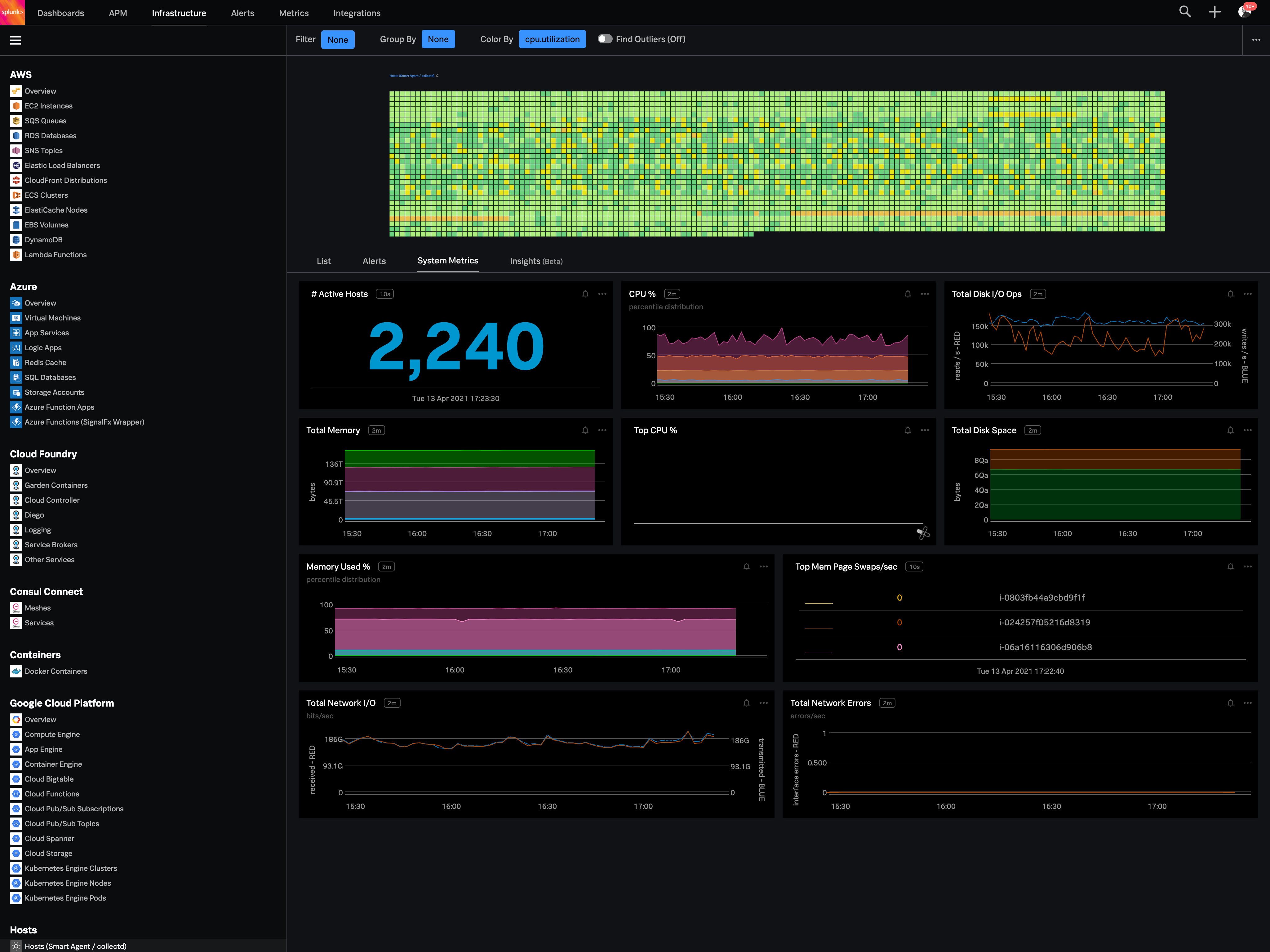
Splunk Observability Cloud aims to enable operational agility and better customer experience through real-time AI-driven streaming analytics allowing accurate alerts in seconds. It is designed to shorten MTTD and MTTR by providing real-time visibility into cloud infrastructure and services.
$180
per year per host
Pricing
SolarWinds Loggly
Splunk Observability Cloud
Editions & Modules
Standard
$79
per month/billed annually
Pro
$159
per month/billed annually
Enterprise
$279
per month/billed annually
Infrastructure
$15
per month (billed annually) per host
App & Infra
$60
per month (billed annually) per host
End-to-End
$75
per month (billed annually) per host
Offerings
Pricing Offerings
SolarWinds Loggly
Splunk Observability Cloud
Free Trial
Yes
Yes
Free/Freemium Version
Yes
No
Premium Consulting/Integration Services
Yes
No
Entry-level Setup Fee
No setup fee
No setup fee
Additional Details
Free trial for Standard and Pro plans for 14 days with all features.
SolarWinds Loggly is great for capturing and organizing logs from 3rd party sources such as NGINX. Without SolarWinds Loggly it's really difficult to manage the logs overtime, find traffic patterns, and identify issues before they become a problem. Anyone who is routinely searching through massive log files could quickly benefit from the SolarWinds Loggly and it's capabilities.
A de minimis incentive was given to thank the reviewer for their time. The incentive was not used to bias or drive a particular response, nor was the incentive contingent on a positive endorsement. More Info
Its great if you need real-time visibility across complex or regulated environments. Also strong for hybrid or multi-cloud setups where uptime, observability and fast IR are required. It’s probably overkill for smaller teams or environments that don’t have constant changes or compliance reporting needs. It's expensive and has a steep learning curve. Also, in my opinion, do not get yourself into a consumption based model. Costs can certainly get out of control quickly.
A de minimis incentive was given to thank the reviewer for their time. The incentive was not used to bias or drive a particular response, nor was the incentive contingent on a positive endorsement. TR verified that a representative sample of customers was invited. More Info
Putting our logs in one place and making them searchable. We use AWS, and CloudWatch has always been a little frustrating in this regard (though it has gotten better recently).
Deriving metrics from our logs. I think log-based metrics is such a good idea because your logs are the ultimate source for truth in regards to what the hell is going on inside your app. I have really loved the simplicity with which I can just count certain statements and call that a metric because just through the normal course of development certain log statements just naturally become a straightforward recording of an event having occurred.
Alerts. I actually have a few complaints about email alerts, but just the way I was able to set them up so easily has been huge. Since we started using Loggly, there have been at least 3 bugs that Loggly exposed that were frankly very bad. And withoutt Loggly or without a user reporting them, we would have never known they were happening! This is stuff I tried to set up in CloudWatch in various ways, but because of my own ignorance or perhaps the complexity/limitations of CloudWatch (or the complexity of my stack?), I wasn't getting the information that I needed until I was able to just tell Loggly to send me an email whenever the word "error" showed up.
A de minimis incentive was given to thank the reviewer for their time. The incentive was not used to bias or drive a particular response, nor was the incentive contingent on a positive endorsement. More Info
The first one is its Kubernetes container monitoring.
I really like this features because as we know how much K8s is vast and to manually monitor each part of the Kubernetes it takes so much time but Splunk Observability Cloud makes it easier. And even once we integrate K8s with Splunk Observability Cloud it gives us some prebuilt dashboards which gives holistic view of our Cluster and its nodes, pods, etc.
The dashbaord feature of Splunk Observability Cloud, it gives us full flexibility to customize our dashboard with a wide range of predefined chart types.
Now it also supports OTEL, which is a plus point for observability. As now everyone is moving towards Otel and in current market there are only few tools who supports OTEL based integrations, Splunk Observability Cloud is one out of them.
A de minimis incentive was given to thank the reviewer for their time. The incentive was not used to bias or drive a particular response, nor was the incentive contingent on a positive endorsement. TR verified that a representative sample of customers was invited. More Info
We have to use a log aggregating device to ship our logs to Loggly as our network devices can not connect on an encrypted protocol. I would prefer if we could use some sort of VPN-based connector to ship logs securely.
Sometimes when drilled down, it can be difficult to fully reset a search term to back all the way out of a drill down.
A de minimis incentive was given to thank the reviewer for their time. The incentive was not used to bias or drive a particular response, nor was the incentive contingent on a positive endorsement. More Info
You can use table-like functionality to generate dashboards, but these queries are heavy on the system.
It could be easier to give insight into what type of line parsing is used for specific documents in a company-managed environment and/or show ways to gain the insights needed.
I would like to see ways to anonymize specific data for shared reports without pre-formatting this in a dashboard on which reports could be based.
A de minimis incentive was given to thank the reviewer for their time. The incentive was not used to bias or drive a particular response, nor was the incentive contingent on a positive endorsement. More Info
A de minimis incentive was given to thank the reviewer for their time. The incentive was not used to bias or drive a particular response, nor was the incentive contingent on a positive endorsement. More Info
Good: Stable system with low error rate Easy to use for simple use cases Bad: UI is not very clear for complex usage Mobile view (when logged in from phone) is bad No library for .net
A de minimis incentive was given to thank the reviewer for their time. The incentive was not used to bias or drive a particular response, nor was the incentive contingent on a positive endorsement. More Info
Loggly's easy setup, very good customer support, and intuitive interface make Loggly very easy to use. User access management is also very easy as we can tailor the experience for each of our developers to access the information they need without having to wade through other information. While there was a slight learning curve in how to view the logs the way some specifically wanted, everything was possible and quite easy to do.
A de minimis incentive was given to thank the reviewer for their time. The incentive was not used to bias or drive a particular response, nor was the incentive contingent on a positive endorsement. More Info
When there is an issue, it’s a win if one can easily identify the root cause. To do the same, it should allow the user to dig deep with multiple data points and compare the data and identify the anomaly. In this use case, it’s good to drive from Splunk 011y.
A de minimis incentive was given to thank the reviewer for their time. The incentive was not used to bias or drive a particular response, nor was the incentive contingent on a positive endorsement. More Info
The support team have been great when we have logged tickets or had issues, most of the time it is down to user training, however we have had a couple of bugs that they have been able to iron out for us.
A de minimis incentive was given to thank the reviewer for their time. The incentive was not used to bias or drive a particular response, nor was the incentive contingent on a positive endorsement. More Info
A de minimis incentive was given to thank the reviewer for their time. The incentive was not used to bias or drive a particular response, nor was the incentive contingent on a positive endorsement. More Info
A de minimis incentive was given to thank the reviewer for their time. The incentive was not used to bias or drive a particular response, nor was the incentive contingent on a positive endorsement. More Info
A de minimis incentive was given to thank the reviewer for their time. The incentive was not used to bias or drive a particular response, nor was the incentive contingent on a positive endorsement. More Info
We were using Zabbix. While it is an open-source solution that you can install for free the following things were limitations of the solution. 1) The scale and uptime of the solution are now your own problem. Since we were hosting at AWS this meant we still had a cost of the AWS solution. 2) The product is complicated from a configuration standpoint. In order to get anything meaningful out of it, you had to invest a lot of time and effort. We did consider NewRelic. I have experience with that product and do think that it is a solid alternative. Ultimately experience with the simplicity and speed of deployment with Loggly encouraged me to suggest using this again.
A de minimis incentive was given to thank the reviewer for their time. The incentive was not used to bias or drive a particular response, nor was the incentive contingent on a positive endorsement. More Info
Splunk Infrastructure Monitoring provides far superior options for anybody using a complex hybrid multi-cloud environment and allows both your SOC and NOC to work together on the same data while driving their own insights. We found other products are still in the old world view of servers and agents residing together within a single data centre, but modern apps are no longer like this.
A de minimis incentive was given to thank the reviewer for their time. The incentive was not used to bias or drive a particular response, nor was the incentive contingent on a positive endorsement. More Info
Unfortunately, we hit our logging cap on a weekly basis and we lose logs after that.
We have lost logs after hitting the maximum during service outages. We have become accustomed to not being able to rely on having them, then things go poorly.
A de minimis incentive was given to thank the reviewer for their time. The incentive was not used to bias or drive a particular response, nor was the incentive contingent on a positive endorsement. More Info
A de minimis incentive was given to thank the reviewer for their time. The incentive was not used to bias or drive a particular response, nor was the incentive contingent on a positive endorsement. More Info