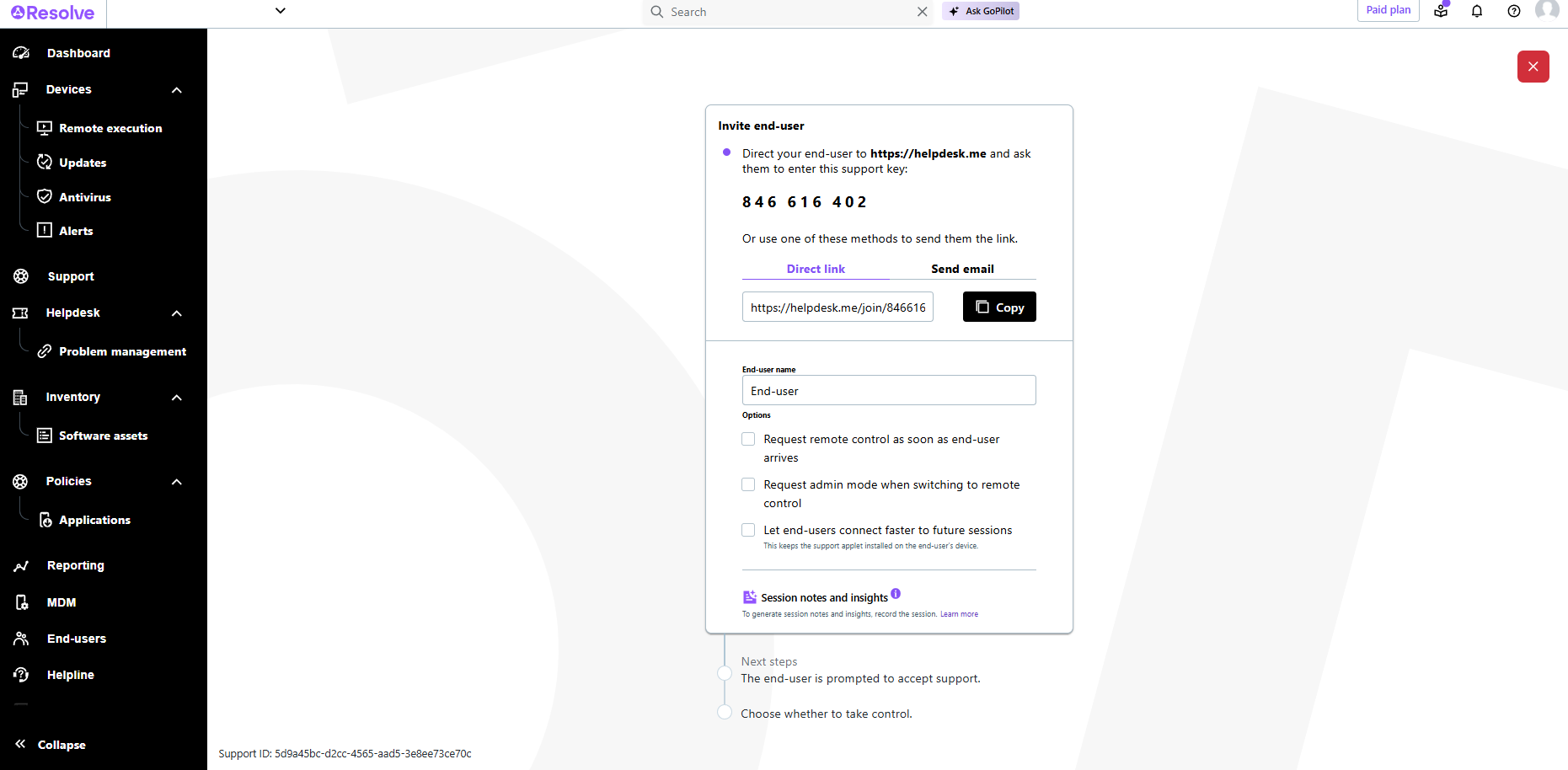
LogMeIn Resolve is an IT management and support solution designed to help organizations take control of their IT infrastructure. The platform combines features like remote monitoring, access, and support with tools such as ticketing, AI-assisted task automation, and patch management.
$29
per month
Microsoft Intune
Score 8.2 out of 10
N/A
Microsoft Intune (formerly Microsoft Endpoint Manager), combining the capabilities of the former Microsoft System Center Configuration Manager, SCCM or ConfigMgr, is presented as a unified endpoint management option. Microsoft Intune is an endpoint management solution for mobile devices, an MDM solution that allows the user to securely manage iOS, Android, Windows, and macOS devices with a single endpoint management solution. The component Endpoint Configuration Manager (the…
$5
per user/per month
Spacelift
Score 10.0 out of 10
N/A
Spacelift is presented as a flexible management platform for Infrastructure as Code hosted in the cloud or on a private server, from the company of the same name headquartered in Redwood City. Designed so users can customize workflows, automate manual tasks, reduce errors, and improve security and auditability of infrastructure.
$250
per month
Pricing
LogMeIn Resolve
Microsoft Intune
Spacelift
Editions & Modules
Starter
$29
per month
Growth
$55
per month
Advanced
$78
per month
Premium Endpoint Management
$78
per month
Complete
$94
per month
Microsoft 365 Business Basic
$5
per user/per month
Microsoft 365 For Individuals
$6.99
per month
Microsoft 365 Apps
$8.25
per user/per month
Microsoft 365 For Families
$9.99
per month
Microsoft 365 Business Standard
$12.50
per user/per month
Microsoft 365 Business Premium
$15
per user/per month
Cloud
starting at $250
per month
Enterprise SaaS
starting at $2000
per month
Offerings
Pricing Offerings
LogMeIn Resolve
Microsoft Intune
Spacelift
Free Trial
Yes
No
Yes
Free/Freemium Version
No
No
Yes
Premium Consulting/Integration Services
No
No
No
Entry-level Setup Fee
No setup fee
No setup fee
No setup fee
Additional Details
Volume discounts are available. MDM is available as a standalone or as an add-on. Discount available for annual billing.
We choose LogMeIn Resolve because unlike AnyDesk it offers helpdesk ticketing, remote monitoring and support in one place and reduces the need of juggling multiple tools.
Although the SolarWinds help desk worked well for our help desk and inventory purposes, it did not provide remote access ability or remote execution of executable files or scripts. We were looking for a product that integrated all of these tasks in order to simplify our day to …
We decided to go with LogMeIn Resolve due to its UEM solution. It offered us various features like remote support, ticketing, remote monitoring, etc. in a single system. It also allowed us to manage many devices from a single, centralized point.
It is better in every way. Intuitively designed, great UI, easy to install and go live, great out of box training videos and features are constantly being improved and supported
LogMeIn Resolve represents a distilled and clean RMM and ticket management system. Autotask has a lot of great features that might be unnecessary for a smaller organization's internal use. Sometimes a team just needs to get in and have that higher overview without setting up a …
At the time that we tested and selected a remote access tool, GoTo was superior to the other options tested. Then came the issues with ctrl+key and shift+key combos which detracted from all of the things that made GoTo the best option. Until these are fixed GoTo will remain …
We traditionally utilize all related products to support our end users in a remote environment. This requires that we have access to their systems, typically monitored, via a screen share session where we can use built in functionality such as file sharing. This allows us to …
Go to offer all-in-one functionalities without compromising organizational security and policy. Go-to is versatile compared to other systems like JIRA and is suitable for medium organizations. It has all the support options required. Like web meetings, conversational ticketing, …
Microsoft Intune fits seamlessly with the other Microsoft products that are installed at our customers. Furthermore, Microsoft Intune has a lot of possibilities and can be used very flexibly. In terms of management, maintenance and rollout, it fits the wishes of our …
Microsoft Intune is more robust as far as fine-tuning security controls. It also allows for software installs, folder access controls, updating PCs, and other features simply not found in previous products we have used. Because it is rolled into MS 365 it's very cost …
We migrated from Skybox to Microsoft Intune because we already owned Intune licensing through our existing Microsoft subscription. Overall, this has reduced costs, increased operating efficiencies, and lead to more streamlined system and process management. It was really a …
A few of our apps get deployed during enrollment, the important ones that are required. For other apps, PDQ makes things a bit quicker as you can hit deploy and it happens instantly. So we use a mix of the two products. If you have a lot of macOS devices, another tool to …
I prefer to go with what is already available from Microsoft to manage my IT infrastructure. My preference is to reduce the number of vendors I have to work with.
Symantec Ghost Solutions only covered only 2 parts, creating and imaging, of what Microsoft Endpoint Protection provided us. Price point wise it was a no brainer for us to switch to it as it covered many other things we were looking for and become an almost all in one solution
We did not evaluate or use other products like Microsoft Endpoint Manager (Microsoft Intune + SCCM). The main reason we did not evaluate or use other products is because Microsoft Endpoint Manager (Microsoft Intune + SCCM) integrates seamlessly with Microsoft 365 and Windows …
Due to work put into getting SCCM up and running, moving to Endpoint Manager was the logical step, without needing to compare to other products and start that development cycle over again. Staying within the Microsoft ecosystem allows our organization to have better-defined …
Not having to invest in Intune and having all the important features its competitors had the choice was very easy to make in favor of Microsoft's product.
[Microsoft Endpoint Manager (Microsoft Intune + SCCM)] was already in our environment when I was hired. We haven't really evaluated the need to use another application because SCCM has been working well for us. Additionally, Microsoft SCCM is the industry-standard when it comes …
SCCM's bread and butter has been imaging, and that still can't be beat. With cloud computing becoming more normal, however, we are seeing fewer instances where we are flat out imaging devices as they come in. However, [Microsoft] Endpoint Manager still [excels] in this area. …
Group policy, the predecessor of Microsoft Endpoint Manager was a great, easy to use tool. It is dated and stuck as an on-prem solution but still very good and served a purpose. We are still using this in conjunction with Microsoft Endpoint Manager whilst we complete our …
We tired other solution which less suite for our needs. Currently we mostly use MS applications and services so, MS Intune ans SCCM close match our expectation and needs. We require easy access and top reliability with support for all of our IT platforms.
I haven't used any of the above-mentioned endpoint management solutions but heard about them. I hope they also provide similar functionalities as provided by Intune.
Dell Kace K1000 does a great job of system patching of Applications, Office, and Windows. It does a great job of software deployment. It even has great software for asset and inventory management. It is also a ServiceDesk platform, and if you're not using that function, it can …
Most companies with Office 365 already own Intune. It also heavily integrated with Office 365. Other product users had more issues and limitations. Security features did not work with other vendors, and we spent more time dealing with issues.
SCCM is probably used across the industry more so than most other Systems Management solutions, and the reasoning behind this is most likely because it is a Microsoft product, which integrates well with the Windows Server platform, and also with clients/endpoints that are on …
We selected Microsoft Intune for the ease of use and its integration with the entire Office 365 ecosystem, which allows us to have an end-to-end of the collaborator.
GFI Lan Guard system is not user-friendly. GFI Lan Guard does not produce laptop/computer images in one place and its asset management is not very good. System Center Configuration Manager was built for asset management and therefore able to provide robust inventory management. S…
Microsoft System Center Configuration Manager is kind of the only option for PC management on a large scale. There are open-source alternatives like Chocolatey, but that only works for very small scale shops. Microsoft kind of monopolizes on this front for enterprise …
We use AD GPO to deploy software, WDS for OS deployment, and Spiceworks for inventory. This solution has significantly reduced feature set compared to SCCM but much easier to troubleshoot and configure. Currently, we are looking into ManageEngine Desktop Central and SmartDeploy …
IT Director of Customer Care, Operations and Academic Technologies
Chose Microsoft Intune
We were a ZENworks shop previously. With our strong tie to Novell that made sense, but as we left Netware and its enterprise directory it made sense to leave Zenworks. At the time, I would have said that ZENworks was a more mature tool and I haven't kept up with their feature …
I inherited an already existing environment system center. My previous experience was using WSUS. Microsoft System Center Configuration Manager does still use WSUS but it is a far more robust and complete solution for managing and reporting on all your PCs. Our Microsoft …
LogMeIn is well-suited for scenarios where remote support is needed. For example, a user submits a ticket about having an issue with Microsoft Word being unable to open documents on their PC. Since this is just a software issue on the device, LogMeIn is great for being able to fix the issue. Scenarios, I would say LogMeIn Resolve is not as well-suited for inventory management. But that's only because my organization has a proprietary system to manage assets.
Windows Autopilot makes provisioning user Windows PC laptops a breeze. A user only needs to turn on the laptop, join it to their local WiFi, login with their O365 account then sit back and let Windows Autopilot handle the app installations required for work, configure the laptop settings to meet my organization requirements. I have seen this all completed in less than 30 minutes depending on how fast the internet connection is. Where Microsoft Intune needs to improve I think is the part where it can push out software updates to 3rd party apps. Right now I have to use Automox to fill in this gap.
[Microsoft Endpoint Manager (Microsoft Intune + SCCM)] helps to speed up the deployment of patches/software throughout our environment. I can easily build a package and then deploy across all endpoints.
The ability to supercede software is also quite handy. This automates the removal of old versions and replacing them with newer versions.
The Intune Autopilot option is very useful if you want to deploy software to devices straight out of the box. You can configure them to download software when a user opens a new PC and turns it on for the first time.
Installation is very laborious and complicated. The number of things to manually configure during the installation is incredible.
OS deployment is hard to configure and troubleshoot. The Microsoft article on deploying Windows 10 via System Center Configuration Manager in a test environment takes 44 minutes to read (Microsoft's estimate, not mine -- check here: https://docs.microsoft.com/en-us/windows/deployment/windows-10-poc-sc-config-mgr). If something goes wrong, there are multiple log locations to check on both the server and client, making troubleshooting difficult.
The management console looks old, and its performance isn't great. It is often hard to find settings in the console, and it refreshes slowly. The old name for System Center Configuration Manager, SMS, comes to mind often. "Slowly Moving Software."
To us, it just works. and it is what our users are comfortable with. It covers all the remote issues that we as an IT department encounter. We have grown to like it and we also have grown to like the Citrix product family. We really can't find anything that would keep us from renewing.
Mascom Wireless is a Microsoft shop and SCCM has proved to be helpful in keeping our Microsoft products up to date every month without fail. We also have a Microsoft Enterprise Agreement which we renewed for three years ending 2022. The remote access utility works wonders for the organisation and have saved travel bills including subsistance allowance. We have been able to fulfill security audits both internal and external. We have been able to keep a robust inventory of our computer assets and nothing falls of the cracks
The interface is clean, intuitive, and easy to navigate. Common actions are easy to locate and exactly where I would expect them to be. Starting a remote session is quick and smooth, which reduces the time users need to wait before receiving support. I also appreciate the single-pane dashboard showing remote access, session details, and device information.
Overall, Microsoft Intune is very usable. While help documentation can be lacking, once setup and configured, Intune does all the work that used to be manual. There is a lot of automation and advanced features and manufacturer integrations you don't get anywhere else. These are absolutely game changers when managing IT workloads.
Usually available without a problem, although sometimes calls get dropped or users sit in empty meeting rooms while waiting for an admin to arrive, while the call is actually going on.
If you are connected to someone with proper bandwidth, there are no issues at all. With all things, if you connect to someone with dial-up (yes, it still exists), the performance is terrible.
It's a 'heavy' system, which demands a lot of resources form the datacenter perspective. So, make sure you followed the requirements to avoid frustration in the future. From the 'client' perspective, it's fine. I've never had any issue with that.
The software runs well overall once installed. It is easy to use and very intuitive from both the technician standpoint and the customer standpoint. There are not a lot of problems or issues with the software, and it doesn't have a big effect on system resources once installed, or when running. It would not be a 10 since the cost of the licensing is one drawback
Being a Microsoft product, support was good. Out interaction was limited to our in-house IT team which was installing the Intune app in our mobile device. The installation was smooth and we haven't faced any difficulties with the app while using it. Provides a smooth and secure access to all Office 365 apps in mobile while separating the personal and professional data.
GoToAssist SeeIt was very easy to implement. As long as your techs have a basic understanding of most remote support tools they will be able to understand this product easily.
Work with a "test group" of users who you have a good relationship with so that when things don't work properly they understand! Work with your partner nicely without forcing things especially timelines as you are bound to make mistakes and create oversights in the project Management can also interfere with the implementation (which can cause delays) if you make too many mistakes which takes me back to having a "test group" where you have good relations
Although the SolarWinds help desk worked well for our help desk and inventory purposes, it did not provide remote access ability or remote execution of executable files or scripts. We were looking for a product that integrated all of these tasks in order to simplify our day to day IT functions.
Microsoft Intune is more robust as far as fine-tuning security controls. It also allows for software installs, folder access controls, updating PCs, and other features simply not found in previous products we have used. Because it is rolled into MS 365 it's very cost effective. It's also a single pane of glass for managing user PCs and personal devices
A positive ROI, the expansive remote abilities allow a minimum of 90% of our IT work without sending a technician to the location.
10% of our technicians travel to locations while 90% are home-based. (Office or Home).
We used to have multiple techs attending one customer location physically (brainstorming does happen during a fire). We are now able to send multiple technicians to the same call 'virtually' without the cost of actually sending them.
The positive impact it's had was it has been really beneficial in having an all-in-one Systems Management solution to be able to manage all endpoints across the organization. This has saved both time and costs from having to search/setup/manage other System Management applications and also have saved money from having to purchase a license for other commercial products.
Another positive impact it has had was in being able to easily remote into computers/endpoints, and also being able to provide remote assistance to end-users.
The negative impact has been it is not being fully utilized by most of the IT staff, as it is a more complicated platform to learn/master. This would require funding for IT staff to take training in learning the product, or require time to consult the documentation in the use of the product. As a result, this may hurt productivity in being able to have to work on other things.