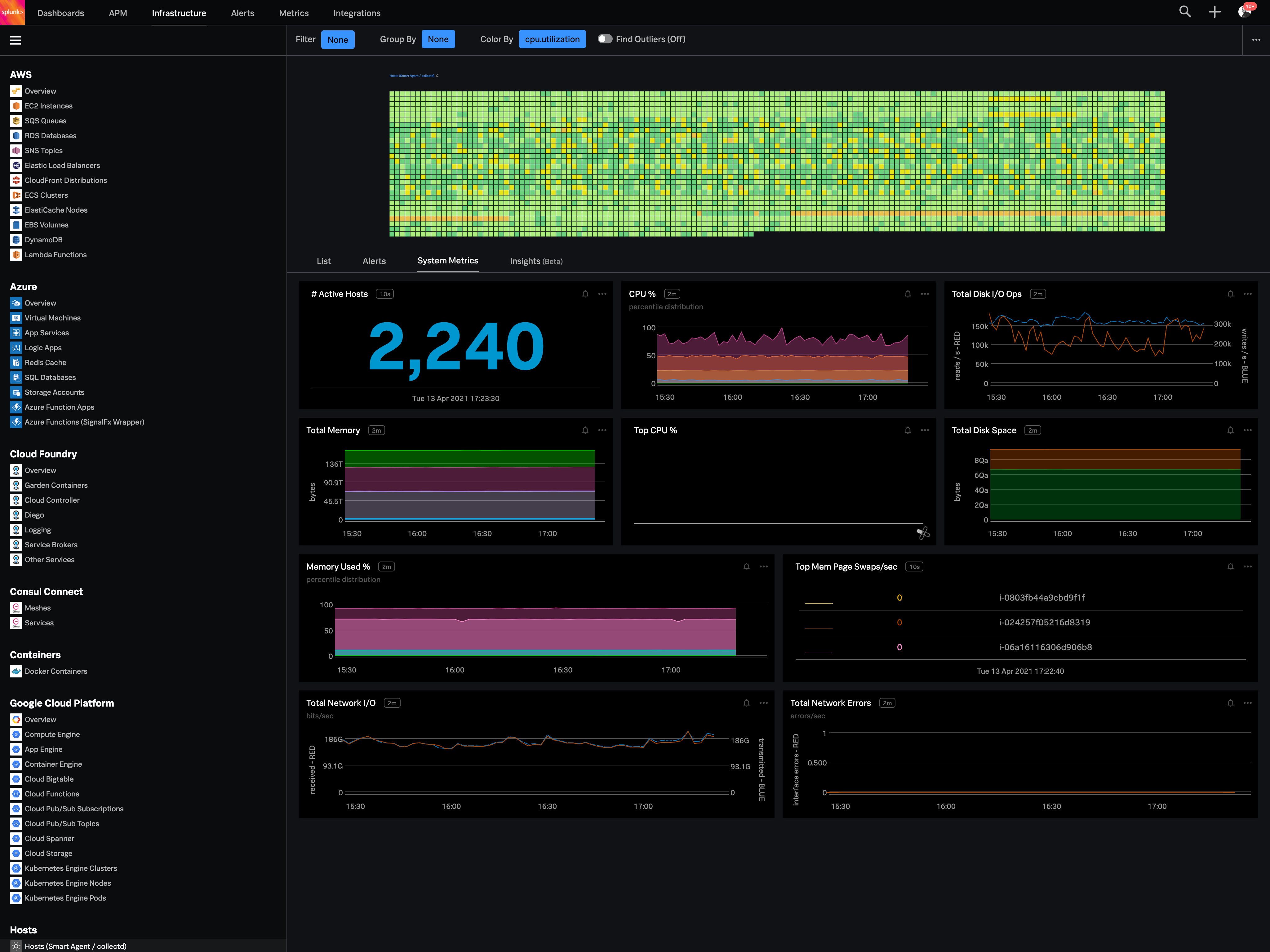
Splunk Observability Cloud aims to enable operational agility and better customer experience through real-time AI-driven streaming analytics allowing accurate alerts in seconds. It is designed to shorten MTTD and MTTR by providing real-time visibility into cloud infrastructure and services.
$180
per year per host
Sumo Logic
Score 8.8 out of 10
N/A
Sumo Logic is a log management offering from the San Francisco based company of the same name.
SignalFX is a strong competitor in the monitoring SaaS space and provide the basic necessities for production grade monitoring and alerting. Other solutions may offer easier adoption and other helpful features, but will have trouble competing for cost for organizations that …
Comparing them to Logstash and other open source tools, Sumo Logic is a clean, already well built tool that is ready to ingest and analyze data instantly. Other open source tools take a lot of time to build and manage; and their graphs/dashboards are almost always lacking. Sumo …
Sumo Logic works very well out of the gate. For a small business it has given us what we need. I worked at a larger company previously, and we produced so many logs we had to create a custom logging service to handle them all. Cost and availability are big issues when …
Perfect for projects where Elasticsearch makes sense: if you decide to employ ES in a project, then you will almost inevitably use LogStash, and you should anyways. Such projects would include: 1. Data Science (reading, recording or measure web-based Analytics, Metrics) 2. Web Scraping (which was one of our earlier projects involving LogStash) 3. Syslog-ng Management: While I did point out that it can be a bit of an electric boo-ga-loo in finding an errant configuration item, it is still worth it to implement Syslog-ng management via LogStash: being able to fine-tune your log messages and then pipe them to other sources, depending on the data being read in, is incredibly powerful, and I would say is exemplar of what modern Computer Science looks like: Less Specialization in mathematics, and more specialization in storing and recording data (i.e. Less Engineering, and more Design).
Its great if you need real-time visibility across complex or regulated environments. Also strong for hybrid or multi-cloud setups where uptime, observability and fast IR are required. It’s probably overkill for smaller teams or environments that don’t have constant changes or compliance reporting needs. It's expensive and has a steep learning curve. Also, in my opinion, do not get yourself into a consumption based model. Costs can certainly get out of control quickly.
SumoLogic is a fantastic log aggregator and analysis tool, a fine alternative to Splunk. Searching is powerful and mostly intuitive and results come fast. If you have application logs in clusters or Kubernetes pods that lose their logs every time they're restarted, Sumo is the solution for you
Logstash design is definitely perfect for the use case of ELK. Logstash has "drivers" using which it can inject from virtually any source. This takes the headache from source to implement those "drivers" to store data to ES.
Logstash is fast, very fast. As per my observance, you don't need more than 1 or 2 servers for even big size projects.
Data in different shape, size, and formats? No worries, Logstash can handle it. It lets you write simple rules to programmatically take decisions real-time on data.
You can change your data on the fly! This is the CORE power of Logstash. The concept is similar to Kafka streams, the difference being the source and destination are application and ES respectively.
The first one is its Kubernetes container monitoring.
I really like this features because as we know how much K8s is vast and to manually monitor each part of the Kubernetes it takes so much time but Splunk Observability Cloud makes it easier. And even once we integrate K8s with Splunk Observability Cloud it gives us some prebuilt dashboards which gives holistic view of our Cluster and its nodes, pods, etc.
The dashbaord feature of Splunk Observability Cloud, it gives us full flexibility to customize our dashboard with a wide range of predefined chart types.
Now it also supports OTEL, which is a plus point for observability. As now everyone is moving towards Otel and in current market there are only few tools who supports OTEL based integrations, Splunk Observability Cloud is one out of them.
Sumo Logic allowed for our InfoSec team to ingest logs from our CDN directly, in real-time, instead of massive compressed archives that were sent every two-hours (the only alternative at the time). Sumo Logic had an app for these logs, that allowed us to easily get an immediate payoff from the data, with canned dashboard and saved searches.
Sumo Logic has a fairly extensive REST API when it comes to log sources, source configurations, dashboard data, searches, etc. Their wiki for the API is usually kept up to date.
Sumo Logic, during the period of time I had used their product, had added the ability to configure agents via configuration files. This allowed customers to configure their endpoints, and modify the endpoints, with configuration management tools like Chef / Puppet / Salt. Beforehand, the only option was to always make changes either via the web portal or REST API.
The solutions engineers were extremely helpful, and easily reachable when issues would occur.
Users at our company found it easy to get started, working on new dashboards, scheduled searches, and alerting. The alerting worked well with our third-party paging tool.
You can use table-like functionality to generate dashboards, but these queries are heavy on the system.
It could be easier to give insight into what type of line parsing is used for specific documents in a company-managed environment and/or show ways to gain the insights needed.
I would like to see ways to anonymize specific data for shared reports without pre-formatting this in a dashboard on which reports could be based.
Good: Stable system with low error rate Easy to use for simple use cases Bad: UI is not very clear for complex usage Mobile view (when logged in from phone) is bad No library for .net
As I said earlier, for a production-grade OpenStack Telco cloud, Logstash brings high value in flexibility, compliance, and troubleshooting efficiency. However, this brings a higher infra & ops cost on resources, but that is not a problem in big datacenters because there is no resource crunch in terms of servers or CPU/RAM
When there is an issue, it’s a win if one can easily identify the root cause. To do the same, it should allow the user to dig deep with multiple data points and compare the data and identify the anomaly. In this use case, it’s good to drive from Splunk 011y.
Sumo Logic is very powerful but definitely requires some configuration work to get the most out of it. You can get a certification related to this, but it is definitely not something you can just throw together.
I would give this rating because I attended a free Sumo Logic training at a WeWork in Chicago. I found the training very useful, and I learned a lot of features that I was not aware of before I went to the training. I like the idea that SumoLogic provides free training seminars. I am certified in level1, and I plan on certifying to level2.
I was satisfied with the implementation, as at the time, it was the best way to implement the product with the available feature sets in Sumo Logic. User creation and management became more of an issue during continued use, instead of it being an issue related to deploying the product in our environment.
Logstash can be compared to other ETL frameworks or tools, but it is also complementary to several, for example, Kafka. I would not only suggest using Logstash when the rest of the ELK stack is available, but also for a self-hosted event collection pipeline for various searching systems such as Solr or Graylog, or even monitoring solutions built on top of Graphite or OpenTSDB.
Splunk Infrastructure Monitoring provides far superior options for anybody using a complex hybrid multi-cloud environment and allows both your SOC and NOC to work together on the same data while driving their own insights. We found other products are still in the old world view of servers and agents residing together within a single data centre, but modern apps are no longer like this.
Sumo Logic works very well out of the gate. For a small business it has given us what we need. I worked at a larger company previously, and we produced so many logs we had to create a custom logging service to handle them all. Cost and availability are big issues when deciding between the different services, whether self maintained and hosted, or provided by another company.
Positive: LogStash is OpenSource. While this should not be directly construed as Free, it's a great start towards Free. OpenSource means that while it's free to download, there are no regular patch schedules, no support from a company, no engineer you can get on the phone / email to solve a problem. You are your own Engineer. You are your own Phone Call. You are your own ticketing system.
Negative: Since Logstash's features are so extensive, you will often find yourself saying "I can just solve this problem better going further down / up the Stack!". This is not a BAD quality, necessarily and it really only depends on what Your Project's Aim is.
Positive: LogStash is a dream to configure and run. A few hours of work, and you are on your way to collecting and shipping logs to their required addresses!