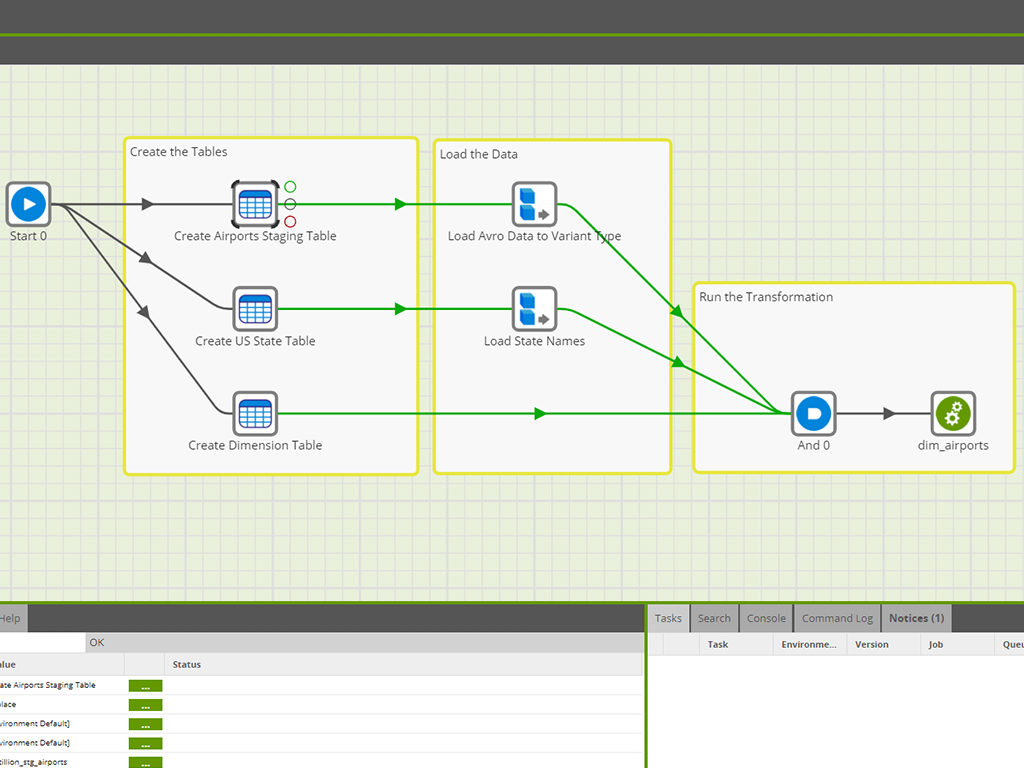
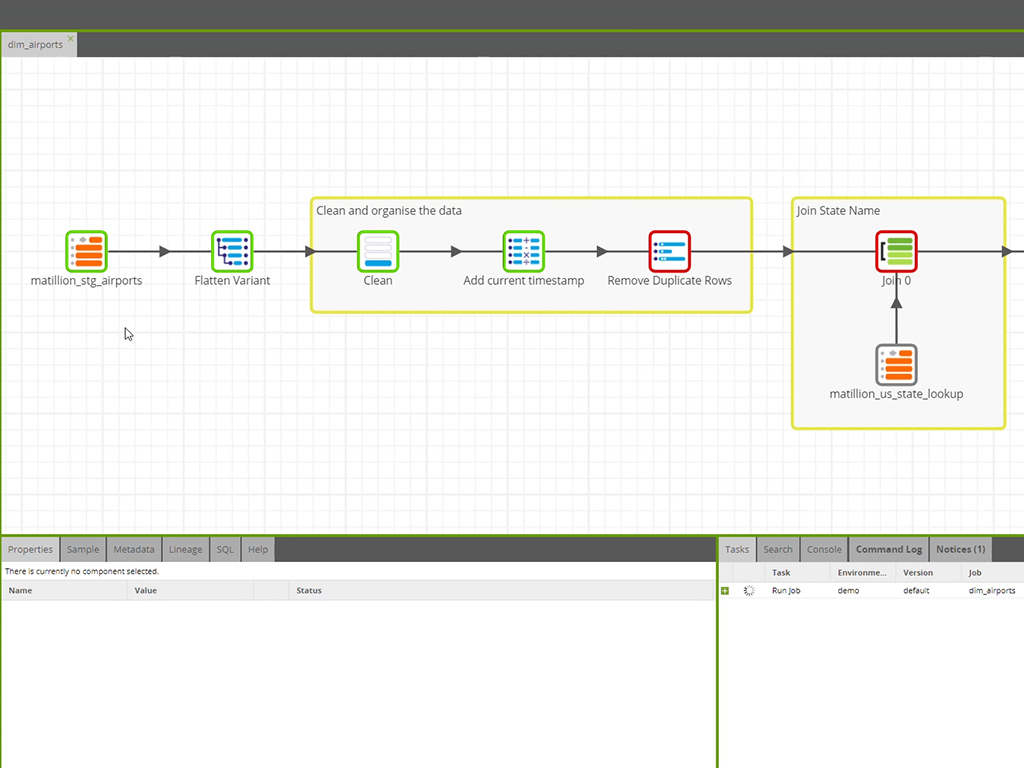
Matillion is a data pipeline platform used to build and manage pipelines. Matillion empowers data teams with no-code and AI capabilities to be more productive, integrating data wherever it lives and delivering data that’s ready for AI and analytics.
$2.50
Pay as you go per user
Oracle Data Integrator (ODI)
Score 7.6 out of 10
N/A
Oracle Data Integrator is an ELT data integrator designed with interoperability other Oracle programs. The program focuses on a high-performance capacity to support Big Data use within Oracle.
N/A
Progress MarkLogic
Score 9.0 out of 10
N/A
MarkLogic Server is a multi-model database that has both NoSQL and trusted enterprise data management capabilities. The vendor states it is the most secure multi-model database, and it’s deployable in any environment. They state it is an ideal database to power a data hub.
$0.01
per MCU/per hour + 0.10 per GB/per month
Pricing
Matillion
Oracle Data Integrator (ODI)
Progress MarkLogic
Editions & Modules
Developer: For Individuals
$2.50/credit
Pay as you go per user
Basic
$1000
per month 500 prepaid credits (additional credits: $2.18/credit)
Advanced
$2000
per month 750 prepaid credits (additional credits: $2.73/credit)
Enterprise
Request a Quote
No answers on this topic
Low Priority Fixed
$0.01
per MCU/per hour + 0.10 per GB/per month
Standard Reserved
$0.07
per MCU/per hour + 0.10 per GB/per month
Standard On-Demand
$0.13
per MCU/per hour + 0.10 per GB/per month
Offerings
Pricing Offerings
Matillion
Oracle Data Integrator (ODI)
Progress MarkLogic
Free Trial
Yes
No
No
Free/Freemium Version
No
No
No
Premium Consulting/Integration Services
Yes
No
No
Entry-level Setup Fee
No setup fee
No setup fee
No setup fee
Additional Details
Billed directly via cloud marketplace on an hourly basis, with annual subscriptions available depending on the customer's cloud data warehouse provider.
Matillion is cloud-native, therefore it doesn't need virtual machines to set up. It is easier to use compared with some of them. It always does query pushdown, while other ones don't'. It is integrated with Snowflake, while other ETLs need to use workarounds in order to perform …
Great: Need to query simpler APIs, or utilize well known services such as GSheets etc.? Matillion has got some of the best and easiest to use connectors out there. Not so great: Do you need have a competent CI/CD flow that you will be able to update / compare from Matillion as well as other sources at the same time? Good luck, you will need to be extra careful, as you might have to have a deeper dive into your servers Terminal each time you have a git conflict.
Oracle Data Integrator is well suited in all the situations where you need to integrate data from and to different systems/technologies/environments or to schedule some tasks. I've used it on Oracle Database (Data Warehouses or Data Marts), with great loading and transforming performances to accomplish any kind of relational task. This is true for all Oracle applications (like Hyperion Planning, Hyperion Essbase, Hyperion Financial Management, and so on). I've also used it to manage files on different operating systems, to execute procedures in various languages and to read and write data from and to non-Oracle technologies, and I can confirm that its performances have always been very good. It can become less appropriate depending on the expenses that can be afforded by the customer since its license costs are quite high.
If you are storing META data then MarkLogic is super useful as it retrieves everything so fast, while storing the whole data shows performance issues some times. If you have legacy systems then migrating from it would really require sweat and blood, on the other hand if you are in systems like Node.js you can simply integrate two systems easily. If you don't know how in the end your your data schema will look like then it's better to make a prototype using MarkLogic.
Oracle Data Integrator nearly addresses every data issue that one can expect. Oracle Data Integrator is tightly integrated to the Oracle Suite of products. This is one of the major strengths of Oracle Data Integrator. Oracle Data Integrator is part of the Oracle Business Intelligence Applications Suite - which is highly used by various industries. This tool replaced Informatica ETL in Oracle Business Intelligence Applications Suite.
Oracle Data Integrator comes with many pre-written data packages. If one has to load data from Excel to Oracle Database, there is a package that is ready available for them - cutting down lot of effort on writing the code. Similarly, there are packages for Oracle to SQL, SQL to Oracle and all other possible combinations. Developers love this feature.
Oracle Data Integrator relies highly on the database for processing. This is actually an ELT tool rather than an ETL tool. It first loads all the data into target instance and then transforms it at the expense of database resources. This light footprint makes this tool very special.
The other major advantage of Oracle Data Integrator, like any other Oracle products, is a readily available developer pool. As all Oracle products are free to download for demo environments, many organizations prefer to play around with a product before purchasing it. Also, Oracle support and community is a big advantage compared to other vendors.
Matillion is brilliant at importing data -- it would be amazing to have more ways to export data, from emailed exports to API pushes.
Any Python that takes more than a few lines of code requires an external server to run it. It would be great to have more integration (perhaps in a connected virtual environment) to easily integrate customized code.
Troubleshooting server logs requires quite a bit of technical expertise. More human readable detailed error handling would be greatly appreciated.
ODI does not have an intuitive user interface. It is powerful, but difficult to figure out at first. There is a significant learning curve between usability, proficiency, and mastery of the tool.
ODI contains some frustrating bugs. It is Java based and has some caching issues, often requiring you to restart the program before you see your code changes stick.
ODI does not have a strong versioning process. It is not intuitive to keep an up to date repository of versioned code packages. This can create versioning issues between environments if you do not have a strong external code versioning process.
MarkLogic still has a long way to go in fostering the developer community. Many developers are gravitating to the simple integrations and do not delve into the deeper capabilities. They have made tremendous strides in recent months and I am sure this will improve over time.
Many of the best features are left on the floor by enterprises who end up implementing MarkLogic as a data store. MarkLogic needs to help customers find ways to better leverage their investment and be more creative in how they use the product.
Licensing costs become a major hurdle for adoption. The pricing model has improved for basic implementations, but the costs seem very prohibitive for some verticals and for some of the most advanced features.
With the current experience of Matillion, we are likely to renew with the current feature option but will also look for improvement in various areas including scalability and dependability. 1. Connectors: It offers various connectors option but isn't full proof which we will be looking forward as we grow. 2. Scalability: As usage increase, we want Matillion system to be more stable.
It is maturing and over time will have a good pool of resources. Each new version has addressed the issues of the previous ones. Its getting better and bigger.
MarkLogic is expensive but solid. While we use open source for almost everything else, the backend database is too critically important. At this point, re-tooling for a different back end would take too much time to be a viable option.
We are able to bring on new resources and teach them how to use Matillion without having to invest a significant amount of time. We prefer looking for resources with any type of ETL skill-set and feel that they can learn Matillion without problem. In addition, the prebuilt objects cover more than 95% of our use cases and we do not have to build much from scratch.
Oracle Data Integrator (ODI) is a reliable ELT tool, supporting data loads from various heterogenous sources. It is effective both for structured as well as non structured data. Its works well for creating translations and transformation and also aids in the data quality checks when combined with an MDM solution. Troubleshooting issues can be of a challenge if it is not configured properly.
Very little about it can be done better or with greater ease. Even things that seem difficult aren't really that bad. There's multiple ways to accomplish any admin task. MarkLogic requires a fraction of administrative effort that you see with enterprise RDBMS like Oracle. MarkLogic is continually improving the tools to simplify cluster configuration and maintenance.
Overall, I've found Matillion to be responsive and considerate. I feel like they value us as a customer even when I know they have customers who spend more on the product than we do. That speaks to a motive higher than money. They want to make a good product and a good experience for their customers. If I have any complaint, it's that support sometimes feels community-oriented. It isn't always immediately clear to me that my support requests are going to a support engineer and not to the community at large. Usually, though, after a bit of conversation, it's clear that Matillion is watching and responding. And responses are generally quick in coming.
There's always room for improvement. Some problems get solved faster than others, of course. MarkLogic's direct support is very responsive and professional. If they can't help immediately, they always have good feedback and are eager to receive information and details to work to replicate the problem. They are quick to escalate major support issues and production show-stopping problems. In addition to MarkLogic's direct support, there are several employees who are very active among the community and many questions and common issues get quick attention from helpful responses to email and StackOverflow questions.
Fivetran offers a managed service and pre-configured schemas/models for data loading, which means much less administrative work for initial setup and ongoing maintenance. But it comes at a much higher price tag. So, knowing where your sweet spot is in the build vs. buy spectrum is essential to deciding which tool fits better. For the transformation part, dbt is purely (SQL-) code-based. So, it is mainly whether your developers prefer a GUI or code-based approach.
I have used Trifacta Google Data Prep quite a bit. We use Google Cloud Platform across our organization. The tools are very comparable in what they offer. I would say Data Prep has a slight edge in usability and a cleaner UI, but both of the tools have comparable toolsets.
We had Fast in place when Microsoft had bought it up and was going to change / deprecate it. One of the biggest advantages of MarkLogic for search actually had to do with the rest of the content pipeline - it allowed us to have it all in one technology. On the NoSQL side, we looked at MongoDB a couple years back. At that time, MarkLogic came in stronger on indexing, transaction reliability, and DR options. For us, that was worth using a commercial product.
We're using Matillion on EC2 instances, and we have about 20 projects for our clients in the same instance. Sometimes, we're struggling to manage schedules for all projects because thread management is not visible, and we can't see the process at the instance level.
MarkLogic reduced the amount of time that the DevOps team needed to dedicate to database updates, as the engineering team was mostly able to easily design and maintain database upgrades without requiring specialists such as database architects on the DevOps side. This capability flowed from the product's speed and the versatility of its XQuery language and libraries.
MarkLogic required significant education and buy-in time for the engineering team.