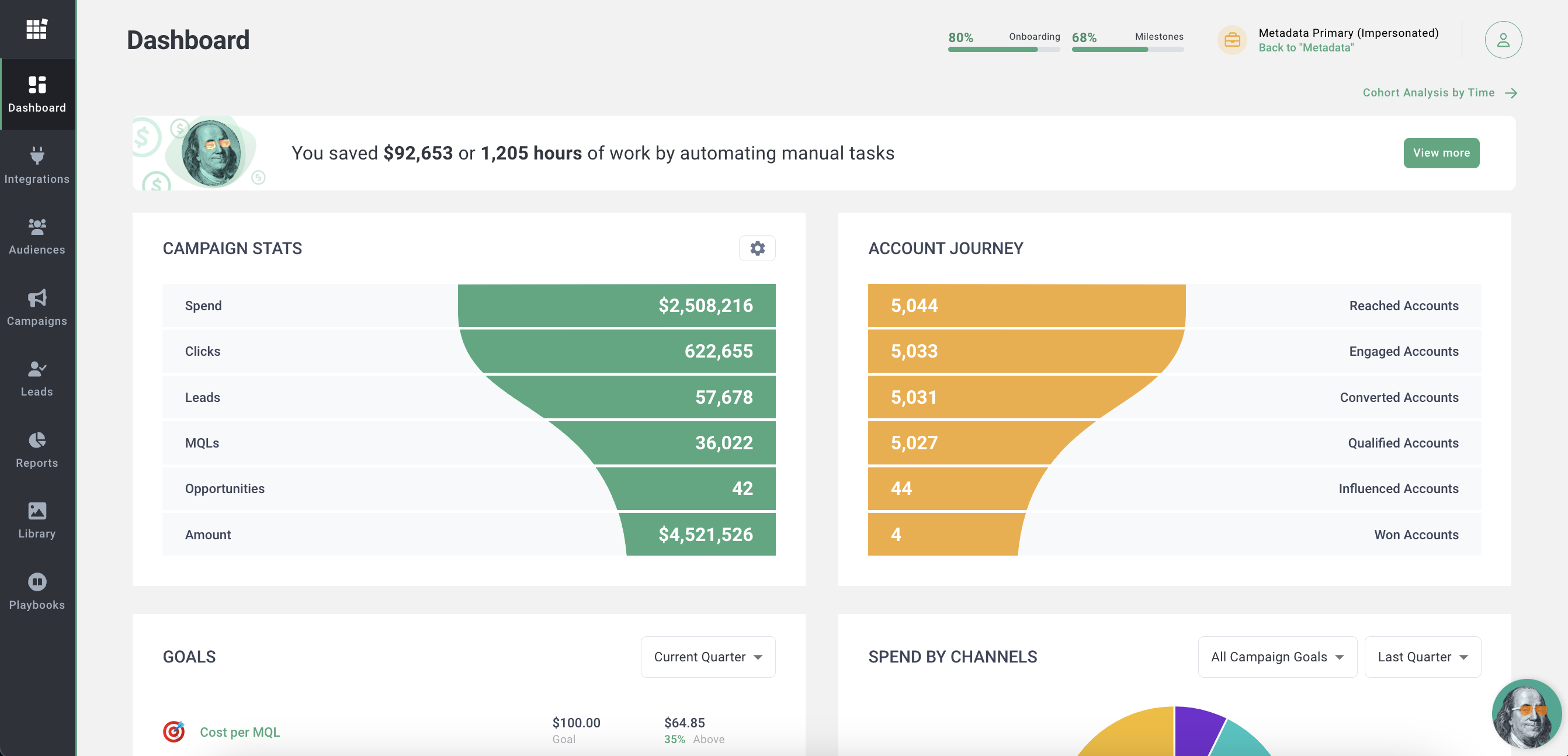
Based in San Francisco, Metadata.io is a Demand Generation and ABM platform designed to execute thousands of B2B campaigns in a matter of hours, automatically optimizing campaigns for pipeline impact at a high velocity.
$24,000
per year
Sitecore Send
Score 8.7 out of 10
N/A
Sitecore Send, formerly Moosend, is an email marketing platform featuring drag and drop editor and templates for newsletters, automated workflow, mailing list management with custom fields and advanced segmentation, and personalized content.
$10
Per Subscriber
Pricing
Metadata.io
Sitecore Send
Editions & Modules
MetaMatch
$295
per month per installation
Web Personalization
$24,000
per year
Audience Targeting
$24,000
per year
Metadata Base Platform
$60,000
per year
Starting Price
$10.00
Per Subscriber
Maximum Price
$760.00
Per Subscriber
Offerings
Pricing Offerings
Metadata.io
Sitecore Send
Free Trial
No
No
Free/Freemium Version
No
No
Premium Consulting/Integration Services
Yes
No
Entry-level Setup Fee
$2,500 one-time fee per installation
No setup fee
Additional Details
—
—
More Pricing Information
Community Pulse
Metadata.io
Sitecore Send
Features
Metadata.io
Sitecore Send
Email & Online Marketing
Comparison of Email & Online Marketing features of Product A and Product B
Metadata.io
-
Ratings
Sitecore Send
9.3
10 Ratings
14% above category average
WYSIWYG email editor
00 Ratings
8.810 Ratings
Dynamic content
00 Ratings
8.89 Ratings
Ability to test dynamic content
00 Ratings
8.19 Ratings
Landing pages
00 Ratings
8.18 Ratings
A/B testing
00 Ratings
10.06 Ratings
Mobile optimization
00 Ratings
10.08 Ratings
Email deliverability reporting
00 Ratings
10.09 Ratings
List management
00 Ratings
10.09 Ratings
Triggered drip sequences
00 Ratings
10.06 Ratings
Reporting & Analytics
Comparison of Reporting & Analytics features of Product A and Product B
Metadata.io
-
Ratings
Sitecore Send
10.0
8 Ratings
26% above category average
Dashboards
00 Ratings
10.08 Ratings
Standard reports
00 Ratings
10.08 Ratings
Custom reports
00 Ratings
10.06 Ratings
Pre-Send Testing
Comparison of Pre-Send Testing features of Product A and Product B
Metadata is well suited when you have a really large ad budget (>50k per month at least). This is because the power of metadata lies in the ability to quickly set up and run a large number of experiments (combinations of channel, audience, creative, and conversion assets). To evaluate these variations, all of them need a large number of impressions, clicks, and conversions to be statistically relevant. If your budget is smaller, you will either have a very small number of experiments (not fully utilizing the power of metadata), or your experiments will not have enough clicks to make informed decisions. We had expected a better explanation of this from metadata before signing up.
UI presented by this application is not only unique but also important to implement for further creation. Hence a proven and tested application for tracing the developments at all places to check the capability of the developmental process. It’s a powerful email marketing tool and helps to maintain the client’s relationship with full support.
If you don't have a large budget and audience it's hard to meaningfully optimize. If I have 4 ad creatives, to 2 audience groups on FB and LinkedIn, that creates 16 experiments, each of which needs an ample enough budget, say $40/day, that's now $640 per day or $19K per month.
Limited ability to edit ads after they've been launched. You usually have to stop the ad, clone it, and launch a new campaign.
Can't add new ads to existing campaigns which limits the ability to optimize. If I start an MD campaign with 4 ads, and in a few weeks we see that one is working well and the other 2 are not performing, I can pause those (or it can autopause by rules), but I can't add 2 more new creatives to the mix against the high performer. I'd have to either stop the high performer, and recreate it in a new campaign (losing likes and comments), OR - leave the high performer in the first campaign, and create. a second campaign with the new ones, which will only optimize against each other.
Limited to a single conversion event on a landing page. I'm not able to choose either a Demo Request OR a Sign-Up conversion, I can only choose one.
Google search ads are doable but aren't necessarily more feature-rich or easy-to use than native, so there's no value added to doing it through Metadata in my opinion aside from unifying ad reporting.
We chose [Metadata.io] because it was a smaller company and could get more personalized attention. The price was better and they seemed more eager to support us. The feature set was what we were looking for and not more - it was exactly as robust as we needed it to be. Didn't want to pay for features we weren't going to use.
Moosend is known as more of an industry standard than BuzzStream (which is a more budget tool), and it shows. BuzzStream has clearly cut corners in areas of usability and general UI, where Moosend, on the other hand, seems to have done it right from the beginning. Moosend is so much less clunky than the other tools we evaluated.
Huge decrease in CPLs, CPMQL and Cost Per Opportunity
Big improvement in MQL to SQL rates
90%+ of our leads from paid social now have valid business emails, before it was like 30%
Saving us hundreds of hours over the course of the next year doing daily manual optimization and budget management tasks for us so we can focus on strategy and testing new things
Moosend is quite affordable (500,000 emails for $500), so it's easy to see an ROI. It only takes a few recipients converting to make a campaign worth the spend.