Microsoft Dynamics 365 is a CRM providing sales, marketing, and service functionality. It is offered as SaaS and on-premise. Dynamics 365 is part of the larger Dynamics suite of business intelligence and ERP products.
$44
per month
Neon CRM
Score5.9 out of 10
Small Businesses (1-50 employees)
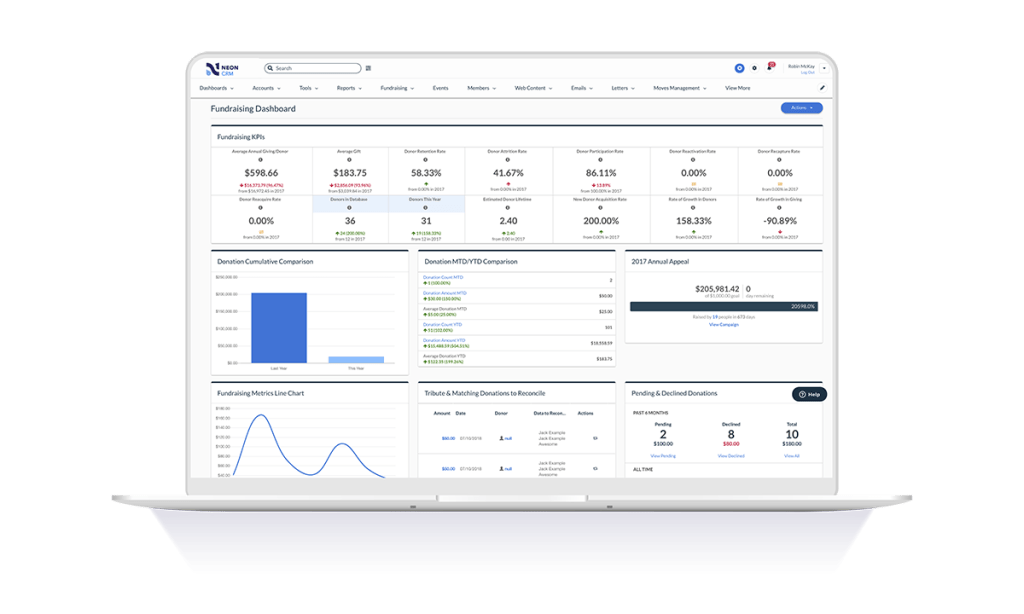
Neon CRM is a nonprofit relationship management platform for small and midsize nonprofits, used to make and maintain the personal connections that drive sustainable growth. By centralizing a nonprofit’s data and tools, Neon CRM helps teams save on manual work, deepen relationships with their supporters, and grow their impact. Key Features: Donor Management: Neon CRM provides a 360-degree view of supporters, automatically capturing every…
$99
per month
Pricing
Microsoft Dynamics 365
Neon CRM
Editions & Modules
No answers on this topic
Neon CRM
$99
per month
Offerings
Pricing Offerings
Microsoft Dynamics 365
Neon CRM
Free Trial
Yes
No
Free/Freemium Version
No
No
Premium Consulting/Integration Services
Yes
Yes
Entry-level Setup Fee
No setup fee
$349 one-time fee
Additional Details
—
—
More Pricing Information
Community Pulse
Microsoft Dynamics 365
Neon CRM
Considered Both Products
Microsoft
No answer on this topic
Neon One LLC
Verified User
Chose Neon CRM
It works. It's easy to customize for nonprofit and industry-specific categories. It does what it does well, and integrates with platforms that specialize in those areas rather than trying to be everything to all users.
A de minimis incentive was given to thank the reviewer for their time. The incentive was not used to bias or drive a particular response, nor was the incentive contingent on a positive endorsement. More Info
Provides our company access to manage and customize the folds tailored to our needs. We needed to have certain paragraphs on certain paperwork per customer. MD 365 has those options to customize where needed and remove when not. The system is easy to navigate, and training can be done in a matter of days, even without prior knowledge of the system or similar systems.
A de minimis incentive was given to thank the reviewer for their time. The incentive was not used to bias or drive a particular response, nor was the incentive contingent on a positive endorsement. More Info
If you are looking for a quick and easy database option, which integrates breezily with email clients like MailChimp and Constant Contact, and has built-in credit/debit card processing capabilities, NeonCRM is a very good option. An affordable alternative to Salesforce or Raiser's Edge, it does lack some of their "bells and whistles" but gets the job done. On the one hand, Neon features a shallow learning curve and solid user interface, and is web based and mobile friendly. On the other hand, Neon might not be totally appropriate for large or national level organizations because some of the reporting seems less "robust" than pricier alternatives...
A de minimis incentive was given to thank the reviewer for their time. The incentive was not used to bias or drive a particular response, nor was the incentive contingent on a positive endorsement. More Info
Best to use for AP - like in our organization, there are plenty of AP bills, so with Dynamics, we can quickly enter the same into the Excel utility, which means CSV-based upload, and then we can easily upload the same to the software. It's a time saver.
Best for Bank reconciliation - MS Dynamics makes Bank reconciliation easy. Banks can easily sync with software and easily get reconciled.
Generating invoices to customers and directly sending them to their inbox is easy with this software.
A de minimis incentive was given to thank the reviewer for their time. The incentive was not used to bias or drive a particular response, nor was the incentive contingent on a positive endorsement. More Info
NeonCRM allows you to build events, take registrations, and customize those events. Customizations include different ticketing options, add-ons, promotions, etc.
NeonCRM does a good job helping you track donors' activities/engagements.
It also provides a variety of reporting mechanisms - from dashboard snapshots to graphical reports - that allow you to review programs at a glance or in-depth.
A de minimis incentive was given to thank the reviewer for their time. The incentive was not used to bias or drive a particular response, nor was the incentive contingent on a positive endorsement. More Info
Small learning curve, obviously. You won't figure this out in a day, a week, or even a month. But given time, you can learn to be an expert. Or you can always get a consultant or hire in somebody. But learning the tool isn't out of the questions by any means.
Licensing can be confusing at times and isn't cheap, but it is cheaper than Salesforce. Plus no additional fees for data calls to better integrate your D365 CE data with other systems.
The Classic user interface left a bit to be desired, but now with the much-improved Unified Interface, the web client and the mobile client look the same, much more modern, and have more flexibility and power behind them for customizers as well.
A de minimis incentive was given to thank the reviewer for their time. The incentive was not used to bias or drive a particular response, nor was the incentive contingent on a positive endorsement. More Info
Learning the ropes is largely accomplished by reading manuals and watching videos. I don't learn that way. I'd much prefer to be shown. I guess I'm old school.
They can be stingy with the customer support. We bought the big package and I still wind up going back to my salesperson to help me cut through any red tape to get what I need.
A de minimis incentive was given to thank the reviewer for their time. The incentive was not used to bias or drive a particular response, nor was the incentive contingent on a positive endorsement. More Info
CRM has allowed us to keep all of our data in one place that is easy for all users within the company to view. I came into the company after they had been using CRM for about 4 years. They have all said that since we have used this it has helped us control work processes better, it has allowed us to be able to track things so much better, and has been something that has helped unite many processes that used to be all over the place. We are currently using CRM 4.0 and are planning on upgrading in the next 18 months to the 2011 version. Support for 4.0 is almost all but dried up. Understandably so. Some of the customization we have done, and a plugins we use, are now contained within the 2011 version so we are looking forward to that upgrade. We use an email marketing company as well, and they primarily support the 2011 version, but their product connects and is integrated within CRM. This is a great benefit as well so that all of our marketing information can be contained in one location.
Neon CRM was difficult and frustrating to use without IT experience, and way to costly for the a small to mid-sized nonprofit. We believe that we lost donors due to the inaccurate report system in Neon CRM
The usability is easily adopted for users familiar with other Microsoft products. Dynamics 365 has several interfaces that cross over browsers and tablets. These multiple interfaces will be phased out and updated to a single unified interface eventually to provide the same usability across all devices. The backend configurations is slowly improving with the introduction of PowerApps compared to pre-D365 Online versions
A de minimis incentive was given to thank the reviewer for their time. The incentive was not used to bias or drive a particular response, nor was the incentive contingent on a positive endorsement. More Info
The Neon CRM system is confusing (we had to watch video tutorials and html code to understand many of the features, many of which we did not need). Around 2022, Neon started to go downhill. Bells and whistles were added that were of no benefit (to our nonprofit) and the system became even harder to use
Our partner, Ledgeview Partners has been FANTASTIC to work with. They are always timely in their response and have taken time to understand our business and our specific needs. We've made a lot of advanced customizations and they have been a great help in making those updates.
A de minimis incentive was given to thank the reviewer for their time. The incentive was not used to bias or drive a particular response, nor was the incentive contingent on a positive endorsement. More Info
As stated before, they push you to read the manual or watch the video when what I want is a human being to walk/talk me through it. Like I said, maybe I am old school but that's how I learn. It's been a challenge.
A de minimis incentive was given to thank the reviewer for their time. The incentive was not used to bias or drive a particular response, nor was the incentive contingent on a positive endorsement. More Info
We used a data warehouse to house our data, and our IT team and implementation vendor worked diligently ahead of time to construct idea implementation plans. Out of millions of records- we had less than a dozen errors, which is remarkable. My major insight is simply having a group of completely devoted individuals working towards your goal who fully understand the desired outcome. Focused resources for implementation season are critical to success.
Microsoft Dynamics was part of a system overhaul for a local school, and we looked at many products. If we had used it for a company with low turnover, then it might have been more feasible. They needed something a new person could learn quickly, someone who might also be learning marketing terms at the same time - especially if there is nobody to train the individual now expected to know the system. Similar issues occurred with all of these programs (we called it being too big for their britches), and one of the bigger things we liked was that it is more compatible with MS Office products in both technical and visual appeal. If you have a steady employees who use a CRM consistently, low turnover, and those who are very familiar with Office products, Dynamics would be the smartest option for you. Unfortunately, this was just not true for the school environment
A de minimis incentive was given to thank the reviewer for their time. The incentive was not used to bias or drive a particular response, nor was the incentive contingent on a positive endorsement. More Info
It works. It's easy to customize for nonprofit and industry-specific categories. It does what it does well, and integrates with platforms that specialize in those areas rather than trying to be everything to all users.
A de minimis incentive was given to thank the reviewer for their time. The incentive was not used to bias or drive a particular response, nor was the incentive contingent on a positive endorsement. More Info
On our purchase, I'd been interrogated about our usage. Our needs are met by Microsoft Dynamics 365, which is simple to use. With so much data and information available, we must ensure that it is presented correctly to managers. Due to a lack of use, we don't have to spend as much money on Salesforce.
My company's preferred program right now is Microsoft Dynamics 365. We use it to keep track of customers and important sales metrics in a streamlined manner. Anyone familiar with CRMs will find the tool extremely useful. Considering that we have a good turnover, this product will be used for its basic segments. As a result, there are few chances of error with Microsoft dynamics because it is so easy to use. Many options for recording data on these leads are available. It meets our needs and pays off.
For those without a centralized, all in one solution for major HR, Finance and other departments, Microsoft Dynamics 365 has vastly improved employee time utilization and profit.
Migrating clients from on-premise to the cloud has reaped benefits including better security, no unscheduled downtime and frequent updates to functionality.
Those transferring from cheaper solutions have lost money in the aim to be better integrated with other Microsoft products and AI they don't really utilize.
A de minimis incentive was given to thank the reviewer for their time. The incentive was not used to bias or drive a particular response, nor was the incentive contingent on a positive endorsement. More Info
A de minimis incentive was given to thank the reviewer for their time. The incentive was not used to bias or drive a particular response, nor was the incentive contingent on a positive endorsement. More Info