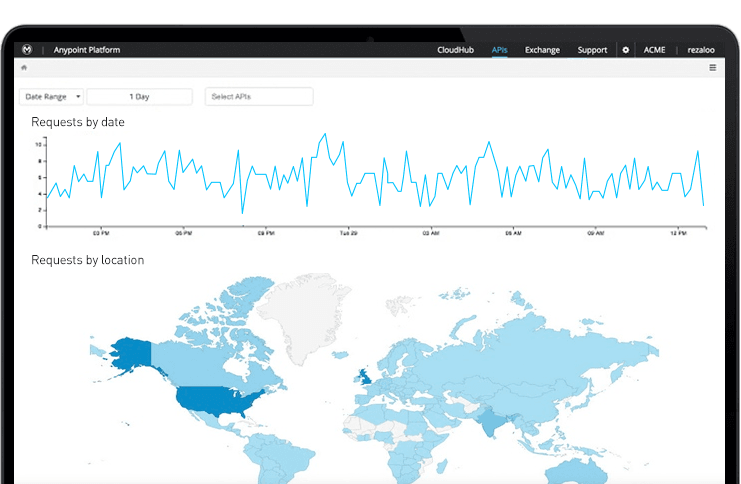
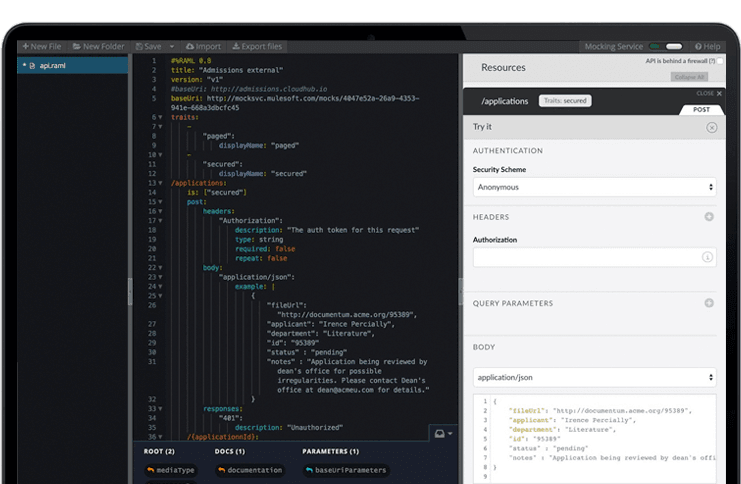
The Anypoint Platform developed by MuleSoft and acquired by Salesforce in early 2018 is designed to
connect apps, data, and devices anywhere, on-premises or in the cloud. This platform was built to
offer out-of-the-box connectors as well as tools that architects and developers can adopt quickly to
design, build and manage the entire lifecycle of their APIs, applications, and products.
N/A
Oracle Integration (OIC)
Score 7.9 out of 10
N/A
The Oracle Integration Cloud Service is an iPaaS providing prebuilt integration flows between applications, including other Oracle products. The Integration Cloud Service is scaled for enterprises, with prebuilt codeless adapters for on-premises and SaaS systems and low-code automation capabilities.
N/A
SPS Commerce
Score 7.4 out of 10
N/A
SPS Commerce is a retail network, connecting trading partners around the globe to optimize supply chain operations for retail partners. SPS Commerce supports data-driven partnerships with cloud technology. Their retail cloud services platform features supplier onboarding, EDI compliance, ERP integration, product content management, and sales analytics.
MuleSoft Anypoint Platform is best tool in the market for developing APIs with complex structures communicating with various different types of applications including web applications as well as legacy applications. Also applications including database connectivity for fetching and updating data in the DB tables. I cant think of any scenario which MuleSoft Anypoint Platform could not be used for developing the integrations.
Oracle Process Cloud is suited for medium-sized companies and up who want to create applications that can automate tasks without the need of recruiting more software developers. With a couple hours of training, any member of the organization's business team will be well-equipped with all of the knowledge that is needed to use Oracle Process Cloud effectively. If your IT team is large and able to take upon the task of making the given application, then something like Oracle BPM is a better solution.
When you find yourself growing and finding success faster than you can keep up with, SPS Commerce will save your life and your reputation. The services they offer are easy to understand, they are available with suggestions and ideas for better ways, personalization is available to best suit your needs or the needs of your customers so that you can really shine and relieve the worries that come with growing pains. SPS also helps to keep information accurate with less human touching to cause errors.
New enhanced activities that are targeted to reduce the integration pain. For example, file stage activity reduces the pain of chunking the input file while sending and mapping the data to the target application. Stage activity takes care of it automatically for the customer. Similarly, recommendation on the mapper is a huge plus for people looking for common integration.
There are around 50 adapters available including dedicated out of the box application adapters and generic technologies adapters on OICS. The best part of these application adapters is that they are designed considering LOB users. Most of the time integration implementor does not require, application knowledge to perform the integration. OICS has some of Oracle Cloud applications adapters which make integration much easier may not be available in other integration platforms.
Inbuilt diagnostic dashboard and error hospital makes this product lucrative. OICS also comes with integrated Process Cloud and Visual Builder at the same cost. the customer can have seamless integration with Apiary and SSI on demand.
Has more features than what we really need so we're paying for more than we use. Sort of like paying for an Abrams tank when all we really need is a Toyota Corolla.
Not a value product, tends to be expensive.
Takes a while for developers to learn to use Mulesoft Anypoint.
Currently, it is not retaining the logs for more than 3 days, which it needs to address.
We also need some functionality inside the interface to re-push the same transaction again so that it will be helpful while testing and fixing the issue.
Also, some log errors are not giving the correct details. Oracle needs to rectify those.
We have quite a few people here who use this portal, and we have it set up to receive an email when an order is available to print. As of now, you can only add a few recipients to receive those emails; it limits you.
Invoicing is challenging at times as you have to remember to go in and invoice. If you forgot, it is hard to find the order to invoice, as it seems to disappear.
We still haven't figured out how to have some of the invoicing features auto-populate, so there isn't so much to fill out. I wish some of those features were easier to use, or find if you have them.
There’s a lot of learning curve at the beginning when it comes to building the code and everything. In terms of usability, I’d say once you get used to it, it’s fine — but it’s not very easy during the initial stages.
Anypoint Platform support is very responsive. There is also a huge knowledge base and an active online forum where answers to most questions can be found. When needed support engages the engineering group so adequate solutions or workarounds are always provided.
Phone support is generally very good and you can get a person on the phone within a few minutes. Their emailed customer support however is very poor and often goes several days or longer before receiving a response, if ever at all
Once we have moved all of our system integration APIs to the MuleSoft Anypoint Platform, we will need to communicate with a wide variety of external systems. All of our business and service logic is stored in the aforementioned core systems. Anypoint Platform (and all of our APIs) makes it easy to connect to various other platforms. In order to link to these many other systems, connectors and/or components are utilized, and they are simple to configure and integrate.
The nearest thing I have used to OIC is UiPath, as it is often used as a tool to integrate software together. However, it is much more suited to legacy software which have little to no API endpoints. If the infrastructure already exists I understand why people use RPA for integration, however for when API's are easily accessible and you're using Oracle tools, OIC is better.
In my opinion, SPS Commerce is the bottom out of all three provided here. I think, essentially, if you are looking to be hands off and only oboard on setup and don't plan on growing your business and want to not understand anything about EDI and how it affects your company, SPS Commerce is a fine choice. Just if you want to do anything beyond that, I believe you are going to have the worst time.
The modern and advanced analytical abilities in Oracle Process Cloud are also a missing element that should be catered to.
This tool is used greatly for IT departments at a lower level with some very basic and limited access for general employees only.
Oracle Process Cloud has many advantages like it offers some very great and scalable solutions.
I find Oracle Process Cloud pretty straightforward and easy as compared to the different options available. Lastly, I think that as it is just one platform, managing the Oracle Process Cloud is pretty easy too.
I enrolled in a product I ended up not using because the vendor that required it ended our working relationship and SPS refused to offer a refund. After I canceled it, they continued to charge our account for three more months of service.
The interface is simple and easy to understand and use, so it saved time when preparing shipments.