PRTG Network Monitor is the flagship offering from German software company Paessler, for monitoring local and wide area networks (LANs & WANs), servers, websites, apps, and more.
$2,149
per year
SolarWinds Network Configuration Manager (NCM)
Score 8.8 out of 10
N/A
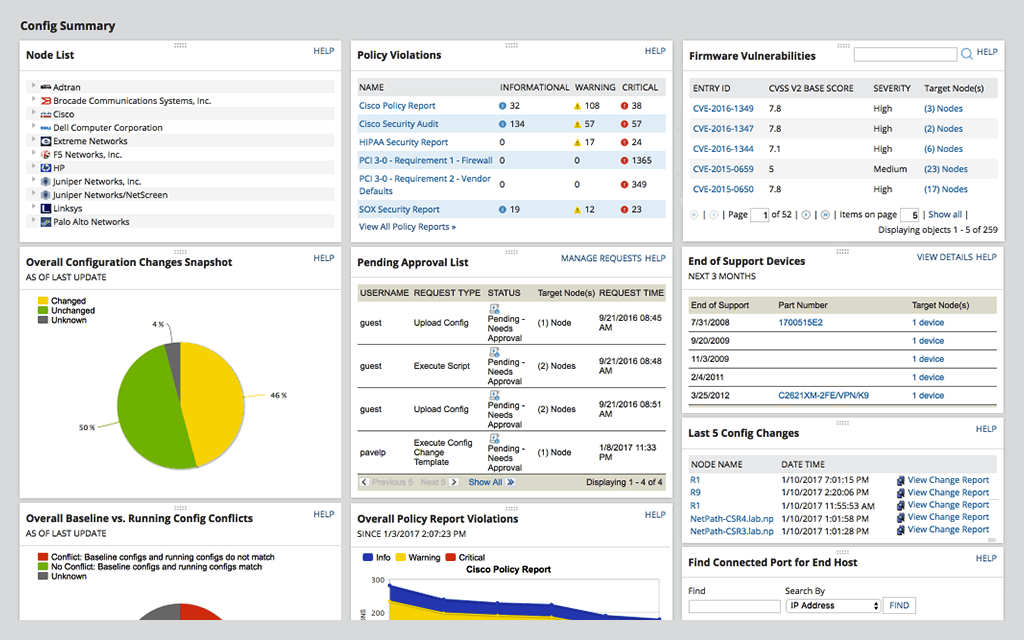
SolarWinds Network Configuration Manager is network diagnostics and troubleshooting technology, from Austin-based SolarWinds.
N/A
Pricing
PRTG Network Monitor
SolarWinds Network Configuration Manager (NCM)
Editions & Modules
PRTG 500
$2,149
per year
Hosted 500
$2,149
per year
PRTG 1,000
$3,899
per year
Hosted 1000
$3,899
per year
PRTG 2,500
$8,099
per year
Hosted 2500
$8,099
per year
PRTG 5,000
$14,199
per year
Hosted 5000
$14,199
per year
PRTG 10000
$17,899
per year
PRTG Enterprise
Custom Pricing
subscription license
No answers on this topic
Offerings
Pricing Offerings
PRTG
SolarWinds Network Configuration Manager (NCM)
Free Trial
Yes
Yes
Free/Freemium Version
No
No
Premium Consulting/Integration Services
Yes
No
Entry-level Setup Fee
No setup fee
Optional
Additional Details
—
—
More Pricing Information
Community Pulse
PRTG Network Monitor
SolarWinds Network Configuration Manager (NCM)
Considered Both Products
PRTG
Verified User
Analyst
Chose PRTG Network Monitor
The mobile app and ease of use set PRTG apart from the others. PRTG can be up and running in a much shorter time than any other product I have used or evaluated. Templates can be set up so once a system is detected the appropriate sensors will be created automatically.
Easier to configure, lower cost, greater potential usage, better for mixed environments. Easier to use and certainly easier to setup than the competition.
PRTG does a lot of things similar to the SolarWinds products but I believe it gives you better near real-time metrics on monitored links between devices. I enjoy being able to pull up the sensor page of an interface between two devices and seeing just how much, or not, a link …
Intermapper is a fine product but one that we felt that we outgrew.
It is a very reliable product that we have used for many years and provides excellent status and alerting but it is lacking in many of the features that SolarWinds is capable of providing. It's a simplistic …
We evaluated PRTG Network Monitor which was similar to SolarWinds but was very resource-intensive and the server kept crashing when we got close to 100 devices
whereas on SolarWinds we were able to add several thousand devices. We
also evaluated Nagios Core as a free …
We have a very diverse IT environment (Cisco/Palo Alto, VMWare, Cisco UC, SD-WAN, Windows Servers) and we wanted to have one suite of software that we could manage as many of our different areas in one single pane of glass. SolarWinds allows the network team, VOIP team, Storage …
SolarWinds NCM is easier to use, has a larger knowledge base, and is more easily configured than other competitors I have tried. With time being extremely important to everyone, not having to worry about these CI's makes implementation and maintenance much easier.
Device42 Did not feel like a complete solution and was lacking in a lot of areas. I know it is a new competitor in the area, but they still have a long way to go.
integrates seamlessly with Windows servers via WMI and PowerShell, providing deep insights into resource usage, performance metrics, and system health. It's excellent at tracking CPU, memory, disk space, and event logs, enabling rapid troubleshooting and proactive maintenance. PRTG Network Monitor also effectively monitors Fortigate devices, providing detailed data on firewall health, traffic patterns, bandwidth utilization, VPN status, and security alerts. This visibility helps detect and resolve network security issues promptly.
If your IT team isn't proficient in automation and scripting, Solarwinds NCM can fill that gap (assuming your company's security team signs off on approving SW in your environment given the hack.) Basic device configuration, pushing mass changes reliably and backups are NCM's strong suites. If you have a complex scenario where if/then cases are needed, NCM is a bit lack luster. Auto discovery isn't as easy either as certain parameters need to be met for that feature to work 100% of the time
Licensing on a per entity basis can be cumbersome for devices which have a ton of monitoring points like network switches\routers. Each sensor may count against a license, which could be a lot of you were monitoring every TX\RX of an SFP for example
A better method to easily template\copy monitors across devices
The navigation in the web GUI could be a little more straightforward in terms of the hierarchy
For our use case, it does everything great and some of the features we underutilize but I would like to be able to set a configuration baseline when initially adding a node instead of after the configuration is pulled but it's not a particularly big deal to let it pull the configuration then set it as the baseline.
I would renew it because the platform has brought us many technical and economic benefits that make the cost-benefit ratio very good. Additionally, to do so does not require large investments in training, licensing or infrastructure, and at the administration level, extensive knowledge is not required to be able to bear it.
Medium complexity to set up in the beginning if using any non-standard devices or configurations, else fairly easy (e.g. Cisco Nexus or IOS-based devices). Reports are fairly straightforward to set up. Updates to the platform are fairly straightforward and don't take a major effort. Easy to add or remove devices.
The tool is very intuitive to use and it is Windows-based (everybody knows how to use Windows) so it's easy to get into. Every time is setup in a hierarchy so if you have a good initial hierarchy design, it will really reduce administrative effort down the road.
The user interface is lacking. It is difficult to navigate at times and things can be done multiple ways. Quite often I am confused by how their notification structure works. It is not very intuitive. They do offer a free Academy. They also offer a community of other technical folks. I have enjoyed both.
PRTG does everything we need it to do and more. Ease of use, ease of management and maintenance and clarity of monitoring of hundreds of different types of device and service gives this a large advantage over other products on the market that I have tried. I would definitely recommend it to anyone who needs a network monitoring product in their environment and even to people who don't know they need a solution yet!
To be fair, I have not had to involve Support in a number of years, but when I did, I was greeted with enthusiastic engineers who wanted to understand and solve the issue. It was a fairly complex scenario and I have discovered in my most recent implementation that engineering included that option as a standard now.
Solarwinds has actually produced new training since I last used it that is available on their site at any time. Their previous training was more than enough to get us started but now there is significantly more content. Since I'm comfortable with the Orion platform and the products we use I haven't checked the new training out yet but we have new staff go through portions of that training and they always come away with an understanding of the platform and ready to use it
It's very important that de project's teams have different member of the TI. We have learned too late the importa of Security Analyst at the design architecture moment. We have to rebuild part of the implementation for made this big mistake.
it was a fairly easy implementation and everything was pretty straightforward. only challenge we had was getting all the snmp communities updated on the networking equipment
PRTG offers more versatility in monitoring when compared to the other solutions we tested. The other solutions were also limited as far as customization options, which made them less adaptable to our networks. When compared to Auvik, for instance, we prefer PRTG as it offers immediate notifications through the desktop client - not limited to email notifications as with Auvik. We also appreciate the fact that PRTG can be self/on-prem hosted vs Auvik's cloud model. This makes for an easier deployment and less firewall adjustments to allow traffic to cloud-hosted solutions.
Red Hat Ansible Automation Platform is a great tool and matches much of the functionality of SolarWinds Network Configuration Manager. Nothing about Ansible will likely be overwhelming to an engineer with a little time to spare, but that spare time combined with SolarWinds already being our monitoring tool made the decision easy. Time is at a premium in small teams and SolarWinds Network Configuration Manager is very easy to use right out of the box without all the tweaking required by powerful command line driven tools like Ansible.
The ability to analyze multiple pieces of information in one place, especially with historical data, has saved our IT department time and headaches. It would be so much more difficult to trace an issue without PRTG, just relying on event logs and an open task manager window.
The cost is not cheap, so it's an expense that hits the bottom line like everything else. Figure in hardware costs as well, ideally a server outside of your main environment.
I keep saying this, but the historical data piece is worth so much. There's really no good way to collect all of that information in one place without something like PRTG. And that definitely saves time and money in the long run.