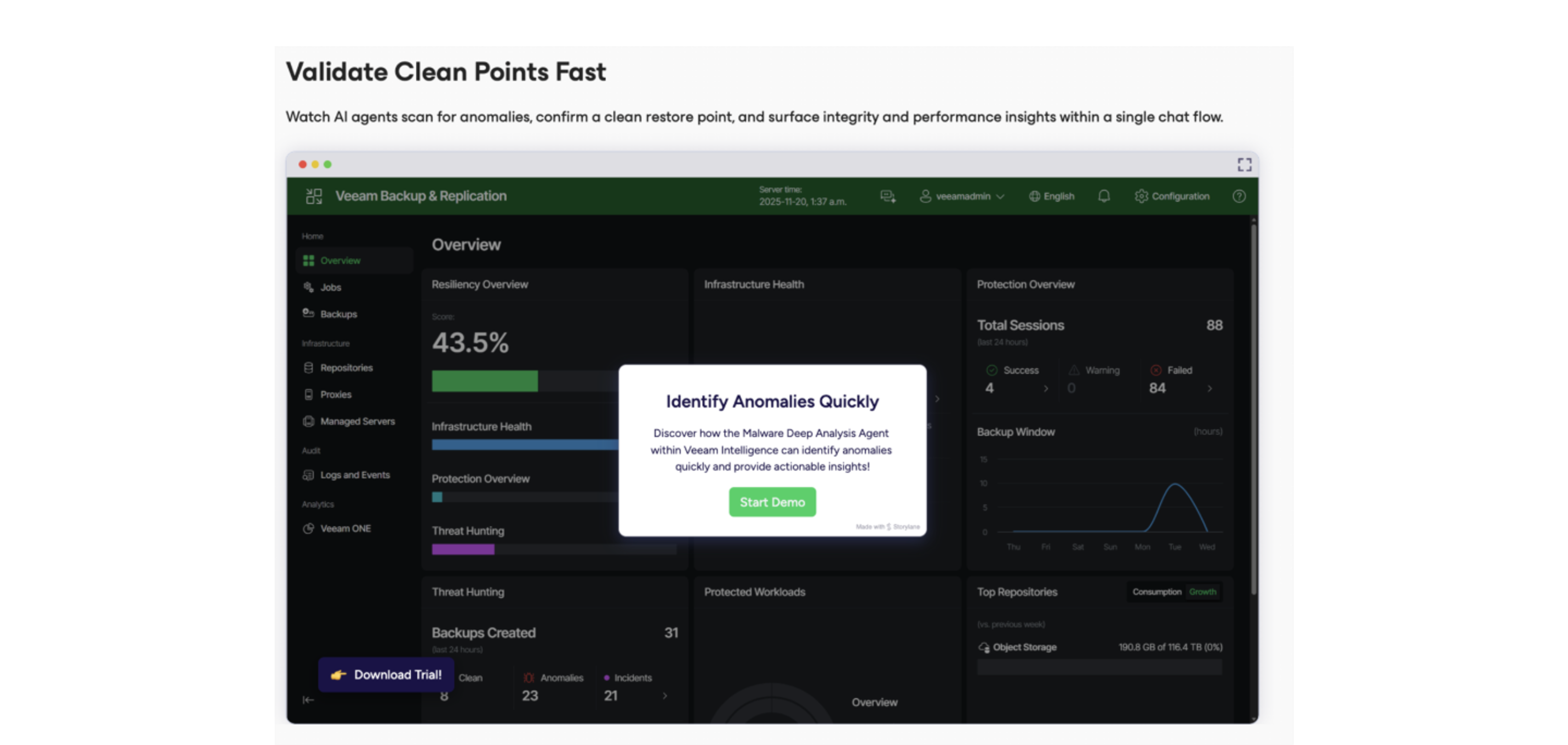
Veeam’s® premier product, Veeam Backup & Replication™, delivers availability for all cloud, virtual, Kubernetes and physical workloads. Through a management console, the software provides backup, archival, recovery and replication capabilities.
$428
per year per 5 instances
VMware vCenter
Score8.4 out of 10
N/A
VMware vCenter is an advanced server management software that provides a centralized platform for controlling vSphere environments for visibility across hybrid clouds. VMware vCenter is no longer sold as a standalone product and is now available as a part of VMware Cloud Foundation.
$6,044
per year
Pricing
Veeam Data Platform
VMware vCenter
Editions & Modules
Veeam Data Platform Essentials
$428
per year per 5 instances
Veeam Data Platform
Contact sales team
Basic
6,044
per year
Production
6,244
per year
Offerings
Pricing Offerings
Veeam Data Platform
VMware vCenter
Free Trial
Yes
No
Free/Freemium Version
Yes
No
Premium Consulting/Integration Services
Yes
No
Entry-level Setup Fee
No setup fee
No setup fee
Additional Details
Veeam sells through channel partners. Contact a partner for detailed pricing and quotes. Resellers or sales personnel are available for assistance.
We use Arcserver for our physical server or drive partition backup. But it's not stable. Once in a while, it has alarms stating the data tranasferring to its destination has problem. We spent much time on this, but it still happens. Furthermore, the switch between the primary …
A de minimis incentive was given to thank the reviewer for their time. The incentive was not used to bias or drive a particular response, nor was the incentive contingent on a positive endorsement. TR verified that a representative sample of customers was invited. More Info
Verified User
Chose Veeam Data Platform
Originally, our organization used to use Symantec Backup Exec which was very time consuming, confusing and cumbersome to for me and my staff to use. When taking over another company's infrastructure, they had used Carbonite to backup their physical servers. Again, the software …
A de minimis incentive was given to thank the reviewer for their time. The incentive was not used to bias or drive a particular response, nor was the incentive contingent on a positive endorsement. More Info
A de minimis incentive was given to thank the reviewer for their time. The incentive was not used to bias or drive a particular response, nor was the incentive contingent on a positive endorsement. More Info
Verified User
Chose Veeam Data Platform
I am still getting to know Unitrends, but they seem pretty equal.
A de minimis incentive was given to thank the reviewer for their time. The incentive was not used to bias or drive a particular response, nor was the incentive contingent on a positive endorsement. More Info
Verified User
Chose Veeam Data Platform
At the time we started using Veeam, there was only one other applicable competitor, and I cannot remember the name of it anymore. I think it was Qwest or something like that. We also concurrently run ArcServe and ShadowProtect. Veeam now has features available so that we can …
A de minimis incentive was given to thank the reviewer for their time. The incentive was not used to bias or drive a particular response, nor was the incentive contingent on a positive endorsement. More Info
Verified User
Chose Veeam Data Platform
I have only used Veeam from the start. It was recommended by my vendor. I reviewed all products available at the time, prior to making the decision to go with Veeam. There are other good products out there, but I think Veeam is absolutely the best!
A de minimis incentive was given to thank the reviewer for their time. The incentive was not used to bias or drive a particular response, nor was the incentive contingent on a positive endorsement. More Info
VMware by Broadcom
Verified User
Chose VMware vCenter
I was not involved in the evaluation, but my understanding from colleagues was that the years of experience in VMware vs. Hyper-V were very evident. VMware vCenter was simply a much more mature product.
A de minimis incentive was given to thank the reviewer for their time. The incentive was not used to bias or drive a particular response, nor was the incentive contingent on a positive endorsement. More Info
Verified User
Chose VMware vCenter
Citrix Xen Server.... Great Hypervisor but very limited in terms of functionality
MS Hyper-V... [VMware vCenter Server] is better for almost everything and appliance form makes a clear winner for security and ease of deployment
A de minimis incentive was given to thank the reviewer for their time. The incentive was not used to bias or drive a particular response, nor was the incentive contingent on a positive endorsement. More Info
Verified User
Chose VMware vCenter
VMware vCenter Server's biggest competitor is Microsoft's Hyper-V Server. We prefer VMware vCenter Server because the hypervisor is much less resource intensive. It also gives us a different environment so that a specific Microsoft bug wouldn't take down all of our VMs if the …
A de minimis incentive was given to thank the reviewer for their time. The incentive was not used to bias or drive a particular response, nor was the incentive contingent on a positive endorsement. More Info
Verified User
Chose VMware vCenter
[VMware vCenter Server] is the true leader in this space. The functionality and ability to offload tasks to other teams makes this a no brainer. The granularity in permission allows [VMware vCenter Server] to be secure and isolate teams to only the objects they are allowed to …
A de minimis incentive was given to thank the reviewer for their time. The incentive was not used to bias or drive a particular response, nor was the incentive contingent on a positive endorsement. More Info
Verified User
Chose VMware vCenter
We considered Microsoft Hyper-V very briefly. At the time we considered Hyper-V you still needed to purchase an extra management product to get features similar to vCenter; and even then, it didn't seem fully baked, yet. The situation may, and probably has changed, with later …
A de minimis incentive was given to thank the reviewer for their time. The incentive was not used to bias or drive a particular response, nor was the incentive contingent on a positive endorsement. More Info
Server and Storage Engineer in Information Technology at Debevoise & Plimpton (Law Practice, 501-1000 employees)
Chose VMware vCenter
Our desktop team uses Citrix XenApp for remote connectivity of our employees. However, this environment runs on our VMware vSphere hosts which are managed by VMware vCenter Server. :) XenApp was never considered to replace VMware vCenter Server or our vSphere hosts.
A de minimis incentive was given to thank the reviewer for their time. The incentive was not used to bias or drive a particular response, nor was the incentive contingent on a positive endorsement. More Info
Verified User
Chose VMware vCenter
I have used Microsoft Hyper-V at a previous employment. It was good in those situations of a small batch of servers. Hyper-V is relatively easy to manage and can use Powershell scripting for management and control. In larger deployments, like we have currently, Hyper-V …
A de minimis incentive was given to thank the reviewer for their time. The incentive was not used to bias or drive a particular response, nor was the incentive contingent on a positive endorsement. More Info
Technical Engineer in Information Technology at Kore Technology Resources (Information Technology and Services, 1-10 employees)
Chose VMware vCenter
It feels like other hypervisors are either trying to catch up to VMware or filling a smaller niche that VMware may be too broad to fill. VMware continues to bring the newest features and improvements and it's hard to compare any other hypervisor as long as VMware continues to …
A de minimis incentive was given to thank the reviewer for their time. The incentive was not used to bias or drive a particular response, nor was the incentive contingent on a positive endorsement. More Info
IT Manager in Information Technology at Springfield Public Schools (Education Management, 201-500 employees)
Chose VMware vCenter
Honestly it made no sense to look elsewhere since vCenter is an integral component of VMware and designed and supported but he same team. We need to ensure business operational continuity and did not want to end up in a finger pointing contest with a 3rd party product.
A de minimis incentive was given to thank the reviewer for their time. The incentive was not used to bias or drive a particular response, nor was the incentive contingent on a positive endorsement. More Info
It is well-suited for most environments, from Small and medium businesses to large enterprises. But its cost may be prohibitive for smaller businesses with a limited budget. While there are multiple licensing levels, there may be a use case for creating a level between the community edition and the Foundation.
A de minimis incentive was given to thank the reviewer for their time. The incentive was not used to bias or drive a particular response, nor was the incentive contingent on a positive endorsement. More Info
The VMware vCenter server is very useful in maintaining the CPU/RAM/datastore resources are balanced when there are multiple ESX/ESXi host servers. It is clear what resources are being used, and it is easy to migrate VMs to different ESX/ESXi hosts. Being able to remotely connect to the VM servers in vCenter when you cannot have other remote connections helps in maintenance and troubleshooting.
A de minimis incentive was given to thank the reviewer for their time. The incentive was not used to bias or drive a particular response, nor was the incentive contingent on a positive endorsement. More Info
The ease of use in creating jobs and adding clients enables our new and less skilled administrators to work efficiently, quickly, and accurately.
The same ease of use is essential for junior admins as well. Backups are quickly and accurately restored, allowing our networking team to bring clients back to production within expected times.
The ability to create a restore for testing and to remove it quickly has proven to be an excellent asset for our production and DB teams.
A de minimis incentive was given to thank the reviewer for their time. The incentive was not used to bias or drive a particular response, nor was the incentive contingent on a positive endorsement. TR verified that a representative sample of customers was invited. More Info
A de minimis incentive was given to thank the reviewer for their time. The incentive was not used to bias or drive a particular response, nor was the incentive contingent on a positive endorsement. More Info
On occasion, the 'reason' for a failed backup can be a little hard to understand. It would be nice if it were a bit more straightforward.
I would love to run the platform natively on Linux, but I don't think it's an option.
Sometimes, locating the correct update file for the platform software can be a bit confusing. If they had an option to download the correct update file from within the console, that would take some of the guesswork out of it.
A de minimis incentive was given to thank the reviewer for their time. The incentive was not used to bias or drive a particular response, nor was the incentive contingent on a positive endorsement. TR verified that a representative sample of customers was invited. More Info
Currently, the HTML 5-based vSphere Client lets you manage the essential functions of vSphere from any browser, however, it would be nice if they would port all management functions over to the HTML 5-based Client.
Performing updates and upgrades to the infrastructure is a bit challenging for someone that may not be as intimate with vSphere. I think the updates/upgrades should be more integrated into the UI and provide the ability to push to the hosts, etc...
It would also be nice to have a more robust snapshot management tool to prevent snapshot overgrowth. It would be nice to be able to set a lifespan for the snapshot(s)
A de minimis incentive was given to thank the reviewer for their time. The incentive was not used to bias or drive a particular response, nor was the incentive contingent on a positive endorsement. More Info
I really have no complaints about Veeam Backup & Replication. Their service has been excellent and the cost is minimal in comparison to other services I checked out. Implementation wasn't simple and the Veeam Support team was there to help each step of the way.
A de minimis incentive was given to thank the reviewer for their time. The incentive was not used to bias or drive a particular response, nor was the incentive contingent on a positive endorsement. More Info
We are very dependent on this software, it has become a much needed tool to perform the daily tasks that are required to maintain the virtual server environment. VMware has become very pricey over the years, so we are looking for alternatives for cost savings strategy, but nothing has been found to be on par to what we are currently using
A de minimis incentive was given to thank the reviewer for their time. The incentive was not used to bias or drive a particular response, nor was the incentive contingent on a positive endorsement. More Info
It is a very robust solution that has never failed. It also has perfect integration with Windows server volume shadow copies. The processing load is moved from the backup server to the backup proxy. Increased fault tolerance: you can store data on a separate machine, the backup repository. Can perform a bare metal restore.
A de minimis incentive was given to thank the reviewer for their time. The incentive was not used to bias or drive a particular response, nor was the incentive contingent on a positive endorsement. More Info
I work with vCenter for 10+ years and i love it. I can find my way around and can help building and expanding the platform. It is easy to use and there are a lot good communities for the extra support when needed. Even the Homelab community is of great value.
A de minimis incentive was given to thank the reviewer for their time. The incentive was not used to bias or drive a particular response, nor was the incentive contingent on a positive endorsement. More Info
I give Veeam Data Platform a rating of 9 for availability because it consistently performs reliably in critical data protection and recovery tasks. The platform is designed to minimize downtime, ensuring that backup and recovery processes are accessible when needed.While there may be rare instances of maintenance or minor application errors, these do not significantly affect the overall reliability of the system. Veeam’s strong architecture and features like high availability configurations further enhance its performance, allowing us to trust it in crucial situations. Overall, it has proven to be a dependable solution that meets our organization's needs effectively.
A de minimis incentive was given to thank the reviewer for their time. The incentive was not used to bias or drive a particular response, nor was the incentive contingent on a positive endorsement. More Info
Veeam does a good job with backing up our servers in a timely manner. We are still at the beginning of our Veeam use and are pleased with the speed at which we can access the system as well as the backups and restore points. Veeam is definitely superior to our previous backup system in terms of speed and accessibility
A de minimis incentive was given to thank the reviewer for their time. The incentive was not used to bias or drive a particular response, nor was the incentive contingent on a positive endorsement. More Info
The support team has never asked me to jump through silly hoops or waste time on pointless exercises. They seem to truly have a handle on what may be wrong. In fact, when we were having trouble getting our license renewal setup (because of yet another license migration at Veeam) a support incident got us connected to the right people to get our renewal done in time.
A de minimis incentive was given to thank the reviewer for their time. The incentive was not used to bias or drive a particular response, nor was the incentive contingent on a positive endorsement. More Info
VMware support has always been fantastic and they have been invaluable in solving tougher issues that have been run into. Most of the time, any oddities encountered are fixed by available updates. This can be deduced by support quickly with logs within vCenter. We have not run into something yet that support was unable to help with. They either have a solution already, or they are able to find one quickly.
A de minimis incentive was given to thank the reviewer for their time. The incentive was not used to bias or drive a particular response, nor was the incentive contingent on a positive endorsement. More Info
I rated the in-person training an 8 because it was generally effective and provided a solid foundation for understanding the Veeam Data Platform. The instructors were knowledgeable and engaged, making the sessions interactive. However, I felt that some topics could have been covered in more depth, and additional hands-on exercises would have further reinforced the learning experience. Overall, it was a positive training session that adequately prepared attendees for using the product, but there's room for improvement.
A de minimis incentive was given to thank the reviewer for their time. The incentive was not used to bias or drive a particular response, nor was the incentive contingent on a positive endorsement. More Info
I gave it a rating of 7 because, although the online training offered valuable content and covered the essential aspects of the Veeam Data Platform, it lacked interactivity and opportunities for direct engagement with instructors. This made it challenging to ask questions or delve deeper into specific topics. Additionally, some sections felt a bit rushed, which could hinder a comprehensive understanding of more complex features. Overall, while the training was useful, improvements in interactivity and pacing could elevate the experience significantly.
A de minimis incentive was given to thank the reviewer for their time. The incentive was not used to bias or drive a particular response, nor was the incentive contingent on a positive endorsement. More Info
Plan the process and then work through your plan, i know this should go without saying but its easy to get sidetracked. You tend to want to just get up and running so you can have that sigh of relief, spend the time to talk to your business stakeholder to see what goals they are trying to accomplish and how that may impact your plans first.
A de minimis incentive was given to thank the reviewer for their time. The incentive was not used to bias or drive a particular response, nor was the incentive contingent on a positive endorsement. More Info
Since moving away from the Windows Server hosting the vCenter application and instead using a virtual appliance, it has become much easier to implement and deploy the new versions. We can easily create a snapshot or clone of the vCenter vApp to ensure any problems encountered during the upgrade can be mitigated with a fall back to the old version to prevent unscheduled downtime.
A de minimis incentive was given to thank the reviewer for their time. The incentive was not used to bias or drive a particular response, nor was the incentive contingent on a positive endorsement. More Info
I believe it's not possible to compare these three products, as none of them are as feature-rich as Veeam Data Platform. The addition of Proxmox-VE in version 12 was certainly a game-changer, as we were previously dependent on the VMware environment to access all the features that Veeam Data Platform offers.
A de minimis incentive was given to thank the reviewer for their time. The incentive was not used to bias or drive a particular response, nor was the incentive contingent on a positive endorsement. More Info
A de minimis incentive was given to thank the reviewer for their time. The incentive was not used to bias or drive a particular response, nor was the incentive contingent on a positive endorsement. More Info
In terms of scalability for our company, Veeam was able to cover our backup needs with ease. They have options for even more individualized backup if we were to need them; i.e. if a specific workstation needs its own independent backup. We have not used these resources yet, but I am confident they will be beneficial to our company in the near future.
A de minimis incentive was given to thank the reviewer for their time. The incentive was not used to bias or drive a particular response, nor was the incentive contingent on a positive endorsement. More Info
Positive impact: it "saved our ass" on one occasion. In that particular scenario, we were hit with ransomware.
On another occasion, it provided a means of building a staging environment from our production and saved us a significant amount of time from having to build from scratch.
A de minimis incentive was given to thank the reviewer for their time. The incentive was not used to bias or drive a particular response, nor was the incentive contingent on a positive endorsement. More Info
A de minimis incentive was given to thank the reviewer for their time. The incentive was not used to bias or drive a particular response, nor was the incentive contingent on a positive endorsement. More Info