The Airship Experience Platform provides an end-to-end solution for unifying experiences across channels and capturing value across the entire customer lifecycle.
N/A
Convert Experiences
Score 9.9 out of 10
Mid-Size Companies (51-1,000 employees)
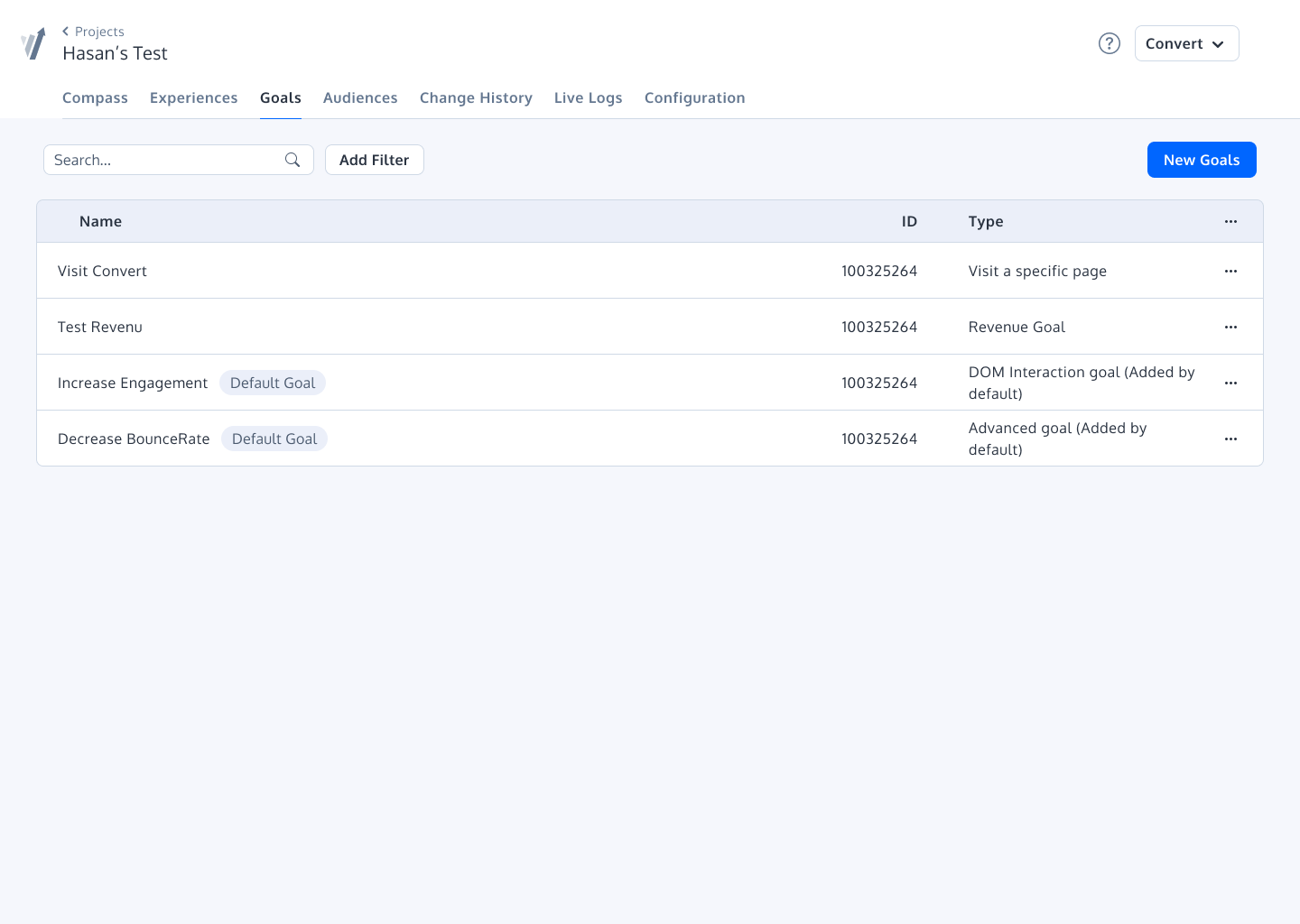
Convert Experiences is an experimentation platform that offers features and support to run A/B tests across multiple growth channels. Its enterprise-ready advanced features include full stack experimentation, multi-page testing, post-segmentation, sequential testing, targeting with 40+ filters, triggering tests based on data in other apps (data sources), dynamic triggers, complex goal tracking, and a secure API. It includes 90+ out-of-the box integrations in a…
$399
per month up to 100k tested users per month
Firebase
Score 8.2 out of 10
N/A
Google offers the Firebase suite of application development tools, available free or at cost for higher degree of usages, priced flexibly accorded to features needed. The suite includes A/B testing and Crashlytics, Cloud Messaging (FCM) and in-app messaging, cloud storage and NoSQL storage (Cloud Firestore and Firestore Realtime Database), and other features supporting developers with flexible mobile application development.
$0.01
Per Verification
Pricing
Airship
Convert Experiences
Firebase
Editions & Modules
No answers on this topic
Growth
$399
per month 100k tested users per month
Pro
$5040
per year 1.5M tested users/year
Enterprise
Pricing available on request
From 1M tested users/mo (billed annually)
Phone Authentication
$0.01
Per Verification
Stored Data
$0.18
Per GiB
Offerings
Pricing Offerings
Airship
Convert Experiences
Firebase
Free Trial
Yes
Yes
No
Free/Freemium Version
No
No
No
Premium Consulting/Integration Services
Yes
No
No
Entry-level Setup Fee
Optional
No setup fee
No setup fee
Additional Details
—
1. Annual contract or monthly payments available
2. Pricing is not feature dependent. Some features like integrations, goals, Live Logs are necessary to test successfully. This is why Convert caps by unique tested users - basically visitors who have been bucketed to see a variation and are unique to that variation. As a result the app tested users are always </= the site's net traffic.
—
More Pricing Information
Community Pulse
Airship
Convert Experiences
Firebase
Considered Multiple Products
Airship
Verified User
Team Lead
Chose Airship
I have also worked with Vibes, Salesforce, Pendo, and Swrve for mobile app marketing efforts, and I always come back to airship as delivering the best Push and In-App messaging capabilities. If you want a full service platform for Push and In-App messaging rather than …
The above mentioned products were evaluated for initial RFQ process however Airship was awarded for the robustness and ease of use, and its strategy aligns with Vodafone's App usage engagement
Well-Suited for: 1. Mobile App Notifications: Ideal for targeted push notifications in apps. 2. Customer Segmentation: Effective for personalized marketing campaigns based on user data. 3. Event-Triggered Automation: Great for automated messaging based on user actions. 4. A/B Testing: Useful for optimizing campaign messages and strategies. Less Appropriate for: 1. Non-Mobile Channels: Less effective if the primary focus is on non-mobile communications like email or direct mail. 2. Basic Email Marketing: Other platforms might be better suited for simple, broad email campaigns without complex segmentation or personalization needs.
Definitely well suited for budget conscious companies that want a solid array of functionality but without having to pay an exorbitant amount. Great for marketing and analytics team members that need the ability to get in and set up tests w/o dev assistance. But, functionality is there for developers to get in and set up more complicated tests.
Firebase should be your first choice if your platform is mobile first. Firebase's mobile platform support for client-side applications is second to none, and I cannot think of a comparable cross-platform toolkit. Firebase also integrates well with your server-side solution, meaning that you can plug Firebase into your existing app architecture with minimal effort.
Firebase lags behind on the desktop, however. Although macOS support is rapidly catching up, full Windows support is a glaring omission for most Firebase features. This means that if your platform targets Windows, you will need to implement the client functionality manually using Firebase's web APIs and wrappers, or look for another solution.
The marketing push notifications are very effective, and it gives us free hand to define different business criteria to target user groups
The user experience or the message content could differ from Android and iOS, and this is a huge benefit for us
As an Architect, troubleshooting an issue is very detailed and the time it takes to troubleshoot an issue is considerably less from our previous product
Over the top powerful Javascript enabled targeting. This feature is called DMP Profiling and is available in the Pro Plan, currently only +$100 more than the plus plan. An article explaining this feature is here for further reading: https://convert.zendesk.com/hc/en-us/articles/206631623-Target-experiment-based-on-a-custom-Javascript-condition-that-evaluates-true-at-a-later-stage. I wrote up a much longer explanation but TR broke it up weirdly. The gist is that you can powerfully use JS to target. This allows me to target users in our SPA in incredibly advanced ways. I can walk their entire history model and assign them an audience value, or I can exclude them. It's MUCH more powerful than just a "Site Area" tool. We recently used it against 900K users to check if they had written a review of their apartment or not yet. This allowed me to only expose the user on the homepage to an experiment that prompted them to write a review while excluding users that couldn't write a review from the experiment (because they had already written one). The experiment converted 50% better than what we do now, generating 9k reviews in a matter of hours.
Audience targeting IN ADDITION to all that fancy DMP targeting. This means I can define demographics or other data as a qualifier AS WELL as the previously mentioned qualifier. This can be setup in so many ways: Traffic source, Visitor Data, Include / Exclude users part of a current experiment (!!), Date/Time, Device/Browser/OS, JS Conditon
Real-time reporting that makes sense to the whole company to view. Seriously, I can share a Convert Report to any level of intelligence on my team and they understand what's happening.
Audiences and Goals are saved as presets, so your entire team can use them. Using the example above, we have an audience called "Wrote a Review" that we exclude from the Review Prompt treatments.
Their customer support is seriously fast at answering questions. I've never had to wait more than a day.
Analytics wise, retention is extremely important to our app, therefore we take advantage of the cohort analysis to see the impact of our middle funnel (retargeting, push, email) efforts affect the percent of users that come back into the app. Firebase allows us to easily segment these this data and look at a running average based on certain dates.
When it comes to any mobile app, a deep linking strategy is essential to any apps success. With Firebase's Dynamic Links, we are able to share dynamic links (recognize user device) that are able to redirect to in-app content. These deep links allow users to share other deep-linked content with friends, that also have link preview assets.
Firebase allows users to effectively track events, funnels, and MAUs. With this simple event tracking feature, users can put organize these events into funnels of their main user flows (e.g., checkout flows, onboarding flows, etc.), and subsequently be able to understand where the drop-off is in the funnel and then prioritize areas of the funnel to fix. Also, MAU is important to be able to tell if you are bringing in new users and what's the active volume for each platform (Android, iOS).
We are aggressive testers and have demanding clients, and if there was any part of the Convert platform where I'd like to see improvement, it would be in the reporting section where I feel a vertical report could present in a more readable fashion to the users.
Attribution and specifically multi-touch attribution could be more robust such as Branch or Appsflyer but understand this isn't Firebases bread and butter.
More parameters. Firebase allows you to track tons of events (believe it's up to 50 or so) but the parameters of the events it only allows you to track 5 which is so messily and unbelievable. So you're able to get good high-level data but if you want to get granular with the events and actions are taken on your app to get real data insight you either have to go with a paid data analytics platform or bring on someone that's an expert in SQL to go through Big Query.
City-specific data instead of just country-specific data would have been a huge plus as well.
The interface takes a bit getting used to in order to know how to take advantage of everything. Some of the analytics that are available are particularly hard to find, so it's important to pay attention when customer support reviews everything, but everything I'd want and need in terms of Push and In-App messaging is all there.
To use the platform in the context of developing enhanced tests that stretch the platform there is as with most things a learning curve. However, if you're a casual user or have standard experiments that you wish to run you would be easily able to hit the ground running.
I don't use the Firebase UI much, but rather connect it to GA4. GA4 has a great event model but the GA4 UI and analysis capabilities are limited. It's harder to measure product usage type of engagement but if you have the time and resources to leverage the GA4 to BiqQuery export you'll have all the raw event data you'll need for deep analysis, segmentation, and audience activation.
I have not had to interact much with customer support as I have been able to find the vast majority of the answers I'm looking for within their documentation, which I very much appreciate because it saves me a lot of time. Customer support has been responsive and helpful for the most part during the couple of interactions I've had.
Our analytics folks handled the majority of the communication when it came to customer service, but as far as I was aware, the support we got was pretty good. When we had an issue, we were able to reach out and get support in a timely fashion. Firebase was easy to reach and reasonably available to assist when needed.
We've tested a bunch of different CRM tools over the years and Airship has been a winner for its functionality, features, cost, and ability to integrate with other softwares that we use. It has been great for SMS and mobile in particular. It could certainly be a one stop shop for CRM.
Convert was selected based on price point, feature set, and UI/UX. All three are very friendly to new testers and small to mid-market size companies. Their UI and tool workflow is the best out of all of the non-enterprise solutions that I have tried. There is some small room for improvement, but that only really affects power users or tests that require significant coding/development work to execute.
Before using Firebase, we exclusively used self hosted database services. Using Firebase has allowed us to reduce reliance on single points of failure and systems that are difficult to scale. Additionally, Firebase is much easier to set up and use than any sort of self hosted database. This simplicity has allowed us to try features that we might not have based on the amount of work they required in the past.
The ROI has increased more than approx. 50% (exact details to be confirmed) based on cross-channel orchestration
Using push notifications alone, we have seen a huge increase in app engagement which was a challenge before to nudge users to get back to the App after initial download
Using Convert has allowed us to make quick decisions on site edits and price changes. Seeing and sharing quick results makes our operations much more profitable.
Connecting the tests with Shopify has produced very valuable and timely results that we can act upon as soon as we see statistically significant results.
Makes building real-time interfaces easy to do at scale with no backend involvement.
Very low pricing for small companies and green-fields projects.
Lack of support for more complicated queries needs to be managed by users and often forces strange architecture choices for data to enable it to be easily accessed.