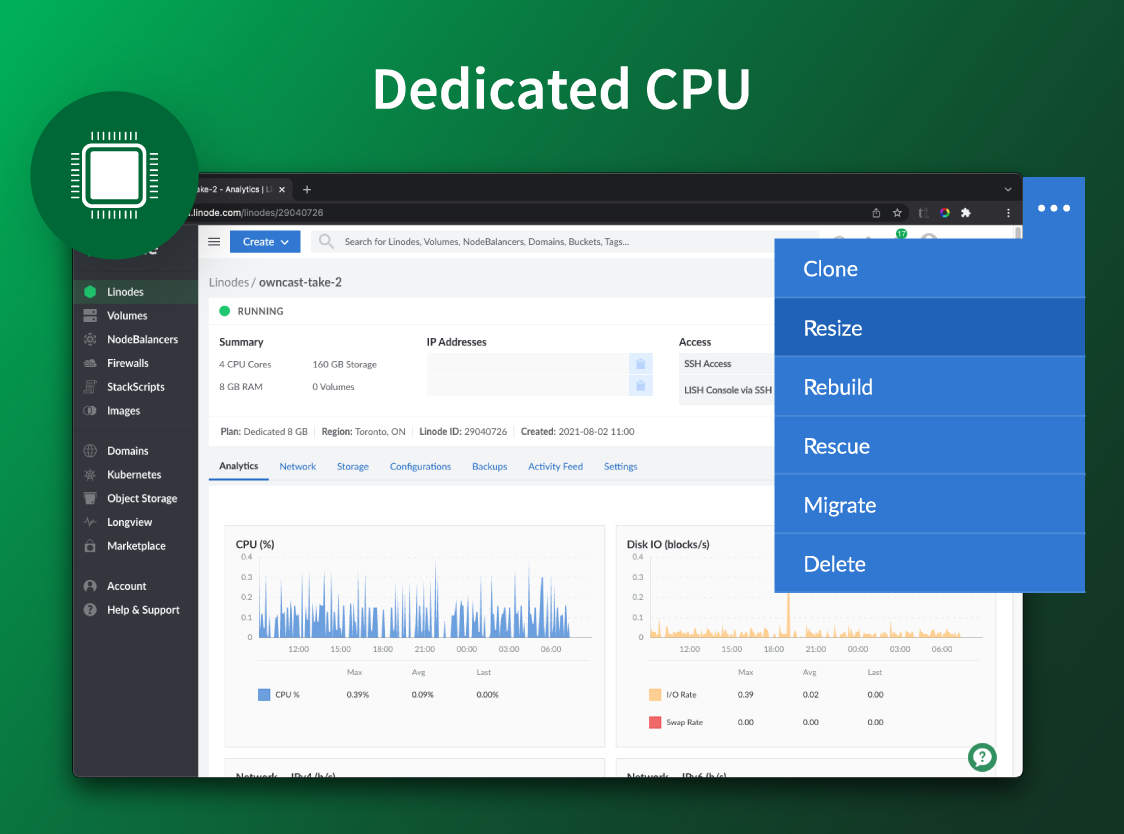
Akamai Cloud Computing (formerly Linode) include scalable and accessible Linux cloud solutions and services. These products and services support developers and enterprises as they build, deploy, secure, and scale applications.
$5
per month
AWS Lambda
Score 8.3 out of 10
N/A
AWS Lambda is a serverless computing platform that lets users run code without provisioning or managing servers. With Lambda, users can run code for virtually any type of app or backend service—all with zero administration. It takes of requirements to run and scale code with high availability.
$NaN
Per 1 ms
Pricing
Akamai Cloud Computing
AWS Lambda
Editions & Modules
No answers on this topic
128 MB
$0.0000000021
Per 1 ms
1024 MB
$0.0000000167
Per 1 ms
10240 MB
$0.0000001667
Per 1 ms
Offerings
Pricing Offerings
Akamai Cloud Computing
AWS Lambda
Free Trial
Yes
No
Free/Freemium Version
No
No
Premium Consulting/Integration Services
Yes
No
Entry-level Setup Fee
Optional
No setup fee
Additional Details
CPU, transfer, storage, and RAM are bundled into one price. Storage capacity can be increased with additional Block Storage or S3-compatible Object Storage. Instant Backups can be added with complete independence to the stack. Linode NodeBalancers ensure applications are available.
—
More Pricing Information
Community Pulse
Akamai Cloud Computing
AWS Lambda
Considered Both Products
Akamai Cloud Computing
Verified User
C-Level Executive
Chose Akamai Cloud Computing
I've tried all of Digital Ocean, AWS EC2 and AWS Lightsail - I found Linode to give the best price/performance for a VPS. However, compared to serverless functions like AWS Lambda, there's a lot of maintenance work if you want to keep your VPS up-to-date. If you're looking for …
We built some applications on Google App Engine, and in comparison to Linode, you are more locked in and there is a steeper learning curve, as you have to adapt to Google's tools. In Linode, you can use whatever you are used to. With AWS, you are able to make whatever setup you …
I used a lot of different services, a lot of services inside Amazon AWS and Digital ocean, but I found at Linode a different way to do all what I need, without having to be worried about weird costs calculations and other things like that.
For simple VMs or Kubernetes, Linode is cheaper and it also has consistently good performance. As long as this is what you need, you get all you'd want. AWS and GCP shine when you need their other services. Oracle Cloud was bare bone and expensive. Droplets are easy to start …
Akamai Connected Cloud Linode would be a good service to host a content delivery network (CDN) because of its edge network but I'd prefer not to use Akamai Connected Cloud Linode for tasks that need GPU power such as Machine Learning or Artificial Intelligence (AI) because Akamai Connected Cloud Linode lacks deep GPU compute compared to AWS or Google Cloud or Microsoft Azure
Lambda excels at event-driven, short-lived tasks, such as processing files or building simple APIs. However, it's less ideal for long-running, computationally intensive, or applications that rely on carrying the state between jobs. Cold starts and constant load can easily balloon the costs.
Developing test cases for Lambda functions can be difficult. For functions that require some sort of input it can be tough to develop the proper payload and event for a test.
For the uninitiated, deploying functions with Infrastructure as Code tools can be a challenging undertaking.
Logging the output of a function feels disjointed from running the function in the console. A tighter integration with operational logging would be appreciated, perhaps being able to view function logs from the Lambda console instead of having to navigate over to CloudWatch.
Sometimes its difficult to determine the correct permissions needed for Lambda execution from other AWS services.
I've been with them a long time. They provide me with the capabilities I need coupled with knowledgeable support that's not pay-for-extra. However, if I move to a non-Linux OS, the level of support by necessity will drop off. I can still ask questions about the infrastructure but I my ability to ask about OS features will decrease.
Simple and clear, no BS interface. From a design perspective it's no Apple or Stripe, but it does what it needs without making me want to stick a fork in my eyes, like when being forced to use Azure, AWS or GCP.
I give it a seven is usability because it's AWS. Their UI's are always clunkier than the competition and their documentation is rather cumbersome. There's SO MUCH to dig through and it's a gamble if you actually end up finding the corresponding info if it will actually help. Like I said before, going to google with a specific problem is likely a better route because AWS is quite ubiquitous and chances are you're not the first to encounter the problem. That being said, using SAM (Serverless application model) and it's SAM Local environment makes running local instances of your Lambdas in dev environments painless and quite fun. Using Nodejs + Lambda + SAM Local + VS Code debugger = AWESOME.
There is very little planned downtime. Whenever planned downtime is necessary I'm always given lots of advanced notice and an explanation that I can pass along to my users that they'll understand. I really appreciate that Linode appreciates my commitment to reliable service to my users. It shows that they believe they've been successful when I'm successful.
Servers are well dimensioned and price performant. Of course one always wants more, so if they were to upgrade their hardware for the same price I'd consider moving more workloads. Networking - never had an issue. Hardware speeds - disks are fast and can grow to great size.
Support was excellent and fast. The documentation is extensive and helpful. I learned many things from their online documentation. I did not contact them by phone, but email took a day or less. Complex problems would probably need a service contract. I liked the friendly and polite tone of the support.
Amazon consistently provides comprehensive and easy-to-parse documentation of all AWS features and services. Most development team members find what they need with a quick internet search of the AWS documentation available online. If you need advanced support, though, you might need to engage an AWS engineer, and that could be an unexpected (or unwelcome) expense.
We got kick started with an initial walkthrough along with some free credits. The initial walkthrough helped us to understand Linode's ecosystem and start our hands on with Linode. We tried out some apps from Marketplace initially with the free credits, which not only helped us understand Linode better, but also those apps. We had implemented many such apps to our customers with Linode
We're a small organization. The implementation of our Linode solution was trivial. Once I justified a cloud server to my bosses over a co-location -- the co-lo wasn't as fast as our linode server in load tests -- it was a matter of moving one Linux implementation to another. Trivial.
We switched to Linode from Namecheap due to poor uptime, and never had any issues with stability ever again after switching. We also cut our costs in half by switching. We compared Linode to DigitalOcean and Vultr, with the primary factor that caused us to go with Linode initially being their documentation. After using Linode for 3 years, their amazing support is another reason why we wouldn't consider anyone else at this point.
AWS Lambda is good for short running functions, and ideally in response to events within AWS. Google App Engine is a more robust environment which can have complex code running for long periods of time, and across more than one instance of hardware. Google App Engine allows for both front-end and back-end infrastructure, while AWS Lambda is only for small back-end functions
Although I use only a fraction of their product offerings, the total set makes scalability an easy goal to shoot for. As I said, I have a few customers that use the services my Linode provides...and I like it that way. However, should I need to scale up, I can...without incurring any more cost than I need to.
Positive - Only paying for when code is run, unlike virtual machines where you pay always regardless of processing power usage.
Positive - Scalability and accommodating larger amounts of demand is much cheaper. Instead of scaling up virtual machines and increasing the prices you pay for that, you are just increasing the number of times your lambda function is run.
Negative - Debugging/troubleshooting, and developing for lambda functions take a bit more time to get used to, and migrating code from virtual machines and normal processes to Lambda functions can take a bit of time.