Overview
ProductRatingMost Used ByProduct SummaryStarting Price
Amazon DynamoDB
Score 8.2 out of 10
N/A
Amazon DynamoDB is a cloud-native, NoSQL, serverless database service.
$0
capacity unit per hour
Microsoft Azure
Score 8.4 out of 10
N/A
Microsoft Azure is a cloud computing platform and infrastructure for building, deploying, and managing applications and services through a global network of Microsoft-managed datacenters.
$29
per month
MongoDB
Score 8.9 out of 10
N/A
MongoDB is an open source document-oriented database system. It is part of the NoSQL family of database systems. Instead of storing data in tables as is done in a "classical" relational database, MongoDB stores structured data as JSON-like documents with dynamic schemas (MongoDB calls the format BSON), making the integration of data in certain types of applications easier and faster.
$0.10
million reads
Pricing
Amazon DynamoDBMicrosoft AzureMongoDB
Editions & Modules
Provisioned - Read Operation
$0.00013
capacity unit per hour
Provisioned - Write Operation
$0.00065
capacity unit per hour
Provisioned - Global Tables
$0.000975
per Read Capacity
On-Demand Streams
$0.02
per 100,000 read operations
Provisioned - Streams
$0.02
per 100,000 read operations
On-Demand Data Requests Outside AWS Regions
$0.09
per GB
Provisioned - Data Requests Outside AWS Regions
$0.09
per GB
On-Demand Snapshot
$0.10
per GB per month
Provisioned - Snapshot
$0.10
per GB per month
On-Demand Restoring a Backup
$0.15
per GB
Provisioned - Restoring a Backup
$0.15
per GB
On-Demand Point-in-Time Recovery
$0.20
per GB per month
Provisioned - Point-in-Time Recovery
$0.20
per GB per month
On-Demand Read Operation
$0.25
per million requests
On-Demand Data Stored
$0.25
per GB per month
Provisioned - Data Stored
$0.25
per GB per month
On-Demand - Write Operation
$1.25
per million requests
On-Demand Global Tables
$1.875
per million write operations replicated
Developer
$29
per month
Standard
$100
per month
Professional Direct
$1000
per month
Basic
Free
per month
Shared
$0
per month
Serverless
$0.10million reads
million reads
Dedicated
$57
per month
Offerings
Pricing Offerings
Amazon DynamoDBMicrosoft AzureMongoDB
Free Trial
NoYesYes
Free/Freemium Version
NoYesYes
Premium Consulting/Integration Services
NoNoNo
Entry-level Setup FeeNo setup feeNo setup feeNo setup fee
Additional DetailsThe free tier lets users have access to a variety of services free for 12 months with limited usage after making an Azure account.Fully managed, global cloud database on AWS, Azure, and GCP
More Pricing Information
Community Pulse
Amazon DynamoDBMicrosoft AzureMongoDB
Considered Multiple Products
Amazon DynamoDB
Chose Amazon DynamoDB
More flexible and easier to get started with than RDS, but, in my opinion, much worse monitoring/cost and query/modeling complexity than MongoDB
Chose Amazon DynamoDB
MongoDB vs. Amazon DynamoDB:• MongoDB requires more human management than DynamoDB, which is a fully managed service.• DynamoDB's scalability is automatic, whereas MongoDB's horizontal scaling may require more work.• When compared to DynamoDB, MongoDB offers more extensive data …
Chose Amazon DynamoDB
DynamoDB provided an easy to use, schema-less, out of the box solution that can be used to spin up a full working implementation very easily. It doesn't require extra knowledge such as MongoDB query functions
Chose Amazon DynamoDB
Lesser flexibility but better performance, and more predictable development support are the key points where Amazon DynamoDB comes out on top, when compared to MongoDB.
Chose Amazon DynamoDB
We are always assembling our solutions on AWS and DynamoDB is a better fit for us because of its simplicity.
DynamoDB has its ow sets of triggers that make this an integrated solution on AWS.
Besides, we wanted to use a key-value solution for our simple edge DB, and we didn't …
Chose Amazon DynamoDB
DynamoDB's scalability is more automated and effortless, making it easier to handle rapid growth. Other tools require more manual configuration while DynamoDB simplifies database administration. Also, DynamoDB provides strong consistency while other tools like MongoDB and Apache…
Chose Amazon DynamoDB
MongoDB has some performance issues and can get corrupted from time to time and has needed to be rebuilt. We have not had that experience while using DynamoDB.
Chose Amazon DynamoDB
For our use case, we needed a noSQL that would work with AWS Lambdas of specific parts of the internal web applications. We optimized billing and uses , diversified databases for various parts; so it’s not very expensive.
Chose Amazon DynamoDB
i think both depends on usuability and app requirement
Chose Amazon DynamoDB
Performance at high scales is better and the cost at high scales is less. If one has a ton of data generated and has to work their way through it, I think Amazon DynamoDB should the go-to database. There are no compromises when it comes to performance at a huge scale. With any …
Chose Amazon DynamoDB
The Amazon Web Services managed Amazon DynamoDB has excellent features which makes it stand out from all the others in market right now. The management ease it offers is far superior than its competitors and on top of that the on-demand pricing model is an advantage which works …
Chose Amazon DynamoDB
Compare to other products its so easier to set up, meeting all of our business requirements and easy usable, highly efficient and scalable.
Chose Amazon DynamoDB
high scalability #single-digit latency. #so much flexile. #very easy to use. # low maintenance.#GLobal Access
Chose Amazon DynamoDB
Amazon DynamoDB seems to be more cost effective and easy to integrate with other aws services.
Chose Amazon DynamoDB
Haven't had a chance to use this up to an extent to be compared to DynamoDB.
Chose Amazon DynamoDB
DynamoDB offers strong consistency, more fine-grained control over read and write capacities, and integrates seamlessly with other AWS services.
DynamoDB is designed for horizontal scalability and high throughput, making it a better choice for applications with rapidly changing …
Chose Amazon DynamoDB
The automation is much more subtle and it performs way better for internet-scale applications. No matter the number of connections, the performance doesn't dip even a bit.
Chose Amazon DynamoDB
Mongo services are outside of our Vpc and are on a different network. Since most of our infra is on AWS, dynamo by AWS was a natural choice. Most of our engineers are familiar with AWS sdk and the console so that brought in a much smaller learning curve for our engineering team
Chose Amazon DynamoDB
It seamlessly integrates with Lambda, simplifying the deployment and management of serverless architecture. Both Lambda and DynamoDB are designed are highly scalable. Lambda functions can be triggered by various AWS services and events, such as changes in DynamoDB tables which …
Chose Amazon DynamoDB
Because of it's access control features, quick scalability and high performance.
Microsoft Azure
Chose Microsoft Azure
Azure is an ideal platform for disaster recovery and backup. It is very flexible because of its site regeneration capabilities and other features. All of our data can be backup, regardless of the language or operating system. Azure’s inherent flexibility comes from its status …
Chose Microsoft Azure
The most common alternatives are Amazon Web Services and Google Cloud Platform. AWS is known for its non-existent customer support and abysmal documentation - Azure is clearly better on both fronts. Google Cloud Platform is a solid product, but in my experience Azure Functions …
Chose Microsoft Azure
AWS is competitor and it's leading in cloud space with his wide sprawl of offerings and services. AWS is a ocean once you login you get everything on one console. AWS leads this space with all his offerings and capabilities. But Azure is not behind, it is competing and is …
MongoDB
Chose MongoDB
MySQL is a great for querying related data, but it's unable to store structured data and has a fixed schema. Also SQL can be non-intuitive. DynamoDB, CouchDB and Redis all make querying the data quite difficult and lack important features. The problem CouchDB tries to solve is …
Chose MongoDB
The environment I work in is somewhat unique in that we use both MySQL and MongoDB. However, each is used for specific purposes that the other is not well suited for. MongoDB is not a relational database like MySQL, so it serves as the perfect place to dump key bits of data for …
Chose MongoDB
In our early development days we weighed NoSQL databases like MongoDB with RDBMS solutions like MySQL. We were more familiar with MySQL from past experience but also were wary of painful data migrations that slowed down development iterations and increased the risk of outages …
Chose MongoDB
Your default choice should not be MongoDB in my opinion. Most user-facing systems are relational by nature so a well known and reliable SQL database would be easier to maintain and simpler to develop long term. If you highly value speed of development go with Firebase. If you …
Chose MongoDB
It does not belong to certain cloud platforms. MongoDB is an independent program that works with any cloud platform including Amazon Web Services and the Google Cloud Platform. For companies who want to maintain a cloud agnostic structure, MongoDB is a great choice for NoSQL …
Chose MongoDB
We tend to choose MongoDB when we're faced with a particular situation: we know that we need a NoSQL database in general, and want an open-source implementation that allows us to prevent against platform lock-in. Amazon's new DocumentDB product even allows us to choose to use …
Chose MongoDB
MongoDB was the most full-featured NoSQL database we evaluated - that offered atomic transactions at a document level, built-in HA & DR, open source, robust queries, and enterprise level support.

Other platforms had specific parts of what we were looking for - MongoDB had it all.
Chose MongoDB
MongoDB's interface is extremely intuitive and allows [you to] come up from no knowledge to a working deployment with no effort,
even without a background in the NoSQL world.
Features
Amazon DynamoDBMicrosoft AzureMongoDB
NoSQL Databases
Comparison of NoSQL Databases features of Product A and Product B
Amazon DynamoDB
9.2
69 Ratings
3% above category average
Microsoft Azure
-
Ratings
MongoDB
10.0
39 Ratings
12% above category average
Performance9.368 Ratings00 Ratings10.039 Ratings
Availability9.569 Ratings00 Ratings10.039 Ratings
Concurrency9.067 Ratings00 Ratings10.039 Ratings
Security9.269 Ratings00 Ratings10.039 Ratings
Scalability9.468 Ratings00 Ratings10.039 Ratings
Data model flexibility8.266 Ratings00 Ratings10.039 Ratings
Deployment model flexibility10.023 Ratings00 Ratings10.038 Ratings
Infrastructure-as-a-Service (IaaS)
Comparison of Infrastructure-as-a-Service (IaaS) features of Product A and Product B
Amazon DynamoDB
-
Ratings
Microsoft Azure
8.5
27 Ratings
3% above category average
MongoDB
-
Ratings
Service-level Agreement (SLA) uptime00 Ratings8.126 Ratings00 Ratings
Dynamic scaling00 Ratings8.725 Ratings00 Ratings
Elastic load balancing00 Ratings8.624 Ratings00 Ratings
Pre-configured templates00 Ratings8.225 Ratings00 Ratings
Monitoring tools00 Ratings8.326 Ratings00 Ratings
Pre-defined machine images00 Ratings8.424 Ratings00 Ratings
Operating system support00 Ratings9.026 Ratings00 Ratings
Security controls00 Ratings8.626 Ratings00 Ratings
Automation00 Ratings8.224 Ratings00 Ratings
Best Alternatives
Amazon DynamoDBMicrosoft AzureMongoDB
Small Businesses
IBM Cloudant
IBM Cloudant
Score 7.4 out of 10
DigitalOcean Droplets
Score 9.4 out of 10
IBM Cloudant
IBM Cloudant
Score 7.4 out of 10
Medium-sized Companies
IBM Cloudant
IBM Cloudant
Score 7.4 out of 10
SAP on IBM Cloud
SAP on IBM Cloud
Score 9.0 out of 10
IBM Cloudant
IBM Cloudant
Score 7.4 out of 10
Enterprises
IBM Cloudant
IBM Cloudant
Score 7.4 out of 10
SAP on IBM Cloud
SAP on IBM Cloud
Score 9.0 out of 10
IBM Cloudant
IBM Cloudant
Score 7.4 out of 10
All AlternativesView all alternativesView all alternativesView all alternatives
User Ratings
Amazon DynamoDBMicrosoft AzureMongoDB
Likelihood to Recommend
8.9
(79 ratings)
8.8
(96 ratings)
10.0
(79 ratings)
Likelihood to Renew
10.0
(34 ratings)
10.0
(17 ratings)
10.0
(67 ratings)
Usability
9.1
(4 ratings)
8.3
(36 ratings)
10.0
(15 ratings)
Availability
-
(0 ratings)
6.8
(2 ratings)
9.0
(1 ratings)
Performance
9.1
(42 ratings)
-
(0 ratings)
-
(0 ratings)
Support Rating
5.2
(4 ratings)
9.0
(27 ratings)
9.6
(13 ratings)
Implementation Rating
-
(0 ratings)
8.0
(2 ratings)
8.4
(2 ratings)
Product Scalability
9.1
(42 ratings)
-
(0 ratings)
-
(0 ratings)
User Testimonials
Amazon DynamoDBMicrosoft AzureMongoDB
Likelihood to Recommend
Amazon AWS
It’s great for server less and real-time applications. It would be great for gaming and mobile apps. However, if you need relational database and have fixed budget, do not use it. While budget can be managed, you need to be careful. Also this is not a tool for storing big data, there are other wide-column database types you could use for it ins the ad
Read full review
Microsoft
Azure is particularly well suited for enterprise environments with existing Microsoft investments, those that require robust compliance features, and organizations that need hybrid cloud capabilities that bridge on-premises and cloud infrastructure. In my opinion, Azure is less appropriate for cost-sensitive startups or small businesses without dedicated cloud expertise and scenarios requiring edge computing use cases with limited connectivity. Azure offers comprehensive solutions for most business needs but can feel like there is a higher learning curve than other cloud-based providers, depending on the product and use case.
Read full review
MongoDB
If asked by a colleague I would highly recommend MongoDB. MongoDB provides incredible flexibility and is quick and easy to set up. It also provides extensive documentation which is very useful for someone new to the tool. Though I've used it for years and still referenced the docs often. From my experience and the use cases I've worked on, I'd suggest using it anywhere that needs a fast, efficient storage space for non-relational data. If a relational database is needed then another tool would be more apt.
Read full review
Pros
Amazon AWS
  • To manage varying workloads, it enables users to increase capacity as necessary and decrease it as needed.
  • Users can take advantage of its auto-scaling, in-memory caching, and backup without paying for the services of a database administrator.
  • We can use it for low scale operations.
Read full review
Microsoft
  • Microsoft Azure is highly scalable and flexible. You can quickly scale up or down additional resources and computing power.
  • You have no longer upfront investments for hardware. You only pay for the use of your computing power, storage space, or services.
  • The uptime that can be achieved and guaranteed is very important for our company. This includes the rapid maintenance for security updates that are mostly carried out by Microsoft.
  • The wide range of capabilities of services that are possible in Microsoft Azure. You can practically put or create anything in Microsoft Azure.
Read full review
MongoDB
  • Being a JSON language optimizes the response time of a query, you can directly build a query logic from the same service
  • You can install a local, database-based environment rather than the non-relational real-time bases such a firebase does not allow, the local environment is paramount since you can work without relying on the internet.
  • Forming collections in Mango is relatively simple, you do not need to know of query to work with it, since it has a simple graphic environment that allows you to manage databases for those who are not experts in console management.
Read full review
Cons
Amazon AWS
  • Cost model may not be easy to control and may lead to higher costs if not carefully planned
  • Indexing may be a cost culprit when not planned, because it's not included on the data costs
  • The Query Language may not fulfill everybody's expectations, as it has less features than those of competitors.
Read full review
Microsoft
  • The cost of resources is difficult to determine, technical documentation is frequently out of date, and documentation and mapping capabilities are lacking.
  • The documentation needs to be improved, and some advanced configuration options require research and experimentation.
  • Microsoft's licensing scheme is too complex for the average user, and Azure SQL syntax is too different from traditional SQL.
Read full review
MongoDB
  • An aggregate pipeline can be a bit overwhelming as a newcomer.
  • There's still no real concept of joins with references/foreign keys, although the aggregate framework has a feature that is close.
  • Database management/dev ops can still be time-consuming if rolling your own deployments. (Thankfully there are plenty of providers like Compose or even MongoDB's own Atlas that helps take care of the nitty-gritty.
Read full review
Likelihood to Renew
Amazon AWS
It's core to our business, we couldn't survive without it. We use it to drive everything from FTP logins to processing stories and delivering them to clients. It's reliable and easy to query from all of our pipeline services. Integration with things like AWS Lambda makes it easy to trigger events and run code whenever something changes in the database.
Read full review
Microsoft
Moving to Azure was and still is an organizational strategy and not simply changing vendors. Our product roadmap revolved around Azure as we are in the business of humanitarian relief and Azure and Microsoft play an important part in quickly and efficiently serving all of the world. Migration and investment in Azure should be considered as an overall strategy of an organization and communicated companywide.
Read full review
MongoDB
I am looking forward to increasing our SaaS subscriptions such that I get to experience global replica sets, working in reads from secondaries, and what not. Can't wait to be able to exploit some of the power that the "Big Boys" use MongoDB for.
Read full review
Usability
Amazon AWS
Functionally, DynamoDB has the features needed to use it. The interface is not as easy to use, which impacts its usability. Being familiar with AWS in general is helpful in understanding the interface, however it would be better if the interface more closely aligned with traditional tools for managing datastores.
Read full review
Microsoft
As Microsoft Azure is [doing a] really good with PaaS. The need of a market is to have [a] combo of PaaS and IaaS. While AWS is making [an] exceptionally well blend of both of them, Azure needs to work more on DevOps and Automation stuff. Apart from that, I would recommend Azure as a great platform for cloud services as scale.
Read full review
MongoDB
NoSQL database systems such as MongoDB lack graphical interfaces by default and therefore to improve usability it is necessary to install third-party applications to see more visually the schemas and stored documents. In addition, these tools also allow us to visualize the commands to be executed for each operation.
Read full review
Reliability and Availability
Amazon AWS
No answers on this topic
Microsoft
It has proven to be unreliable in our production environment and services become unavailable without proper notification to system administrators
Read full review
MongoDB
No answers on this topic
Performance
Amazon AWS
It works very well across all the regions and response time is also very quick due to AWS's internal data transfer. Plus if your product requires HIPPA or some other regulations needs to be followed, you can easily replicate the DB into multiple regions and they manage all by it's own.
Read full review
Microsoft
No answers on this topic
MongoDB
No answers on this topic
Support Rating
Amazon AWS
I have not had to contact support for this service, however I have had to contact AWS for other services and their support has been good.
Read full review
Microsoft
We were running Windows Server and Active Directory, so [Microsoft] Azure was a seamless transition. We ran into a few, if any support issues, however, the availability of Microsoft Azure's support team was more than willing and able to guide us through the process. They even proposed solutions to issues we had not even thought of!
Read full review
MongoDB
Finding support from local companies can be difficult. There were times when the local company could not find a solution and we reached a solution by getting support globally. If a good local company is found, it will overcome all your problems with its global support.
Read full review
Implementation Rating
Amazon AWS
No answers on this topic
Microsoft
As I have mentioned before the issue with my Oracle Mismatch Version issues that have put a delay on moving one of my platforms will justify my 7 rating.
Read full review
MongoDB
While the setup and configuration of MongoDB is pretty straight forward, having a vendor that performs automatic backups and scales the cluster automatically is very convenient. If you do not have a system administrator or DBA familiar with MongoDB on hand, it's a very good idea to use a 3rd party vendor that specializes in MongoDB hosting. The value is very well worth it over hosting it yourself since the cost is often reasonable among providers.
Read full review
Alternatives Considered
Amazon AWS
The only thing that can be compared to DynamoDB from the selected services can be Aurora. It is just that we use Aurora for High-Performance requirements as it can be 6 times faster than normal RDS DB. Both of them have served as well in the required scenario and we are very happy with most of the AWS services.
Read full review
Microsoft
As I continue to evaluate the "big three" cloud providers for our clients, I make the following distinctions, though this gap continues to close. AWS is more granular, and inherently powerful in the configuration options compared to [Microsoft] Azure. It is a "developer" platform for cloud. However, Azure PowerShell is helping close this gap. Google Cloud is the leading containerization platform, largely thanks to it building kubernetes from the ground up. Azure containerization is getting better at having the same storage/deployment options.
Read full review
MongoDB
We have [measured] the speed in reading/write operations in high load and finally select the winner = MongoDBWe have [not] too much data but in case there will be 10 [times] more we need Cassandra. Cassandra's storage engine provides constant-time writes no matter how big your data set grows. For analytics, MongoDB provides a custom map/reduce implementation; Cassandra provides native Hadoop support.
Read full review
Scalability
Amazon AWS
I have taken one point away due to its size limits. In case the application requires queries, it becomes really complicated to read and write data. When it comes to extremely large data sets such as the case in my company, a third-party logistics company, where huge amount of data is generated on a daily basis, even though the scalability is good, it becomes difficult to manage all the data due to limits.
Read full review
Microsoft
No answers on this topic
MongoDB
No answers on this topic
Return on Investment
Amazon AWS
  • Some developers see DynamoDB and try to fit problems to it, instead of picking the best solution for a given problem. This is true of any newer tool that people are trying to adopt.
  • It has allowed us to add more scalability to some of our systems.
  • As with any new technology there was a ramp up/rework phase as we learned best practices.
Read full review
Microsoft
  • For about 2 years we didn't have to do anything with our production VMs, the system ran without a hitch, which meant our engineers could focus on features rather than infrastructure.
  • DNS management was very easy in Azure, which made it easy to upgrade our cluster with zero downtime.
  • Azure Web UI was easy to work with and navigate, which meant our senior engineers and DevOps team could work with Azure without formal training.
Read full review
MongoDB
  • Open Source w/ reasonable support costs have a direct, positive impact on the ROI (we moved away from large, monolithic, locked in licensing models)
  • You do have to balance the necessary level of HA & DR with the number of servers required to scale up and scale out. Servers cost money - so DR & HR doesn't come for free (even though it's built into the architecture of MongoDB
Read full review
ScreenShots

Amazon DynamoDB Screenshots

Screenshot of Amazon DynamoDB in the AWS Console

MongoDB Screenshots

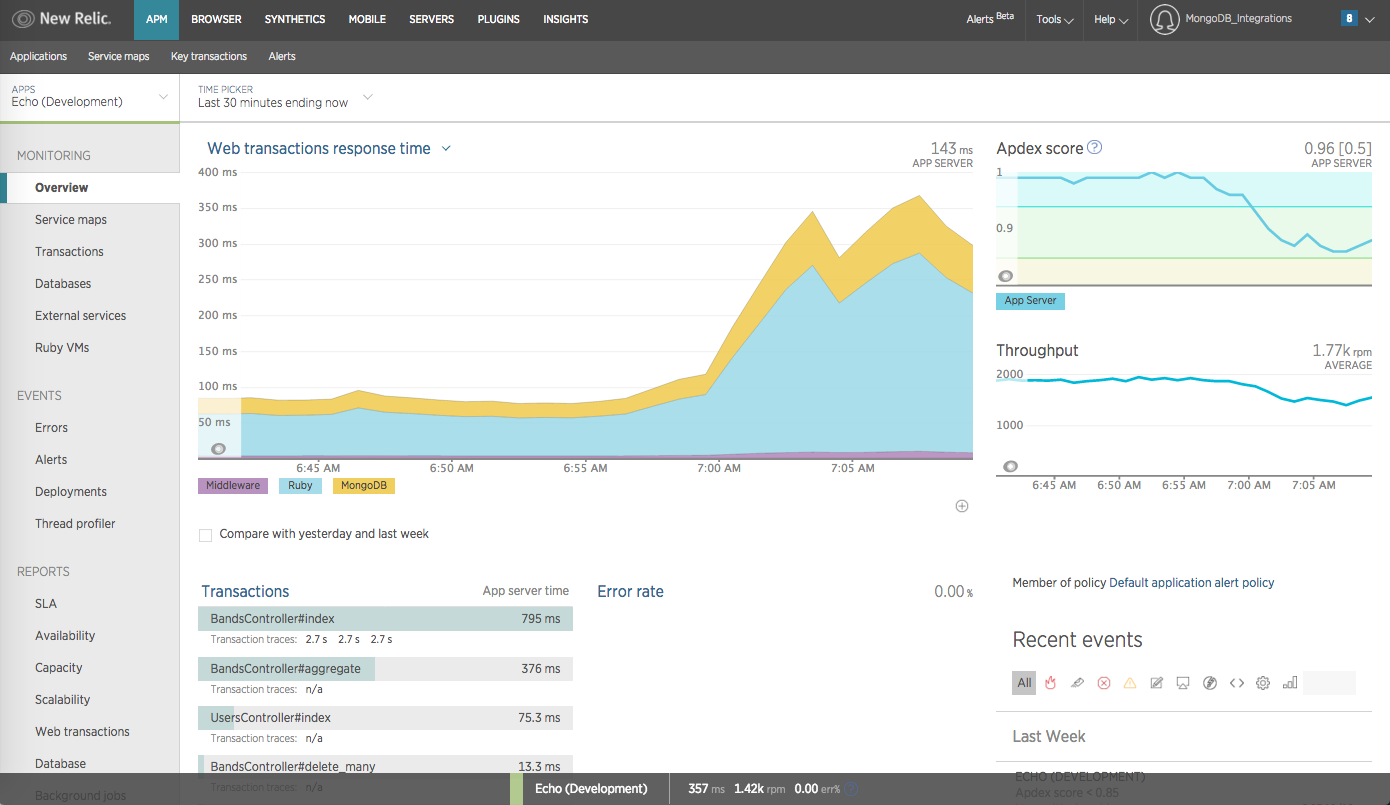
Screenshot of Screenshot of Screenshot of Screenshot of Screenshot of Screenshot of