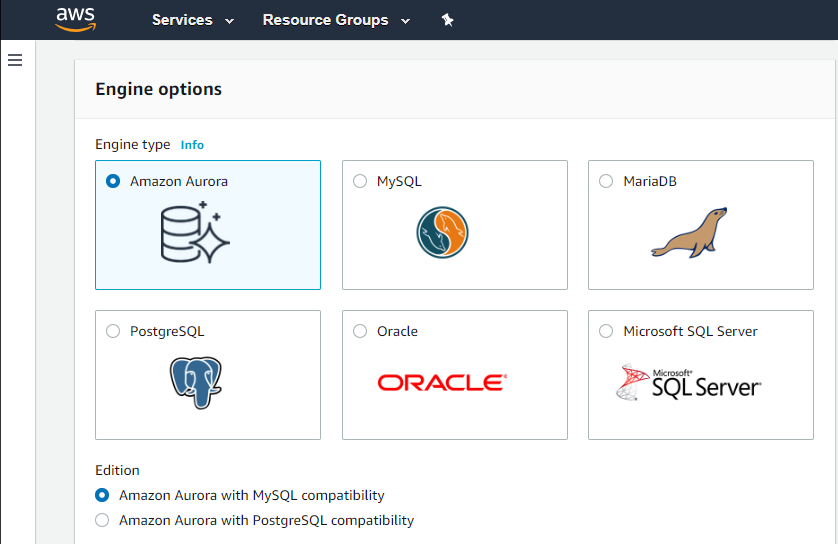
Amazon Relational Database Service (Amazon RDS) is a database-as-a-service (DBaaS) from Amazon Web Services.
N/A
Amazon S3
Score8.8 out of 10
N/A
Amazon S3 is a cloud-based object storage service from Amazon Web Services. It's key features are storage management and monitoring, access management and security, data querying, and data transfer.
N/A
Snowflake
Score8.7 out of 10
N/A
The Snowflake Cloud Data Platform is the eponymous data warehouse with, from the company in San Mateo, a cloud and SQL based DW that aims to allow users to unify, integrate, analyze, and share previously siloed data in secure, governed, and compliant ways. With it, users can securely access the Data Cloud to share live data with customers and business partners, and connect with other organizations doing business as data consumers, data providers, and data service providers.
N/A
Pricing
Amazon RDS
Amazon S3
Snowflake
Editions & Modules
Amazon RDS for PostgreSQL
$0.24 ($0.48)
per hour, R5 Large (R5 Extra Large)
Amazon RDS for MariaDB
$0.25 ($0.50)
per hour, R5 Large (R5 Extra Large)
Amazon RDS for MySQL
$0.29 ($0.58)
per hour, R5 Large (R5 Extra Large)
Amazon RDS for Oracle
$0.482 ($0.964)
per hour, R5 Large (R5 Extra Large)
Amazon RDS for SQL Server
$1.02 ($1.52)
per hour, R5 Large (R5 Extra Large)
No answers on this topic
No answers on this topic
Offerings
Pricing Offerings
Amazon RDS
Amazon S3
Snowflake
Free Trial
No
No
Yes
Free/Freemium Version
No
No
No
Premium Consulting/Integration Services
No
No
No
Entry-level Setup Fee
Optional
No setup fee
No setup fee
Additional Details
—
—
—
More Pricing Information
Community Pulse
Amazon RDS
Amazon S3
Snowflake
Considered Multiple Products
Amazon AWS
Verified User
Chose Amazon RDS
Amazon Relational Database Service (RDS) stands out among similar products due to its seamless integration with other AWS services, automated backups, and multi-AZ deployments for high availability. Its support for various database engines, such as MySQL, PostgreSQL, and …
A de minimis incentive was given to thank the reviewer for their time. The incentive was not used to bias or drive a particular response, nor was the incentive contingent on a positive endorsement. More Info
Verified User
Chose Amazon RDS
With products like Google Cloud SQL, Azure SQL Database, AWS RDS stacks up quite well in all features. Features like licensing, performance, security comes to my mind the most. Another aspect is AWS's global reach.
A de minimis incentive was given to thank the reviewer for their time. The incentive was not used to bias or drive a particular response, nor was the incentive contingent on a positive endorsement. More Info
Technical Leader (Citibank) in Information Technology at Tecso Coop (Banking, 10,001+ employees)
Chose Amazon RDS
Although the Rackspace service is not comparable, even though it is very good, it requires a lot of administration on my part. Regarding Atlas, although it is not the same as RDS in terms of provisioning and administration panel, I mention it because I found it simpler and more …
A de minimis incentive was given to thank the reviewer for their time. The incentive was not used to bias or drive a particular response, nor was the incentive contingent on a positive endorsement. More Info
Manager, Web and Interactive Media in Marketing at National Bulk Equipment, Inc. (Machinery, 201-500 employees)
Chose Amazon RDS
Previously used Media Temple database hosting (now GoDaddy). While that endeavor was also successful, the AWS RDS is more secure, with higher availability and better documentation.
A de minimis incentive was given to thank the reviewer for their time. The incentive was not used to bias or drive a particular response, nor was the incentive contingent on a positive endorsement. More Info
Software Engineer in Information Technology at Mytechcasa (Information Technology & Services, 11-50 employees)
Chose Amazon RDS
Installing, configuring, and managing Oracle Database can be challenging, especially for people who are new to Oracle products. Longer learning curves and higher operational overhead can be caused by this complexity. Amazon Relational Database Service is easy to understand and …
A de minimis incentive was given to thank the reviewer for their time. The incentive was not used to bias or drive a particular response, nor was the incentive contingent on a positive endorsement. TR verified that a representative sample of customers was invited. More Info
Head of Engineering in Information Technology at Damstra Technology (Information Technology & Services, 51-200 employees)
Chose Amazon RDS
Amazon Relational Database Service (RDS) is an excellent option for those using AWS already, and provides a scalable, performant, database engine. Unlike Azure SQL Server it has a limit on the number of databases you can hold. However, if you're already in the AWS ecosystem it …
A de minimis incentive was given to thank the reviewer for their time. The incentive was not used to bias or drive a particular response, nor was the incentive contingent on a positive endorsement. TR verified that a representative sample of customers was invited. More Info
A de minimis incentive was given to thank the reviewer for their time. The incentive was not used to bias or drive a particular response, nor was the incentive contingent on a positive endorsement. TR verified that a representative sample of customers was invited. More Info
A de minimis incentive was given to thank the reviewer for their time. The incentive was not used to bias or drive a particular response, nor was the incentive contingent on a positive endorsement. TR verified that a representative sample of customers was invited. More Info
IT Manager in Information Technology at Rancilio Group North America (Wholesale, 11-50 employees)
Chose Amazon RDS
I selected AWS RDS over Azure because of the [number] of products AWS has that work together. The cost for RDS was cheaper than Azure's SQL also. I use Azure for MSSQL workloads and AWS for MySQL workloads. Probably the main reason was we wanted to use S3 and Azure doesn't have …
A de minimis incentive was given to thank the reviewer for their time. The incentive was not used to bias or drive a particular response, nor was the incentive contingent on a positive endorsement. More Info
Verified User
Chose Amazon RDS
Amazon RDS provides more configuration ability, and also it's scalable and highly available for real-time response to the complex query.
A de minimis incentive was given to thank the reviewer for their time. The incentive was not used to bias or drive a particular response, nor was the incentive contingent on a positive endorsement. More Info
Application Developer in Information Technology at Monsanto Company (Farming, 10,001+ employees)
Chose Amazon RDS
Though you could get similar functionality using Docker, Amazon RDS offers a more comprehensive SaaS solution.
With Docker, you still need to have an EC2 instance to install the Docker and manage backup scripts using EC2 snapshots or S3. But RDS provides that solution …
A de minimis incentive was given to thank the reviewer for their time. The incentive was not used to bias or drive a particular response, nor was the incentive contingent on a positive endorsement. More Info
Amazon AWS
Verified User
Chose Amazon S3
Amazon S3 (Simple Storage Service) is the only AWS offering for object storage. DynamoDB is fantastic for unstructured data but does not handle object storage. The relational database service (RDS) is excellent but only applies to use cases with structured table data, and does …
A de minimis incentive was given to thank the reviewer for their time. The incentive was not used to bias or drive a particular response, nor was the incentive contingent on a positive endorsement. More Info
Technical Co-Founder in Corporate at Infofree.com (Computer Software, 1-10 employees)
Chose Amazon S3
We originally were looking between FTP and Amazon S3 as a storage location for customer-created files. FTP had been used for years, but as it was a new product were didn't understand how much utilization would be needed. Amazon S3 won out because it was easier to integrate into …
A de minimis incentive was given to thank the reviewer for their time. The incentive was not used to bias or drive a particular response, nor was the incentive contingent on a positive endorsement. More Info
Verified User
Chose Amazon S3
As most of our work loads and the under laying platforms are build on EMR, Spark and AWS Lambda, we did not find HDFS a suitable solution to have all of our data in. HDFS was very costly as we had to maintain data nodes only for the sole purpose of maintaining the extra storage …
A de minimis incentive was given to thank the reviewer for their time. The incentive was not used to bias or drive a particular response, nor was the incentive contingent on a positive endorsement. More Info
Verified User
Chose Amazon S3
We chose S3 over Azure Storage because it integrated very easily and quickly with our existing AWS environment. S3 pricing was also cheaper than Azure at the time. S3 is also more mature and has been on the market 10 years longer than Azure Storage. Amazon also offers a higher …
A de minimis incentive was given to thank the reviewer for their time. The incentive was not used to bias or drive a particular response, nor was the incentive contingent on a positive endorsement. More Info
A de minimis incentive was given to thank the reviewer for their time. The incentive was not used to bias or drive a particular response, nor was the incentive contingent on a positive endorsement. More Info
Software Developer in Information Technology at Monsanto Company (Farming, 10,001+ employees)
Chose Amazon S3
I haven't been personally involved in the decision to use S3, but in comparison to Dropbox or Google Drive, this offers a less robust UI to modify things, while being a cheaper storage mechanism over the rest.
A de minimis incentive was given to thank the reviewer for their time. The incentive was not used to bias or drive a particular response, nor was the incentive contingent on a positive endorsement. More Info
Software Developer in Engineering at TrueCar, Inc. (Internet, 501-1000 employees)
Chose Amazon S3
Amazon S3 is where you want to default to if you want to store a large amount of data. Compared to formatted data that you can store in Amazon RDS or DynamoDB, you can store your data in any format you want on S3. And the data retention policy can be really useful if you use S3 …
A de minimis incentive was given to thank the reviewer for their time. The incentive was not used to bias or drive a particular response, nor was the incentive contingent on a positive endorsement. More Info
Snowflake Computing
Verified User
Chose Snowflake
Since we switch from Amazon Redshift to Snowflake, we found Snowflake is much better than redshift in many ways, including the data integrate and data pull. However, comparing directly pull data from Amazon S3, Snowflake is quite slow in terms of data pull speed and the more …
A de minimis incentive was given to thank the reviewer for their time. The incentive was not used to bias or drive a particular response, nor was the incentive contingent on a positive endorsement. More Info
Director of Business Intelligence in Engineering at CareCloud (Health, Wellness and Fitness, 201-500 employees)
Chose Snowflake
Instant provisioning of computing resources and data sharing is something we have not seen with any other vendor. Being HIPAA compliant at the time of evaluation was a must for us. Other vendors were late on this. Onboarding on support during implementation was also excellent.
A de minimis incentive was given to thank the reviewer for their time. The incentive was not used to bias or drive a particular response, nor was the incentive contingent on a positive endorsement. More Info
Verified User
Chose Snowflake
I evaluated Redshift and Panoply when making the choice for Snowflake. Panoply is built on Redshift, so the two are equal in drawbacks: Redshift requires a cluster to be running 24/7 for your data to live there. We produce terabytes of data every day, so this was not an option …
A de minimis incentive was given to thank the reviewer for their time. The incentive was not used to bias or drive a particular response, nor was the incentive contingent on a positive endorsement. More Info
If your application needs a relational data store and uses other AWS services, AWS RDS is a no-brainer. It offers all the traditional database features, makes it a snap to set up, creates cross-region replication, has advanced security, built-in monitoring, and much more at a very good price. You can also set up streaming to a data lake using various other AWS services on your RDS.
A de minimis incentive was given to thank the reviewer for their time. The incentive was not used to bias or drive a particular response, nor was the incentive contingent on a positive endorsement. More Info
Amazon S3 is a great service to safely backup your data where redundancy is guaranteed and the cost is fair. We use Amazon S3 for data that we backup and hope we never need to access but in the case of a catastrophic or even small slip of the finger with the delete command we know our data and our client's data is safely backed up by Amazon S3. Transferring data into Amazon S3 is free but transferring data out has an associated, albeit low, cost per GB. This needs to be kept in mind if you plan on transferring out a lot of data frequently. There may be other cost effective options although Amazon S3 prices are really low per GB. Transferring 150TB would cost approximately $50 per month.
A de minimis incentive was given to thank the reviewer for their time. The incentive was not used to bias or drive a particular response, nor was the incentive contingent on a positive endorsement. More Info
Snowflake is well suited when you have to store your data and you want easy scalability and increase or decrease the storage per your requirement. You can also control the computing cost, and if your computing cost is less than or equal to 10% of your storage cost, then you don't have to pay for computing, which makes it cost-effective as well.
A de minimis incentive was given to thank the reviewer for their time. The incentive was not used to bias or drive a particular response, nor was the incentive contingent on a positive endorsement. More Info
Automated Database Management: We use it for streamlining routine tasks like software patching and database backups.
Scalability on Demand: we use it to handle traffic spikes, scaling both vertically and horizontally.
Database Engine Compatibility: It works amazingly with multiple database engines used by different departments within our organization including MySQL, PostgreSQL, SQL Server, and Oracle.
Monitoring: It covers our extensive monitoring and logging, and also has great compatibility with Amazon CloudWatch
A de minimis incentive was given to thank the reviewer for their time. The incentive was not used to bias or drive a particular response, nor was the incentive contingent on a positive endorsement. TR verified that a representative sample of customers was invited. More Info
Fantastic developer API, including AWS command line and library utilities.
Strong integration with the AWS ecosystem, especially with regards to access permissions.
It's astoundingly stable- you can trust it'll stay online and available for anywhere in the world.
Its static website hosting feature is a hidden gem-- it provides perhaps the cheapest, most stable, most high-performing static web hosting available in PaaS.
A de minimis incentive was given to thank the reviewer for their time. The incentive was not used to bias or drive a particular response, nor was the incentive contingent on a positive endorsement. More Info
Snowflake scales appropriately allowing you to manage expense for peak and off peak times for pulling and data retrieval and data centric processing jobs
Snowflake offers a marketplace solution that allows you to sell and subscribe to different data sources
Snowflake manages concurrency better in our trials than other premium competitors
Snowflake has little to no setup and ramp up time
Snowflake offers online training for various employee types
A de minimis incentive was given to thank the reviewer for their time. The incentive was not used to bias or drive a particular response, nor was the incentive contingent on a positive endorsement. More Info
It is a little difficult to configure and connect to an RDS instance. The integration with ECS can be made more seamless.
Exploring features within RDS is not very easy and intuitive. Either a human friendly documentation should be added or the User Interface be made intuitive so that people can explore and find features on their own.
There should be tools to analyze cost and minimize it according to the usage.
A de minimis incentive was given to thank the reviewer for their time. The incentive was not used to bias or drive a particular response, nor was the incentive contingent on a positive endorsement. TR verified that a representative sample of customers was invited. More Info
Web console can be very confusing and challenging to use, especially for new users
Bucket policies are very flexible, but the composability of the security rules can be very confusing to get right, often leading to security rules in use on buckets other than what you believe they are
A de minimis incentive was given to thank the reviewer for their time. The incentive was not used to bias or drive a particular response, nor was the incentive contingent on a positive endorsement. More Info
Do not force customers to renew for same or higher amount to avoid loosing unused credits. Already paid credits should not expire (at least within a reasonable time frame), independent of renewal deal size.
A de minimis incentive was given to thank the reviewer for their time. The incentive was not used to bias or drive a particular response, nor was the incentive contingent on a positive endorsement. More Info
We do renew our use of Amazon Relational Database Service. We don't have any problems faced with RDS in place. RDS has taken away lot of overhead of hosting database, managing the database and keeping a team just to manage database. Even the backup, security and recovery another overhead that has been taken away by RDS. So, we will keep on using RDS.
A de minimis incentive was given to thank the reviewer for their time. The incentive was not used to bias or drive a particular response, nor was the incentive contingent on a positive endorsement. More Info
A de minimis incentive was given to thank the reviewer for their time. The incentive was not used to bias or drive a particular response, nor was the incentive contingent on a positive endorsement. More Info
SnowFlake is very cost effective and we also like the fact we can stop, start and spin up additional processing engines as we need to. We also like the fact that it's easy to connect our SQL IDEs to Snowflake and write our queries in the environment that we are used to
A de minimis incentive was given to thank the reviewer for their time. The incentive was not used to bias or drive a particular response, nor was the incentive contingent on a positive endorsement. More Info
I've been using AWS Relational Database Services in several projects in different environments and from the AWS products, maybe this one together to EC2 are my favourite. They deliver what they promise. Reliable, fast, easy and with a fair price (in comparison to commercial products which have obscure license agreements).
A de minimis incentive was given to thank the reviewer for their time. The incentive was not used to bias or drive a particular response, nor was the incentive contingent on a positive endorsement. More Info
It is tricky to get it all set up correctly with policies and getting the IAM settings right. There is also a lot of lifecycle config you can do in terms of moving data to cold/glacier storage. It is also not to be confused with being a OneDrive or SharePoint replacement, they each have their own place in our environment, and S3 is used more by the IT team and accessed by our PHP applications. It is not necessarily used by an average everyday user for storing their pictures or documents, etc.
A de minimis incentive was given to thank the reviewer for their time. The incentive was not used to bias or drive a particular response, nor was the incentive contingent on a positive endorsement. More Info
Because the fact that you can query tons of data in a few seconds is incredible, it also gives you a lot of functions to format and transform data right in your query, which is ideal when building data models in BI tools like Power BI, it is available as a connector in the most used BI tools worldwide.
A de minimis incentive was given to thank the reviewer for their time. The incentive was not used to bias or drive a particular response, nor was the incentive contingent on a positive endorsement. More Info
I have only had good experiences in working with AWS support. I will admit that my experience comes from the benefit of having a premium tier of support but even working with free-tier accounts I have not had problems getting help with AWS products when needed. And most often, the docs do a pretty good job of explaining how to operate a service so a quick spin through the docs has been useful in solving problems.
A de minimis incentive was given to thank the reviewer for their time. The incentive was not used to bias or drive a particular response, nor was the incentive contingent on a positive endorsement. More Info
AWS has always been quick to resolve any support ticket raised. S3 is no exception. We have only ever used it once to get a clarification regarding the costs involved when data is transferred between S3 and other AWS services or the public internet. We got a response from AWS support team within a day.
A de minimis incentive was given to thank the reviewer for their time. The incentive was not used to bias or drive a particular response, nor was the incentive contingent on a positive endorsement. More Info
We have had terrific experiences with Snowflake support. They have drilled into queries and given us tremendous detail and helpful answers. In one case they even figured out how a particular product was interacting with Snowflake, via its queries, and gave us detail to go back to that product's vendor because the Snowflake support team identified a fault in its operation. We got it solved without lots of back-and-forth or finger-pointing because the Snowflake team gave such detailed information.
A de minimis incentive was given to thank the reviewer for their time. The incentive was not used to bias or drive a particular response, nor was the incentive contingent on a positive endorsement. More Info
A de minimis incentive was given to thank the reviewer for their time. The incentive was not used to bias or drive a particular response, nor was the incentive contingent on a positive endorsement. TR verified that a representative sample of customers was invited. More Info
Amazon Relational Database Service (RDS) stands out among similar products due to its seamless integration with other AWS services, automated backups, and multi-AZ deployments for high availability. Its support for various database engines, such as MySQL, PostgreSQL, and Oracle, provides flexibility. Additionally, RDS offers managed security features, including encryption and IAM integration, enhancing data protection. The pay-as-you-go pricing model makes it cost-effective. Overall, Amazon RDS excels in ease of use, scalability, and a comprehensive feature set, making it a top choice for organizations seeking a reliable and scalable managed relational database service in the cloud.
Overall, we found that Amazon S3 provided a lot of backend features Google Cloud Storage (GCS) simply couldn't compare to. GCS was way more expensive and really did not live up to it. In terms of setup, Google Cloud Storage may have Amazon S3 beat, however, as it is more of a pseudo advanced version of Google Drive, that was not a hard feat for it to achieve. Overall, evaluating GCS, in comparison to S3, was an utter disappointment.
A de minimis incentive was given to thank the reviewer for their time. The incentive was not used to bias or drive a particular response, nor was the incentive contingent on a positive endorsement. More Info
I have had the experience of using one more database management system at my previous workplace. What Snowflake provides is better user-friendly consoles, suggestions while writing a query, ease of access to connect to various BI platforms to analyze, [and a] more robust system to store a large amount of data. All these functionalities give the better edge to Snowflake.
A de minimis incentive was given to thank the reviewer for their time. The incentive was not used to bias or drive a particular response, nor was the incentive contingent on a positive endorsement. More Info
A de minimis incentive was given to thank the reviewer for their time. The incentive was not used to bias or drive a particular response, nor was the incentive contingent on a positive endorsement. More Info
It practically eliminated some real heavy storage servers from our premises and reduced maintenance cost.
The excellent durability and reliability make sure the return of money you invested in.
If the objects which are not active or stale, one needs to remove them. Those objects keep adding cost to each billing cycle. If you are handling a really big infrastructure, sometimes this creates quite a huge bill for preserving un-necessary objects/documents.
A de minimis incentive was given to thank the reviewer for their time. The incentive was not used to bias or drive a particular response, nor was the incentive contingent on a positive endorsement. More Info
A de minimis incentive was given to thank the reviewer for their time. The incentive was not used to bias or drive a particular response, nor was the incentive contingent on a positive endorsement. More Info