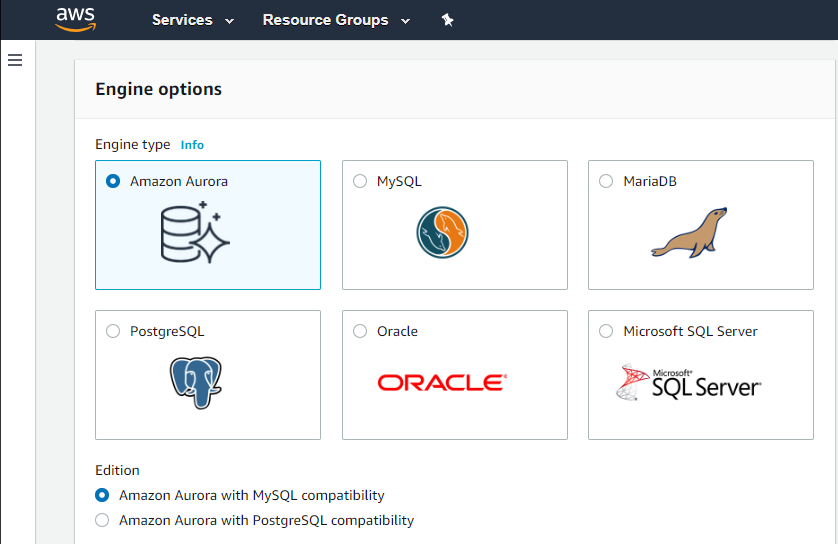
Amazon Relational Database Service (Amazon RDS) is a database-as-a-service (DBaaS) from Amazon Web Services.
N/A
Db2
Score 8.6 out of 10
N/A
DB2 is a family of relational database software solutions offered by IBM. It includes standard Db2 and Db2 Warehouse editions, either deployable on-cloud, or on-premise.
$0
Oracle Database
Score 8.4 out of 10
N/A
Oracle Database, currently in edition 23ai, is a converged, multimodel database management system. It is designed to simplify development for AI, microservices, graph, document, spatial, and relational applications.
Oracle Database can be more expensive in comparison to Amazon RDS. This may be because of licensing fees. Installation can be a bit messy and take longer than necessary. The user interface could also use some work when compared to Amazon RDS. Some companies will need a DBA to …
Oracle Autonomous Database is designed for Oracle Database workloads, making it suitable for organizations with existing Oracle investments. RDS supports various database engines. Autonomy and Automation: Oracle Autonomous Database places a strong emphasis on automation for …
Installing, configuring, and managing Oracle Database can be challenging, especially for people who are new to Oracle products. Longer learning curves and higher operational overhead can be caused by this complexity. Amazon Relational Database Service is easy to understand and …
In a few words, we are just to confortable working with oracle and sql server. Using RDS add another layer of distributed database in order to backup everything we have in case of a disaster and also complies with authorities locally and internacionally. All database we use, …
Earlier we were using the Azure Ecosystem but we faced some issues in DevOps side so we decided to migrate towards some other reliable infra so we migrated all our engines, RDS and other services to Amazon Relational Database Service (RDS) and from that time we are using this. …
Every traditional rational Database requires server installation & accessing needs to be monitored periodically manually. But Amazon provides easy-to-access and monitor health and scale-up and scale-down option just by clicks without adding any additional hardware.
amazon provides wide range of support for multiple database engines so we dont have to look for any other providers integration with aws ecosystem so we can seemlessly use other aws services connected to database aws have data points globally so it if data needs to be in …
[Amazon Relational Database Service (RDS)] is much better to have everything in the cloud instead of having it on-premise once you can get all the benefits from Cloud. Of course, it can be a bit expensive if your company it's not growing anymore but if you check it in detail, …
Db2 provides a combination of performance and scalability. Security wise, Db2 is always a first choice, especially for the systems where security can't be compromised. For mainframe systems, there is no other DB in the market that can perform better than Db2. If an organization …
IBM Db2 in my organization has had overall a much better consistency rating and effectiveness. Turnaround times are shorter and the need for human intervention is significantly less. We find Db2 to be more reliable overall and a better experience to use. In terms on real time …
From working with other databases, I always felt that Db2 was at the top of its game in all aspects of performance, recoverability, and stability—pretty much everything you want out of an Enterprise database system.
Access controls, encryption, and auditing
capabilities are just a few of the strong security features supported by IBM Db2.I think Strong security features are offered by it, such as integration with Active Directory and LDAP enterprise security infrastructures, row and column …
we have felt Db2 with enhance capability stands better than oracle offering and cost benefit is also there with features like better security and better integration with analytical engines and provision for XML, JSON, text and spatial data formats for different kinds of …
Considering Price, features configurations timelines of the IBM Db2 we found that is very Robust in Scalability, Reliability, Highly Available. also, we are already a IBM products user and we are much satisfied with the overall product as well as customer support from IBM team. …
Db2 is more scalable, reliable, and easily configurable than all the products that we evaluated. We were already using some of the services provided by IBM and were satisfied with the support and pricing. This led us to select Db2 as our database management system.
I have experience with the above-mentioned similar products but mainly with MySQL. In terms of speed and query optimization capabilities, Db2 is far ahead in comparison to MySQL. Because of various issues like scalability, multiple departments hitting DB together causing …
Compared to similar products, Db2 shared common Relational DataBase Management System (RDBMS) features such as SQL support, data integrity, Atomicity, Consistency, Isolation and Durability (ACID) Compliance and concurrency control. However, the Db2 is designed for scalability, …
Db2 is one of the oldest and mature rdbms available in the market. IBM products were already been used in the organization. Cost effective in terms of licensing.
DB2 works as good as any of these databases. It is cheaper to run than any of them. It is more solid and stable that SQL server or Netezza. It is very comparable to Oracle for reliabilty.
But for administration, Netezza is a little simpler because it has no indexes. Netezza is …
DB2 was more scalable and easily configurable than other products we evaluated and short listed in terms of functionality and pricing. IBM also had a good demo on premise and provided us a sandbox experience to test out and play with the product and DB2 at that time came out …
Db2 is one of the best relational databases I’ve used. It has the ability to maintain large amount of data and execution of million transactions in fraction of a second. If you use it properly, an organization can build a database with thousands of tables, and it can provide …
It's almost not comparable because they all do the same job in varying degrees. There are some things I like about Db2 that I don't enjoy about Oracle, but it mostly comes down to how it works and where it stores everything like SYS tables in Db2. MySQL is probably the fastest …
I did not choose DB2 over any other database engine, the corporation we are currently working for uses all of them for different companies/systems/departments and we need to consolidate data from all of them into a single data warehouse. DB2 is one of the many different data …
I have heard from other similar institutions that they have problems unique to their DB2 database when using the ERP that we have in common. I found the DB2 database system difficult to interact with when I had to use it for a project many years ago. I personally developed some …
The reason why my team and organization chose to go with Oracle Database 12c with it stacked up against IBM's DB2, or Microsoft's SQL server, as when using other Oracle products, it has been much easier in the past to work along side with other Oracle products, which by the way …
MySQL: I used MySQL as part of an old CRM. I think that's also light. But, Oracle seems to have better speed and reliability. DB2: I used DB2 mainly on mainframe and z/OS. I always felt that it's cumbersome to access and write queries on DB2.
Oracle 12c is superior to SQL Server for large mission critical databases and applications.
We also used DB2 in the past. We migrated many of our SAP applications from DB2 to Oracle 11.2 several years ago. These applications are now on Oracle 12c.
We use IBM DB2 in AS400 to handle part of our accounting system and our legacy ERP. We are migrating all functionalities to Oracle Database 12c because it is more secure and stable. We have some applications using SQL Server but we want to handle those systems in it because at …
IBM DB2 is extremely heavy as compared to Oracle and is expensive for the price we pay for the product. MySQL doesn’t have most of the features that Oracle has.
Oracle is placed in a good spot against its competitors. It has advantages over its competitors in its legacy stability and high availability. A common engine to handle relational, JSON, Vector, and graph data makes it more cost-effective. Given all the good features, the …
I have selected Oracle database from other databases as this database is relational database which stored the data in structural and tabular format which is better than any other databases which I have used in my carrier. Also MongoDB is no SQL database where we can use SQL …
Oracle Database is best in business, consistent, and robust. Even the standard version is sufficient for the best performance. The main thing is I have never seen corruption and in my opinion, it is best when used with Linux.
While I was not available for the original selection, the reason I have fought to keep it in place and not change is mainly due to performance and security. The company has sought other options, however, I continue to maintain that this is the best course of action in our …
Oracle Database 12c is far superior to Microsoft SQL Server (or any other database in fact). For starters, Oracle 12c offers much better performance and higher reliability. That itself should make the difference. Oracle 12c is also superior in terms of features. On a high level, …
Microsoft SQL Server is our most commonly used DBMS because most vendors support it. The user interface for SQL Server Management studio is also very easy to use. For this reason, we usually prefer SQL Server over Oracle. However, we also support Oracle because it is a …
While there are several very good relational databases, some are offered by companies where the database is not the key focus. Even though Oracle's software portfolio has expanded greatly over the years, they remain keenly focused on database technology.
We generally choose Oracle 12c whenever the requirements include reliability, scalability, and interconnectivity with existing applications. Most application upgrades are re-hosted in Oracle, if on Oracle. If the application supplier prefers, or has exclusive experience with a …
If your application needs a relational data store and uses other AWS services, AWS RDS is a no-brainer. It offers all the traditional database features, makes it a snap to set up, creates cross-region replication, has advanced security, built-in monitoring, and much more at a very good price. You can also set up streaming to a data lake using various other AWS services on your RDS.
I have primarily used it as the basis for a SIS - but I have migrated more than a few systems from there database systems to DB2 (Filemaker, MySQL, etc.). DB2 does have a better structural approach, as opposed to Filemaker, which allows for more data consistency, but this can also lead to an inflexibility that can sometimes be counterintuitive when attempting to compensate for the flexibility of the work environment as Schools tend to have an all in one approach.
We migrated from NoSQL to an Oracle database. One of the reasons was robust backup and recovery options available in the Oracle database, which provide zero data loss. A transactional database like Oracle is a better fit for our use case than NoSQL. On a large scale, deployment was evaluated as a cheaper option than the NoSQL engine. This conclusion came even after considering Oracle license is expensive.
Automated Database Management: We use it for streamlining routine tasks like software patching and database backups.
Scalability on Demand: we use it to handle traffic spikes, scaling both vertically and horizontally.
Database Engine Compatibility: It works amazingly with multiple database engines used by different departments within our organization including MySQL, PostgreSQL, SQL Server, and Oracle.
Monitoring: It covers our extensive monitoring and logging, and also has great compatibility with Amazon CloudWatch
It is a little difficult to configure and connect to an RDS instance. The integration with ECS can be made more seamless.
Exploring features within RDS is not very easy and intuitive. Either a human friendly documentation should be added or the User Interface be made intuitive so that people can explore and find features on their own.
There should be tools to analyze cost and minimize it according to the usage.
We do renew our use of Amazon Relational Database Service. We don't have any problems faced with RDS in place. RDS has taken away lot of overhead of hosting database, managing the database and keeping a team just to manage database. Even the backup, security and recovery another overhead that has been taken away by RDS. So, we will keep on using RDS.
The DB2 database is a solid option for our school. We have been on this journey now for 3-4 years so we are still adapting to what it can do. We will renew our use of DB2 because we don’t see. Major need to change. Also, changing a main database in a school environment is a major project, so we’ll avoid that if possible.
There is a lot of sunk cost in a product like Oracle 12c. It is doing a great job, it would not provide us much benefit to switch to another product even if it did the same thing due to the work involved in making such a switch. It would not be cost effective.
I've been using AWS Relational Database Services in several projects in different environments and from the AWS products, maybe this one together to EC2 are my favourite. They deliver what they promise. Reliable, fast, easy and with a fair price (in comparison to commercial products which have obscure license agreements).
You have to be well versed in using the technology, not only from a GUI interface but from a command line interface to successfully use this software to its fullest.
Many of the powerful options can be auto-configured but there are still many things to take into account at the moment of installing and configuring an Oracle Database, compared with SQL Server or other databases. At the same time, that extra complexity allows for detailed configuration and guarantees performance, scalability, availability and security.
I have never had DB2 go down unexpectedly. It just works solidly every day. When I look at the logs, sometimes DB2 has figured out there was a need to build an index. Instead of waiting for me to do it, the database automatically created the index for me. At my current company, we have had zero issues for the past 8 years. We have upgrade the server 3 times and upgraded the OS each time and the only thing we saw was that DB2 got better and faster. It is simply amazing.
The performances are exceptional if you take care to maintain the database. It is a very powerful tool and at the same time very easy to use. In our installation, we expect a DB machine on the mainframe with access to the database through ODBC connectors directly from branch servers, with fabulous end users experience.
I have only had good experiences in working with AWS support. I will admit that my experience comes from the benefit of having a premium tier of support but even working with free-tier accounts I have not had problems getting help with AWS products when needed. And most often, the docs do a pretty good job of explaining how to operate a service so a quick spin through the docs has been useful in solving problems.
Easily the best product support team. :) Whenever we have questions, they have answered those in a timely manner and we like how they go above and beyond to help.
1. I have very good experience with Oracle Database support team. Oracle support team has pool of talented Oracle Analyst resources in different regions. To name a few regions - EMEA, Asia, USA(EST, MST, PST), Australia. Their support staffs are very supportive, well trained, and customer focused. Whenever I open Oracle Sev1 SR(service request), I always get prompt update on my case timely. 2. Oracle has zoom call and chat session option linked to Oracle SR. Whenever you are in Oracle portal - you can chat with the Oracle Analyst who is working on your case. You can request for Oracle zoom call thru which you can share the your problem server screen in no time. This is very nice as it saves lot of time and energy in case you have to follow up with oracle support for your case. 3.Oracle has excellent knowledge base in which all the customer databases critical problems and their solutions are well documented. It is very easy to follow without consulting to support team at first.
Overall the implementation went very well and after that everything came out as expected - in terms of performance and scalability. People should always install and upgrade a stable version for production with the latest patch set updates, test properly as much as possible, and should have a backup plan if anything unexpected happens
Amazon Relational Database Service (RDS) stands out among similar products due to its seamless integration with other AWS services, automated backups, and multi-AZ deployments for high availability. Its support for various database engines, such as MySQL, PostgreSQL, and Oracle, provides flexibility. Additionally, RDS offers managed security features, including encryption and IAM integration, enhancing data protection. The pay-as-you-go pricing model makes it cost-effective. Overall, Amazon RDS excels in ease of use, scalability, and a comprehensive feature set, making it a top choice for organizations seeking a reliable and scalable managed relational database service in the cloud.
DB2 was more scalable and easily configurable than other products we evaluated and short listed in terms of functionality and pricing. IBM also had a good demo on premise and provided us a sandbox experience to test out and play with the product and DB2 at that time came out better than other similar products.
Because of a rich user base and support for any critical issue, this is one of the best options to choose. In case the project has a TCO issue, it can compromise and choose Postgres as the best alternative. SQL server is also good and easy to code and maintain but performance is not as good as the Oracle
By using DB2 only to support my IzPCA activities, my knowledge here is somewhat limited.
Anyway, from what I was able to understand, DB2 is extremely scallable.
Maybe the information below could serve as an example of scalability.
Customer have an huge mainframe environment, 13x z15 CECs, around 80 LPARs, and maybe more than 50 Sysplexes (I am not totally sure about this last figure...)
Today we have 7 IzPCA databases, each one in a distinct Syplex.
Plans are underway to have, at the end, an small LPAR, with only one DB2 sub-system, and with only one database, then transmit the data from a lot of other LPARs, and then process all the data in this only one database.
The IzPCA collect process (read the data received, manipulate it, and insert rows in the tables) today is a huge process, demanding many elapsed hours, and lots of CPU.
Almost 100% of the tables are PBR type, insert jobs run in parallel, but in 4 of the 7 database, it is a really a huge and long process.
Combining the INSERTs loads from the 7 databases in only one will be impossible.......,,,,
But, IzPCA recently introduced a new feature, called "Continuous Collector".
By using that feature, small amounts of data will be transmited to the central LPAR at every 5 minutes (or even less), processed immediately,in a short period of time, and withsmall use of CPU, instead of one or two transmissions by day, of very large amounts of data and the corresponding collect jobs occurring only once or twice a day, with long elapsed times, and huge comsumption of CPU
I suspect the total CPU seconds consumed will be more or less the same in both cases, but in the new method it will occur insmall bursts many times a day!!