Apache Subversion is a version control option that is free to download and open source under the Apache 2.0 license.
N/A
GitKraken
Score 8.8 out of 10
N/A
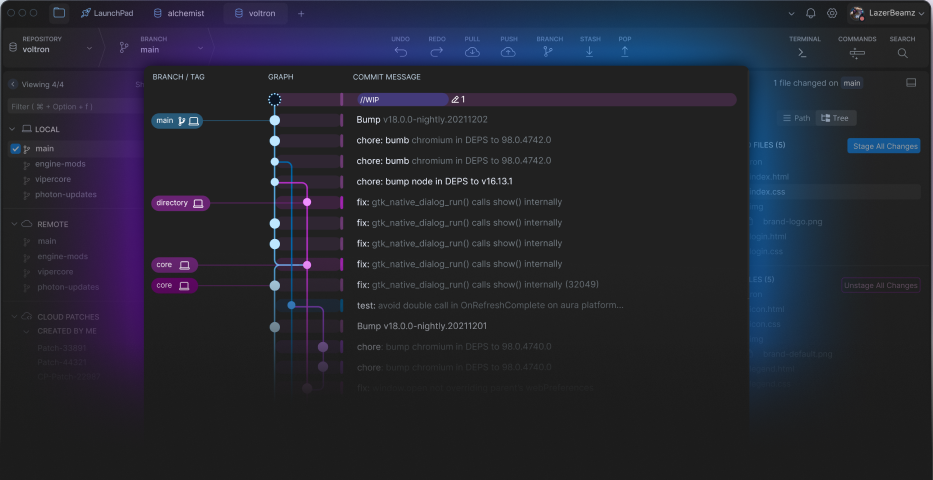
GitKraken's commit graph helps visualize branch structure and commit history. It helps verify recent Git actions on the repo, and also shows who made what code changes and when, so it’s easier to track down when a bug was introduced and revert back to a previous version. GitKraken Client is a Git GUI that detects and alerts users of potential conflicts so as to prevent them from happening. With itsuser Activity Status, the user can know who is online in the GitKraken Client.
$0
SAP Business Network
Score 8.6 out of 10
N/A
SAP Business Network is a comprehensive B2B collaboration platform that connects people, processes, and systems across multiple enterprises, digitizing transactions, and creating transparent, resilient, and sustainable supply chains.
N/A
Pricing
Apache Subversion
GitKraken
SAP Business Network
Editions & Modules
No answers on this topic
Hosted by GitKraken
Customized according to the amount of team members.
It's a relatively simple version control system so it works great for an individual or small team (less than 10 people). But if you have a medium to large team, especially one with members distributed over a large geographic area, or one where individuals need to be able to work "offline" without access to a central server, Apache Subversion will likely not be the best choice.
Also, if you're maintaining an open-source project where outside people will be interacting with your code repository, git is probably a better choice because it's becoming the de-facto standard these days and what most developers are familiar with.
If your organization processes a large number of purchase orders and invoices every month/year, SAP Business Network is very effective, whereas smaller vendors without strong IT support sometimes struggle with setup and ongoing use. making onboarding and training a barrier.
The clients can link with different systems and data sources, making the functioning of various processes more accessible and more efficient.
The audience can interact with high-performance and meaningful analytics that reveal all the critical indicators of influencers and campaigns based on the data/information approach.
It includes a marketplace for brands, which makes the search process easier to find companies to partner with.
Distributed development - I've never worked in an environment where distributed development (developers widely scattered geographically) was a factor, but that's why git exists.
Merging - Merging of code from one branch to another can be painful, especially if it's not done frequently. (On the other hand, doing merges is one of the reasons I get a nice salary, so I can't complain too much!)
Acceptance - Let's face it, git is what "all the cool kids are using." If you've got a bunch of developers fresh out of school, they'll probably know git and not Subversion.
User Interface Complexity This interface can feel overwhelming and difficult to use, mainly for new users. A more streamlined, role-specific layout will help decrease the learning curve and enhance productivity.
Limited Small Vendor Integration for smaller vendors to adopt. Introducing a Modified or simplified version for smaller suppliers will make it more accessible.
Enhanced Predictive Analytics and Automation—The platform's predictive capabilities are limited, particularly in demand risk assessment.
Adding advanced automation analytics will help users proactively address supply chain needs.
While there are interesting alternatives, such a GIT, Subversion has been a breath of fresh air compared to its predecessors like CVS or Microsoft Source Safe (now called Team Foundation Server). Its ease of use and high adoption rate is going to keep me using this product for years to come.
I will give it a 9, one is deducted for business inspection and improvement i feel that they are in the right direction and streamlined our flow of business agility also helped us get the R.o.i and helped with more sales and visibility over business and its metrics.
Over the years, I have used many Git tools, but GitKraken stands out. It's now my favorite Git tool by far—excellent graphical overview of the branches, straightforward usage of all functionality, and lots of integration available. Currently, I am using GitKraken to connect to the ADO and quickly create PRs, using gitflow and tracking the work of my team mates.
There is still a ton of flexability on the customer's end of the platform, which makes standard onboarding for suppliers a challenge. Customers are allowed to ask for things, or customize certain things that are not standard for us, so we have to have special rules set up to complete an integration. There are also some limitations to automate invoice rejections that happen on the platform when a customer rejects an invoice
Good performance from SAP as key deployment partner; collaboration and deployment with additional business partner for data provision and business partner onboarding was rather difficult, slowing down the project progress and overall success perception
Git has become the new standard of version control, with its support for distributed design. As a tool to manage and control versions, Subversion does it well, but Git is the future.
Before we chose SAP Business Network, we looked at Oracle Supply Chain Management Cloud and Infor Supply Chain Management. While SAP Business Network boasted robust features, the fact that our existing ERP system could be integrated with the tool in a better fashion, and it was more intuitive, sealed the deal for us.
SAP Business Network's streamlined supply chain and procurement processes have significantly reduced operational costs and improved resource allocation, leading to enhanced overall efficiency.
The platform's robust analytics have provided valuable insights, facilitating data-driven decision-making and enabling us to make more informed strategic choices, ultimately contributing to improved business performance.
Implementing and integrating the SAP Business Network initially required a substantial financial investment, impacting short-term cash flow and potentially delaying other critical business initiatives.